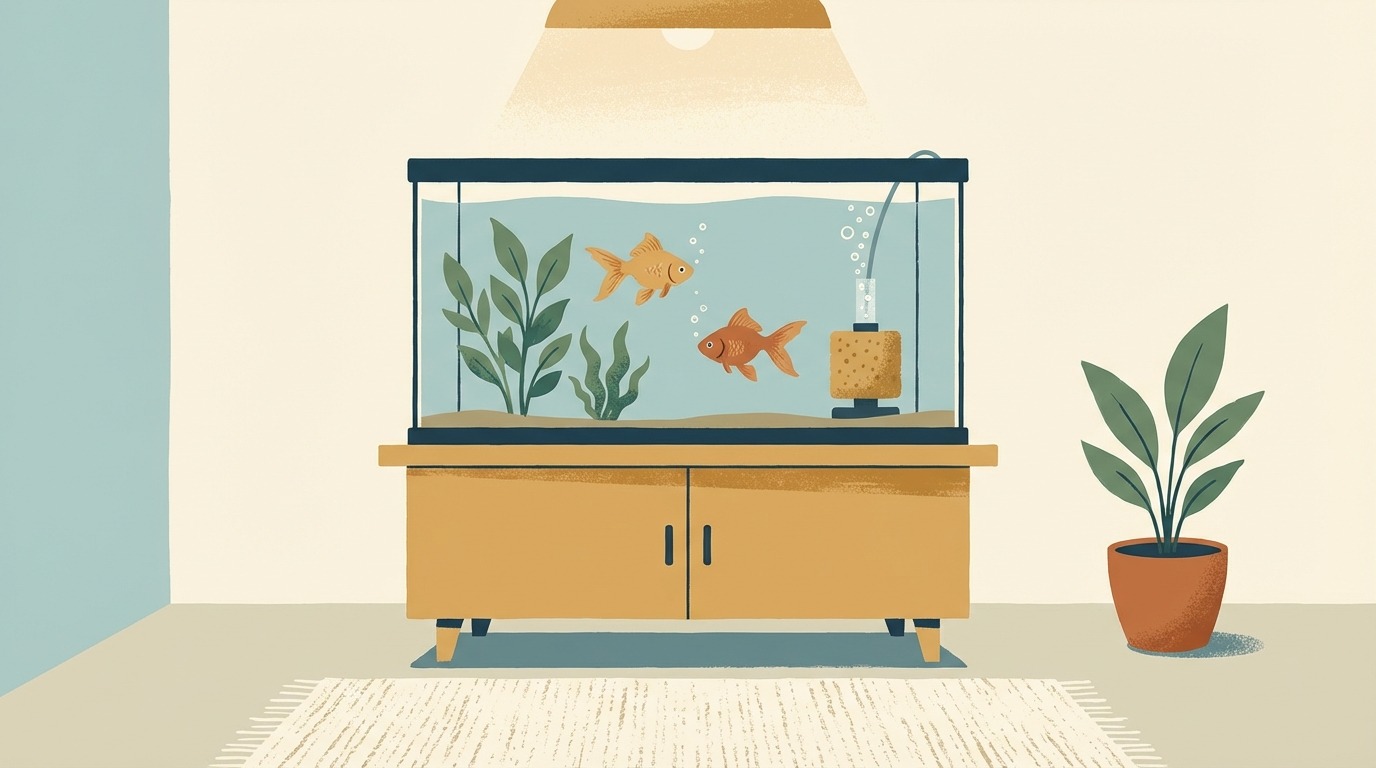
SOS Goldfish Continued: Chronicle: SOS Goldfish, continuation and conclusion.
| Short on time? Here’s the essentials ⏱️ |
|---|
| Goldfish do not belong in a bowl 🛑. Plan for a filtered aquarium of at least 120 L gross for two individuals. |
| Powerful filtration and weekly water changes 💧. Aim for 4 to 6 times the tank volume per hour, and 30% new water each week. |
| Robust plants and inert decor 🌿. Anubias, cryptocorynes, Egeria; avoid untested limestone rocks. |
| No cohabitation with tropical species 🐠❌. The recommendations of the French Goldfish Association go in this direction. |
| Overpopulation = ecological emergency 🌍. In ponds, regulate and give wisely, never release into the wild. |
In this chronicle “SOS Goldfish, continued and concluded”, a strong verdict imposes itself. The myth of the bowl persists, while science, ethics, and ecology condemn it. Yet, simple and reliable care exists, even for motivated beginners. Just rely on clear rules, suitable equipment, and a bit of method. Thus, this page gathers serious aquaristics experience, association feedback, and concrete cases, to turn a mishap into a sustainable action plan.
The common theme is assumed: protection of fish, home safety, and the pleasure of learning with children. From a coherent aquarium choice to routine fish care, every detail counts. Moreover, the family angle is not forgotten, as these small animals often enter very busy households. So, how to succeed without unnecessary stress, and without giving up your values? Here is the method, explained step by step, supported by evidence and tips. And, above all, keys to avoid far too common tragic outcomes.
SOS Goldfish: why the bowl kills, and how to avoid it sustainably
The myth of the “easy” fish demolished by facts
The bowl concentrates three major problems: low volume, lack of filtration, and unstable parameters. Thus, ammonia rises quickly, stress settles in, then diseases follow. Consequently, mortality explodes among goldfish kept this way. This is not an opinion; it is a conclusion shared in the field, by associations and clubs.
Another misunderstanding persists: feeding little does not compensate for an unsuitable tank. Yet, a sparse diet does not eliminate nitrogenous waste. It also does not replace oxygenation from proper water movement. In short, the bowl accumulates handicaps and almost always ends sadly.
Ethical reminder and associative framework
Distributing fish at fair stands shocks more and more. Municipalities now recall the risks and abuses. Associations also remind that animal welfare requires suitable habitat. Here, the protection of fish joins family education. It is also a question of ecology, since irresponsible releases into nature threaten local balances.
In this spirit, a watchword circulates within the community: “we are an association, not a bank; the site lives thanks to you”. Clearly, awareness depends on donations and mutual aid. 5 € is enough to keep your head above water! And, on certain platforms, a firm stance is imposed: “Here, fish are real… and so are messages; zero AI tolerated.”
Simple rules for a positive outcome
The vital minimum for two individuals? A 120 L gross aquarium with serious filtration. Then, robust plants, a lid, moderate lighting, and a simple weekly routine. Thus, the adventure stops being a lottery. It becomes a concrete initiation into responsibility and life science.
With this first milestone set, let’s move on to precise equipment, reliable brands, and domestic safety points. Because a good initial choice avoids many expenses later.

Reliable equipment and home safety: from tank to furniture, the installation that reassures
Volume, filtration, and brand choices
For goldfish, aim for a filtration rate of 4 to 6 times the volume per hour. Thus, a 120 L gross tank will appreciate 500 to 700 L/h. Sets like the Juwel Rio 125 have built a solid reputation. EHEIM also offers recognized quality, sometimes with slightly thicker glass. However, the seriousness of design matters more than an extra 1 mm of glass.
The internal foam filter works very well with these fish. It traps particles and houses beneficial bacteria. It should be rinsed in water taken from the aquarium, never under the tap. Then, biological media are added if needed. Cleaning remains simple and inexpensive.
Plants and decor: robustness and chemical neutrality
Goldfish nibble on tender leaves. So, it is better to choose Anubias, cryptocorynes, Egeria densa, and fix them securely. The decor must be inert and gentle on fins. Beware of unknown pebbles: a white vinegar test reveals suspicious effervescence. If in doubt, abstain.
A lid limits evaporation and prevents jumps. Lighting should remain reasonable to avoid stress. In summer, a small fan directed at the surface promotes evaporation. Thus, temperature stabilizes without additional heating.
Furniture, weight, and safety
A 120 L gross tank, with sand, rocks, and equipment, can weigh between 170 and 220 kg. Therefore, the furniture must be level, rigid, and distribute the load well. Frames of Juwel and EHEIM tanks are designed for direct placement on a flat support. Nothing should be placed between the base and the furniture. A spirit level reassures, as does a structure evaluation.
Finally, a word about oxygenation: a well-directed filter outlet is usually enough. An air stone can be useful during heatwaves or illness. However, regular surface agitation covers the majority of situations.
With these choices, the installation gains reliability and serenity. Now comes the daily routine and health gestures.
Fish care, feeding, and health: the effective anti-stress method
Suitable feeding and life rhythm
A goldfish eats every day, in small quantities. Thus, excess food does not accumulate at the bottom. We vary between sinking pellets, boiled vegetables, and occasionally frozen prey. One fasting day per week helps digestion. Moreover, weekly water changes (20 to 30%) stabilize parameters and reduce nitrates.
Regular water tests avoid unpleasant surprises. Ammonia and nitrites must remain at zero. Nitrates stay low thanks to plants and renewals. This discipline takes little time once the routine is in place.
Common diseases and quarantine protocol
Fungal infections appear mainly after stress. Small cottony patches then appear on the skin. In this case, isolate the sick individual in a hospital tank if possible. Then, improve the water, correct the temperature, and consult a specialized veterinarian if necessary. Opportunistic diseases retreat when the environment becomes healthy.
- 🛑 Ammonia alert: gasping at surface, lethargy, redness on gills.
- 🌫️ Fungus: white filaments, unstable swimming, loss of appetite.
- 🧩 Stress: frantic swimming, refusal to eat, rubbing against decor.
- 🩺 Isolation: quarantine tank, gentle filtration, close observation.
- 💊 Treatment: follow instructions, remove activated charcoal during cure.
This protocol reduces losses and breaks contamination chains. Consequently, the main tank remains stable.
Case study: “the family at the corner of the table”
A family receives two fish via a school party. The animals end up in a bucket, due to lack of anticipation. Quickly, the water clouds and fish suffer. The family then invests in a 125 L filtered tank, plants it, then cycles the aquarium before introduction. Then, light and regular meals replace random feeding. Conclusion? Zero deaths the following year, and a successful educational project.
This pragmatic approach shows that a simple and consistent framework protects health. The next section addresses cohabitation and overpopulation, equally sensitive topics.
Cohabitation, overpopulation in ponds, and ecology: red lines not to cross
No mixing with tropical species
The cohabitation of goldfish with neon tetras, guppies, or cichlids presents problems. Thermal needs differ, as do temperaments. Therefore, field recommendations discourage this mix. In community aquariums, better a homogeneous population. It is simpler, safer, and more ethical.
Conversely, varieties of goldfish coexist among themselves, if the volume is adequate. Circulation must remain strong and oxygenation sustained. Robust plants help structure the habitat. This compromise reconciles animal behavior and care.
The challenge of ponds: regulate without harm
Ponds sometimes overflow with young fish. Rapid reproduction creates overpopulation. The system tightens, water degrades, and ecological balance wavers. Action must then be taken without releasing individuals into the wild. Contact clubs, organize controlled donations, and review feeding management. A net and gentle traps allow respectful selection.
Oxygenating plants and shaded areas help in summer. Seasonal maintenance limits dead leaves and organic matter. This way, the pond’s ecology remains stable while protecting local fauna.
Never “release into the river”
Releasing a domestic fish into a river is harmful. The species can become invasive, carry pathogens, or disrupt local species. The gesture may seem benevolent but is dangerous. Better a solidarity network and responsible donations. It is the only approach consistent with protection of fish and ecosystems.
With these clear red lines, let’s conclude with the family dimension and the story that launched this continuation and conclusion of a chronicle that speaks as much about ethics as about technique.
Family chronicle, continuation and conclusion: laughter, tears, and a holding action plan
From initial confusion to epiphany
A now classic scene: a child “wins” a fish, the family improvises, and disaster strikes. A seller sometimes gives bad advice, or the information is lost. Days later, it’s a catastrophe. Then, awareness transforms guilt into a plan. A correct aquarium, a clear routine, and things proceed differently.
Responsible trade exists and suitable equipment too. A Rio 125, foam filtration, hardy plants, and measured food suffice. Children participate in siphoning and water preparation. They then learn consistency and respect for life. That is where education makes all the sense.
Reconciling family life and aquaristics
Households juggle with other priorities. Parents await a baby, breastfeed, manage fatigue, and seek reliable landmarks. Useful resources exist to stay on track. For example, preconceived ideas about food cravings are clarified here: mozzarella cravings. Daily discomfort also finds solutions: lower belly pain during pregnancy. And, for the fridge, safe choices are imperative: ricotta and pregnancy.
After birth, the rhythm changes again. Thus, planning short and regular tasks for the tank becomes crucial. Concrete markers help: feeding and breastfeeding, heartburn during pregnancy, or skin care and pregnancy mask. Finally, the family project is built together: conceiving a baby from dad’s side and foods and chances of implantation provide a global framework.
A simple and positive moral
The final message is indisputable. Goldfish require a real tank, real filtration, and a stable routine. In return, they provide a calming spectacle and a lesson in responsibility. And, above all, they become ambassadors of living education that helps the whole family grow.
“Taking care of a fish means learning precision, patience, and a promise kept.”
{“@context”:”https://schema.org”,”@type”:”FAQPage”,”mainEntity”:[{“@type”:”Question”,”name”:”What volume for two goldfish?”,”acceptedAnswer”:{“@type”:”Answer”,”text”:”Aim for at least 120 liters gross, with a filtration rate of 4 to 6 times the volume per hour. This threshold reduces toxic peaks and offers comfortable swimming.”}},{“@type”:”Question”,”name”:”Is heating needed for goldfish?”,”acceptedAnswer”:{“@type”:”Answer”,”text”:”No, these fish live in temperate water, often between 15 and 20 °C. A surface fan is enough in summer to dissipate heat by evaporation.”}},{“@type”:”Question”,”name”:”Which plants withstand goldfish?”,”acceptedAnswer”:{“@type”:”Answer”,”text”:”Anubias, cryptocorynes, and Egeria densa. Fix them well. Tender leaves are often nibbled.”}},{“@type”:”Question”,”name”:”How to prevent fungal diseases?”,”acceptedAnswer”:{“@type”:”Answer”,”text”:”Water stability, weekly changes, minimal stress, and quarantine when an individual shows symptoms. A hospital tank helps to treat quickly and well.”}},{“@type”:”Question”,”name”:”Can goldfish be mixed with tropical species?”,”acceptedAnswer”:{“@type”:”Answer”,”text”:”No. Thermal and behavioral needs differ. Cohabitations often result in stress and health problems.”}}]}What volume for two goldfish?
Aim for at least 120 liters gross, with a filtration rate of 4 to 6 times the volume per hour. This threshold reduces toxic peaks and offers comfortable swimming.
Is heating needed for goldfish?
No, these fish live in temperate water, often between 15 and 20 °C. A surface fan is enough in summer to dissipate heat by evaporation.
Which plants withstand goldfish?
Anubias, cryptocorynes, and Egeria densa. Fix them well. Tender leaves are often nibbled.
How to prevent fungal diseases?
Water stability, weekly changes, minimal stress, and quarantine when an individual shows symptoms. A hospital tank helps to treat quickly and well.
Can goldfish be mixed with tropical species?
No. Thermal and behavioral needs differ. Cohabitations often result in stress and health problems.