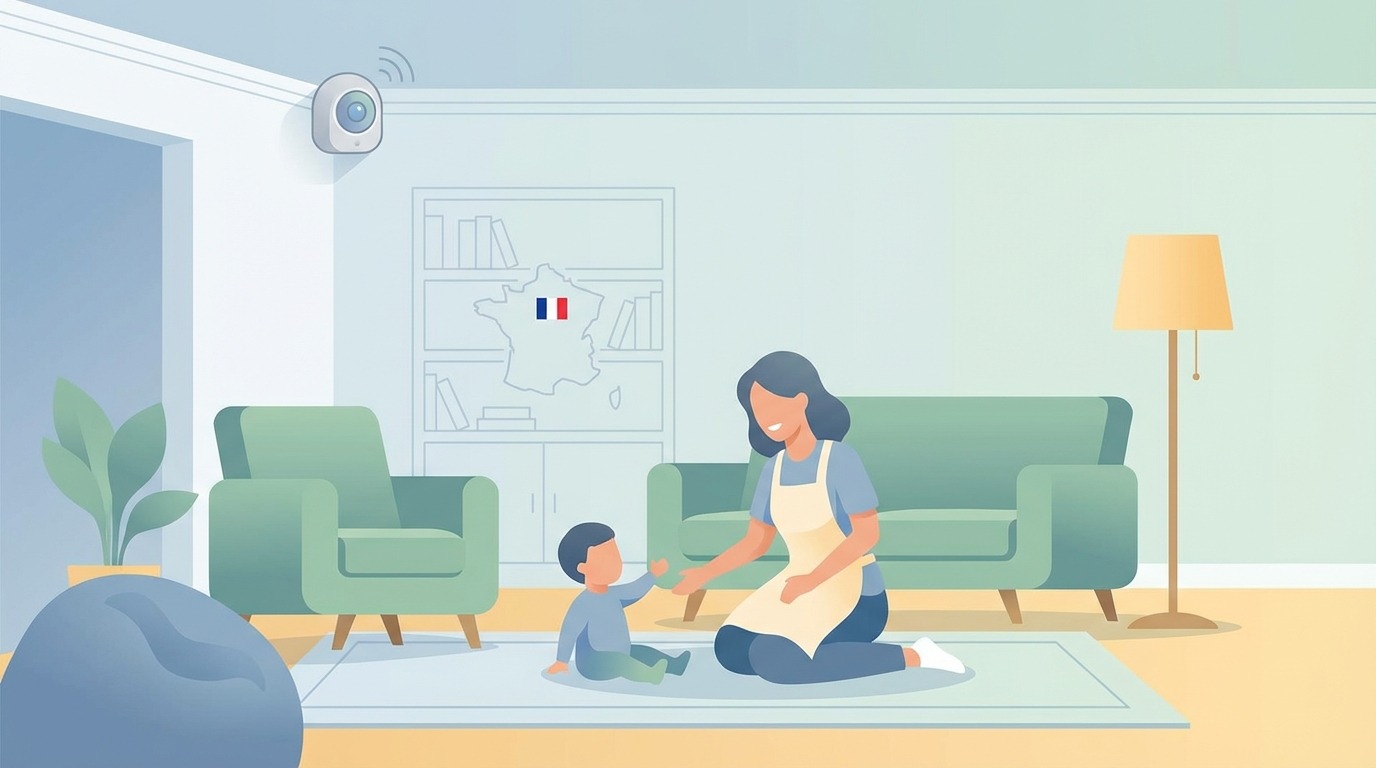
Surveillance cameras at the nanny’s: what does the law say in France?
| In Brief |
|---|
| 📹 Filming at home is legal if the goal remains the security of property and people, not nanny surveillance. |
| ⚠️ Inform the childcare provider about the system, the filmed areas, the retention period, and the people authorized to view the images. |
| 🛑 Forbidden to film without their knowledge in living rooms or resting areas; no intimate spaces nor public roads. |
| 🔐 Keep images for less than one month (except during proceedings). Protect access with password and encryption. |
| ⚖️ Article 226-1 of the Penal Code: up to 1 year in prison and a €45,000 fine in case of invasion of privacy. |
| 👶 Best interest of the child sometimes upheld by judges, but clandestine video proof remains risky. |
The topic touches a sensitive point of family daily life: protecting a young child and, simultaneously, respecting the person taking care of them. Smart cameras have largely replaced simple baby monitors invented in 1937, and today one can see, hear, and control remotely from a smartphone. This technical power reassures, but imposes responsible use. The law precisely regulates home video surveillance, especially when a nanny works within the household. Parents seek concrete guidance: where to place the lens, what to say to the childcare provider, how to store footage, and what these recordings are worth in case of dispute?
In many households, daily life unfolds among Dodie bottles, Mustela cleansers, Petit Bateau bibs, and a Baby Stroller cart ready for the park. This tender reality must not mask legal obligations. Informing, limiting the filmed field, briefly retaining videos, and securing access are essential reflexes. Moreover, the best interest of the child can, in rare cases, justify more attentive viewing or retention, but without derogating from the rights of the filmed person. The course to keep remains clear: security and respect, hand in hand.
Surveillance cameras at the nanny’s: what does the law say in France and how to apply it daily
The French framework is based on a simple principle: filming at home for security is allowed, provided one respects privacy. This means the camera should not aim to evaluate the nanny’s performance, nor to follow her permanently. The camera can monitor an entrance, a window, or the bed of a restless infant, but not all the childcare actions. This point underpins the balance between protection and respect.
The penal law reminds us of the limit not to cross. Article 226-1 of the Penal Code punishes voluntary invasion of another’s privacy by capturing or transmitting their image in a private place, without consent. The penalty can be up to one year imprisonment and €45,000 fine. The text targets visual or audio traps that surprise a person without their knowledge, including in a home.
Furthermore, labor law requires transparency. Informing the employee of the device’s presence, location, and purpose is mandatory. Even better, the employment contract can specify the retention period (ideally brief) and the persons authorized to view. This written framework limits misunderstandings and protects both employer and employee.
The CNIL guides private employers on compliance parameters. When images are recorded, one must protect access, set a short retention period (generally less than one month), and regulate the use of this data. Cameras can operate live to relieve parental concern, but systematic recording must remain proportionate.
A reassurance for families: it is not forbidden to use a baby monitor style camera in the room. The stream can focus on the baby’s sleeping area, as one would have done in the past with audio monitoring. The camera should not cover care or dressing areas, which fall under the intimate domain, even for a young child.
Concrete example: Léa and Karim use a connected model paired with Avent accessories and a certified mattress. They point their camera at the cradle and set up zone masking to exclude the changing table. The childcare provider is informed, and the job description, filed near the Book of Birth, summarizes the security purpose. This smooth routine prevents tensions.
Authorized zones and prohibited perimeter
Sensitive areas to exclude are easy to remember. Do not film bathrooms, adults’ bedrooms, nanny resting areas, and anything overlooking the street or neighbors’ garden. Conversely, a camera pointing at the front door, the garage, or a corridor is a relevant use. The logic remains proportionality.
- 🔒 Authorized: front door, windows, corridors, infant’s cradle.
- 🛑 Forbidden: bathroom, parents’ bedroom, sofa framed to follow the nanny.
- 🌳 Forbidden: public road, common areas of buildings, neighbor’s garden.
- 👶 Acceptable: video baby monitor focused on the bed, with masked zones.
The key message in few words: film yes, spy no.
Installing home video surveillance without breaking the law: step-by-step method
A proper setup begins with purpose. Phrase it as follows: secure the home and protect the child. Then align technology to this goal. Choose cameras with masking zones, and short retention. Disable audio if not needed. The tool must serve protection, not curiosity.
For families, a five-step approach simplifies everything. You can follow it when buying a Baby Stroller or clothes at Vertbaudet, to keep the same sense of organization. The secret lies in sober and documented settings.
- 🧭 Define the filmed perimeter (doors, windows, cradle) and exclude living areas.
- 📝 Inform the nanny in writing and specify purpose, locations, persons accessing images.
- ⏱️ Set retention under 30 days maximum, ideally 7 to 14 days.
- 🔐 Protect access (strong passwords, two-factor authentication, encryption).
- 📁 Keep a compliance file (notice, camera map, durations, access procedure).
Some systems offer smart alerts. Use them to detect door openings or unusual noises, rather than triggering continuous recordings. A smartphone notification is less intrusive than permanent storage.
If you are a private employer, record your practices in a register, and check up-to-date CNIL recommendations concerning home employment. In case of recording on disk or cloud, record duration, legal basis, and security of access. When in doubt, contact the authority to clarify the proper procedure.
In the room, a device aimed at the bed, close to a Fisher-Price mobile or a Petit Bateau sleep sack, often meets the need. Avoid framing the changing table and dressing areas. Your nanny, relieved by clear rules, focuses on the baby’s care.
It is wise to indicate the existence of cameras on visible media. A simple pictogram near the front door suffices to recall the security purpose. This transparency prevents misunderstandings and builds trust.
In summary, configure, inform, secure: this triptych guarantees proportionate and reassuring use.
Nanny’s rights and private employer’s obligations: respect and transparency
The childcare provider has a right to information and a right to respect her image. She must know the filmed zones, activation times, and persons authorized to view. This right does not block child protection, but demands a clear and proportionate approach from the employer.
The private employer, for their part, must document the purpose, set retention duration, and guarantee access security. Access to images is limited to authorized persons. Shared accounts or weak passwords have no place, especially if a child is involved in the recording.
The employment contract may include a “video surveillance” annex. Draft it with concrete elements: camera map, durations (e.g., 14 days), contact of the person managing access requests, and deletion procedure. This simple and factual document limits ambiguities.
In practice, the nanny can request viewing if a sequence directly concerns her. You then define a framework: on-site viewing, in the employer’s presence, no copying, except legal obligation. This compromise protects both parties and prevents misuse.
The sound issue deserves attention. Recording audio increases the level of intrusion. Choose a microphone disabled by default, activated only if needed for security. This technical restraint shows tangible respect.
In a family equipped with Bébé Confort products, Dodie accessories, and a Natalys diaper bag, filmed routine should not become omnipresent. Cameras remain in place, silent, while infant care unfolds serenely. Digital tools support the relationship; they do not replace it.
Good practices to remind families and childcare providers
- ✅ Written and oral transparency from hiring, with acknowledgment of receipt ✍️
- 🔄 Settings reviewed quarterly to ensure proportion 🧭
- 🗓️ Short retention and automatic deletion ensured by cloud provider 🧹
- 🧩 Active masked zones in living areas; video focused if baby monitor 👶
- 🛡️ Strong authentication and access logs available to parents 🔐
The best indicator remains trust built day by day: protect without intruding stays the guiding principle.
Evidence, conflicts and labor courts: secretly filming your nanny, what risks and what legal value?
Using a hidden “nanny cam” may seem tempting when warning signs appear. However, filming without the person’s knowledge exposes one criminally and weakens the employment relationship. In theory, such clandestine footage is not an ideal form of evidence. Judges can reject it or, conversely, assess it case by case, depending on circumstances.
Case law has already upheld the best interest of the child to relativize the illegality of capture, especially when there are serious signs of danger. But these are exceptions. The recommended path is to document other elements first: testimonials, medical certificates, objective traces of incidents, and written exchanges.
Imagine a case: prolonged crying, neighbors reporting screams, a suddenly anxious child. Parents gather testimonies, consult the pediatrician, and note behavior change. They then place a camera aimed at the front door, not at the nanny. If serious facts emerge, the lawyer will advise cross-checking these images with external evidence.
The criminal risk exists. Capturing, recording or transmitting the image of a person in a private place without consent falls under article 226-1. One year imprisonment and €45,000 fine mark the upper limit of risk. Such an outcome traumatizes an already fragile household.
To act without exposure, a graduated method helps greatly. First, talk. A formal, benevolent discussion often clarifies the situation. Then, formalize expectations and rule reminders in writing. Finally, seek external viewpoints (doctor, mediation, inspection if needed). The camera becomes one tool among others, never a magic solution.
When contract termination looms, legal support avoids missteps. Simple advice applies: do not base a decision solely on clandestine recording. Seek complementary evidence, and prefer amicable resolution if the child’s safety is not threatened. Firmness remains compatible with respect.
Ultimately, the law protects the child and adults. Anticipate, dialogue, escalate carefully describes the right approach when serious doubt arises.
Reconcilling trust, security and technology: tools, routines, and alternatives to intrusive cameras
The best device is often the one you forget. For many families, a clear routine calms more surely than a permanent video stream. Start with an adaptation phase, precise morning and evening handovers, and regular feedback. Relationship quality naturally reduces the urge to “monitor.”
Regarding equipment, a baby monitor aimed at sleep suffices in many cases. Brands known like Avent offer stable streams, while Fisher-Price mobiles create a soothing environment. Logistics also count: a functional Baby Stroller, a well-organized Natalys diaper bag, a properly adjusted Bébé Confort car seat reduce outing stress.
Comfort and hygiene support serenity: a Mustela kit for quick care, Petit Bateau bibs that dry fast, and seasonal bodysuits chosen at Vertbaudet. These domestic details deflate many tensions. The nanny feels equipped, the child secure, the household peaceful.
To structure communication, a logbook like The Book of Birth can track naps, meals, and moods. It becomes a ritual for shift handover. Instant messaging serves to send a photo of the snack or a quick question, without invading privacy.
When video is desired, set a live without recording, limited to certain time slots. Zone masks and event detections reduce exposure. As a bonus, a punctual doubt is handled by a scheduled video call with the consenting nanny, to verify an instruction or arrangement.
Here is a simple and effective routine to adopt, without encroaching on privacy:
- 🕒 Morning check-in in 3 points (security, meals, outings) and evening check-out 📒
- 🧸 Changing area prepared in advance, cameras outside intimate zones 🧼
- 📵 Episodic live without recording, access restricted to both parents 🔐
- 📷 If needed, rare event capture, noted and deleted at D+7 ⏳
- 🤝 Weekly 10-minute meeting to adjust rules and expectations 🗣️
The constant remains the same section by section: technology serving the relationship, never the opposite.
Useful resources and legal reminders
Institutional websites offer practical guides, regularly updated. Consult CNIL for principles of proportionality, data security, and informing filmed persons. In case of dispute, quickly seek advice from a specialist in labor or family law.
Last reminder, simple but crucial: document, share, adjust. It is the routine that protects, not technological overkill.
{“@context”:”https://schema.org”,”@type”:”FAQPage”,”mainEntity”:[{“@type”:”Question”,”name”:”Peut-on installer une camu00e9ra dans la chambre de bu00e9bu00e9 si une nounou travaille au domicile ?”,”acceptedAnswer”:{“@type”:”Answer”,”text”:”Oui, si lu2019objectif est la su00e9curitu00e9 de lu2019enfant. Orientez lu2019objectif vers le lit (usage babyphone) et masquez les zones de change. Informez la nounou par u00e9crit et limitez la conservation des images u00e0 moins du2019un mois.”}},{“@type”:”Question”,”name”:”Faut-il pru00e9venir la nounou et obtenir son accord ?”,”acceptedAnswer”:{“@type”:”Answer”,”text”:”Lu2019information est indispensable et doit u00eatre claire : finalitu00e9, emplacements, duru00e9e de conservation, personnes autorisu00e9es. Un accord explicite renforce la transparence, et le contrat de travail peut contenir une annexe du00e9diu00e9e.”}},{“@type”:”Question”,”name”:”Une camu00e9ra cachu00e9e peut-elle servir de preuve ?”,”acceptedAnswer”:{“@type”:”Answer”,”text”:”Cu2019est risquu00e9. Les juges appru00e9cient au cas par cas et lu2019enregistrement clandestin peut u00eatre u00e9cartu00e9. En pru00e9sence du2019un risque pour lu2019enfant, du2019autres u00e9lu00e9ments (tu00e9moignages, certificats) restent essentiels.”}},{“@type”:”Question”,”name”:”Quelles sanctions si lu2019on filme la nounou u00e0 son insu ?”,”acceptedAnswer”:{“@type”:”Answer”,”text”:”Lu2019article 226-1 du Code pu00e9nal pru00e9voit jusquu2019u00e0 un an du2019emprisonnement et 45 000 u20ac du2019amende pour atteinte u00e0 la vie privu00e9e. Respecter lu2019information et la proportionnalitu00e9 u00e9vite ce risque.”}}]}Can you install a camera in the baby’s room if a nanny works at home?
Yes, if the purpose is the child’s safety. Aim the camera at the bed (baby monitor use) and mask the changing areas. Inform the nanny in writing and limit image retention to less than one month.
Should the nanny be informed and her agreement obtained?
Information is essential and must be clear: purpose, locations, retention duration, authorized persons. Explicit agreement strengthens transparency, and the employment contract may include a dedicated annex.
Can a hidden camera be used as evidence?
It is risky. Judges assess on a case-by-case basis and clandestine recordings can be dismissed. When there is risk to the child, other elements (testimonies, certificates) remain crucial.
What sanctions if the nanny is filmed without her knowledge?
Article 226-1 of the Penal Code provides up to one year imprisonment and €45,000 fine for invasion of privacy. Respecting information and proportionality avoids this risk.