The secret lessons of vacation: what children discover without even realizing it
In Brief
- Holidays expose children to unforeseen events (weather, journeys, schedules), which lead to concrete adjustments in the way they think, organize, and manage their emotions.
- The novelty of places and daily rules leads to informal learning: observation, trial and error, imitation, then progressive autonomy on simple tasks.
- An environment less filled with familiar objects often encourages exploratory play: a stick, a towel, or a box become supports for creation and storytelling.
- Social interactions change (cousins, club, camping neighbors): children practice negotiation, politeness, joining a group, and resolving minor conflicts.
- Parents can support these secret lessons by asking open-ended questions and valuing effort, rather than turning every moment into a mini-lesson.
According to Thomas Fournier, psychologist, quoted by Parents.fr in an article updated on July 7, 2024, holidays act as a development accelerator for children, provided everything is not made educational. This observation is reassuring for adults who feel guilty as soon as a screen appears or when a “we’re bored” echoes through the living room: part of the discovery happens without educational display, without worksheet, without “daily objective.” Year-round routines structure, secure, and save time, but they leave less room for cognitive adjustments. On vacation, landmarks shift: schedules stretch, rules are discussed, places force observation before acting. Children then learn in ordinary scenes: packing a bag, waiting for a bus, ordering an ice cream, joining a playgroup, coping with a canceled outing. These are tiny experiences from an adult’s perspective but often very “big” from a child’s perspective.
In this context, the secret lessons of holidays resemble an invisible curriculum: mental flexibility when the plan changes, planning when anticipating is required, social adaptation when making space, emotional regulation when frustration appears. The funniest thing is that no one needs to announce “educational activity” for it to work: play, exploration, and boredom already do a big part of the job, especially when adults allow some breathing room. And yes, sometimes, a fanciful hypothesis about the tides becomes a family anecdote that lasts longer than a holiday workbook.
Holidays and cognitive flexibility: adapting when the plan depends on a cloud
Cognitive flexibility is the ability to change strategy when the context changes. At home, everything is often set: shoes are in the same place, the route is known, “we eat at such and such time” repeats. On holiday, the setting plays with moving the furniture. The supermarket doesn’t have the same aisles, the accommodation has a tiny bathroom, the road is longer than expected, and the weather puts on its little show. For a child, these micro-variations require constant updating: observe, understand, try, retry. It’s a very concrete informal learning because it deals with lived situations, not abstract exercises.
Unforeseen events are the most punctual teachers (they always arrive at the worst possible moment). A beach outing canceled due to a storm forces a plan B. The child goes through frustration, then discovers other options exist: board games, museum, crafts, reading, cooking. This shift fosters a form of flexibility: letting go of an idea without collapsing, accepting an alternative, re-engaging. The parent who “fixes” everything in two seconds sometimes robs the child of the full journey. The parent who supports without dramatizing gives the brain space to learn to change tracks.
This flexibility is also seen in the relationship to rules. At the campsite, you mind the noise; at grandparents’, you take off your shoes at the entrance; at the hotel, you wait for the elevator; at the club, you follow an instructor. Each place imposes a mini-code. The child who quickly grasps these codes hones their adjustment ability. The one who struggles eventually progresses too, by observing others. This resembles a “second socialization”, softer than school because it passes through varied scenes and brief interactions.
To support this discovery without turning the suitcase into a classroom, adults can use simple guidelines: let the child choose between two realistic options (“museum or pool?”), entrust a mini-role (“you check we have water”), then accept that this role is done poorly at first. Laughter helps: when the child proposes a totally impossible plan (picnic in the rain, for example), the idea can be welcomed as a proposal, then adjusted. The message conveyed is not “you were wrong”, but “we think and adapt.” The targeted skill, meanwhile, settles over time.
Planning and autonomy on holiday: the bag, the budget, and real life (the kind that sticks to your fingers)
Planning is not just making a list: it’s anticipating steps, estimating needs, adjusting according to constraints. Holidays provide perfect raw material because the objectives are concrete and immediate. A day out requires a bag: water, snack, sunscreen, cap, sunglasses, light clothing, sometimes a sweater. The child who participates in this preparation learns to link a situation to useful objects. They also experience forgetting: no bottle, so thirst; no towel, so discomfort. This “plan–test–correct” loop is a solid informal learning because it relies on physical experiences, not morals.
From a certain age, the notion of budget can be introduced on holiday without an anxious tone. At a seaside resort, the child sees prices: ice cream, drink, bike rental. Without entering family accounting, it’s possible to set limits: an amount defined for souvenirs, a decision to make (“a big beach bucket or two small toys”), a trade-off between two paid activities. The skill developed is not obsession with money but the ability to choose with limits. And, surprise, limits are often better tolerated when set before purchase, rather than in the queue, when temptation somersaults.
Travel logistics also work on planning. A train requires a schedule, a platform, a ticket; a car requires breaks, toilets, organizing belongings. The child learns to be patient, to find their way, to ask for help, to respect safety rules. Families who let the child hold a mini-checklist (even drawn) often see a gain in autonomy. The checklist can be very simple: comfort object, water bottle, book, cap. It works because it makes the child an actor, without giving them all the weight of success.
Practical list: small responsibilities that turn a day into an exploration ground
- Choose clothing according to the announced weather and prepare a backup option.
- Fill a water bottle and check it’s properly closed before leaving.
- Put three useful items in the bag (tissues, sunscreen, small game), then explain why.
- Identify a meeting point in a busy place (park entrance, visible bench), with a clear rule if separated.
- Keep a small “journal” of discoveries in the form of drawings, tickets, or collected leaves, without a daily obligation.
This type of responsibility provides a framework but leaves room for play and exploration. The child understands that they have a role in the organization. They also learn that autonomy is not a magic status: it’s a series of micro-skills, sometimes poorly done, then better done. This progress is rarely spectacular but can be seen at the start of school in concrete details: less forgetting, more initiative, and a calmer relationship to instructions.
Successful autonomy on holiday also depends on adult tolerance of imperfection. A forgotten cap does not deserve a report but a fix: find shade, buy a simple solution if necessary, then adjust the next day. This logic drives planning without turning the day into an exam.
Social development on holiday: clubs, cousins, and invisible group rules
Holidays change the social geography. At school, children see each other daily, in a stable setting, with known rules and adult references. On holiday, they enter temporary micro-societies: a beach club, a playground, a campsite courtyard, a family home. The child must quickly decode: who plays with whom, what are the rules of the game, how to ask to join, how to say no. This social adaptation is a real-time discovery, sometimes with awkward attempts. And it’s normal: even adults sometimes struggle to “crash” a group that has been talking for an hour.
Joining a group is a technical exercise. Some children rush in, others circle, observe, then offer an object or idea. Holidays offer a variety of contexts that allow for varied scenarios: playing with a child you’ll never see again, reuniting with cousins you love but who don’t always share the same rules, meeting older teenagers on a sports field. The child trains in introduction, negotiation (“we play a round, then we switch”), conflict management (“you took my bucket”), and repair (“sorry, I give it back to you”). These social skills build better when the adult stays available without taking control at the first tension.
Family meals are another laboratory. One must say hello, listen to adults, handle noise, wait one’s turn, accept unfamiliar dishes. It’s not a manners lesson but training for collective life. Children observe codes: who serves whom, how to ask, how to thank. They also test limits. The parent can support by setting simple rules before the meal, rather than correcting each gesture live, which often turns the table into an involuntary stand-up scene (and not always funny for the targeted person).
When conflict becomes an informal learning experience
Holiday arguments have a particularity: they often occur under the gaze of new people, in shared spaces, with material stakes (toys, space, turn on the slide). The child learns to name a need and propose a solution. A bucket can become “a mediation object”: we share it, lend it, keep it five minutes each. Language progresses because it serves something immediately. The parent who reformulates (“you wanted to play, you didn’t like that we took your turn”) helps the child move from shouting to messaging.
Social development also advances by imitation. One child sees another politely ask or propose an exchange, and reuses the formula. These social scripts settle without formal lessons. Parents.fr reports that Thomas Fournier emphasizes this dimension: the child learns by doing, even if the adult does not comment on each scene. The important thing is repetition in varied contexts and the possibility of trying again the next day, without being stuck in a label (“shy”, “difficult”, “too sensitive”).
A useful sign to watch is not the total absence of conflict but the speed of return to play. When the child manages to re-engage after tension, they have gained in social regulation. This ability builds during holidays because interactions are numerous, brief, and often less charged than in a stable class group.
Curiosity, play, and exploration: boredom as fuel for discovery
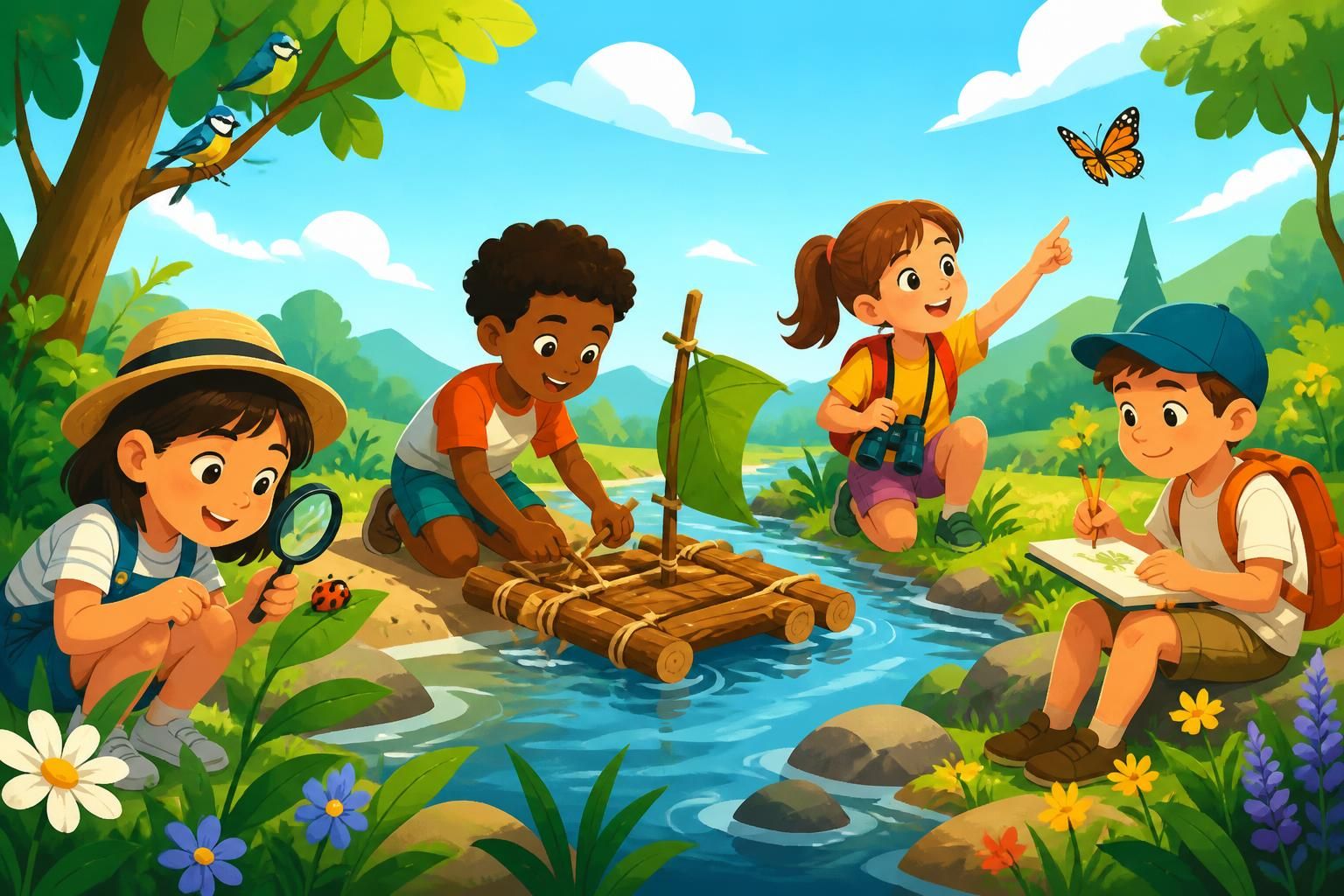
Holidays often remove some of the usual stimulations. At home, children have their toys, their landmarks, sometimes a mountain of planned activities. On the move, the environment is simpler: a few objects, a new space, time. This relative “empty” pushes invention. A stick becomes a magic wand, a stone a treasure, a towel a cape, a cardboard box a tunnel for figurines. This shift toward exploratory play is not trivial: it mobilizes imagination, motor skills, storytelling, cooperation. The child discovers because they seek to fulfill an internal need for activity, not because an adult handed out instructions.
The role of boredom is often misunderstood. It is not always pleasant, and it can trigger noisy complaints. Yet boredom has a function: it signals that the brain wants something new. When the adult does not immediately provide a “turnkey” solution, the child starts to explore. They observe the environment, gather materials, try out ideas. This “boredom–idea–trial” chain is a powerful informal learning because it encourages initiative. The adult can keep a safety framework while avoiding constant hyper-activity.
Table: holiday activities and skills worked on, with concrete markers
| Holiday situation | Skill mobilized | Observable indicator | Minimal useful time |
|---|---|---|---|
| Preparing a bag for an outing | Planning | The child thinks of 3 relevant objects | 5 to 10 minutes |
| Waiting (train, restaurant, queue) | Emotional regulation | Uses a calm strategy (play, drawing, discussion) | 10 to 20 minutes |
| Free play with simple objects | Creativity | Invents a scenario or repurposes an object | 15 to 30 minutes |
| Meeting unknown children | Social adaptation | Proposes a rule, an exchange, or asks to join | 10 to 30 minutes |
| Plan canceled (rain, closure) | Cognitive flexibility | Accepts an alternative after a moment of disappointment | Variable (often 5 to 30 minutes) |
This table shows a concrete point: skills do not require hours of “educational” activities. They work through small repeated sequences. The child does not need a creativity course to transform three pebbles into currency in an imaginary store. They need space, time, and an adult who doesn’t cut the momentum at the idea’s start.
Curiosity is also nourished by simple observations. On the beach, the child notices traces in the sand, shells, tides. In the mountains, they notice insects, paths, the temperature difference between shade and sun. The parent can support by asking for a hypothesis before giving an explanation. The hypothesis can be fanciful and still useful: it puts the child in a researcher position. This stance leads to better memorization than an answer delivered express.
Emotional regulation on holiday: frustration, unforeseen events, and informal learning of calm
Holidays promise pleasure but also deliver hassles. The sun turns into a heatwave, a site is closed, a sibling refuses to share, a snack falls on the floor, an insect sting arrives without warning. These episodes create frustration, sometimes intense. For children, it’s emotional training ground: feeling, expressing, then calming down. The important point is not to avoid frustration at all costs, but to accompany it. A child who goes through a “no” or “we’re canceling” learns to tolerate discomfort, which later serves at school, in sports, in relationships.
Emotional regulation is built with simple, often repeatable tools. Drinking water, moving to the shade, breathing, sitting quietly for five minutes, changing activity, verbalizing what’s wrong. The parent can offer a strategy rather than a sermon. It’s also possible to name the emotion (“disappointed”, “angry”, “tired”) to help the child recognize it. A recognized emotion becomes more manageable. At the same time, the child learns that the adult is not a vending machine of solutions: sometimes the solution is just waiting for it to pass, then doing something else.
Avoiding the trap of “all educational” without letting chaos take the wheel
Parents.fr reports that Thomas Fournier warns against a common trap: wanting to turn every moment into an explicit lesson. The risk is saturating the child and making the adult omnipresent in scenes where the child could discover alone. The balance lies in a posture: observe, secure, intervene if necessary, but leave room for trial. A child seeking a solution to a toy conflict progresses. A child to whom the adult immediately imposes a verdict progresses less in negotiation.
“Not making everything educational” does not mean “letting anything happen.” A clear framework remains useful: safety rules, respect for others, rest times. Within this framework, the child gains real freedom to explore. They can also participate in light rituals that help emotional stability: a story at night, a quiet time after lunch, a bedtime routine even when traveling. These landmarks limit fatigue, and fatigue is often the secret fuel of crises.
An effective lever is to value the process rather than the result. When the child tries to calm down, even if imperfectly, the effort deserves recognition. The brain then records that the strategy matters. This type of reinforcement is more useful than a compliment on “good behavior” at the end, because it emphasizes what is reproducible. Holidays then become a space where the child learns to know themselves: what annoys them, what soothes them, what helps them return to play after a difficult moment.
So, what do we say?
Holidays give children a more effective informal learning ground than an overloaded activity program, because skills build through lived and repeated experiences. Parents are wise to aim for a simple and stable framework (safety, respect, rest), then allow play and exploration so that secret lessons appear naturally. The most rewarding approach is to ask open questions and support effort, instead of immediately providing answers or correcting every detail. Families that accept a reasonable dose of boredom and unforeseen events often see more autonomy and emotional regulation as the stay progresses.
At what age do children really benefit from holiday learning?
From early childhood, children gain skills from holidays because observation and imitation suffice to trigger discovery. Before age 6, the focus is mainly on language, motor skills, and emotional regulation. From 7–8 years old, planning and autonomy (preparing a bag, finding one’s way, managing a small budget) become more visible.
How to encourage curiosity without turning every outing into a lesson?
A simple method is to ask for a hypothesis before answering, then complement with a short explanation if necessary. The goal is that the child formulates, tests, and adjusts. The parent can also provide minimal materials (paper, pencils, treasure box) and let the child lead their exploration, intervening mainly for safety or respect of others.
Are holiday workbooks essential to avoid forgetfulness?
They can help some children if adapted and used without pressure, but they are not essential for nurturing informal learning. Regular reading, playing rule-based games, cooking, counting money, or writing a postcard already engage school skills. The important thing is light regularity, not daily performance.
What to do if the child is bored and demands activities all day?
Boredom can serve as a starting point for play, but it is better managed with a framework. Offering two or three realistic options (free play, reading, craft activity) avoids endless negotiation. Providing a few “open” objects (rope, ball, leaves, pencils) helps the child invent. Once started, the child often needs less adult stimulation.