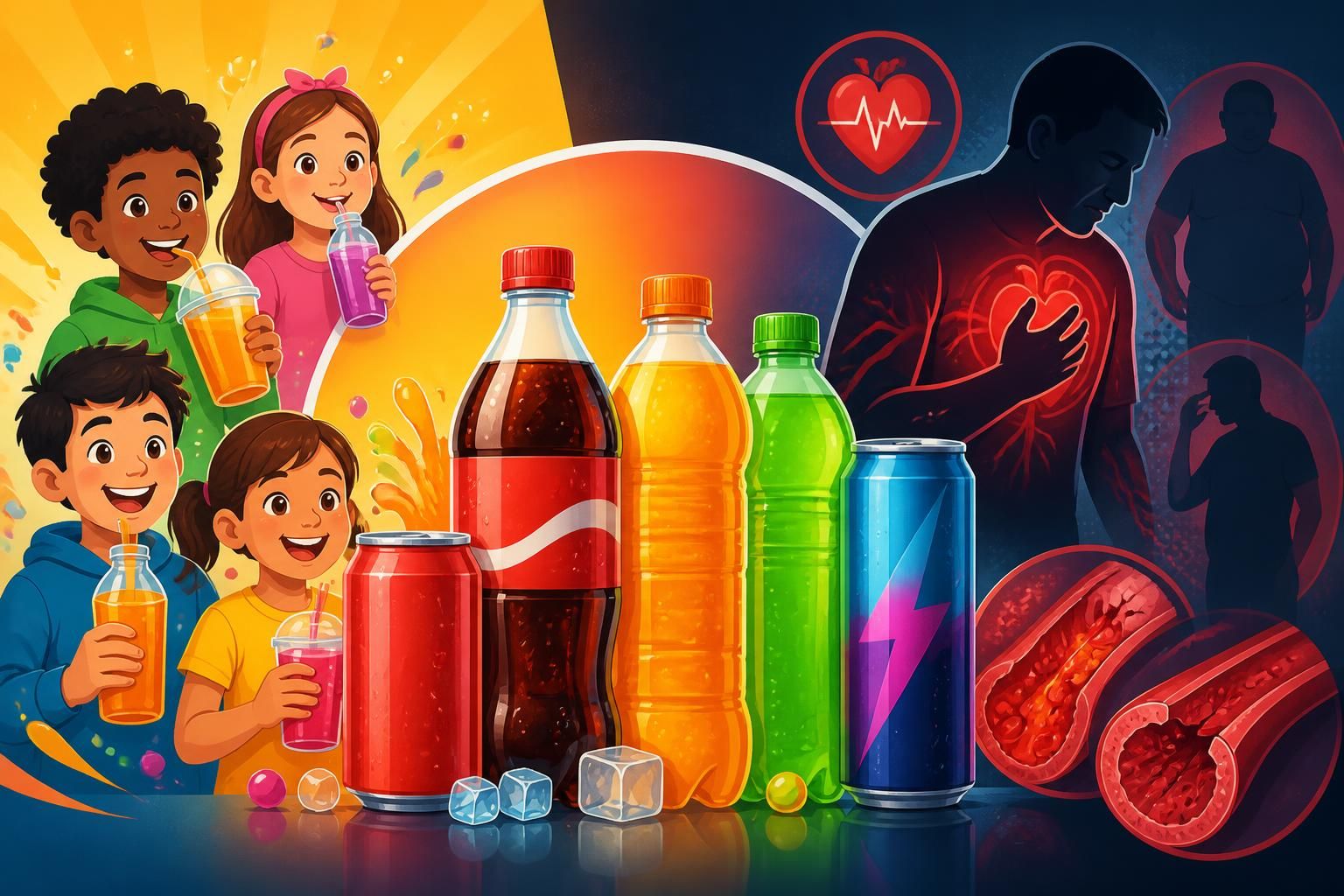
These drinks favored by children could increase the risk of hypertension in adulthood
In Brief
- According to a study from the University of Toronto published on June 3, 2026, in the journal Circulation, more than 25,000 children and adolescents were followed for nearly 25 years to link certain sugary drinks to the risk of hypertension in adulthood.
- Over the entire follow-up, 1,625 participants reported hypertension, and the highest consumers of sugary drinks had a 52% higher risk compared to those who drank them rarely.
- Fruit juices are not “neutral”: from about 1.5 servings per day, the risk increased by 35% compared to consumption below one glass per week.
- Whole fruits did not show the same association, a point consistent with their fiber content and their effect on sugar absorption.
- Replacement analyses suggested that swapping a daily soda for a whole fruit, water, or milk was associated with a lower risk (up to 22% for whole fruit).
On June 3, 2026, a study published in Circulation shone a somewhat too strong spotlight on sugary drinks often served “quick and easy” to children: sodas, energy drinks, and even certain fruit juices. The topic does not only concern cavities or restlessness on the couch, but blood pressure and cardiovascular risk years later, when snacks have been replaced by meetings and subway tickets. Researchers followed more than 25,000 participants for nearly 25 years, allowing time to witness many dietary trends, and quite a few bottles as well. In the end, 1,625 people reported hypertension.
The clearest signal concerns sodas and other sugary drinks: the highest consumers showed a 52% higher risk of hypertension compared to those who drank them rarely, after adjustment for physical activity, overall diet, body mass index, tobacco, and sleep. Fruit juices, often categorized as “it’s fruit so it’s okay,” fared better… but not that much: at about one and a half servings per day, the risk increased by 35% compared to less than one glass per week. The idea is not to police the glass, but to speak about prevention and nutrition, with concrete choices that fit in a backpack.
Sugary drinks and hypertension: what the 25-year follow-up in children shows
A follow-up over nearly a quarter of a century is the opposite of the “before/after” format seen on social media. Here, researchers observed how repeated consumption of sugary drinks during childhood and adolescence could be associated with hypertension later. The central finding is simple to understand: the more room sodas and similar drinks take, the higher the risk of hypertension in adulthood, with a 52% gap between the consumption extremes.
This number didn’t come out of a hat, nor from a “cardiologist uncle” commenting at a barbecue. The analysis was adjusted for several major factors: activity level, overall diet quality, body mass index, smoking, and sleep. This doesn’t turn the study into an individual crystal ball, but it helps avoid blaming everything on a single parameter. For families, the interest is above all practical: drinks are easy calories to swallow, and habits easy to set.
Beyond the risk of hypertension reported by 1,625 participants, this type of follow-up invites viewing the drink as a food in its own right. A soda at snack time is not just a liquid that fizzes and laughs in the glass. It provides free sugars, often notable acidity, and, depending on the product, caffeine. Blood pressure is influenced over years, via weight, insulin sensitivity, taste preferences, and how the body manages sodium and water balance.
Why childhood is a sensitive period for blood pressure
In children, preference building happens quickly: a very sweet drink gets the palate used to an intensity that makes water taste “bland” for a while. This dynamic matters for prevention because it influences future consumption, including in adulthood. Once the routine “a sweet thing for reward” is established, it easily recycles into “a sweet thing to get through work.”
There is also a portion size dimension. In real life, a “glass” sometimes turns into a 33 cl can, then a large shared bottle, then a refill. Epidemiological follow-up doesn’t track living room couches, but it captures a deeper trend: when sugary drinks become a daily reflex, cardiovascular health doesn’t applaud.
In parental discussions, the word “ban” comes up quickly and tires everyone. The useful point here lies in the risk hierarchy: sugary drinks stand out clearly, fruit juices are not harmless, and whole fruits don’t follow the same trajectory. This gives a priority map clearer than an endless debate on the ideal snack.
Fruit juices: why “100% pure juice” does not erase cardiovascular risk
Fruit juice has long enjoyed a special status: it looks like a fruit, comes from a fruit, sometimes has packaging with green leaves that make you want to breathe deeply. In the study, high consumption of fruit juices was associated with a 35% increased risk of hypertension in adulthood for participants who drank about one and a half servings per day compared to those who stayed below one glass per week.
The mechanism behind this association is consistent with basic nutrition: juice provides so-called “free” sugars, with very little fiber. Yet fibers in whole fruits slow sugar absorption, moderate glycemic spikes, and contribute to satiety. Juice “passes” quickly, and it is easier to consume a lot without realizing it, especially when it serves as an accompanying drink.
Whole fruits vs juices: the difference isn’t just fructose
Researchers emphasize an important point: looking at fructose alone doesn’t explain everything. It’s the whole food that counts. A whole fruit also provides vitamins, minerals, and polyphenols, which interact with physiology, whereas juice mainly concentrates sugary aspects and leaves the fibrous matrix behind.
In everyday family life, this translates into very concrete scenes. A child can gulp down a large glass of orange juice in two minutes, but it takes more time (and more chewing) to eat two oranges. The body doesn’t register the same thing. Neither does the brain: the feeling of satiety isn’t identical, and requests for “something else to drink” might come back faster.
“Fruit-based” drinks: the trap of marketing and portion sizes
Store shelves are full of in-between products: nectar, fruit drinks, cocktails, “tropical flavor.” Many contain added sugars in addition to naturally present sugar. The vocabulary sometimes creates confusion, especially when a child associates “fruit” with “it must be healthy.” In a prevention context, reading the label (carbohydrates including sugars, portion size) becomes a helpful habit, just like checking pickup time at school.
The tone can remain light at home, but guidelines benefit from clarity: a juice can count as an occasional serving, not as the default drink. Reserving it for a specific breakfast or a precise moment helps avoid the “vitamin open bar” effect.
Discussions about juice can quickly become emotional because many parents grew up with the idea that a glass of juice in the morning was foundational. The challenge here is to recalibrate habits without turning the kitchen into a courtroom and without letting sugary drinks nibble away at water’s place daily.
Energy drinks and sodas: caffeine, sugar, and blood pressure in youth
Energy drinks have a talent: they sell themselves as a style accessory, almost like a badge. The problem is that they often combine caffeine and sugar, two ingredients that don’t mix well with stable blood pressure, especially in children and adolescents. Even when the cited study mainly distinguishes “sugary drinks” and “juices,” the topic of energy drinks remains relevant for cardiovascular risk prevention because the consumption context is often intensive and social.
Caffeine, at certain doses, can cause a transient increase in blood pressure and accelerate heart rate, with variable effects depending on individual sensitivity. In youth, the sleep question adds up: a stimulating drink late in the afternoon can delay falling asleep, shorten the night, and cause fatigue that leads to… another stimulating drink the next day. This loop helps neither health nor household mood.
What makes these drinks attractive to children
The sweet taste masks the potential bitterness of caffeine and makes the drink easy to swallow. Packaging often plays on “sport,” “performance,” “cool” codes. Result: children may perceive these products as an adult version of soda, not as something to consume cautiously.
Cost is also a factor: a can is easy to find, to share, to drink on the go. Where water requires a bottle and some organization, energy drinks can be grabbed on a whim. Prevention then passes through environmental choices: what is available at home and what is slipped into the bag.
A list of situations where vigilance really pays off
- After training: prioritize water and a solid snack rather than a sugary “reward” drink.
- In front of screens in the evening: avoid caffeinated products that disrupt falling asleep.
- At breakfast: prefer a whole fruit and a dairy product or toast rather than a juice + sugary drink duo.
- Outings: bring a water bottle to limit impulse buys.
- At parties: control quantity and alternate with water, without turning the event into a lecture.
These types of guidelines do not aim for perfection. They serve to reduce frequency because daily repetition often weighs most heavily on long-term health.
In a family, the difficulty is not understanding that “too sweet” is not the goal. The real challenge is logistics: availability of alternatives, shopping habits, social pressure. A simple strategy is to make water the standard drink and reclassify the rest as occasional products, like dessert.
Replacing a sugary drink: concrete numbers and realistic daily options
The study did not just say “beware.” It also statistically tested what a habit replacement would yield. Analyses suggest that swapping one daily serving of soda for a whole fruit would be associated with a 22% reduction in hypertension risk. Replacement with a glass of milk was associated with a 13% decrease, and with a glass of water a 9% decrease. For fruit juices, replacing one daily glass with a whole fruit was linked to a 19% reduction.
These numbers speak well to parents because they translate into simple actions. A whole fruit fits into a bag. Water needs to be prepared. Milk, depending on eating habits, can serve as a snack drink or be part of dairy. The idea isn’t to do everything at once but to target the most “automatic” moment of consumption.
| Daily change (1 serving) | Observed association with hypertension risk | Practical household guideline |
|---|---|---|
| Replace a soda with a whole fruit | Associated decrease of 22% | Ready-to-eat fruit (banana, apple) at snack time |
| Replace a soda with a glass of milk | Associated decrease of 13% | Plain milk at snack time, or yogurt as alternative |
| Replace a soda with a glass of water | Associated decrease of 9% | Filled water bottle before school and after sports |
| Replace a fruit juice with a whole fruit | Associated decrease of 19% | Fruit at breakfast instead of juice |
Examples of “switches” that don’t trigger a strike at home
The replacement that works is often the one that respects the context. After sports, water makes sense because thirst is real. At breakfast, a whole fruit can be integrated into a quick routine. At snack time, a plain dairy product can work if the child is used to a less sweet taste.
Timing also matters. Changing shopping time is more effective than negotiating at 6:42 p.m., when everyone is hungry. A consistent home environment reduces “counter talks” in front of the fridge.
Prevention: focus on frequency before perfection
For cardiovascular health, frequency is a major lever. An occasional soda does not weigh the same as a daily soda. In real life, reducing from 7 to 2 servings per week can be a massive improvement without requiring a complete diet overhaul.
Prevention also gains by being “visible.” A carafe of water on the table and an accessible fruit basket often do more than ten speeches. And it works even on days when parental energy is at “battery 12%”.
These approaches are not spectacular, but they fit reality. A lasting change is built with simple, repeatable options compatible with busy weeks.
Talking nutrition without dramatizing: health guidelines for parents and children
Children understand rules very well when they are stable, especially if they avoid blurred lines. Saying “not too much” without explaining the framework leaves the door open to all interpretations, including the one ending in a bottle of juice in the car. A clear guideline could be: water as the base drink, sugary drinks as exceptions, and fruit juices as a product to limit, even when “pure juice.”
Hypertension might seem distant for a family with a primary school child. Yet the logic of prevention is long-term: consumption habits, preference for sugar, sleep management, dietary balance. Blood pressure doesn’t become unbalanced in a week, which is precisely why routines matter.
At school, sports, home: three environments, three levers
At home, the main lever is purchase. If sugary drinks aren’t in the cupboard, they don’t invite themselves to the table. For school, a water bottle becomes a health tool, just like adapted outerwear: not glamorous, but useful. In sports, normalizing water as an effort drink prevents physical activity from becoming a “pretext for sugar.”
Discussions can remain light. A child doesn’t need a physiology lesson on cardiovascular risk. However, they can understand that some drinks are “party drinks,” and that daily life aims for something else. The brain loves simple categories.
Formulations that avoid permanent power struggles
Rather than opening a debate with every request, a predefined frame helps: “There is water to drink, and juice on weekends.” Or: “Soda only on birthdays.” It’s not a punishment; it’s organization. Announcing the rule when calm (not when the child is already frustrated) reduces scenes worthy of a drama series.
When a child asks for something sweet, offering a concrete alternative works better than a blunt “no”: water + fruit, water + yogurt, water + sugar-free compote. The important part is that the alternative is available immediately. Otherwise, the easiest option wins, and it is rarely the healthiest.
Prevention often looks like logistics: preparing, making accessible, repeating. It is less spectacular than a major diet change but more compatible with real family life.
What Do We Make of It?
Long-term follow-up data clearly point to sugary drinks as a factor associated with an increased risk of hypertension in adulthood, with a 52% gap between high and low consumers. Fruit juices also deserve re-framing, as high consumption associates with a 35% increase, even when the “fruit” image reassures. The most effective prevention lever is to reduce frequency and prioritize replacement by water and whole fruits, as substitution analyses suggest. For a family, making water available and routine is a simple decision that pays off for health and long-term blood pressure.
Which drinks are concerned when we talk about sugary drinks?
The term mainly covers sodas, sweetened flavored drinks, some “fruit” drinks with added sugars, and depending on context, energy drinks. The common point is the provision of free sugars in liquid form, which are quickly ingested and easily become part of consumption routine.
Do 100% pure juices count as a risk for cardiovascular health?
In the cited study, high consumption of fruit juice (about 1.5 servings daily) was associated with increased risk of hypertension in adulthood. The proposed mechanism is based on low fiber content and proportion of free sugars, which differentiates juice from whole fruit.
What to give instead of a soda at snack time to help prevention?
The simplest options are water (bottle or pitcher) and a ready-to-eat whole fruit. A plain dairy product can also be part of alternatives depending on habits. The concrete goal is to replace one daily serving of sugary drink with a less sweet and more satiating option.
Does a child doing sports need a sugary drink to recover?
In most normal physical activity situations for children, water suffices for hydration. A solid snack (fruit, yogurt, toast) can cover energy needs without sugary drinks. This avoids turning effort into an “automatic sugar permit.”