Touch Development Baby: The development of the sense of touch in baby (0-12 months).
| Short on time? Here’s the essential ✨ |
|---|
| 🤱 Baby touch is the first operational sense in utero and remains the pillar of sensory development from 0 to 12 months. |
| 💞 Care and cuddles, massages and skin-to-skin regulate stress, support sleep, and secure attachment. |
| 🧠 The neuroscience of touch shows that every caress sculpts neural connections and nourishes cognitive development. |
| 👋 Primitive reflexes (grasping, sucking) pave the way for fine motor skills and exploration. |
| 🧩 Varied tactile stimulations (textures, temperature, pressure) refine sensory perception and multisensory integration. |
| 🚩 Watch out for hyper- or hyposensitivity to touch and ask for advice if in doubt to act early. |
The first sense to emerge, touch carves a fast track to the infant’s brain. Within a few months, sensory development transforms caresses into landmarks, gentle pressures into messages, and textures into genuine lessons about the world. Numerous studies confirm that care and cuddles calm heart rate, stabilize body temperature, and stimulate key neural circuits. Supporting this, prenatal ultrasound observation already reveals the fetus’s responsiveness to gentle touches on the maternal belly. That’s why the quality of contact matters as much as its quantity.
From birth, the skin becomes the main interface between the child and their environment. It perceives warmth, cold, pressure, but also relational security. Thanks to the neuroscience of touch, it is established that the repetition of kind contacts promotes the maturity of sensory pathways and the autonomic nervous system. In daily life, this translates into simple, effective, and joyful rituals. A massage after the bath. A tight cuddle before the nap. A reassuring hand during discoveries. And, above all, a smooth parent-baby interaction, paced by voice, gaze, and the right gesture.
Baby touch development: neuro-sensory basics and the role of care and cuddles
Baby touch forms very early. Around eight weeks of gestation, the first skin receptors activate. Later, ultrasound imaging research (Max V., Nagy E.) showed that the fetus reacts to caresses on the maternal belly during the third trimester. Movements of the arm, head, and mouth then intensify. This early sensitivity would already be a sketch of communication mediated by pressure variations in the amniotic fluid.
At birth, the skin concentrates thousands of sensors. It translates textures, temperatures, and pressures into nerve impulses. The brain draws internal maps of the body and nearby space from this. This foundation supports emotional regulation and attachment, but also nascent cognitive development. Every repeated touch stabilizes connections. It anchors reliable sensory predictions, useful for anticipating and learning.
Primitive reflexes play a transitional role. Grasping, for example, represents the automatic hand grasp when touching a finger. Well-supported, this reflex integrates and gives way to voluntary grasping. Thus, fine motor skills emerge. The rooting reflex and sucking guide initial feeding. They then weaken, allowing intentional gestures directed by the mouth and hands.
Why is skin-to-skin contact so powerful? It synchronizes breathing and heart rate. It stabilizes cortisol and increases oxytocin, the bonding hormone. The child learns that the environment is predictable and safe. Result: better sleep quality, faster calming, and appetite for exploration. This calm setting favors refined sensory perception, as attention is not monopolized by stress regulation.
Let’s illustrate with Léa, 4 months old, and her parents. After a lukewarm bath, a delicate massage from feet to shoulders is carried out, with pauses to observe her signals. The parents’ hands adjust pressure and rhythm. Léa relaxes her shoulders, opens her palms, then follows with her eyes the hand that caresses her. This trio of gaze-voice-gesture forms an exemplary parent-baby interaction, sculpting lasting circuits.
To support this development, a well-chosen play mat becomes an ideal stage. It offers varied textures, soft arches, and rattles. Selecting an appropriate model in 2026 remains simple thanks to this 2026 guide to the best baby play mats. Contrasted surfaces and graspable elements invite hands to discover without overload.
Underlying all this, the neuroscience of touch highlights a crucial point: well-calibrated repetition is better than overdoing it. Better a few rich tactile stimulations per day than a confusing flood. The key is quality tuning. A sensitive presence, an attentive gesture, and the baby’s brain finds its rhythm. This solid base will support all subsequent stages.
0-3 months: skin-to-skin, emotional regulation and sensory perception
Skin-to-skin and massages: regulation through contact
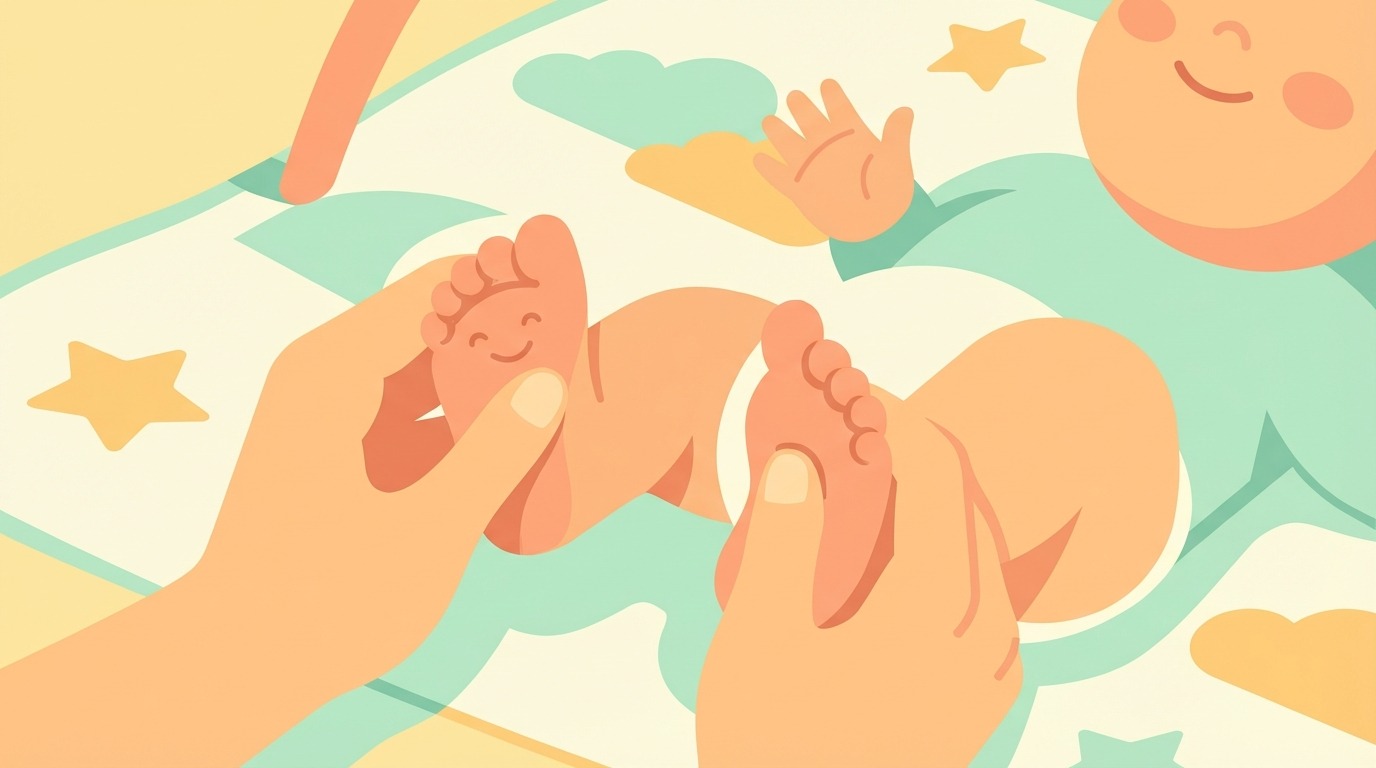
From the first days, skin-to-skin envelops and reassures. It reduces crying and promotes breastfeeding. Simple, repeated gestures build internal security. A gentle massage after the bath, with a neutral oil, activates skin receptors and soothes the nervous system. Slow, symmetrical movements respectful of the baby’s reactions facilitate self-regulation.
On a motor level, the support of hands on the chest and limbs awakens body schema awareness. The mouth and cheeks, very sensitive, also guide exploration. A kiss on the cheek, a caress on the palm, and the child already refines their sensory maps. The key is to read micro-signals: tightening, averted gaze, yawns. These signs call for a pause, then a gentler resumption.
Textures, pressures and emotional security
To vary sensory perception, alternate supports: cotton, velvet, muslin. A slightly heavy blanket on the legs may reassure if the baby accepts it. Position changes – tummy, back, side – enrich the tactile and proprioceptive repertoire. These are building blocks of future fine motor skills.
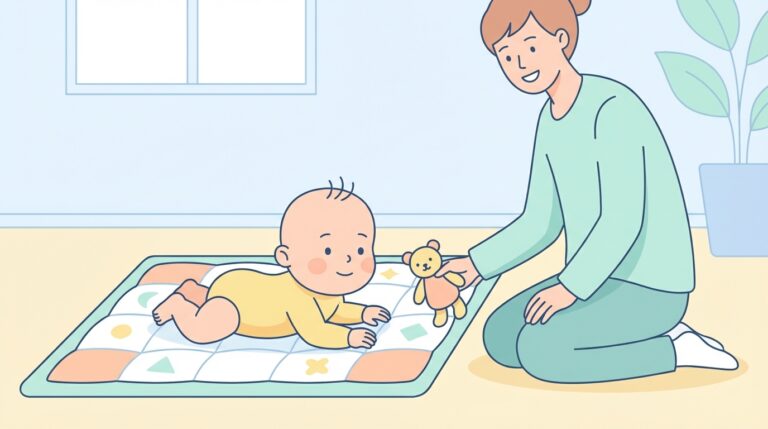
Tummy time links floor touch and postural awakening. Short sessions, several times a day, suffice. The adult props elbows, supports the chest, and encourages with voice. Pressure of the mat on the forearm and chest stimulates sensory pathways that will facilitate rolling over, then crawling.
Practical framework and daily landmarks
A three-step ritual works well: eye contact, calm speech, then touch. This predictable sequence reduces startle and prepares the brain to receive tactile information. A temperate room and soft lighting also help. Care and cuddles inserted into these routines strengthen trust.
Looking for simple and safe ideas? The inspiration catalogs evolve with needs: see Fisher-Price development-centered resources and these Chicco game ideas. The goal remains to blend gentleness, variety, and observation. Always in small doses, with listening breaks.
To accompany these gestures, a short video session often provides a concrete model to reproduce step by step.
At this age, the density of tactile receptors is an asset. Used moderately, it lays solid foundations for future exploration. This is where confident curiosity takes root.
3-6 months: tactile stimulations, fine motor skills and safe exploration
From reflex grasp to voluntary grasp
From three months on, the hand opens, then voluntary grasping begins. Primitive reflexes fade, letting intention guide the gesture. The baby brings objects to the mouth to “read” them with lips and tongue, highly sensitive areas. This exploration directs fine motor skills through micro-adjustments of pressure and finger positioning.
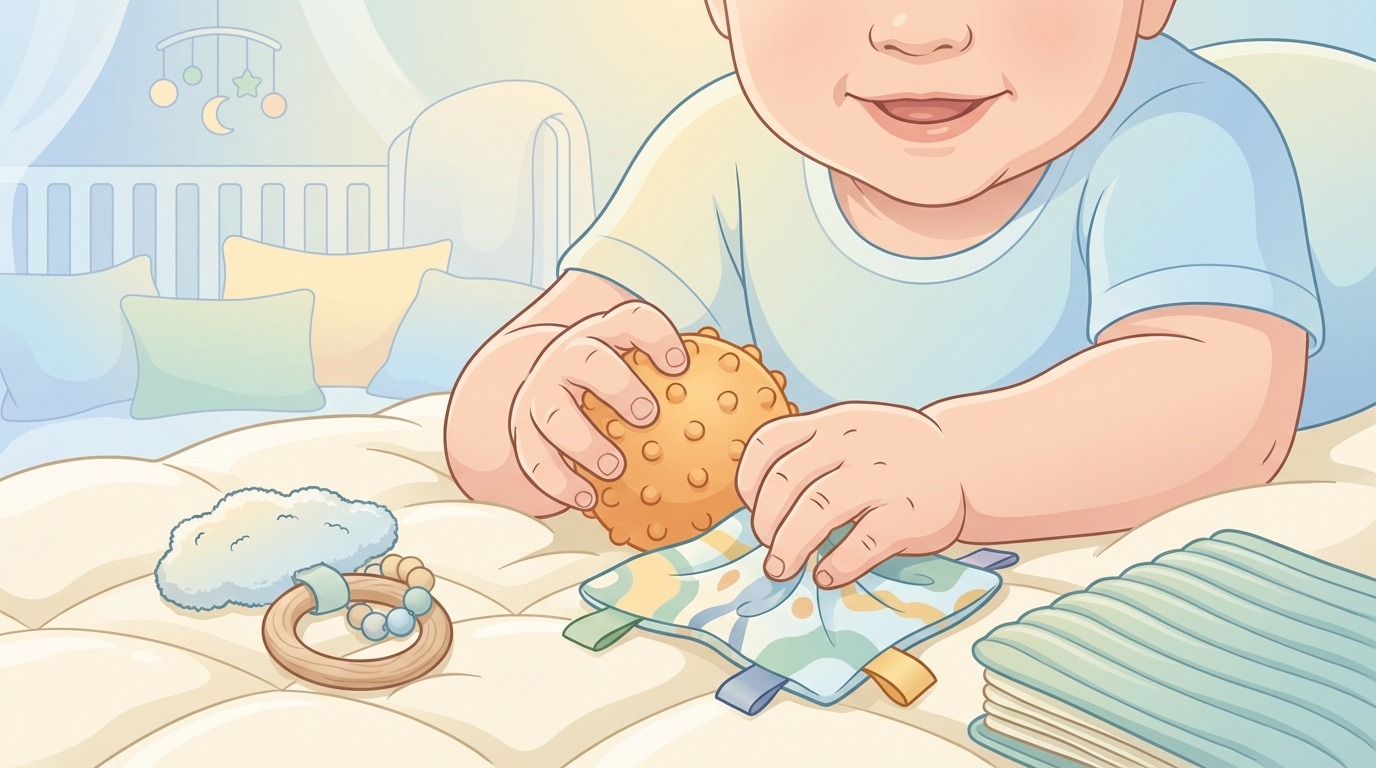
A soft ring, crumpled fabric, a light rattle: these simple tools suffice. The adult calibrates difficulty. A material that is too hard or heavy discourages. A too simple object does not engage the hand. Finding the middle ground develops grip strength and eye-hand coordination.
Tactile paths and body landmarks
Set up a mini course with a firm cushion, textured towel, and soft mat to stimulate sensory perception. Varying positions, back and side, enriches the range of tactile inputs. The floor becomes a precise teacher: it sends information at every support. The adult comments on what the child experiences. The voice gives meaning without overloading.
The play mat remains a base. To choose well, this 2026 play mat guide compares textures, arches, and safety devices. Models offering variety and stability are quickly spotted. Golden rule: one novelty per session suffices to avoid sensory overload.
Concrete and progressive activity ideas
- 🪄 Peek-a-hand games under a soft scarf: work on waiting and surprise without rushing.
- 🧶 Texture bag (velvet, satin, knit): alternate touching hands and feet, eyes open then closed.
- 🧸 Dual-texture rattle (foam + smooth wood): compare grasps and observe finger pressure.
- 🎵 Finger-play songs: touch each finger to the rhythm of the song to link music and touch.
- 🌬️ Gentle fan breeze (from a distance) on forearm: sensitize to temperature and airflow.
Want to vary even more? Motor development and touch support each other daily. A firm, uncluttered floor gives confidence to the reaching hand and organized trunk.
A well-chosen video resource can inspire you without multiplying equipment.
With measured tactile stimulations, the hand gains precision. This period prepares the pincer grip and fine coordination, essential for what follows.
6-12 months: tactile discrimination, sensory integration and cognitive development
Discriminate, compare, memorize
Between six and twelve months, the hand becomes a laboratory. Differentiating smooth and rough, warm and cool, soft and firm nourishes tactile discrimination. The child begins to recognize objects by touch alone. This skill enhances memory and categorization. It fuels cognitive development: sorting, classifying, inferring.
Simple sensory bins work very well: semolina, giant beans, cooled cooked pasta. Treasures to find are slipped inside. Words are verbalized: “soft,” “grainy,” “slippery.” The tongue becomes a labeling tool that stabilizes experience and structures thought.
Multisensory and feeding: textures in the mouth
At table, mouth textures extend the hand. Small smooth purees, then lumpy, and finally melting pieces. The mouth compares, modulates jaw pressure, and adjusts the tongue. This is also tactile. Respecting hunger and satiety signals remains a priority. The kind repetition of a food several times promotes acceptance.
Tactile stimulations combine: see, touch, taste. This sensory integration solidifies circuits. The adult remains a guide, not an omnipresent director. Allowing time for the gesture often works better than too quick help.
Hyper- or hyposensitivity: adjust without forcing
Some children react strongly to tags, rough plush toys, or baths that are too hot. Others constantly seek strong pressure or rubbing. These are signs of hyper- or hyposensitivity to touch. The idea is not to “correct” but to adjust the environment. Alternatives are offered, transitions anticipated, and clear landmarks given.
If reactions interfere with feeding, dressing or sleep, an assessment can help. An occupational therapist specialized in sensory integration then proposes an individualized program. The goal is to equip the child to self-regulate responses, step by step.
Need ideas for daily life? Home courses, lukewarm water play, and varied surfaces in the living room often suffice. You can draw inspiration from activities offered for 17 months and adapt them cautiously in a simplified version. The most important remains fine observation of the child, the compass for adjustments.
When touch opens these doors, exploration becomes a learning strategy. Awakening then transforms into pleasure.
Practical tactile guides and warning signs: daily parent-baby interaction
Winning routine in 5 steps
A clear routine maximizes the benefits of touch. Greet the child face to face. Announce the upcoming gesture. Place a warm and steady hand. Perform a slow and ample movement. Finally, let the child integrate without rushing. This micro-choreography builds trust and refines sensory perception.
To pace the week, alternate short massage sessions, regular tummy time, and texture play on the floor. One session dedicated to the hand, another to the feet, then one linked to the mouth through diversification. Regularity matters more than duration.
Minimalist tactile toolkit
No need to stack purchases. With a stable mat, two soft balls, a few contrasting fabrics, and a textured teething ring, the essentials are there. The rest, the home provides: rice in an airtight box, dry then wet sponge, smooth wooden spoon. Inspiration catalogs like these Chicco game ideas broaden the path while keeping focus on the essential: the right gesture at the right time.
Want to deepen the notion of the body experienced by the child? Resources on baby body awareness illuminate how skin signals guide spatial orientation and posture. This internal compass also supports balance and attentional availability.
When to consult? Concrete landmarks
- 🚩 Lack of calming with repeated gentle contact, or increased crying from caressing.
- 🚩 Persistent and total refusal of clothing textures, or panic at bathing despite adaptations.
- 🚩 Constant seeking of intense pressures, repeated object biting, or compulsive rubbing.
- 🚩 Noticeable delay in voluntary grasping after 6 months, or absence of manual exploration.
- 🚩 Long-lasting feeding difficulties related to textures, despite progressive and kind exposure.
These signs deserve professional advice. Referral to sensory occupational therapy or psychomotricity offers precise strategies. The environment is then adjusted, and successes reinforced by repeated, pleasant, and predictable experiences.
The discovering hand, the sensing skin, and the accompanying adult: this trio opens the door to a lasting and joyful learning.
Why is touch the first sense to stimulate in infants?
Touch is functional from fetal life. It regulates stress, secures attachment, and provides rich information about pressure, temperature, and texture. These calibrated sensory inputs support neuronal maturation and prepare fine motor skills and early learning.
Which tactile activities should be favored between 0 and 6 months?
Skin-to-skin, slow massages, and varied fabrics. Add very short tummy time sessions, a stable mat, a light rattle, and sung hand games. The golden rule: observe signals and time the duration.
How to link touch and motor development?
The floor provides clear feedback and guides body alignment. Simple courses, calibrated object grasping, and repeated intentional gestures support eye-hand coordination and trunk stability. See also this guide on motor development to better synchronize the stages.
What to do if my child reacts strongly to certain textures?
Reduce novelty, offer accepted alternatives, anticipate transitions, and introduce changes very gradually. If there is impact on feeding, dressing, or sleep, consult an occupational therapist specialized in sensory integration.
Which equipment is really useful?
A stable play mat, a few contrasting textured objects, a soft ball, and a textured teething ring. The 2026 guides help choose safe and varied models without multiplying equipment.
“The shortest gesture, a caress, can trace in the child’s brain the longest path to trust.” 💫