Tummy Time: The importance of “Tummy Time” for the development of babies from 0 to 12 months.
Tummy Time, or time on the tummy, concentrates an impressive number of benefits for baby development. In a few daily minutes, this practice shapes the tone of the neck and shoulders, refines coordination, and supports motor awakening. It also contributes to preventing flat head by diversifying cranial pressure points. For families with a baby aged 0-12 months, the challenge is twofold: stimulate baby in a playful way and build a solid foundation for future motor skills, without overloading already busy days. Between concrete ideas, age-by-age milestones, and gentle adaptations, this guide offers a clear and well-reasoned strategy, validated by early childhood professional practices.
Over the months, tummy time prepares the major milestones: rolling over, sitting up, crawling, then walking. Yet, many give up too soon, as some infants protest at first. The solution doesn’t rely on chance but on a gradual setup, well-chosen games, and precise progression markers. Thus, a short and regular routine can turn the first efforts into visible successes. In short, Tummy Time is envisaged as a gentle, joyful, and strategic training where every minute counts and every smile encourages continuation.
| Short on time? Here’s the essentials ⏱️ |
|---|
| Start early (from the first days), 2-3 minutes, several times a day 👶 |
| Increase progressively up to 15-20 minutes cumulatively, then more after 3-4 months 📈 |
| Key objectives: muscle strengthening, coordination, motor development, flat head prevention 💪🧠 |
| Make it playful: high-contrast toys, unbreakable mirror, singing voice, skin to skin 🎲🪞 |
| Ensure comfort: calm moments, firm and soft surface, constant supervision ✅ |
Tummy Time: clear definition and immediate benefits for babies 0-12 months
Tummy Time consists of placing an awake infant on their tummy for a few minutes, then a little longer as the habit establishes. This position strengthens the deep trunk muscles and organizes posture. Indeed, it contributes to muscle strengthening of the neck, shoulders, back, and arms.
This foundation directly prepares upcoming milestones: controlling the head, rolling over, pivoting, crawling, then sitting. With each lifted gaze towards a face, the child trains cervical extension and improves essential eye-hand coordination crucial for grasping. Thereby, motor development gains fluency.
Since campaigns promoting back sleeping, flat head prevention has become a daily concern. Tummy Time distributes cranial pressures, reducing the risk of plagiocephaly. For more, useful resources detail flat head prevention in infants.
Sensory-wise, the prone position opens a perspective close to the ground. Baby observes textures, feels the carpet’s resistance, listens to the encouraging voice. This abundance of cues feeds curiosity, increases alertness, and supports overall baby development.
Is equipment needed? No, a firm and comfortable surface suffices. However, a nursing pillow under the chest can offer a gentle angle at first. Moreover, an unbreakable mirror invites lifting the head eagerly. This simplicity makes the habit accessible to all families.
Useful age-by-age markers: in the first weeks, aim for 2-3 minutes, 3 to 5 times a day. By 3 months, cumulative time often reaches 45-60 minutes, broken by breaks. Between 6 and 9 months, mobility explodes: pivoting, mini-crawling, more stable forearm supports. Finally, around 9-12 months, the position is no longer an isolated exercise but a springboard towards verticality.
To illustrate, the little story of Naël: at 6 weeks, he tolerates 90 seconds on his tummy. With a playful routine, he reaches 10 cumulative minutes within a week. At 4 months, his forearm supports are solid, and his hands grasp a rattle. It’s concrete, measurable, motivating.
Section conclusion: the prone position is no detail. It is the discreet foundation aligning strength, coordination, and curiosity for visible progress month after month.
Implementing Tummy Time daily: step-by-step method and tips to stimulate baby
The key lies in a gentle and planned progression. First, choose a moment when the child is satiated, awake, and relaxed. Then, set up a firm, non-slip mat. Soft lighting, reassuring background sound, and the presence of a familiar face secure the scene.
To start, place baby on the tummy for 2 minutes, then return several times during the day. Add 30 to 60 seconds per session depending on acceptance. These micro-sessions accumulated are better than one long frustrating moment. Thus, tolerance grows smoothly.
How to stimulate baby without overloading? With voice. A rhythmic nursery rhyme synchronizes breathing, encourages lifting the head. An unbreakable mirror placed 20-30 cm away encourages cervical extension. Finally, a high-contrast rattle attracts the eyes and triggers visual tracking.
Making these minutes playful changes everything. A selection of adapted and evolving accessories simplifies the task. For inspiration, here are stimulating game ideas that refresh proposals without unnecessary over-equipment.
The environment matters as much as duration. A safe floor avoids dangerous distractions. Pets stay at a distance. Siblings participate under clear instructions: applause, waving hello, giving a toy, but no pulling arms.
- 🎯 Start after diaper change, when baby is alert and comfortable
- 🪞 Place an unbreakable mirror to encourage head lifting
- 🎵 Sing softly to rhythm breathing and prolong effort
- 🧸 Alternate soft and high-contrast toys to vary grasps
- ⏳ Break into 4-6 short sessions to avoid fatigue
- 💗 Stay at eye level for reassuring “coaching” effect
And if Baby protests? Slightly incline the plane with a pillow under the chest, shoulders above the support. Position elbows under shoulders for better leverage. Then reduce time and increase positive feedback. Result: the effort becomes bearable, then pleasant.
Case of Camille and Léo: at first, Léo cries after 40 seconds. Camille places her hands under the chest, sings “À la volette”, and puts a mirror in front of him. In four days, Léo tolerates 4 minutes. After two weeks, he spontaneously pivots towards a sound cube. Consistency pays off.
Section conclusion: a simple method, millimeter adjustments, warm encouragements. Here is the recipe to anchor a lasting and effective routine.
Gross motor skills, muscle strengthening, and coordination: how tummy time builds motor development
Tummy time organizes motor skills around effective supports. Forearms, elbows, then palms alternate to stabilize the trunk. This sequence refines head control, awakens obliques, tones the shoulder girdle. Thus, a solid base is built for posture changes.
On the neuromotor level, Tummy Time trains belt dissociation. Shoulders learn to move independently from the pelvis. This fine coordination frees rolling, then pivoting. Then, mini-crawling appears, with those charming little “tractions” that make the whole family smile.
The hand becomes precise. Placed on the ground, it explores, pushes, scratches, grasps. Each micro-adjustment enriches the sensory map. By ripple effect, vision focuses on near targets, then farther ones. Visual tracking then gains precision, benefiting future environmental readings.
Proofs are observed daily: a baby lifting the head higher, longer; another who maintains unilateral support to catch a rattle. At 5-6 months, many lift into palm support, arms extended, chest raised. This joyful “little cobra” signals harmonious extension.
To deepen the link between Tummy Time and global skills, a look at gross motor skills enlightens the logic of progression. We better understand why a solid prone base accelerates acquisition without forcing them.
Progressive example over three weeks: week 1, 3 sessions of 2 minutes with mirror. Week 2, 4 sessions of 3 minutes with a rolling toy right then left to stimulate pivot. Week 3, 5 sessions of 4 minutes, with a textured mat to enrich tactile feedback of the palm.
To visualize game and setup options, a video search guides inspiration step by step.
Finally, the cumulative effect deserves emphasis: the more the prone posture refines, the more the child feels capable of exploring. This feeling of competence feeds the desire to try, and the attempt feeds competence. A virtuous circle, driving autonomy.
Section conclusion: build strength through play, make coordination lively, and link each progress to a pleasant experience. This is the DNA of effective Tummy Time.
Preventing plagiocephaly and acting early: the decisive role of Tummy Time
Positional plagiocephaly, or “flat head,” occurs when the same cranial pressure point repeats too often. Tummy Time diversifies support points and promotes neck mobility. Therefore, it stands as a pillar of flat head prevention, alongside alternating awake positions and varied carrying methods.
What signs to watch? A visible flattened area, an advanced ear, or a preference for head rotation. Congenital torticollis may accentuate asymmetry. Early detection helps to correct early. This parental vigilance, combined with simple actions, changes the trajectory.
What concrete actions? Multiply awake tummy moments, vary bed orientation, place stimuli on the less turned side, and play on the floor rather than in seats. In parallel, frequent carrying relieves pressure points. These daily choices modulate skull shape.
For more, a practical guide on how to detect plagiocephaly helps objectify warning signs. If needed, early care optimizes results. Additionally, you’ll find complementary paths to treat plagiocephaly when it develops despite prevention.
Case of Élise and Sohan: at 2 months, a marked right preference. Proposed program: fractional Tummy Time, light games on the left, ventral carrying in a wrap. In one month, head circumference evolves, supports balance, and Sohan now turns both sides without resistance.
And if discomfort persists? Evaluate environment and duration. Consult if crying continues, if neck mobility seems limited, or if asymmetry worsens. Better to ask early than wait and complicate correction.
In summary, Tummy Time does not replace safe back sleeping at night. It complements safety by balancing supports during the day. This coherent duo protects, strengthens, and supports growth.
Section conclusion: act early, often, and intelligently. Prevention then becomes a reflection of simple and effective awakening habits.
Special cases and gentle adaptations: prematurity, reflux, twins, and special needs
Every baby progresses with their story. In preemies, tummy tolerance can be lower initially. Start skin-to-skin, then a slightly inclined plane, shoulders above support, elbows framed. The rule remains: very short, very frequent exposures and careful observation of signals.
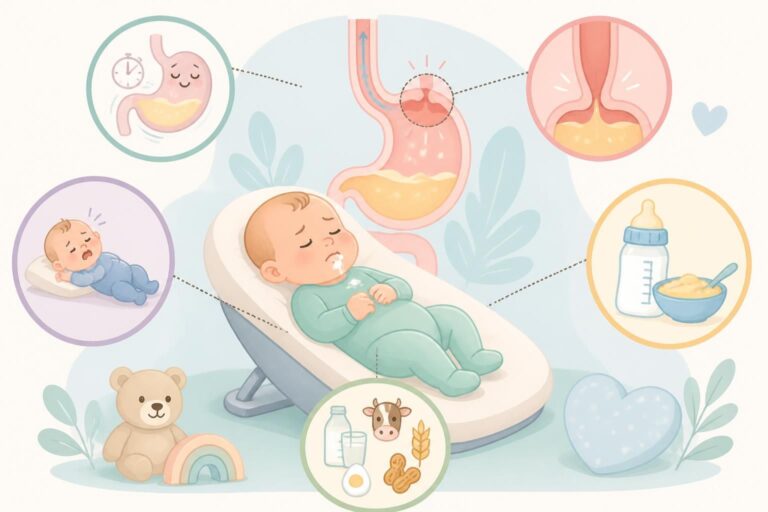
In gastroesophageal reflux, avoid tummy position just after feeding. Offer it before the next feed or 30-45 minutes after. A pillow placed low under the sternum can reduce abdominal pressure. The goal is to maintain a positive, pain-free experience.
With twins, organization refines. Alternate: one baby in Tummy Time with active interaction, the other carried or on back with toy to explore. Then swap. A few face-to-face duo sessions trigger delightful facial expressions and vocalizations prolonging the effort.
For profiles with special needs, ventral support remains relevant but personalizes. A physiotherapist or occupational therapist advises facilitative positions, tailored durations, and adapted supports. Thus, activity remains accessible, safe, and promotes progress.
Guided example: Noa has hypertonia of extensors. The protocol proposes very contained forearm supports, an adult hand on the pelvis to limit startle, and slow nursery rhymes to reduce activation. After ten days, head control improves in quality, without stiffness.
Another example: Inès, slight hypotonia, tires quickly. Elbows placed more forward, chest raised slightly, soft textures under palms proposed. In three weeks, endurance increases, supports structure, and interest in pivot returns.
Useful video resource: targeted research shows progressive, safe, and motivating setups for these particular situations.
Section conclusion: adapting is succeeding. With a few millimeters of adjustment and a large dose of observation, every baby can benefit from Tummy Time.
Tummy Time: milestones and goals by age group
To finish, a chronological memo guides ambition without unnecessary comparison. 0-2 months: short tolerance, priority on regularity, close mirror, soft voice. 3-4 months: stable forearm supports, hands opening, longer visual tracking. 5-6 months: palm supports, mini-crawling, joyful pivot.
7-9 months: more varied floor movements, expansive curiosity, first transitions to sitting via the side. 9-12 months: complete mobility circuit, back-and-forth between prone and sitting, beginnings of verticality. At each stage, tummy time remains a discreet but powerful lever.
To secure this progression, stay flexible on duration and firm on regularity. Progress follows consistency more than isolated performances. Thus, the child grows with confidence.
“A few minutes on the tummy today, miles of autonomy tomorrow.”
Quel est le meilleur moment de la journée pour proposer le Tummy Time ?
Choisir un moment d’éveil calme, loin des repas immédiats. Après le change ou avant le bain fonctionne bien. Fractionner en plusieurs courtes séances rend l’expérience plus agréable et efficace.
Combien de temps cumulé viser vers 3-4 mois ?
La plupart des bébés tolèrent 30 à 60 minutes cumulées par jour, en plusieurs séances. L’important reste la régularité et le plaisir, pas le chronomètre.
Le Tummy Time suffit-il pour prévenir la tête plate ?
C’est un pilier majeur, mais il s’ajoute à d’autres gestes : varier les appuis d’éveil, porter souvent l’enfant, alterner le côté d’orientation du lit. En cas de doute, consultez tôt.
Quels jouets privilégier pour stimuler bébé sur le ventre ?
Des objets contrastés, un miroir incassable, des hochets légers et des surfaces texturées. L’objectif est d’encourager la levée de tête, la poursuite visuelle et la saisie.
Que faire si bébé n’aime pas du tout la position ventrale ?
Réduire la durée, élever légèrement la poitrine avec un coussin, se mettre à hauteur des yeux, chanter, puis réessayer plus tard. Si la gêne persiste ou si la mobilité du cou semble limitée, demander un avis professionnel.