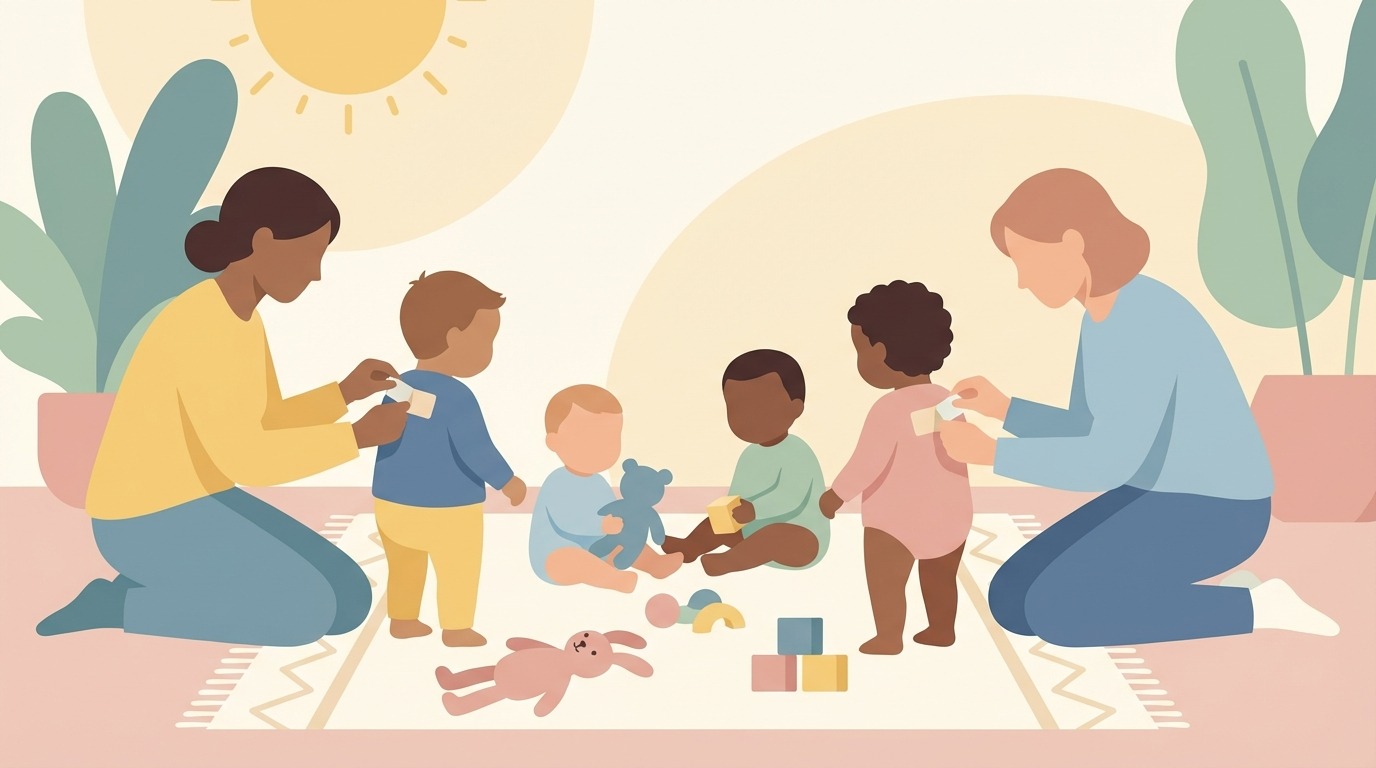
Avoid Behavior Labels: Avoid labeling the behavior of children aged 1 to 3 years.
| Short on time? Here’s the essentials ✨ |
|---|
| Words shape self-image 🧠: a repeated label (e.g., “you are slow”) can become an identity and hinder development. |
| Observe, understand, support 👀💬: choosing observation and understanding rather than judgment changes behaviors. |
| Describe precisely 🧩: highlighting concrete actions (“you shared your toy”) strengthens the child’s individuality. |
| Emotional co-regulation 🌬️: breathing, naming, ritualizing help children aged 1 to 3 years to self-regulate. |
| No idealism 🚦: supporting doesn’t mean accepting everything; we set limits with non-judgment and communication. |
Because one word can open or close a horizon, sticking labels on toddlers affects their development far more than we imagine. Between 1 to 3 years, children learn to name their emotions, experiment with roles, test responses. Freezing them into “slow,” “whiny,” or “clumsy” clouds their individuality, sometimes for a long time.
The heart of the matter is not to ignore difficult behaviors, but to adopt a firm direction: observation, non-judgment, understanding, then effective communication. This process, both demanding and joyful, invites us to see the child as a learner in full growth, not as a file to correct. Time for concrete strategies and words that nurture growth.
How to avoid labeling children aged 1 to 3: challenges and evidence
At this age, the social brain develops rapidly. Frequent verbal feedback becomes landmarks, sometimes prisons if they take the form of labels. Saying “you are disobedient” ties identity to a temporary behavior, whereas “you refused to tidy up” describes a fact and leaves the door open to change.
The “self-fulfilling prophecy” explains this trap. When a child hears they are “restless,” they internalize this role and end up confirming the label. This mechanism, observed in family education and nurseries, harms self-esteem and stiffens daily relationships.
Effects on self-esteem and motivation
A child repeats what they think of themselves. If told “you are clumsy,” they avoid trying, fearing failure. Conversely, a precise and kind description, like “you held the glass with both hands, keep going,” nurtures effort and endurance.
This shift doesn’t only concern negative labels. Overgeneralizing compliments (“you are kind”) can create pressure. Better to describe the act: “you waited your turn,” which clarifies expectations without confining.
Assigned roles and family climate
Within siblings, roles like “wise,” “clown,” or “leader” appear quickly. They simplify understanding but impoverish individuality. When one is “the troublemaker,” their successes are minimized, while others’ misbehaviors go unnoticed. This bias distorts communication and cooperation.
To avoid these tracks, a clear direction helps: describe facts, offer limited choices, set stable boundaries. Positive parenting and its principles provide solid guidelines to balance firmness and warmth without slipping into labeling.
Families report clear benefits when they co-construct a shared language with professionals. A simple sheet “observe-describe- support” shared between home and nursery reduces overgeneralizing descriptions and clarifies expectations.
Implicitly, one question guides: do we want the child defined by their past, or invited to invent their future? Dropping labels opens the second path.

Observe and understand behavior at 3 years old and before: the alternative to judgment
Non-judgment is not a soft stance; it is a method. It starts with fine observation: when does the troubling behavior occur, with whom, after what? These clues often reveal fatigue, hunger, a poorly anticipated transition, or an unnamed emotion.
Describing what we see soothes. Saying “you are shouting, your hands are clenched” helps the child become aware of their state. Understanding follows: “it’s hard to turn off the TV, you wanted to keep watching.”
Observe without judging, step by step
A simple tool structures analysis: context, trigger, behavior, consequence. This sequence avoids shortcuts and prepares a tailored response. For example, tantrums before leaving can sometimes be explained by a ritual that is too long or unclear.
Visual routines make transitions predictable. A sequence of images “get dressed, breakfast, shoes, comfort toy, leave” reassures and limits friction. The child gains autonomy, the adult serenity.
Rephrase and describe instead of labeling
Replacing “you are capricious” with “you want the red truck now” refocuses the scene on the need. Then, we guide: “we wait our turn, I can help you wait.”
A descriptive feedback specifies success: “you put away three books, thank you.” This language nourishes competence. It encourages repeating because the target is clear and achievable.
The brain of 1 to 3 years old is not wired for full self-regulation. Co-regulation through breathing, contact, and calm voice forms the necessary bridge. Gradually, the child internalizes these strategies.
This approach does not deny misbehaviors. It places them within a learning process, with stable limits. The message remains twofold: “I help you” and “I hold the framework.”
Concrete tools to replace labels with effective communication
In daily life, three pillars transform dynamics: co-regulation, clear routines, descriptive language. Together, they reduce conflicts and make observation easier. Children feel guided, not catalogued.
Putting precise words on behaviors allows associating a strategy. Saying “you hit when you’re frustrated” opens the door to “hit the cushion and breathe with me.” The child experiments with a new path, supported by the adult.
Rituals, supports, and tips that work
- 🗺️ Visual routine morning/evening: 4 to 6 steps, photos of the child if possible.
- 🧸 Calm down corner: cushion, sensory bottle, 2-minute sand timer.
- 🌬️ Butterfly breathing: hands on shoulders, inhale/exhale 4 times.
- ⏳ Clear expectations: “first shoes, then story.”
- 🎯 Positive instructions: “please walk” instead of “don’t run.”
Prevention also involves lifestyle. Too much sugar or salt can increase irritability; a useful reminder is found in this guide on children’s food: salt and sugar. Anticipating physiological needs remains a powerful lever.
Expression table to replace a label
| Label to avoid 😕 | Descriptive formulation to prefer 😊 |
|---|---|
| You are slow | You need time to get dressed; let’s do the first step together |
| You are capricious | You want this toy now; we wait for the sand timer, then it’s your turn |
| You are clumsy | Milk spilled; take the sponge, you’ll manage |
| You are mean | You pushed; your hands can stay near you |
Some children dream, wander, observe for a long time. This temperament can be seen through the lens of the label “daydreamer.” A nuanced approach is offered here: understanding the daydreamer child. The goal remains the same: value individuality, not constrain it.
In rare cases, lasting difficulties call for specialist advice. This information page on autism spectrum disorder reminds to consult rather than hastily label. Better an evaluation than vague judgments.
Helping a child break free from an already stuck label
When a label has settled, the child has often internalized a limiting narrative. Repair begins with messages of unconditional worth: “you are more than that moment,” “you can learn.” These phrases plant seeds of confidence.
A simple plan guides action: observe when the label emerges, propose an alternative micro-skill, celebrate effort. Repeated successes gradually replace the old story.
Repair self-image through concrete evidence
Evidence matters more than promises. If a child is seen as “rough,” creating care situations (watering a plant, carrying an egg on a spoon) proves they can be gentle. Then we name precisely: “you poured very gently.”
Repetition anchors the new identity. Three to five close repetitions of a successful gesture strengthen the associated neural pathway. Kind descriptions seal the new perception.
Graduated responsibilities and support circle
Responsibilities suited to the 1 to 3 years stage strengthen the sense of competence: putting on a sock, finding the comfort toy, sticking a picture “routine.” Each task, well calibrated, supports individuality rather than diminishing it.
The adult circle must speak with one voice. Family and professionals align words and expectations. A common conversation prevents a parent undoing what an educator builds, and vice versa.
For persistent situations, early detection remains a strength. Seeking medical or educational advice does not mean “putting a label,” but opening help pathways. Diagnoses, when they exist, guide targeted support.
A key point closes this chapter: the child changes when the adult first changes their perspective. The framework and words are the most immediate levers.
Growing in individuality: supporting 1 to 3 year olds without labels in real life
Theory is put to the test in morning hallways, supermarket lines, park exits. Public places sometimes amplify our stress and the temptation to label. Yet, this is where the “observe-understand-communication” method shines.
Before going out, a “check” routine limits outbursts: drink, bathroom break, transitional object, clear instructions. The child leaves with a plan in mind, the adult with realistic expectations.
Managing your own frustration to guide better
Adult emotions are contagious. Calmly saying “I’m tired and need calm” models a clear request without accusation. A 30-second breathing pause often resets the scene.
When tension rises, a guided choice works: “you stay in the cart or hold my hand.” This binary option gives the child acceptable control and secures the framework.
When everyday life is challenging
Shopping tests patience. Very practical tips are gathered here: shopping with a child without tantrums. Anticipating a small snack, a simple mission (“find the bananas”), and a limited time reduce demands.
Nutrition influences mood. A balanced snack before going out avoids irritability spikes. The trio water-proteins-fibers stabilizes energy and supports regulation.
In the evening, the “quarter-hour of exclusive attention” repairs many slips. When the child feels seen, they seek less attention through noisy behaviors. This ritual strengthens the secure base.
Last useful tip: thank effort publicly with discreet descriptive feedback. A “you waited at the counter, thank you” sets a virtuous spiral. The crowd doesn’t impose the label; it becomes a learning ground.
“Change the words, you change the path; change the perspective, you free the child.”
Should all compliments be banned?
No. We keep compliments but make them descriptive and precise. Saying “you helped set the table” guides better than “you are great.” The child knows what they did well and can repeat it.
How to react when someone labels my child?
Stay factual and rephrase. For example: “He had trouble waiting; with the sand timer, he does better.” Then suggest a concrete alternative. The goal is not to blame but to establish a common language.
Do positive labels cause problems?
They can create pressure if they fix identity. Better to describe action (“you shared”) than essence (“you are generous”). The child remains free to explore and evolve.
What to do if behavior persists anyway?
Review routines, check sleep and hunger, then seek professional advice if necessary. An evaluation sheds light, while a label confuses. Seek the cause, not blame.
How to link nursery and home?
Create a mini-shared charter with three points: describe before judging, co-regulate, value effort. Sharing a simple tracking chart smooths communication between adults.