Video Yoga Children: Yoga and relaxation for children.
| Short on time? Here’s the essential ⏱️ |
|---|
| Kids Yoga strengthens concentration, regulates emotions, and supports physical development 🧠💪 |
| 3-minute Kids Breathing routines establish a calm activity at school and at home 🌬️🏠 |
| Simple yoga poses, gently linked, improve balance and self-esteem 🧘♀️✨ |
| Guided Kids Meditation soothes tension and promotes kids’ well-being 🕊️ |
| A Beginner Yoga video program of 10–15 min, 3 times a week, is enough for visible effects 📺📅 |
| Making sessions fun with stories and challenges maintains motivation over time 🎯📈 |
Yoga is not just a gentle trend; it is a precise, joyful, and structured method that helps children grow with confidence. Thanks to adapted yoga poses, kids breathing, and kids meditation, the classroom becomes a space for calm activity, and the home a cocoon for regrouping. In video, these rituals take place at each child’s own pace, which strengthens adherence.
In many workshops, such as “Breathe and Grow”, stories guide the youngest. A roaring lion to release tension, a tree rooting to stabilize balance, a turtle curling up to calm down… These images facilitate bodily integration. Families then observe better kids’ well-being, while teachers notice clear improvements in concentration and cooperation. The video broadens access: a mat, ten minutes, and the adventure begins.
Kids Yoga and measurable benefits on concentration and self-regulation
Kids Yoga establishes itself as a pedagogical and family lever. Indeed, it trains the brain to modulate attention while reinforcing harmonious physical development. Rhythmic movements and kids breathing create stable landmarks that soothe excitement and support emotional regulation.
In a second-grade classroom, a seven-minute routine was introduced every morning. Teachers quickly noted increased concentration in reading and fewer interruptions during transitions. Because bodily reference is reassuring: when the belly inflates, the mind stabilizes. This stability permeates the entire schedule.
At home, feedback converges. Siblings who practice a guided calm activity after school fall asleep more peacefully. Parents report fewer arguments at homework time. It’s not magic, but physiology: deep breathing stimulates the vagus nerve, which reduces stress load.
The effects go beyond simple relaxation. Children learn to name what they feel, then to act. For example, Mila, 6 years old, spontaneously gets into a “bubble” when noise bothers her. She closes her eyes, places a hand on her belly, and counts three breaths. This quick gesture is enough to return to the group without overflow.
To support this approach, a clear resource on the benefits of yoga is useful. A comprehensive guide presents the concrete benefits of yoga for children. It covers cognitive, motor, and emotional areas, which helps convince the more skeptical.
On the motor side, postural stability and fine coordination improve quickly. Samir, 8 years old, struggled to copy on the board. After four weeks of routine including “mountain, chair, half-bridge,” his handwriting regularized. Physical development supports finger dexterity by refining muscle tone.
Results gain strength when adults clearly frame the practice. A short ritual with identical steps reassures. Moreover, variety in play refreshes engagement. Ultimately, this structurally stable but playfully lively combination produces lasting improvements.
- 🧘 Short daily routine = anchoring markers
- 🌬️ Guided kids breathing = reduction of impulsivity
- 🧠 Stories and images = better concentration
- 🤝 Cooperative games = calm classroom atmosphere
- 💤 Evening relaxation = easier falling asleep
In sum, the alliance of movement, breath, and imagination supports attention and relationships with others. The next section explains how to lay these respiratory foundations.
Kids Breathing and guided meditation: effective foundations for beginner yoga
Before yoga poses, the breath. For Beginner Yoga, the rule is simple: three minutes of breathing, three minutes of movement, one minute of silence. This key opens the door to mental availability. Moreover, it reassures children who like to know “how long.”
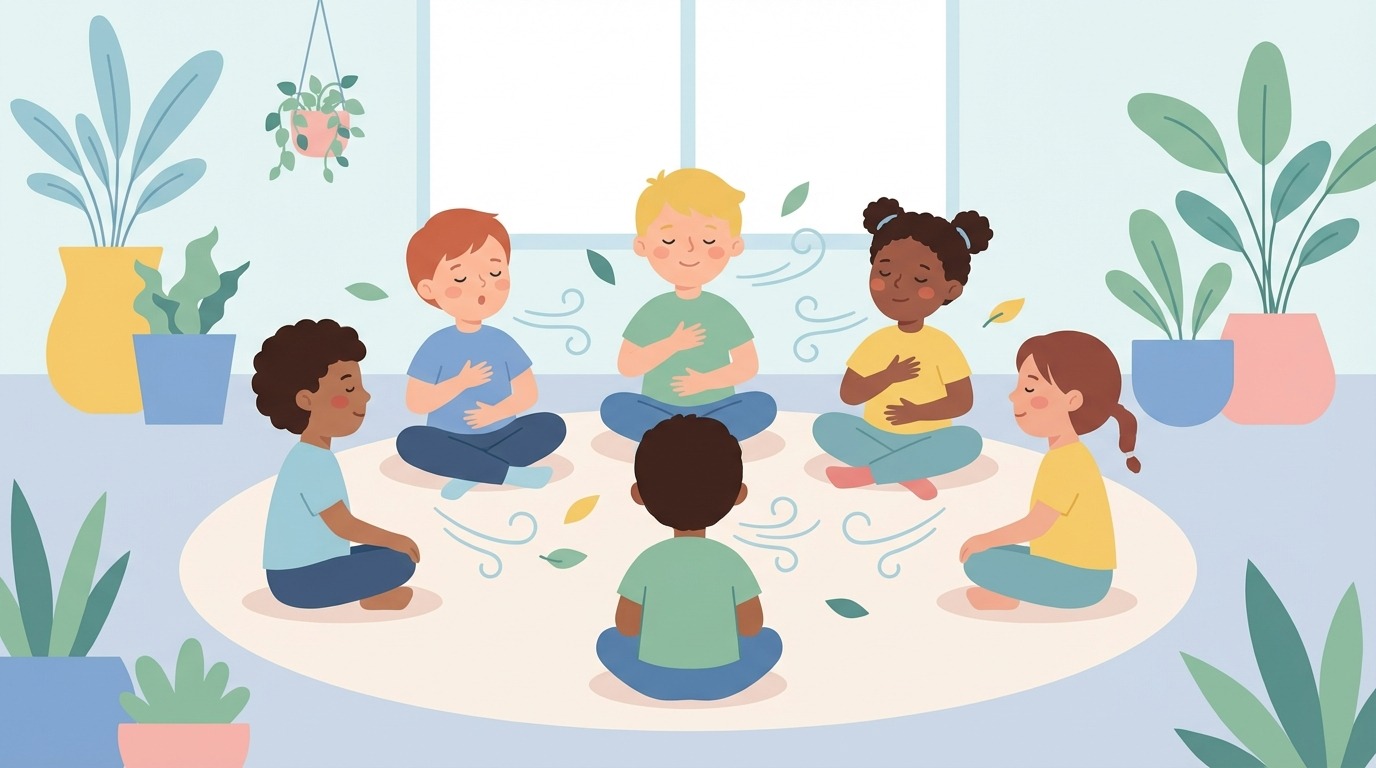
“Hands on the belly” provides an accessible entry. Sitting, feet grounded, inhale through the nose gently inflating the abdomen, exhale as if blowing on a feather. A one-minute hourglass is enough to make duration tangible. Gradually, cycles lengthen.
To vary, breathing games help. The “soup bowl” invites inhaling the imaginary smell, then blowing to cool. The “snake” offers a hissing exhale, which prolongs the breath and calms agitation. These metaphors turn the exercise into sensory exploration.
Families can rely on clear and structured content. An overview of relaxation techniques for children details practical steps, with age and duration hints. This base secures beginnings and prevents awkwardness.
Kids Meditation requires neither absolute stillness nor total silence. A 90-second body scan, guided by a gentle voice, suffices. Starting from the toes, going up to the top of the head, naming “warm,” “tingling,” “release.” Indeed, describing without judging soothes the nervous system.
Short videos, with a warm tone, support regularity. The child knows what to do, when, and how to adjust. Thus, progress stays smooth even on more restless days. Once the respiratory base is laid, movements flow seamlessly.
To integrate these rituals in class, a visual signal works well. A “breath” card placed on the teacher’s desk suffices. At home, a visual timer supports the evening routine. The frame simplifies, resistance drops.
Studies show that slow breathing improves heart rate variability and supports emotional flexibility. However, there is no need to talk about biomarkers with children. Just say “your heart likes it when you breathe like a turtle.” The image does the work without jargon.
Finally, these micro-practices act as an emotional seatbelt. The next part presents adapted movement sequences, with clear progression.
Adapted yoga poses and age progression for harmonious physical development
An effective Kids Yoga session starts with warm-up. Shoulders roll, neck lengthens, ankles draw circles. Then, a gentle sequence consolidates confidence. The body understands the language of repetition, especially when joyful.
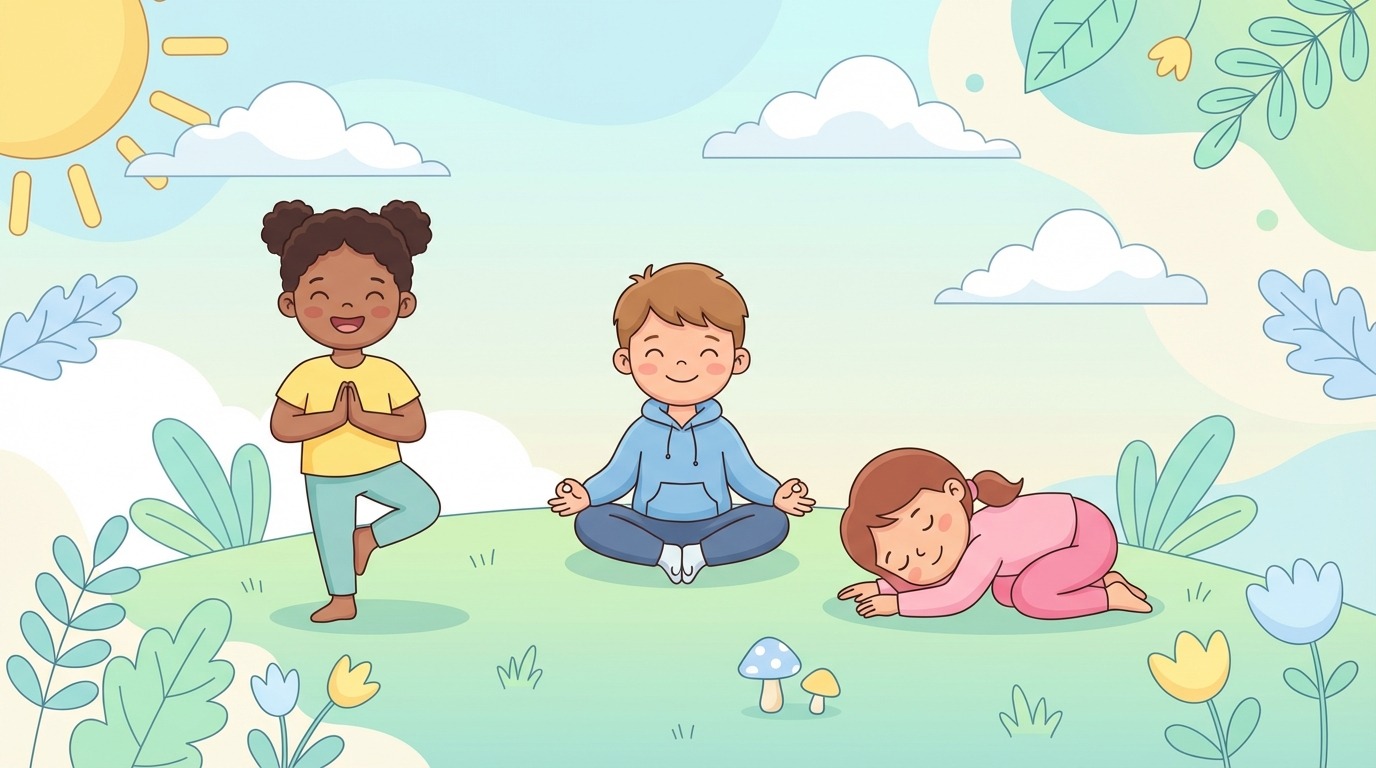
A basic scheme works from age 5. “Mountain” to feel the axis, “tree” for balance, “cat-cow” to mobilize the spine, “downward dog” for momentum, then “happy baby” to release. Children love naming animals. This narration anchors attention in action.
For physical development, the order of poses matters. Mobilize, stabilize, stretch, release. For example, before “tree”, wake the toes. Before “downward dog”, warm the wrists. This logic avoids tension and prevents boredom.
Beginners benefit from practicing near a wall. A light hand on the surface reassures, then it is withdrawn over sessions. Success builds step by step without force. The goal is not performance but sensation.
The video helps calibrate duration and pace. As a family, you can complement with simple and fun materials. A guide of active and gentle family activities offers ideas to vary sessions and maintain motivation over several weeks.
| Age 👶👧 | Ideal Duration ⏳ | Key Goal 🎯 |
|---|---|---|
| 4–5 years | 6–8 min | Calm activity, breathing landmarks |
| 6–7 years | 8–12 min | Balance, coordination, concentration |
| 8–9 years | 10–15 min | Gentle endurance, smooth sequences |
| 10–11 years | 12–18 min | Controlled strength, comfortable seated posture |
Some technical benchmarks facilitate safety. Knees stay aligned with toes, neck stretches without crushing the throat, wrists align under shoulders. Also, a stable mat changes everything: it prevents slipping and reassures beginners.
For livelier children, alternating dynamism and relative stillness is wise. Two poses that warm up, one pose that calms. This alternation spares the nervous system. It also maintains the desire to follow the video to the end.
At the end of the sequence, inviting to “listen to the rain” on the belly soothes the end of the day. Hands resting on the abdomen, follow three breaths. The key message is engraved: “your body knows how to rest.” The next section transposes this know-how into daily life.
Children’s relaxation rituals at school and home for lasting well-being
Schools adopting a Children’s Relaxation ritual see smoother transitions. After recess, a two-minute timer with “soup bowl” then “shoulder scan” suffices. Thus, the group refocuses, and reading resumes without tension.
In the late afternoon, home benefits from offering a calm activity. A mat on the floor, soft light, and a short video structure the atmosphere. Children then know that fast time turns into slow time. This emotional signal prevents many conflicts.
To support falling asleep, markers are precious. A set of concrete sleep tips perfectly complements yoga rituals. It includes ideas on light, noise, and consistent timing. These levers enhance the soothing effect of slow breathing.
The “Breathe and Grow” workshop established the “3-3-1” routine before assessments. Three minutes of breath, three minutes of familiar poses, one minute of silent listening. Students report feeling a “clear head” and “strong legs.” Dictation results improved, but above all, confidence took root.
At home, ritualizing does not mean rigidifying. You can create a “slowness box” with animal cards, hourglasses, and touch stones. Each child draws a card, and the video proposes the corresponding pose. This playful mechanic stimulates autonomy.
The evening video can last ten minutes, no more. The essential is consistency. The same opening theme, the same greeting, reassure and mark the break from the day’s bustle. The body loves these predictable landmarks.
Finally, thinking about the environment supports practice. A stable corner, a blanket, a stuffed animal, and warm light set the scene. Shiny screens are then put away. The message is simple: “we breathe, we move, we settle.” Body and mind harmonize, and peace returns.
These rituals open the way to a structured video program. The next chapter provides a clear schedule to start and stay on track.
Setting up a Kids Yoga video program: progressive planning, motivation, and playful tools
A successful program relies on realistic progression. The golden rule boils down to three verbs: repeat, vary, celebrate. Repeat the structure, vary one or two poses, celebrate each micro-achievement. This triptych stabilizes motivation without pressure.
Here is a four-week plan. Week 1, two sessions of 8 minutes: breathing, mountain, cat-cow, child. Week 2, three sessions of 10 minutes: add the tree. Week 3, three sessions of 12 minutes: introduce the half-bridge. Week 4, two sessions of 12–15 minutes: smooth out the transitions. This gentle rise builds confidence.
Adherence climbs when practice links to creative projects. A file of creative activities at home provides ideas to make pose cards, decorate an hourglass, or paint a “breath tree.” Children become authors of their ritual.
For siblings, an autonomy chart avoids incessant reminders. Check off “breath,” “poses,” “pause.” This responsibility respects each child’s rhythm. An article on autonomy markers by age helps gauge support without over-framing.
Motivation is fueled by stories. Each session can follow a mini-quest: find the forest key, escort a star, heal a cold dragon. This narration diverts attention from effort and turns the video into a shared adventure.
- 🌟 Set a fixed slot 3 times/week
- 🎵 Choose a recurrent opening music
- 🃏 Prepare 5 favorite pose cards
- 📺 Launch a Beginner Yoga video of 10–12 min
- 📝 Note a key sensation felt
Finally, alternating indoors and outdoors maintains curiosity. One weekend, take the mat to the park. A resource dedicated to family activity ideas inspires outdoor variations. Breath changes with the wind, posture adjusts on the grass, and joy circulates.
The core message remains clear: repeat without tiring, vary without scattering, celebrate without comparing. Thus, regularity sets in and effects amplify.
“A child who breathes learns to choose their calm, and a group that moves together invents its peace.”
At what age to start Kids Yoga with videos?
From 4–5 years old, routines of 6–8 minutes work well. Before this age, very short breathing games and free movements inspired by animals are favored. The important thing is enjoyment and safety, not performance.
How many times per week to observe effects on concentration?
Three short sessions per week are enough to see progress in 2 to 4 weeks. Aim for regularity, even with videos of 8–12 minutes, rather than rare long sessions.
Which yoga poses to avoid at the start?
Avoid prolonged inversions and positions that compress the neck or strain the wrists. Favor mountain, tree, cat-cow, child, half-bridge, and gentle stretches.
How to integrate kids meditation without boredom?
Offer body scans of 60–90 seconds with a sensory story. Use a visual timer and vary the instruction: count 3 breaths, listen to a sound, feel the hand on the belly.
What to do if the child refuses the video of the day?
Offer a limited choice: 3 minutes of breathing or 3 preferred poses. The decision makes the child an actor. The essential is to keep a coherent mini-ritual.