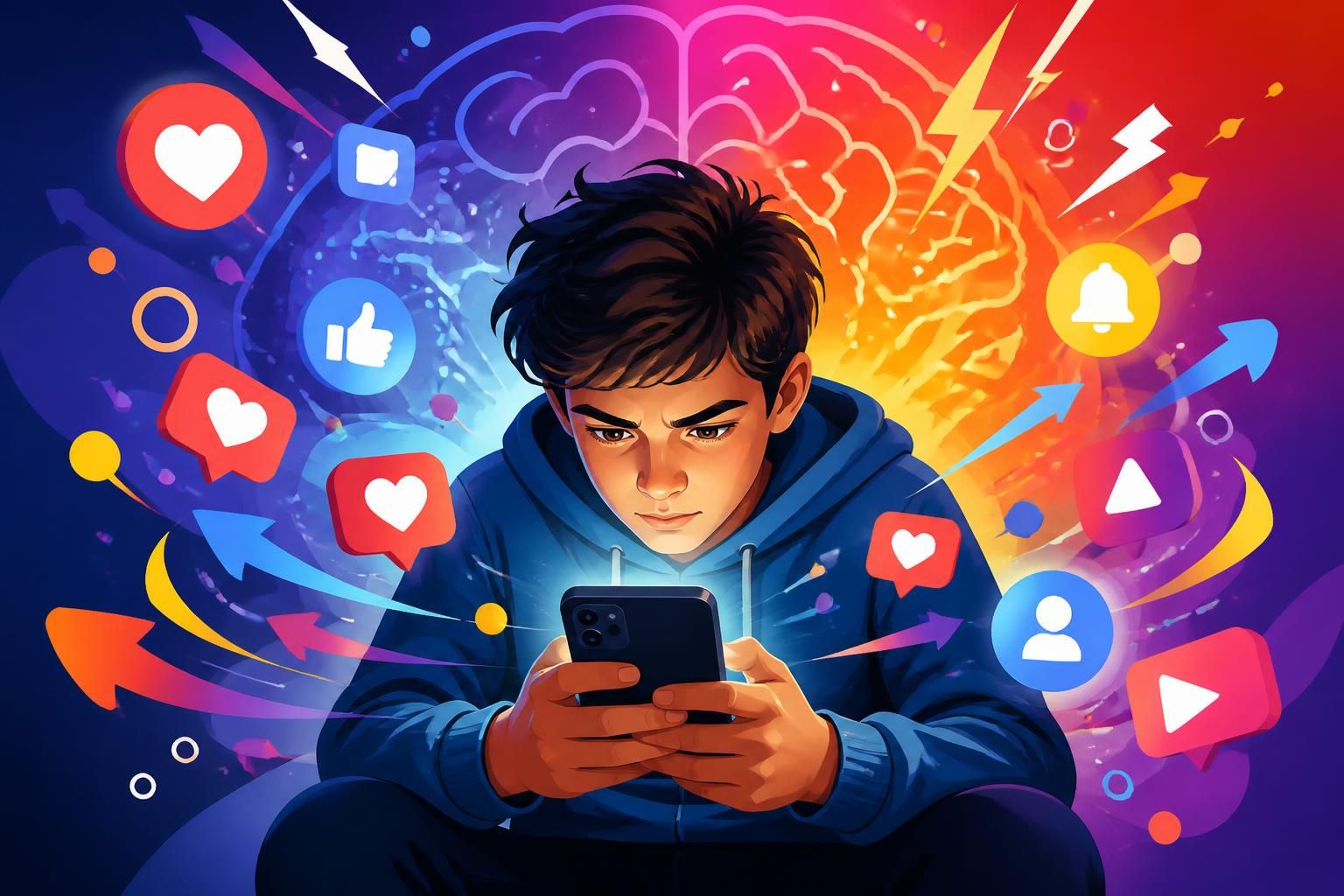
When social networks captivate teenagers too much: what a study reveals about the link with ADHD
In Brief
- According to a study from the University of California, San Francisco published on October 18, 2024, in JAMA Network Open, an increase in problematic social media use among teens is associated with a subsequent rise in ADHD-related symptoms.
- More than 11,000 adolescents were followed for five years, starting at about 12 years old, with annual follow-ups and an evaluation of inattention and hyperactivity behaviors reported by parents.
- Signs to watch go beyond screen time: rumination (thinking about it often), repeated failures to cut down, emotional refuge, irritability when access is cut off, disrupted sleep and school.
- The observed association does not prove causality: the study is observational and focuses on symptoms, not new medical diagnoses.
- The most useful parental lever is often a mixed strategy: clear rules, sleep hygiene, technical settings, and discussion about behavior rather than “total time.”
On October 18, 2024, a study from the University of California, San Francisco, published in the scientific journal JAMA Network Open, placed a hot topic in the middle of the family table: when social media use feels less and less like a leisure activity and more like a crutch, attention difficulties may follow. The work does not blame a “bad screen” that would instantly turn a teen into a live wire. Rather, it describes a sequence: certain usage habits, those resembling addiction (thinking about the next connection, failing to cut down, using it as a refuge to manage stress), increase and are associated with a rise in ADHD-like symptoms the following year.
In real life, this rarely translates to a teen hypnotized all the time, like a wax figure with an automatic thumb. The picture is more subtle: a behavior that eats away at sleep, the ability to get bored, and perseverance on long tasks. Add to that notifications falling like popcorn and short content calibrated to renew attention every few seconds, and the cocktail becomes very concrete. The mental health issue is therefore not only “how many hours,” but “how and why” the platforms are used daily.
Social Media and ADHD: What the Study Precisely Says (and What It Does Not)
The study relies on a large-scale longitudinal follow-up: more than 11,000 American adolescents observed for five years. The participants were about 12 years old at the start, then surveyed each year until an average age of about 16. The mechanism is interesting because it limits the “snapshot at a given moment” effect: one can look at year-to-year evolutions and see what precedes what in the sequence.
Regarding measures, adolescents described their relationship to social media with items focused on problematic use. It was not just about counting minutes. Parents, meanwhile, reported typical behaviors: difficulty finishing a task, lack of concentration, restlessness, impulsivity. This teen/parent dissociation is imperfect (not everyone observes the same things), but it avoids confusing “what the teen feels” with “what the environment notices.”
The key result: when problematic use increased from one year to the next, ADHD-associated symptoms tended to increase the following year. The association appeared more pronounced among boys around ages 14 and 15, a period where attention is already under pressure between school load, puberty, and social life fueled by voice messaging. Conversely, the study did not consistently find a reverse pattern where ADHD symptoms would systematically “predict” worsening social media use.
This point is crucial, as it avoids the quick conclusion “a distracted teen = future addict.” Research rather suggests a dynamic where the escalation of certain digital habits often precedes a worsening of attention difficulties. This does not mean social media “create” a disorder on their own. Jason Nagata, the lead author, reminds in the article that this is not a randomized controlled trial, so it is not proof of causality. In other words, the study observes associations in real life, with variables it cannot fully control (family stress, sleep, other screens, anxiety disorders, etc.).
Finally, a detail that avoids misunderstandings at dinner: the work focuses on symptoms reported by parents, not on the emergence of new medical ADHD diagnoses. Some adolescents already showed signs at baseline. For a family, this distinction matters because it guides the reaction: no need to brandish the “ADHD” label at the first notification too many, but it is useful to monitor the evolution of behavior over time.
Social Media Addiction in Teens: Spotting the Signals Without Getting the Target Wrong
The figures reported in the study provide simple benchmarks. At 12 years old, 23% of adolescents reported often thinking about social media or planning their next use. About 18% said they used it as a refuge to forget their problems, and 15% had already tried to cut down without success. This trio “rumination – refuge – control failure” more finely describes a possible addiction than a simple total of hours does, because it reveals the emotional relationship to the tool.
In many households, the typical scene is not the teen who refuses all human interaction. It is rather the teen who “does two things at once” all the time: homework open, app open, brain tabbed. The problem is that some school tasks require sustained attention for 20 to 40 minutes, whereas the video feed is designed to reward attention every 5 to 15 seconds. The body is in the chair, the mind goes back and forth, and energy evaporates.
Concrete Signs of Problematic Use in Daily Life
The most useful indicators are observable without a neuroscience degree, and they mostly relate to behavior. A practical rule is to look at the effect on three areas: mood, sleep, obligations (school, tasks, activities). When social media become the main “emotional pause button,” internal regulation weakens, and domestic conflicts often increase.
- Impossible to stop despite a clear intention to cut or limit.
- Anxiety, irritability or agitation when access is prevented (outage, confiscation, no Wi‑Fi).
- Disrupted sleep: delayed bedtime, night wakings, morning fatigue that damages attention.
- Disorganized schoolwork: homework started, interrupted, then rushed to finish.
- Dropping usual activities: sports, music, outings, family discussions.
- Limiting attempts that often degenerate into conflict, with endless negotiation.
The list is deliberately “down to earth.” It avoids turning every scroll into a diagnosis. A teen may spend a lot of time online to chat with friends, create, or follow a passion, without it looking like an addiction. The warning sign is when use mainly serves to escape discomfort and disrupts attention and mood.
Why Screen Time Alone Is Not Enough (and How to Make It Useful)
Duration remains an indicator, but it becomes relevant when contextualized: at what time, after what event, with what effect on attention the next day. A common example: the teen “does not spend that many hours,” but concentrates use after 10 p.m. As a result, sleep debt builds up and the following day feels like a browser with 37 tabs open, including one playing music with no idea which one.
To clarify this point without getting lost, a simple observation table helps get out of the blur. It is not for spying but for objectifying, especially when discussions go in circles.
| Observable Indicator | Concrete Home Example | Possible Effect on Attention | Adjustment Lead |
|---|---|---|---|
| Time of last connection | Scrolling in bed after lights out | Fatigue, slowness, distractibility | Phone outside bedroom, night mode |
| Attempts to reduce | “I quit” then resumed in 10 minutes | Loss of control, impulsivity | Timers, app limits, planned breaks |
| Reactions to cutoff | Irritability during restriction | Agitation, difficulty settling | Stable rules, immediate alternative (short activity) |
| Use as refuge | Connection after an argument or a grade | Avoidance, rumination, decreased concentration | Talk about emotion, offer a screen-free zone |
This type of tool has an advantage: it puts the teen back into a concrete framework without humiliating them. And it gives parents precise elements to discuss impact, mental health, and attention, rather than fighting over “you are always on it” versus “not true at all.”
Why Platforms Capture Attention: Mechanisms, Hyperactivity, and Cognitive Fatigue
Social media are built around short content, renewed continuously, and a form of immediate reward: a message, a like, the next video, a trendy sound. This system pushes to shift quickly from one stimulus to another. On an adolescent brain, already adjusting (sleep, emotions, impulsivity), this rapid alternation can make it harder to maintain sustained attention on less “rewarding” tasks such as long reading or exercises.
The sensitive point is not novelty itself: teens have always liked what moves, what makes them laugh, what surprises. The difference is the industrialization of attention grabbing. The feed never “ends,” preventing the brain from concluding a sequence. Many teens describe feeling tired without feeling like they did anything really “hard.” This fits with a day fragmented into micro-attention episodes, where concentration is constantly reset.
Fragmented Attention: When the Brain Switches to Zapping Mode
A symptom often reported in families is the inability to stay on a single task. Homework becomes a succession of mini-starts and mini-returns. Working memory is continuously solicited: “Where was I already?”, “What was I going to say?”. This constant friction can give the impression of hyperactivity even in a teen who does not climb the walls.
One must distinguish internal agitation from physical agitation. The former is seen when the teen moves little but seems mentally rushed, irritable, or unable to wait. The latter is more visible: getting up often, manipulating objects, interrupting speech. Social media are not the only possible factors, but they can amplify these states by maintaining a high level of stimulation, including late at night.
Sleep: The Lever That Changes the Most Things (and Fastest)
Sleep is a key piece because it directly influences attention and emotional regulation. When use shifts to the evening, it affects two things: sleep time decreases, and falling asleep can be delayed by stimulation. The next day, the teen has more difficulty concentrating, which increases the temptation to seek a “quick shot” of fast distraction. The cycle becomes self-perpetuating.
A simple adjustment is to sanctuarize a period without social media before bedtime. The duration depends on families, but the goal is always the same: get the brain to accept slowing down. In practice, built-in tools (screen time, focus modes, night restrictions) help, provided they are accompanied by a clear and stable family rule.
A well-chosen educational video often helps put words on what is happening: cognitive fatigue, fragmented attention, the role of notifications. The audiovisual format speaks to teens, especially if the tone is not moralizing and explains mechanisms rather than distributing blame.
What Parents Can Do: Framework, Tools, and Conversation (Without Permanent Conflict)
Managing social media in adolescence rarely looks like a straight line. There are “okay” weeks and “disaster” weeks, especially when school, friendships, and self-esteem mix. The study highlights one useful point: monitor behavior, not just duration. This changes the approach. Instead of playing the stopwatch, the family focuses on mental health indicators: sleep, irritability, conflicts, isolation, difficulty finishing tasks.
A framework works better when it is predictable. Rules that change every two days feel arbitrary, and a teen exploits this with the energy of a trainee lawyer. A stable rule is less discussed, even if they complain. Negotiation can concern adjustments, not the existence of the framework.
Technical Settings: Useful but Not Magic
Native smartphone tools allow setting app limits, cutting notifications, scheduling “do not disturb” periods, and creating focus modes. These settings effectively reduce automatic solicitations, thus supporting attention. However, they become counterproductive if experienced as permanent punishment, especially if the teen has no leeway.
A pragmatic approach: start with notifications. Many teens do not use half the alerts but endure them. Reducing “pings” decreases interruptions and can improve the ability to stay on task. In school terms, another concrete adjustment is creating a fixed work period without social media, with a short, announced break. This avoids permanent nibbling.
Conversation: Talk About Use, Not Identity
Discussion works better when it avoids labels (“addict,” “incapable”) and stays on observable facts. A parent can say: “For two weeks, bedtimes have shifted and mornings are hard” rather than “You have no willpower.” The latter triggers an immediate cold war, with a slamming door as a bonus.
When the teen uses social media as a refuge, the issue is not only the screen. There is often an emotion behind it: school stress, friendship conflict, social anxiety. Spotting this trigger makes it possible to offer something other than a firm ban: a brief activity, a walk, a shower, a snack, a chat, or quiet time. These are simple alternatives, but they replace a function the screen already filled.
In situations where inattention and hyperactivity symptoms become marked and persistent, a medical consultation remains the most relevant route. It allows distinguishing exhaustion related to sleep, anxiety, depression, or ADHD, and avoiding self-diagnostics based on short videos.
Video content oriented towards “methods” can help set up realistic routines: evening rules, focus modes, homework organization, and conflict management. The right signal is when the teen understands the goal is not to deprive them, but to help protect their attention.
What Do We Say About It?
The most useful reading of this study is to shift the spotlight: the issue is not only time spent on social media, but signs of addiction and the behavior that follows. A family should first act on sleep and notifications, as these are the two quickest levers to measure attention. When irritability, repeated failure to cut down, and school disorganization settle in, waiting “for it to pass” generally costs more in mental health than a calm and structured reset. If ADHD-like symptoms persist despite concrete adjustments, a medical opinion clarifies the situation and prevents daily struggles.
Which social networks cause the most attention problems in teens?
The risk does not depend solely on the platform, but on the features used: short auto-playing videos, numerous notifications, endless recommendations. The same social network can be neutral for a teen who rarely posts and very disruptive for another who scrolls long at night. The most reliable benchmark remains the impact on sleep, school, and mood.
How to differentiate intense use from a true social media addiction?
Intense use can remain compatible with good mental health if the teen sleeps enough, keeps up activities, and can stop without crisis. Addiction looks more like loss of control: intrusive thoughts, failed reduction attempts, irritability at cutoff, and use as an emotional refuge. Frequent conflicts over limits are also a serious warning sign.
Is a teen with ADHD automatically more addicted to social media?
No, and the cited study does not consistently observe that ADHD symptoms precede a worsening of problematic use. In practice, some teens with ADHD may be drawn to quick rewards, but others grow tired of it or self-protect. The important thing is to assess overall functioning: sleep, organization, impulsivity, classroom attention, and well-being.
Which family rules work best without triggering permanent war?
The most effective rules are stable, simple, and measurable: phone outside the bedroom at night, reduced notifications, homework time without social media, planned breaks. They work better when explained in terms of attention and recovery, not as punishment. A gradual adjustment (one lever at a time) often yields better results than a brutal reset.