4 Work Stages: The 4 stages of labor work.
| Short on time? Here’s the essentials ✨ |
|---|
| 4 stages of labor 🧭: 1) Dilation (latent then active phase), 2) Pushing and crowning, 3) Expulsion of the placenta, 4) Two golden hours of monitoring and skin-to-skin. |
| Benchmarks ⏱️: Latent phase often 5–8 h (longer with a first-time mother), active phase faster, pushing 20 min–2 h, delivery 10–60 min. |
| Key signs 📌: Regular contractions intensifying, dilation up to 10 cm, urge to push, burning sensation at the crowning. |
| Pain and options 💡: Breathing, positions, warm water, support, epidural (possible from start of active phase up to ~8–9 cm depending on context). |
| Safety 🧑⚕️: Fetal heart rate monitoring, hemorrhage prevention, delayed cord clamping (often recommended), immediate skin-to-skin. |
| Quick tip ✅: Stay hydrated, move, urinate often, breathe with the rhythm of the contractions, listen to instructions at the moment of birth. |
Labor of childbirth follows a precise choreography, but each body dances to its own tempo. The stages follow one another with their own logic, sensations, and decisions. Understanding dilation, the role of contractions, the increasing intensity of the active phase, then the crowning and expulsion of the placenta, helps to turn uncertainty into concrete landmarks. This knowledge reduces apprehension and gives the couple tools for action.
In this guide, a fictional expectant mother, Lina, serves as a thread. Her experience illustrates common situations in the birth room. Throughout the sections, helpful gestures, relief options, safety points, and clinical examples interact. The goal is clear: to provide a reliable foundation to experience each step with serenity, whether one chooses an epidural or physiological support. Let’s get concrete, and acknowledge the quiet power of a body that knows what to do.
Stage 1 — Cervical dilation: from latent to active phase
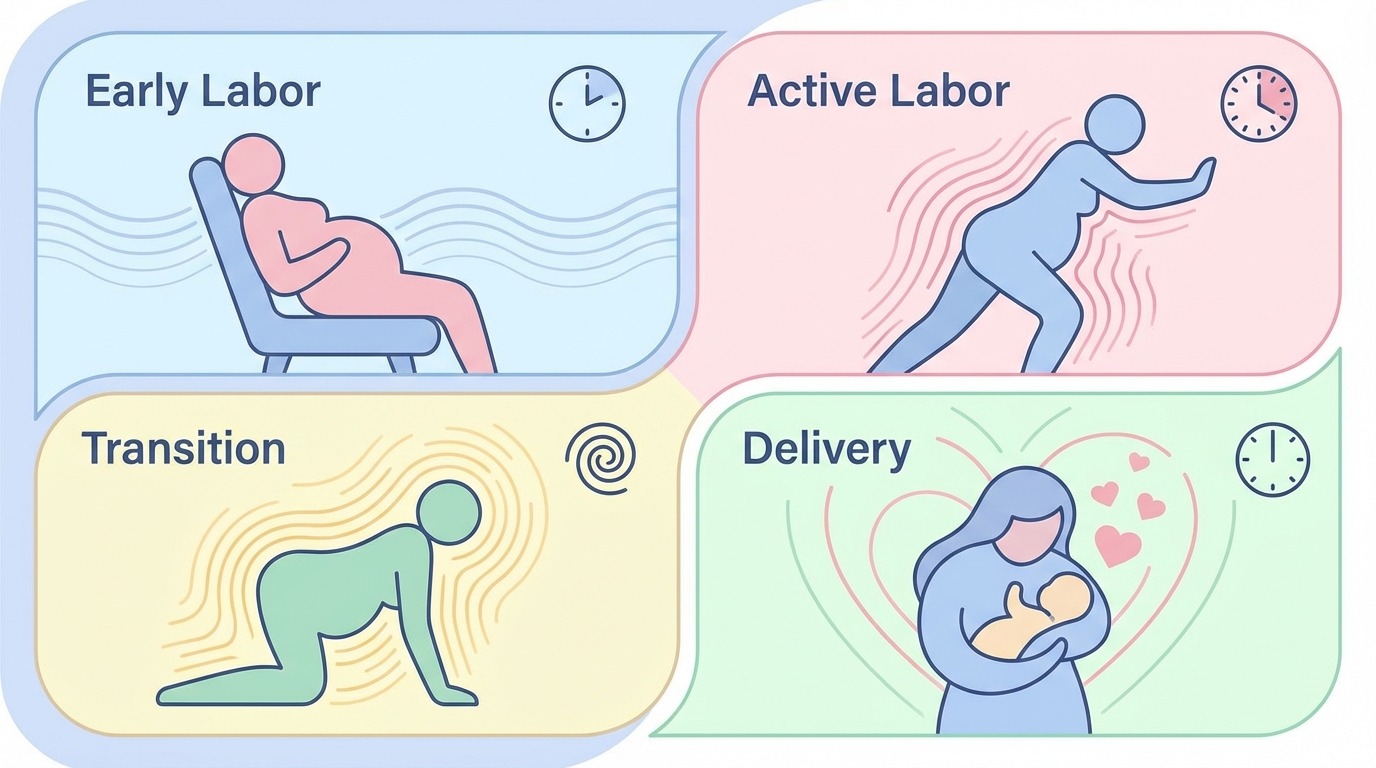
The first stage sets the scene. The cervix softens, thins, and opens up to 10 cm, under increasingly coordinated contractions. With Lina, the latent phase starts with irregular waves spaced 10 to 20 minutes apart. They last 30 to 45 seconds and feel like menstrual cramps. The temptation to panic exists, but the best reflex is to rest, hydrate, eat lightly, and urinate often. An empty bladder gives the baby the necessary space to engage well.
On average, the latent phase lasts about eight hours with a first child, and less with subsequent pregnancies. Some experience this phase longer without it indicating a problem. Warning signs remain simple: fever, heavy bleeding, reduced fetal movements, or greenish amniotic fluid. Lina notices pink discharge and lower back pain; this is consistent with the baby progressively engaging. She walks, takes a warm shower, and tries positions: ball, hands-and-knees, pelvic tilts.
The active phase begins when dilation exceeds 4–5 cm with regular, more intense contractions every 3–5 minutes, lasting 45–60 seconds. Progress becomes visible: about 1 cm per hour is a classic benchmark, but individual variability dominates. Appropriate monitoring starts: fetal heart rate auscultation, vital signs check, pain assessment. Membranes may rupture spontaneously. If not and progress stalls, artificial rupture may be discussed with the team.
Pain management is based on a multimodal strategy. Stair-step breathing, visual focus, deep vocalizations, sacral massage, and heat stimulate sensory pathways. The epidural is often offered at the start of active phase. It reduces perceived intensity, while sometimes allowing movement with an adapted dose. Benefits and constraints are weighed: comfort and reduced stress on one side; increased monitoring and potential mobility limits on the other. Lina accepts a late placement to preserve freedom of movement while keeping the option open.
To know when to go to the maternity ward, a practical rule helps: 3–4 effective contractions in 10 minutes for at least one hour, or water breaking, or unusual signs. Upon arrival, an exam confirms 6 cm for Lina: active phase is progressing. She alternates supported lunges, side-lying positions, and hanging from the sheet to facilitate head-cervix-pelvis alignment. Each choice aims for the same goal: optimize the mechanics of passage.
Key end-of-stage marker: emotional intensity rises, words become scarce, and the need for grounding becomes urgent. This is often the threshold leading to the transition. The phrase to remember: when the body cooperates, technique fades and the cervix opens.
Stage 2 — Pushing, crowning, and birth: the axis of expulsion
The transition shifts to pushing. Contractions reach an intensity plateau. Trembling, nausea, and a sensation of warmth are common. For Lina, the urge to push arises when dilation reaches 10 cm and the head descends to the level of the sciatic spines. The team suggests waiting for a reflexive push, more effective, especially if the epidural dulls sensation. Each effort must accompany the wave, never fight it.
Mechanics are key. Aligning the baby’s back with the pelvic curve directs effort downward and forward. Positions play a decisive role: side-lying with supported leg, squatting, hands-and-knees, or semi-seated with supports. A handful of sheet or suspension bar provides useful traction points. Breathing patterns modulate: deep inhalation, brief hold at the peak, then release. When fatigue sets in, the tactic changes. Pushing shorter but more often can revive effectiveness.
The moment of crowning arrives. The vulva stretches, a characteristic burning appears. This “ring of fire” signals the head passing through the vulvar ring. The essential instruction follows: blow, control, and let tissues open gradually. Controlled resistance limits tearing. Manual perineal support, warm compresses, and clear communication optimize protection. Lina slows down under guidance. The head rotates, then the shoulders slip out one after the other.
Emotions surge, but clinical precision remains. The team suctions as needed, assesses tone, then places the baby skin-to-skin if all is well. The cord is ideally clamped after a few minutes to improve hemodynamic transition. This practice is established in modern maternity wards. It encourages smooth passage between life in utero and the air world.
And if progress stalls? We analyze: head orientation, support symmetry, available pelvic space. Changing position or manual rotation may unlock the situation. A stuck shoulder calls for codified maneuvers. Brute force doesn’t help; intelligent gestures do. The tool remains the fine understanding of maternal-fetal biomechanics.
Birth concludes this stage. Lina welcomes her baby, warmth against warmth. Active silence replaces agitation. Every second counts for bonding and thermal regulation. The strategic key: prioritize an effective push, respectful of rhythm, then slow the exit at crowning to protect the perineum. Breath control turns the ordeal into victory.
Stage 3 — Placenta delivery: safety, prevention, and useful gestures
Delivery often unfolds gently. This third stage starts after birth and ends with the expulsion of the placenta and membranes. Typical duration ranges from 10 to 60 minutes. A strong contraction, brief bleeding, and cord elevation signal detachment. Controlled cord traction, assisted by fundal support, is done when signs are present. This protocol reduces hemorrhage risk.
Several strategies enhance safety. The uterus must contract vigorously. Preventive oxytocics are often administered. External uterine massage, if well tolerated, can help. Clinical monitoring reads the flow: color, amount, and progress. The room remains calm to preserve skin-to-skin and the initial feeding, which stimulate natural oxytocin. Nature and science cooperate at this precise moment.
And if delivery is delayed? Avoid hasty tractions. Check the bladder. Favor positions that bend the trunk forward. A bathroom trip can sometimes unlock the situation. If the placenta doesn’t come after a reasonable delay or bleeding increases, the team intervenes. Evaluation includes checking placental completeness once expelled. A retained fragment may cause prolonged bleeding; careful examination prevents it from going unnoticed.
Mother’s comfort matters too. A sweet drink, warm blanket, and reassuring words maintain energy. Pain, less than during pushing, may surprise with cramps. Slow, guided breathing, acupressure points, or an appropriate analgesic bring quick relief. The couple enjoys this in-between moment to gaze at the baby’s face and name features.
Good practices have evolved rigorously. Delayed cord clamping, active hemorrhage prevention, systematic verification of placental completeness, and strict asepsis are now massive standards. The unique goal: secure the mother without spoiling the founding moment. One phrase sums up the stakes: a successful delivery seals the stability of what follows.
At the end of this stage, the uterus becomes firm under the hand, bleeding decreases, serenity returns. Expulsion of the placenta is not a minor detail. It is the biological signature of the end of the intrauterine journey. And it prepares the entry into the two golden hours.
Stage 4 — The two golden hours: skin-to-skin, perineum, breastfeeding, and targeted monitoring
The fourth stage takes place just after delivery. About two hours that weigh heavily on recovery and bonding. Immediate skin-to-skin stabilizes the newborn’s temperature, sugar, and breathing. It stimulates oxytocin, the hormone of love and uterine contraction. Lina keeps her baby close. Gazes anchor. Calm envelops the room.
Maternal monitoring is paced and discreet. Blood pressure, pulse, bleeding, uterine tone, and pain are tracked without breaking intimacy. The perineum is inspected. A superficial tear may be sutured under local anesthesia. Pain prevention continues; wrapped ice, protective positions, and appropriate analgesics bring comfort. Each gesture is justified; no maneuver is gratuitous.
The first breastfeeding invitation comes naturally. The rooting reflex guides the baby. Let gravity assist, avoid pressures on the neck, and provide prolonged contact to increase chances of good latch. If breastfeeding is not desired, support maintains the same standard. Hydration, skin-to-skin, and respect for the rhythm prevail in all cases.
Parents learn first care steps. Cord clamping and cutting are discussed if not done earlier. A first pediatric exam checks breathing, color, and tone. If the baby has special needs, priority remains to intervene quickly while preserving the triad’s unity. Balance between technique and gentleness is embodied here.
Emotionally, the adrenaline peak falls. Real hunger appears. A salty snack, a warm drink, and sparkling water work wonders. The team encourages early urination. A full bladder hinders good uterine contraction. An accompanied bathroom break can prevent postural faintness. Nothing is left to chance; everything is thought to consolidate the momentum of this birth.
The red thread closes: safety, bonding, and recovery advance together. A stage conclusion imposes itself. The two golden hours are not a luxury; they are a physiological necessity that seals the serene start of life as three.
Preparing and choosing: pain, epidural, positions, and journey organization
Anticipating changes the game. A flexible labor plan, discussed beforehand, guides decisions without rigidifying them. Lina and her partner check their priorities: mobility as long as possible, freedom of positions, trying warm bath, and epidural available if the active phase intensifies too much. The couple also identifies departure signals for the maternity ward and the person to notify.
Pain deserves a plural strategy. Some rely on breathing and visualization. Others prefer medicated analgesia. The epidural can be installed early in active phase, with adjustable dosing. Benefits: pain reduction, rest gain, quality presence. Limits: need for monitoring, possible slowing of descent, reduced proprioception. Intelligent postural coaching often compensates for these limits.
Movement remains central. Changing position every 30 to 45 minutes optimizes the head-pelvis angle. Asymmetric supports open different diameters. Gravity is an ally. A ball, a birthing stool, suspension straps, and positioning cushions offer a simple and effective arsenal. When fatigue appears, the side-lying position with supported leg protects the perineum at the end of stage 2.
A mental kit helps the way. A short phrase per stage strengthens confidence. For example: “One contraction, one progress”; “I open and I release”; “I breathe through the crowning”. These mantras channel attention. The partner plays an active role: water, tissues, sacral pressure, breathing reminders, and advocacy with the team. Loving presence has a physiological impact via oxytocin and lowers cortisol.
Logistics are carefully prepared. Maternity bag ready, documents, crib linens, birth clothes, and plan for the older child if needed. At home, a postpartum corner is planned in advance: snacks, ice, cushions, sanitary pads, and breastfeeding support number. Practical details lighten mental load on D-day. A prenatal appointment with the maternity ward helps adjust expectations and ask final questions.
To keep essentials in mind, nothing beats an operational memo. It gives calm agency amidst turmoil.
- 🕒 When to go? Contractions every 3–5 min for 1 h, water breaking, or unusual sign.
- 🧘 Manage pain: breathing, heat, water, positions; epidural if desired.
- 🤝 Partner’s role: water, sacral pressure, verbal grounding, advocacy.
- 🧴 Useful details: urinate often, hydrate, salty snack, hydrated lips.
- 🍼 After birth: extended skin-to-skin, welcome feeding, gentle monitoring.
A guiding idea concludes this section: knowing your options does not impose a scenario; it creates escape routes at every crossroads.
Numerical references and sensations: a table to visualize
This table visualizes the continuum to turn words into bodily landmarks. It does not replace medical assessment; it will illuminate your sensations in real time.
| Key labor benchmarks ❤️🔥 |
|---|
| Latent: dilation 0–3/4 cm, contractions 10–20 min, moderate pain 🙂 |
| Active phase: 4–7 cm, contractions 3–5 min, strong intensity 💪 |
| Transition: 8–10 cm, powerful sensations, need for grounding 🧩 |
| Stage 2: pushing, crowning, breathing guidance 🎯 |
| Stage 3: expulsion of placenta, hemorrhage prevention 🩸 |
| Stage 4: skin-to-skin, breastfeeding, gentle monitoring 🤱 |
“Each contraction writes a line, each breath holds the pen.”
{“@context”:”https://schema.org”,”@type”:”FAQPage”,”mainEntity”:[{“@type”:”Question”,”name”:”Comment distinguer vraies et fausses contractions ?”,”acceptedAnswer”:{“@type”:”Answer”,”text”:”Les vraies contractions deviennent ru00e9guliu00e8res, plus longues et plus rapprochu00e9es. Elles ne cu00e8dent pas au repos ni u00e0 lu2019hydratation. Les fausses (Braxton-Hicks) restent irru00e9guliu00e8res et diminuent quand on change de position. Si un doute persiste, contactez la maternitu00e9.”}},{“@type”:”Question”,”name”:”u00c0 quel moment demander une pu00e9ridurale ?”,”acceptedAnswer”:{“@type”:”Answer”,”text”:”Souvent u00e0 lu2019entru00e9e en phase active, quand la douleur devient difficile u00e0 gu00e9rer. Selon lu2019organisation, elle peut u00eatre posu00e9e plus tu00f4t ou plus tard. Discutez des bu00e9nu00e9fices et limites avec lu2019anesthu00e9siste et lu2019u00e9quipe, en fonction de la progression et de vos souhaits.”}},{“@type”:”Question”,”name”:”La couronne est-elle toujours douloureuse ?”,”acceptedAnswer”:{“@type”:”Answer”,”text”:”La sensation de bru00fblure est fru00e9quente lors de lu2019u00e9tirement maximal de la vulve. Elle dure peu, et un freinage guidu00e9 par la respiration et la main de la sage-femme lu2019adoucit. Les compresses chaudes et des positions adaptu00e9es protu00e8gent aussi le pu00e9rinu00e9e.”}},{“@type”:”Question”,”name”:”Combien de temps dure le travail en moyenne ?”,”acceptedAnswer”:{“@type”:”Answer”,”text”:”Il varie beaucoup. Chez une primipare, la latence peut durer environ 8 heures, la phase active progresse ensuite plus vite, la poussu00e9e prend 20 minutes u00e0 2 heures, et la du00e9livrance 10 u00e0 60 minutes. Les grossesses suivantes sont souvent plus courtes.”}},{“@type”:”Question”,”name”:”Que faire apru00e8s la naissance pour bien ru00e9cupu00e9rer ?”,”acceptedAnswer”:{“@type”:”Answer”,”text”:”Favorisez le peau u00e0 peau, hydratez-vous, mangez une collation, urinez tu00f4t, et acceptez lu2019aide pour vous lever. Surveillez le saignement et la douleur. Demandez des conseils du2019allaitement si besoin. Le repos des premiu00e8res 24u201348 h est un investissement majeur.”}}]}How to distinguish true and false contractions?
True contractions become regular, longer, and closer together. They do not subside with rest or hydration. False contractions (Braxton-Hicks) remain irregular and decrease when you change position. If in doubt, contact the maternity ward.
When to ask for an epidural?
Often at the start of active phase, when pain becomes difficult to manage. Depending on the organization, it can be administered earlier or later. Discuss benefits and limits with the anesthesiologist and the team, according to progress and your wishes.
Is crowning always painful?
The burning sensation is common during maximal vulvar stretching. It lasts briefly, and controlled slowing by breathing and the midwife’s hand softens it. Warm compresses and adapted positions also protect the perineum.
How long does labor last on average?
It varies greatly. With a primipara, the latent phase can last about 8 hours, the active phase then progresses faster, pushing takes 20 minutes to 2 hours, and delivery 10 to 60 minutes. Subsequent pregnancies are usually shorter.
What to do after birth to recover well?
Favor skin-to-skin, hydrate, eat a snack, urinate early, and accept help to get up. Monitor bleeding and pain. Ask for breastfeeding advice if needed. Rest during the first 24–48 hours is a major investment.