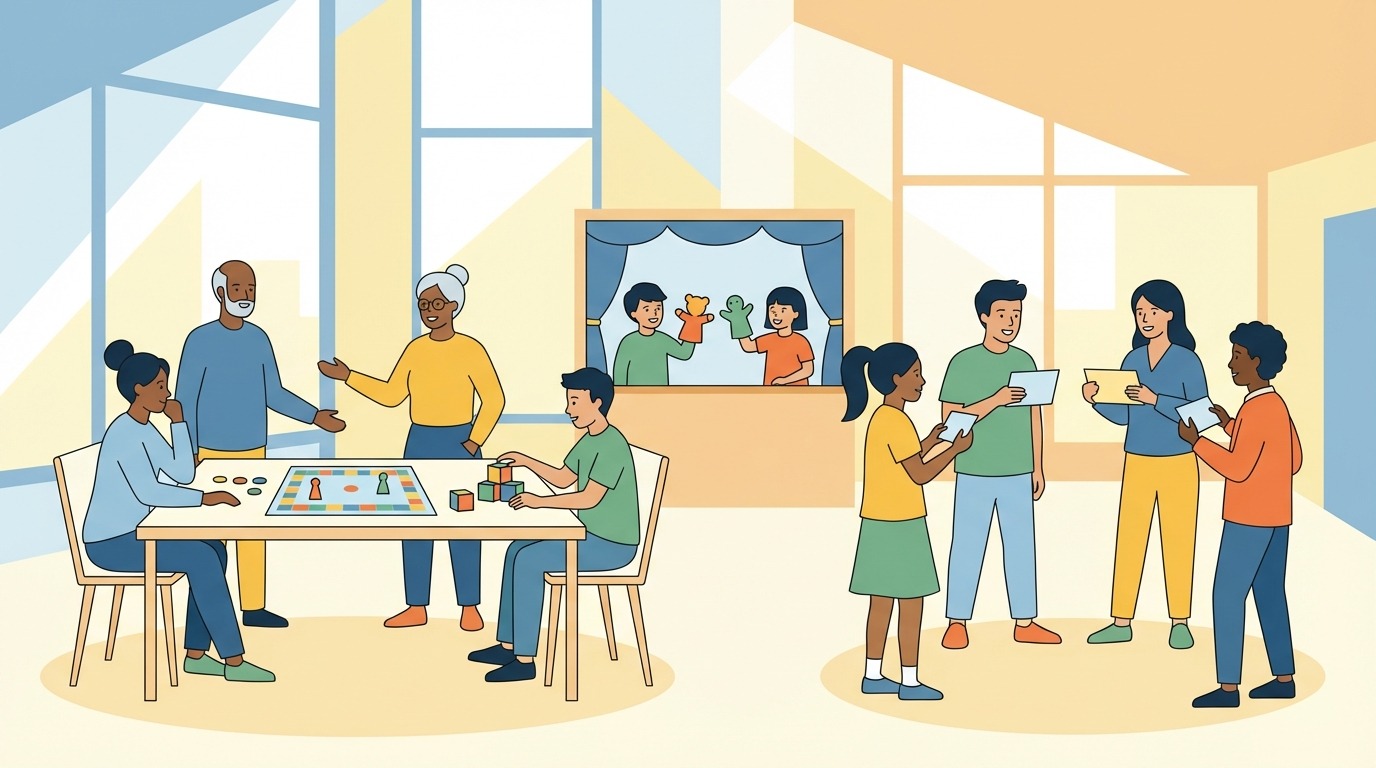
Social Skills AZ: Complete file on social skills from A to Z.
| Short on time? Here is the essentials ✨ |
|---|
| Social skills are built through observation, imitation, and regular practice 👀 |
| Prioritize clear communication, active listening, and empathy in every interaction 🗣️❤️ |
| Strengthen assertiveness to say “yes/no” without aggression, respecting the other 💬🛡️ |
| Use role-playing, scenarios, and immediate feedback to improve 🎭✅ |
| Prevent rather than cure with a structured conflict management approach in stages 🔁🧭 |
| Build self-confidence through small visible and celebrated victories 🎯👏 |
| Constant link between expression of emotions and quality of interpersonal relationships 🌡️🤝 |
| Connect childhood, adolescence, and adulthood with bridging workshops 🪜 |
| Measure needs through grids and tailor each support individually 📊🧩 |
| In 2026, inclusion rhymes with multi-stakeholder cooperation, digital tools, and accessibility 🔗💡 |
Social skills map out our connections: making contact, cooperating, resolving disagreements, and growing from the experience. Hearing “hello” again, daring to say “no,” naming a throat-tightening emotion: all fall under embodied communication. In families, classrooms, care teams, or businesses, active listening, empathy, and assertiveness transform the quality of exchanges. However, the challenge goes beyond mere politeness. Well-mastered, these skills prevent isolation, boost self-confidence, and support mental health. In 2026, inclusion and accessibility require better equipping young people, but also adults long left behind.
This A–Z file offers an operational vision, inspired by research and field initiatives. It links early childhood to the challenges of adulthood, including school and integration. At each stage, keys change, but the logic remains: observe, model, practice, reinforce. An educator enacts life situations in role-plays; a business coach structures conflict management; an association mixes FALC/CAA to pave the way. The following examples show how to build strong bonds progressively, joyfully, and measurably, while respecting each person’s uniqueness.
Social Skills A–Z: definitions, challenges, and action framework in 2026
Talking about social skills means describing specific verbal and non-verbal behaviors adapted to the context. A smile, a clear request, an open posture: so many micro-gestures that support interpersonal relationships. Foundational work on social skills training reminds of a concrete fact: these behaviors develop through imitation, modeling, and repetition.
Six characteristics stand as a practical compass. First, learning by observation and modeling accelerates progress. Next, skills are specific: one script to greet, another to ask for help. Third, initiation and social response are two sides of the same exchange.
Fourth, the search for social reinforcement matters. Quick, positive, descriptive feedback establishes the habit. Fifth, interactions require adaptation and efficiency, as one phrase does not fit all circumstances. Lastly, deficits or excesses become clear intervention targets, without judgment, with graduated objectives.
The French Serafin-PH nomenclature framework clarifies the identification of needs. The axis “relations and interactions with others” structures the analysis of obstacles and levers. This framework equips teams to prioritize realistic, useful, and observable goals.
Let’s illustrate with Lina, 5 years old, curious but hesitant. She knows how to say “hello,” but looks away when an adult speaks to her. The work combines reinforcing eye contact, short greeting scenarios, and sensory breaks if anxiety rises. Progress remains measured on a simple grid, session after session.
Mehdi, 14, manages discussions better among friends but quickly loses his temper during disagreements. The goal targets conflict management in three stages: listen, rephrase, propose. Role-playing introduces difficulty levels. Feedback focuses on tone and breathing.
Clara, 27, is looking for work in catering. She speaks fluently but struggles to set boundaries. Assertiveness training helps her refuse unfair tasks without breaking the bond. Result: a clear “no,” accompanied by a useful alternative, becomes acceptable and respected.
Why does this approach benefit collectives so much? Because it structures communication, reduces misunderstandings, and installs a culture of cooperation. Each micro social skill strengthens shared trust, and this is the true power of a well-thought A–Z.
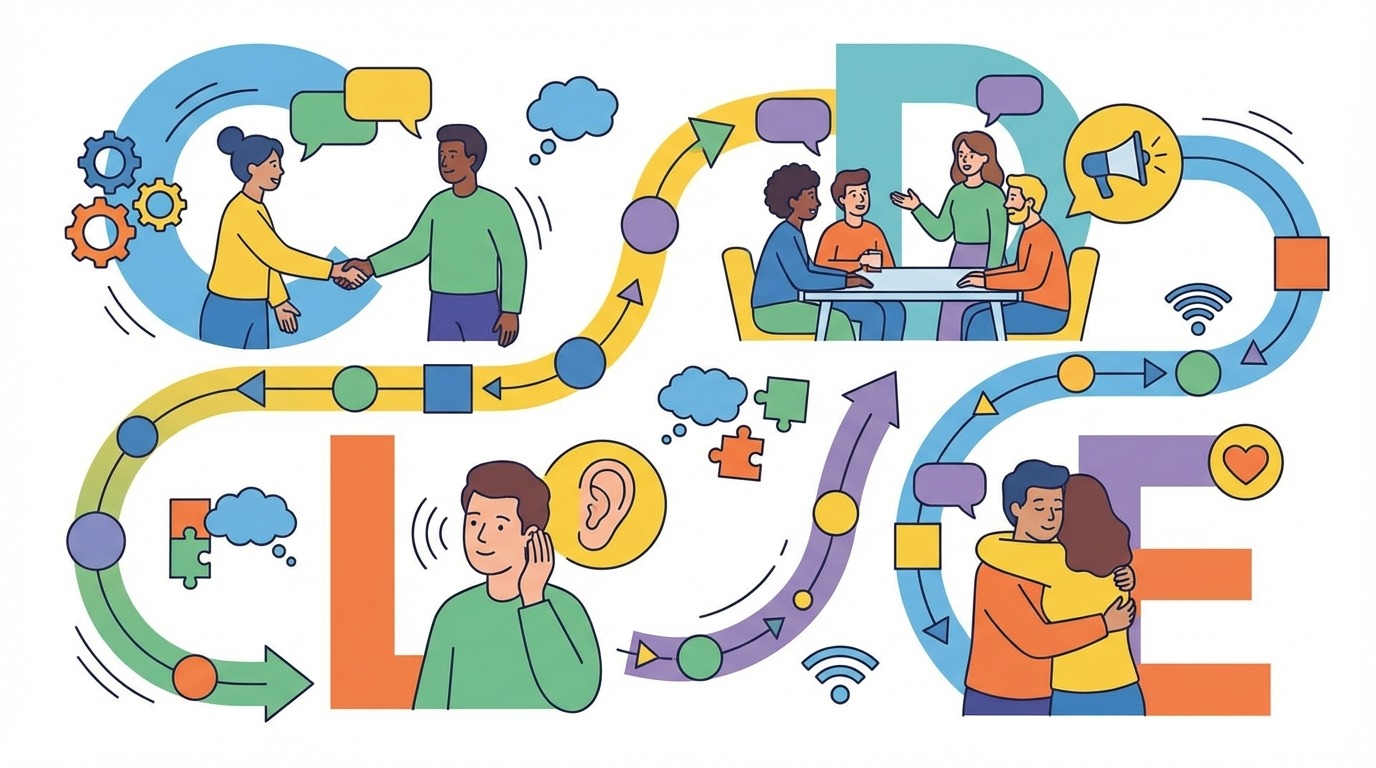
From childhood to adolescence: communication, active listening, and empathy daily
The early years lay the foundations. “Hello,” waiting your turn, sharing: all are built through repetition and warm guidance. Family routines create favorable ground because the child observes and copies.
The book becomes a precious ally for expressing emotions. By naming what a character experiences, the child learns to recognize then regulate what they are feeling. A “I’m angry” card turns into a clear sentence, hence a calmer behavior.
Educators report clear progress when instructions remain simple and concrete. “Walk like a cat” communicates better than an abstract reminder. Board games teach turn-taking and patience, with motivating pleasure.
When frustration arises, gestures often precede words. A short protocol helps: breathe slowly, name the emotion, choose an action to calm down. With habit, tantrums shorten and self-confidence rises.
Playful tools and social skills workshops at school
Small group workshops offer a safe stage. Through role-play, everyone practices greeting, asking, refusing, congratulating. The kind setting welcomes attempts, mistakes, then immediate improvement.
The “observe – play – debrief” model provides clear pacing. A brief demonstration sets the observable target, the scene starts, then the group offers descriptive feedback. Progress becomes visible after a few sessions.
Cooperation is practiced with collective challenges: building a block tower, solving a puzzle, organizing a mini-show. Roles rotate so everyone speaks and listens to others.
Families extend the training without burden. A simple, joyful reinforcement chart suffices. The result: fewer domestic conflicts and a child more available to learn in class.
- 👋 Greet with eye contact + first name: two clues, double impact.
- 🧸 Share a toy for 2 minutes, visible timer to reassure.
- 🗣️ Rephrase in one sentence: “You want the ball after me, right?”
- 🧘 Breathe 3 times before answering when heated.
- 🌈 Say a quality to a classmate every day.
A well-orchestrated progression creates more stable friendships and a calmer class. This prepares for adolescence, where the same foundations support more intense challenges.
This video usefully complements playful practices by showing how to calibrate scene difficulty. It also gives ideas for scenarios to bring out empathy without moralizing.
Adulthood and inclusion: assertiveness, cooperation, and conflict management at work
Many adults have never received formal social skills training. Yet, anyone can progress, including within disabilities or specific needs. The challenge becomes social autonomy, at work and in the community.
Medico-social teams develop cross-sector workshops open to multiple institutions. Psychologists lead, trained professionals co-facilitate, and the young-adult bridge organizes. This format smooths entry into adult life.
The content targets useful assertiveness. Saying “no” to a dangerous instruction, requesting reasonable accommodation, asking for a break: three scripts, three contexts. The “no” is formed with a steady voice, an alternative proposal, and frank eye contact.
Conflict management is learned in stages. Understand intent, rephrase, make a request, conclude. This sequence lowers emotional burden and saves time for all involved.
FALC and AAC supports make workshops accessible. Pictograms, short sentences, emotion icons, simple action plans: information circulates better. Inclusion is thus lived rather than proclaimed.
Field case: Hakim, 32, works in a kitchen. Rush hours led to brusque exchanges. After six sessions, he calmly states his limits and offers to swap tasks if needed. Tensions ease, the team breathes.
Cross-sector programs and sustainable funding
For sustainability, a program fits within an associative project and local partnerships. Bridges with IMEs ensure smooth transition. Funders support better a measured project with simple indicators.
Three indicators suffice initially: number of mastered scripts, number of incident-free situations, peer satisfaction. Quantitative data convince and improve real quality of support.
Digital tools facilitate dissemination. Interactive sheets, video capsules, quick smartphone assessments: training anchors itself in daily life. Peer mentors play a key role as they embody the model.
By aligning accessibility, measurement, and learning pleasure, adult workshops become a lever for employability and relational health. This shift benefits individuals and organizations.
The module offered in this resource illustrates how to break down a conflict into observable micro-skills. It also offers tips to foster a more supportive team culture.
Practical methods: expressing emotions, self-confidence, and regulation rituals
Naming the emotion reduces internal pressure. A color code or cards simplify identification. Saying “I am frustrated” opens the door to a concrete solution.
A mini-protocol solves many situations: identify, breathe, formulate, choose. Breathing through the nose, then a long exhale through the mouth, calms in under a minute. Then speech becomes more precise.
The “I” statement strengthens assertiveness. “I prefer to finish this task then help you” sets a frame without attacking. The other feels respected, the discussion stays open.
Positive reinforcement nourishes self-confidence. It’s better to praise precise and recent behavior. A brief, sincere celebration anchors the habit.
Scripts, modeling, and descriptive feedback
A good script fits in a simple sentence, steady eye contact, and calm tone. Demonstration by a peer facilitates appropriation. Feedback targets observable elements, like posture or voice volume.
Role-play enriches with variants: ambient noise, hurried interlocutor, sidetracked question. The person learns to generalize their know-how. The skill becomes robust.
An end-of-workshop ritual helps consolidation. Each person says a learning, an effort, and an intention for the week. The group bonds and motivation lasts.
These simple routines establish a safer emotional climate. Empathy follows naturally, as everyone feels seen and heard in their uniqueness.
Setting up an A–Z workshop: sequences, evaluations, and professional tools
An effective workshop relies on a clear initial evaluation. A grid lists concrete items: waiting your turn, asking, helping, guiding a group. Priorities emerge in minutes.
Progress plans over eight weeks, with one goal per session. Each goal remains measurable and accessible. Sessions alternate modeling, practice, and debrief.
Supports vary to maintain attention. Photos, skits, emotion cards, visual timer: these tools structure action. Everyone can orient themselves and feel competent.
Co-facilitation promotes cooperation. One professional guides the scene, the other observes and codes progress. Data feeds useful feedback without overload.
8-week pathway: operational template
- 🎯 Week 1: Greet and introduce yourself (eye contact, name, handshake or alternative)
- 🧭 Week 2: Ask and thank (use “I” sentence, intonation, rephrasing)
- 🤝 Week 3: Share and wait (timer, turn-taking, quick self-assessment)
- 🛡️ Week 4: Say no respectfully (assertiveness, alternative, closure)
- 🧘 Week 5: Expression of emotions and calming down (breathing, grounding)
- 🗺️ Week 6: Conflict management in 4 steps (listen, rephrase, ask, conclude)
- 🧑🍳 Week 7: Cooperate on a mission (common project, rotating roles, brief/debrief)
- 🌟 Week 8: Review and transfer (validated scripts, personal plan, celebration)
Measurement closes the loop. Two indicators per goal suffice: frequency of successful initiations and quality of social response. Results feed dialogue with families, employers, and funders.
At the cycle’s end, participants gain social autonomy. Teams obtain useful impact evidence for sustainability. The essential: a clear, lively, and caring framework centered on the person.
How to introduce active listening without weighing down exchanges?
Use three levers: brief eye contact, rephrasing in one sentence, open question. This trio takes 20 seconds and reduces 80% of daily misunderstandings.
What is the difference between assertiveness and aggressiveness?
Assertiveness respects the needs of both parties. The message comes from oneself, stays factual, and proposes an alternative. Aggressiveness imposes and breaks the bond, even when the objective seems achieved.
What resources stimulate the expression of emotions in children?
Emotion cards, children’s books, mime games, and family emotion minutes. Regularity is more important than duration, with simple and repetitive vocabulary.
How to evaluate progress in social skills in adulthood?
Select 4 to 6 observable items (greeting, asking, refusing, cooperating, resolving a conflict). Code immediately after each scene and compare to the baseline every two weeks.
What to do when a conflict drags on?
Return to the 4-step protocol, impose a short break, change environment, then seek a minimal viable agreement. If necessary, quick mediation by a trained third party.
“Social skills do not fall from the sky: they are trained, celebrated, and end up changing life.”