Children’s Video Games: Managing children’s screen time and video games (5-8 years).
| Short on time? Here’s the essentials 💡 |
|---|
| Set a clear playtime limit (45-60 min max in a row, 2 h/day maximum for 6-8 year olds) ⏱️ |
| Prioritize educational and cooperative games, PEGI 3 or 7 rated 🎯 |
| Enable parental controls on every device and block purchases 💳 |
| Establish “before/during/after” rituals for good time management 📆 |
| Co-play when possible, then discuss the game to support child development 🧠 |
| Create easy offline alternatives (lego, reading, cooking, gardening) 🌿 |
| Remind “Zero screen” rules before sleep, meals, and short trips 😴🍽️ |
Screens and children today form a permanent duo, especially between 5 and 8 years old, an age when curiosity and imitation develop rapidly. However, a milestone is possible: children’s video games become learning tools when the framework is clear, the duration controlled, and the content carefully chosen. The key lies in a kind time management approach, based equally on clear rules and daily support. It is less about forbidding than organizing, with simple routines and constant dialogue.
This guide offers practical benchmarks to reconcile digital leisure, digital safety, and the fundamental needs of child development. The ideas are concrete, family-tested, and adapted to the 2026 realities of current platforms. Parents will find tools here to establish a calm playtime limit, select stimulating educational games, and anchor good habits that withstand rainy days as well as holidays. In the end, everyone will know where to set the cursor so that play remains a pleasure… and not a source of tension.
Children’s video games and development ages 5-8: understanding needs and risks
At 5-8 years old, the brain craves concrete experiences. Well-chosen children’s video games nurture coordination, language, and logical reasoning. However, without an adapted playtime limit, excitement rises quickly and cognitive fatigue sets in. This age therefore requires clear content, short rules, and missions that can be completed in one session.
Lila’s family noticed: with a cooperative 20-minute puzzle game, she sharpens her understanding of instructions and her patience. As soon as the session exceeds 60 minutes, irritability increases, and exiting the game becomes abrupt. This contrast illustrates a simple principle: content quality and time management matter more than the “amount gained”.
Attention, emotions, and child rhythms
Impulse control is still developing at ages 5-8. Hence the interest of short goals, gentle feedback, and an adult who verbalizes emotion. A boss that is too difficult can trigger anger or devaluation. Conversely, a cooperative puzzle values mutual aid and releases dopamine without extreme spikes.
Moreover, screens and children share a golden rule: sleep first. A bright screen before bedtime delays falling asleep. “Zero screen 60 minutes before night” rituals help the brain settle down. Morning or late afternoon play is more respectful of the biological rhythm.
Fine motor skills, language, and visuospatial thinking
A construction title develops orientation, anticipation, and resource management. When the adult comments on actions, thematic vocabulary enriches. We talk about angles, blocks, directions, and the child anchors precise words on gestures.
Then, fine motor skills improve through simple interactions: pointing, holding, sliding, choosing. On consoles, calibrating sensitivity avoids frustration. On tablets, a stylus can help younger children gain precision.
Co-playing to learn better
Co-play transforms the experience. The child explains their strategy, listens to advice, formulates a hypothesis. This exchange supports working memory and mental flexibility. And above all, it humanizes the screen: you play together, laugh together, and know when to say “we stop here”.
Ultimately, the issue isn’t “for or against” but “how”. By framing content and durations, attention is protected, emotion is regulated, and digital becomes a relevant exploration ground.
Screen time and time management: setting a clear and calm playtime limit
Current benchmarks remain stable: for 5-8 year olds, aim for 20-30 minute sessions, with a total playtime limit of about 2 hours per day maximum on allowed days. To prevent escalation, split times by activities: reading, outdoor play, free play, then screen time. Sequencing smooths transitions and reassures.
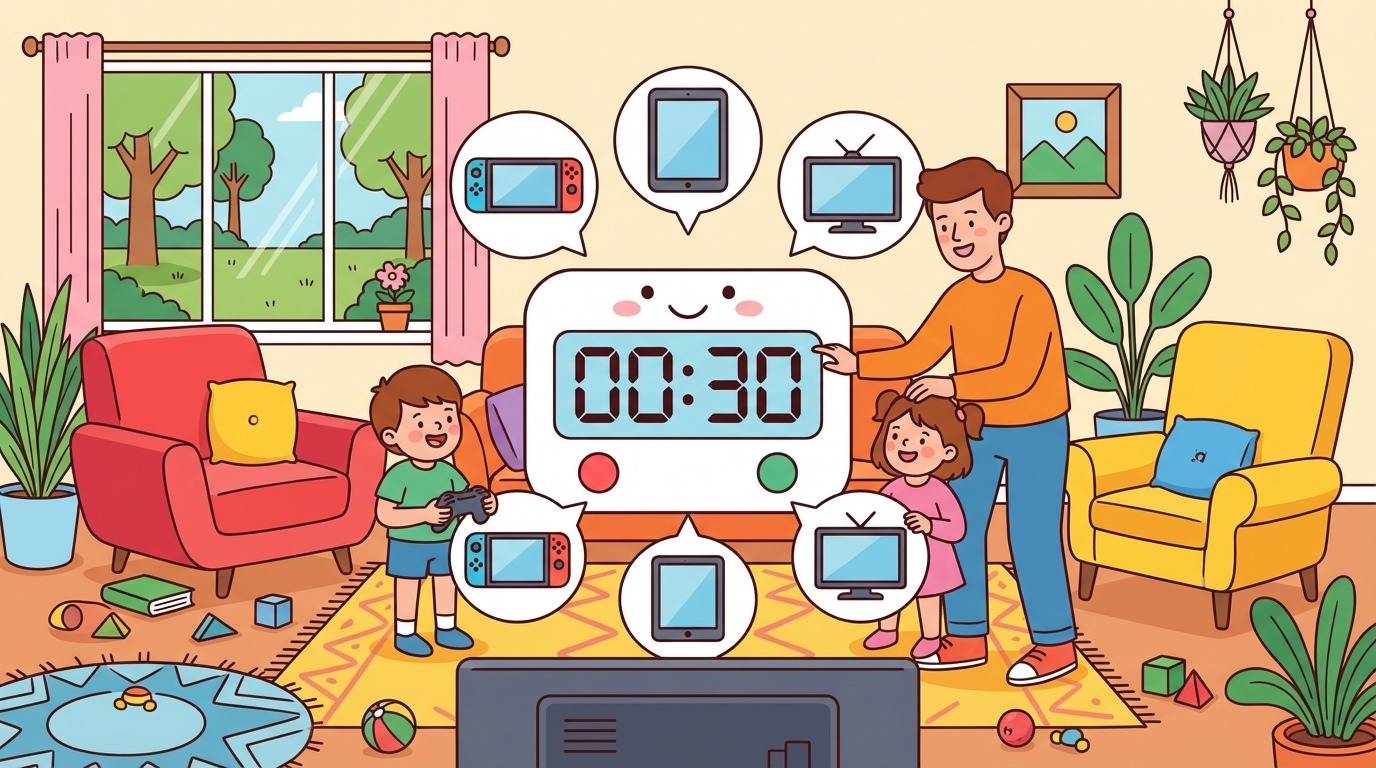
The “3-6-9-12” rule provides a simple framework that still permeates European recommendations. From 6 years old, play becomes possible but in accompanied environments, with explicit durations and chosen content. An hourglass, visual timer, or weekly mission calendar helps the child anticipate the end.
Before/during/after rituals
Before: check free time, choose only one game, and announce the duration. During: pause halfway to drink and breathe. After: put away the controller, recount the best action, then move on to a calm activity. This triptych makes the break smoother.
At Noé’s (7 years), using a “round counter” halved conflicts. The child knows there is only one mission left, not “just a little more”. Ambiguity disappears, and rule respect increases.
- ⏳ Use a visible and non-negotiable timer
- 📆 Display the weekly schedule with “screen-free” days
- 🧩 Choose games with short chapters
- 🗣️ Announce 5 minutes before the end
- 🏅 Praise successful breaks
For more detailed guidelines adapted for younger children, a clear guide helps frame without antagonizing. See for example these benchmarks for young children, useful for reaching household consensus.
Holidays sometimes upset these balances. One can create a “time bank” limited per day, usable in two blocks. Each block is exchanged for an outing, a sports activity, or a cooking workshop. The child keeps control over when to use their credit, but not the amount.

Choosing educational games 5-8 years: content quality before quantity
At this age, prioritize accessible mechanics, progressive challenges, and gentle narration. Educational games strengthen reading, logic, and creativity. The PEGI label guides overall safety: aim for PEGI 3 or 7 for this audience. A glance at help settings (hints, beginner levels) changes everything.
The quick checklist to decide: concrete learning, possible cooperation, short challenges, no open chat, disabled purchases, and available offline mode. If three boxes are missing, look for an alternative. This logic protects pleasure and concentration.
Stimulating content, not overstimulating
Construction and puzzle titles offer readable progression. Music, drawing, or visual programming workshops (block type) nurture creativity and self-esteem. When the game invites storytelling, language trains naturally.
Conversely, avoid games with hyper-accelerated pace, that bombard rewards and notifications. They fragment attention and make session exit harder. A clear and slow experience favors emotional regulation.
Family lived examples
In Aïna’s family, 6 years old, a cooperative puzzle game improved listening and planning. Each takes turns playing, and victory becomes collective. In the evening, they draw the favorite scene: screen and paper communicate, and leisure enriches.
For noise-sensitive children, adjusting music, turning off vibrations, and lowering brightness reduces sensory load. A comfortable headset, at limited volume, avoids tension and preserves hearing.
Finally, think “modularity”: the same game can switch to “free exploration” mode on Wednesday, and “timed challenge” on Saturday. Adjusting the formula by day and energy level avoids saturation. The good game is the one that adapts to the child, not the opposite.
Digital safety and parental control: protect without stifling curiosity
Enabling parental controls on every console, tablet, and smartphone remains non-negotiable. Purchases are locked, time slots fixed, content filtered by age, and open chats cut off. This foundation avoids 80% of worries, without daily negotiation.
Then, secure the account: long password, two-factor authentication, and separate child profile. On Nintendo, PlayStation, Xbox, iOS, and Android, native options exist. Activate them one by one, then test with the child to explain the “why”.
Family rules and trace pedagogy
A simple charter, displayed near the screen, reminds commitments: respect the hour, don’t talk to strangers, ask before downloading, warn if content shocks. Thus, the child knows what to do if a problem arises. They learn to be an actor in their digital safety.
Talking about “digital footprints” from primary school is not too early. A screenshot or a nickname stays a long time. Explaining that certain information is never shared (address, school, identifiable photo) establishes lasting reflexes.
Essential settings
On each device: disable in-app purchases, limit spending to zero, block unrated content, require adult validation. On the home network: enable family DNS control and a unique Wi-Fi password. Occasionally, check game history with the child, starting with a talk about experience.
For further steps, one can rely on a neutral and practical guide that synthesizes rules and tips. This practical guide to screens and children offers a global approach, useful to keep the course when the week gets hectic.
Safety is built hand in hand: technical tools, clear language, and mutual trust. A child trained early becomes more autonomous and less vulnerable to bad encounters.
Lasting habits: routines, holidays, screen alternatives, and co-activities
A habit is born from a fixed point. Thus, anchoring screens after homework, never at the table, never before sleep, stabilizes daily life. When the context is constant, discussion decreases. Play again becomes a framed digital leisure, not endless negotiation.
On weekends, organizing a “leisure menu” where the child checks off three screen-free activities before unlocking a session changes the dynamic. Preferences quickly reappear: drawing, crafts, biking, cooking. Transitions become smooth because the agenda is collective and predictable.
Holidays, outings, and unpredictable weather
When traveling, screens can serve as a joker, but not a pilot. Set a daily credit, divided into two short blocks. Meanwhile, prepare an activity bag: cards, game book, stickers, mini-figures. This plan B avoids the pitfall of “default too much screen”.
On rainy days, setting up a thematic “workshop” pleasantly surprises: quick cooking, herbariums, forts, origami. The brain enjoys alternations. At the authorized session time, the child arrives already calm and leaves without tension.
Co-play and value post-game time
Often 10 minutes of co-play is enough. You discover a tip, laugh at a failure, plan the next step. Then, offering a “creative debrief” extends learning: mime the scene, draw the level, tell the story to a sibling. The experience–language loop closes.
For siblings, fair but not identical rules reassure: small chapters for the younger, finer challenges for the older. Each progresses in their proximal zone, and jealousies decrease. Screens and children then gain in exchange quality, not just in hours quantity.
In the end, a family who ritualizes, explains, and adjusts over time offers itself peace at home. Conflicts decrease, autonomy rises, and play regains its primary function: learning while having fun.
How much screen time for a 5 to 8-year-old child?
Aim for sessions of 20-30 minutes, with a daily total not exceeding 2 hours on allowed days. Keep screen-free days, and ban screens before bedtime and during meals. Routine regularity matters as much as exact duration.
How to avoid tantrums when turning off the console?
Announce the end 5 minutes before, finish on a positive action (save, simple victory), then offer a calm bridging activity (short reading, drink, drawing). Praise the successful transition and keep the same ritual daily to reduce emotional load.
Which educational games to prioritize between 5 and 8 years?
Choose PEGI 3 or 7 titles, with short challenges, local cooperation, and help options. Puzzles, construction games, music, and block programming are excellent choices. Prefer experiences without in-app purchases and with offline mode.
Is online mode suitable for this age?
Better to avoid it or lock it down strongly. Disable open chats, limit games to known friends, and maintain child profiles with parental controls. Local co-play and family cooperation are safer and more formative options.
“A well-framed screen doesn’t imprison childhood: it illuminates it, then turns off.”