Social Skills: Video: developing social skills in children.
| Short on time? Here’s the essentials ✨ |
|---|
| Social skills develop through observation, modeling, and daily practice 👀🎬 |
| Videos serve as learning triggers and facilitate understanding of key social gestures ▶️ |
| Priorities: clear communication, active listening, empathy, emotion management 💬🧠💓 |
| Repeating in varied contexts strengthens self-confidence and generalization of skills 🧩💪 |
| Measuring progress, adjusting supports and valuing each interaction supports lasting relationships 📈🤝 |
At a time when screens shape daily family life, video becomes an educational ally for the development of social skills in children. When used well, it opens windows onto concrete life scenes and demystifies sometimes delicate relational situations. The goal is not to “stick” the child to the screen, but to use it as a springboard to trigger communication, active listening and empathy, then immediately shift to action and play.
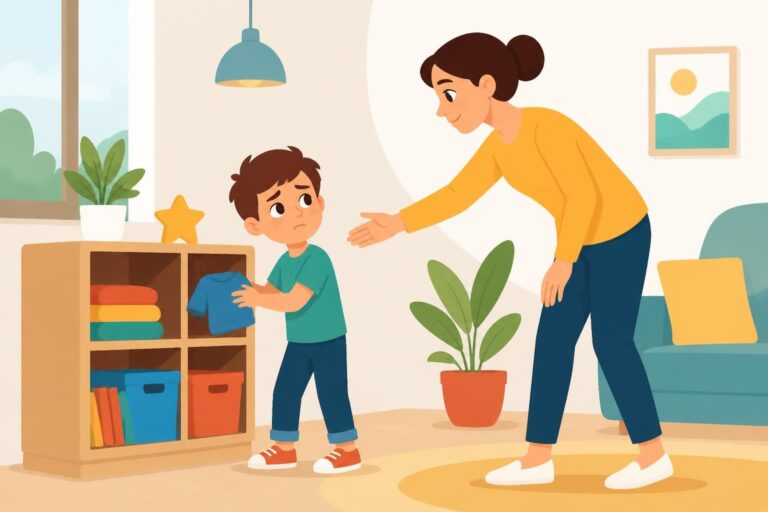
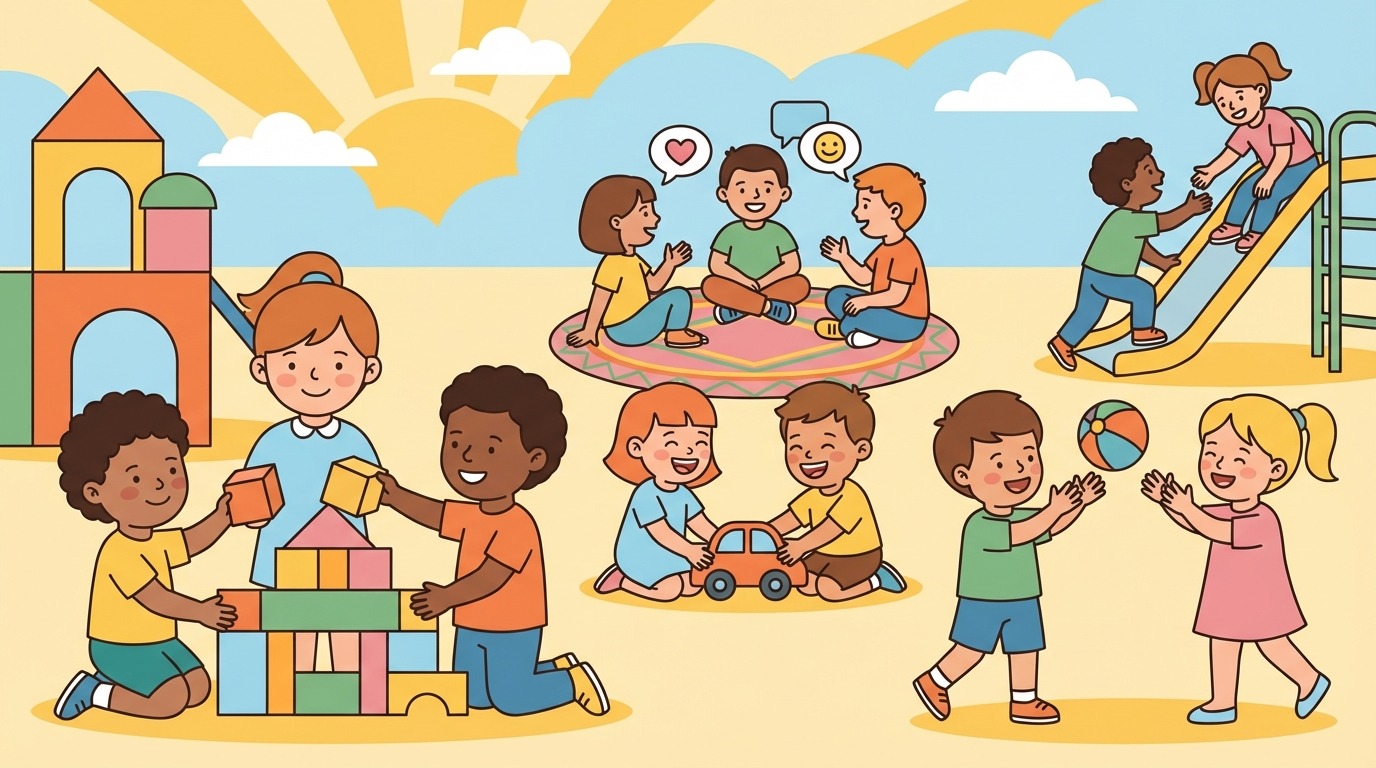
In a kindergarten class as at home, a two-minute clip can show how to say hello, wait your turn or ask for help. Then it’s time for trying, laughing, and adjusting. Because social learning is based on a succession of short, repeated, and well-guided interactions. Above all, each progress nurtures self-confidence and positively impacts the child’s overall behavior, from the reading corner to group times.
LET’S LIVE TOGETHER: Social skills in children and the power of educational videos
Specialists agree: social skills are acquired through learning. This includes observation, modeling, imitation and guided practice. Video, in particular, shows subtle verbal and nonverbal behaviors, with clear timing and salient visual cues. Thus, a child sees when to look at the other, wait for the answer, then continue the interaction. This precision avoids misunderstandings and secures the real attempt.
Why does it work so well? Because filmed sequences condense landmarks. The gaze, tone of voice, body distance and how to fix a mistake are all obvious. Then, a brief pause allows analyzing what helped the communication, then relaunching the scene. This quick alternation video/action energizes attention and maintains engagement.
In reference definitions, there are four pillars: specific and observable behaviors; an alternation of appropriate initiations and responses; the search for natural social reinforcement; the interactive and contextual aspect. A short video can align these elements, then invite the child to replay them in their own setting. This bridge from “seeing” to “doing” triggers relational development.
Everyday, a simple script suffices. For example: “I want the red truck. I breathe. I ask: ‘Can you lend it to me later?’ I watch my friend answer. I thank.” Seen in images, this template becomes accessible to the youngest. Quickly, the class creates its common language: key words, signal gestures, pictograms. Coherence reduces tensions and enhances the joy of cooperating.
To support these skills, structured resources complement the field. A clear overview of steps and ideas can be found in a guide on social skills from A to Z. Moreover, understanding the mechanisms of children’s social development helps adjust expected levels and dosage of guidance. The key remains to orchestrate concrete situations where “succeeding” in a small relationship becomes frequent.
In short, the video tool acts as an effective starter. It illuminates invisible landmarks, then invites the real scene. This passage to action, rhythmic and joyful, makes learning sustainable.
Learning guided by video: modeling, role-playing and effective feedback
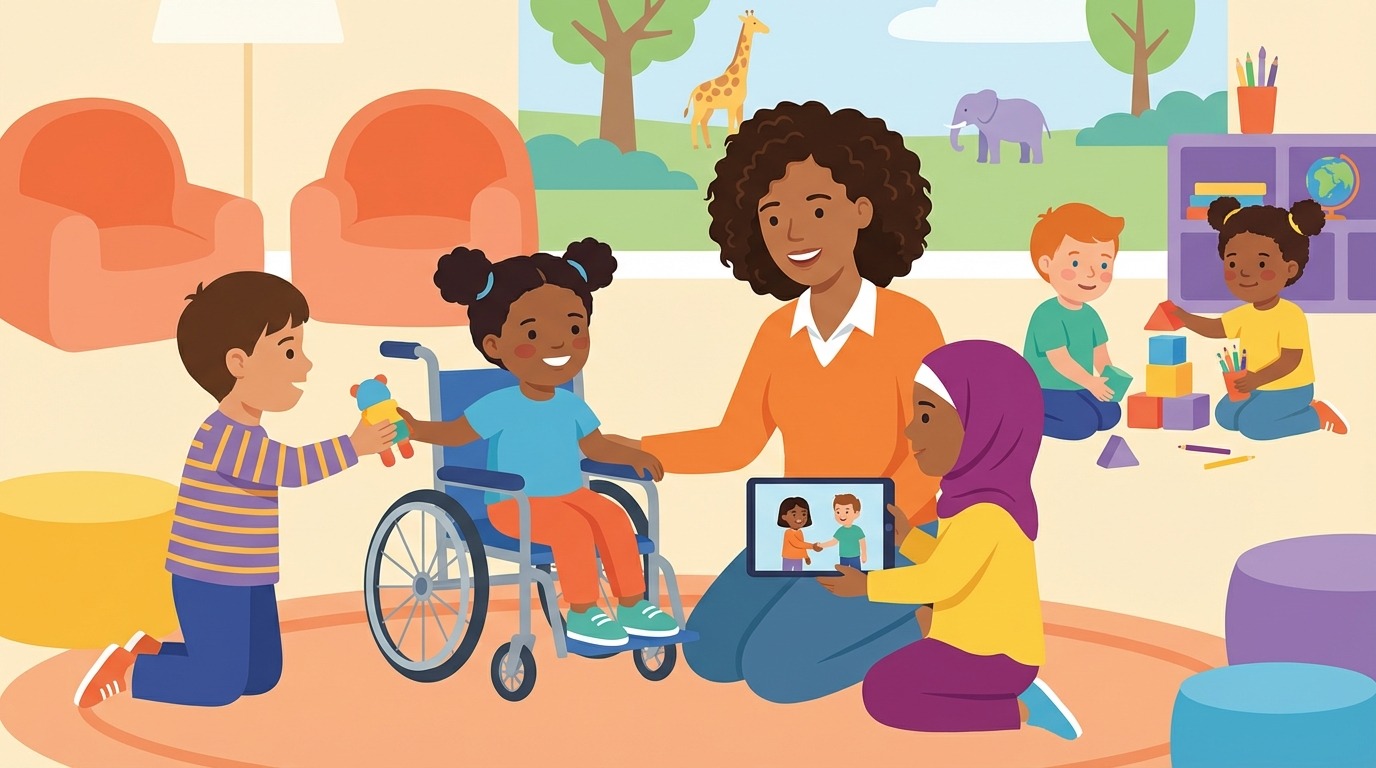
To transform the attempt, a clear teaching sequence maximizes progress. First, the adult explains the skill with simple words. Then, a short video illustrates the expected behavior in a realistic situation. Next come the role plays, precise feedback, and finally repetition in natural conditions. This flexible but consistent structure creates a reassuring framework for the child.
Concretely, the teaching step sets the goal: “How to ask to play?” The adult breaks down the skill: approach, say the name, make the request, listen to the answer, propose an alternative if needed. Immediately, a clip shows two children succeeding in this micro-scene. Active listening is visible: attentive gaze, nodding, slight reformulation. Landmarks get fixed.
Then, onto live modeling. The adult re-enacts the scene with a peer or puppet. Children observe nonverbal cues. The pace is slow at first, then natural. This back-and-forth video/skit encodes the order of actions and the relational “music,” so precious for interaction.
Moving to action: micro-scenarios and checklist
When trying out, a small checklist reassures and structures progress. It fits in the hand, like an entry ticket to success.
- 👣 Approach calmly and introduce yourself
- 🗣️ Make a clear and short request
- 👂 Practice active listening and reformulate
- 🔄 Propose an alternative if the answer is “no”
- 🌟 Thank and celebrate the attempt
Feedback follows immediately. It highlights what supported communication and what can be adjusted. Key words remain concrete: “You looked at your friend, you waited for their answer, well done.” For a more reserved child, specific work on preschool shyness makes the attempt less threatening and maintains self-confidence.
To support the gesture, a short targeted YouTube playlist facilitates getting started. Simple queries offer clips adapted to age and language level.
In this context, video is not an end. It serves as a reusable starter, especially when cognitive fatigue rises. Two minutes of observation, then back to play: this rhythm protects attention and enhances bodily experience. Over time, the child internalizes the sequence, and the relationship becomes smoother.
Communication, active listening and empathy: equipping home and school with short videos
At home as in class, the alliance between micro-videos and predictable routines weaves strong relationships. On the one hand, communication gains clarity thanks to visual scripts. On the other, empathy is strengthened by scenes showing emotions and possible repairs. Thus, daily life becomes a laboratory of bonds.
A powerful lever lies in mirror play and joyful imitation. Explored with toddlers, it establishes the necessary tuning for any interaction. Concrete leads are shown here: mirror play and child development. Meanwhile, “loop” stories support anchoring: rereading the same story allows predicting turns, anticipating moral choices and daring to participate; this approach is detailed in Read me again.
For smooth deployment, pairing each skill to a one-minute video and a concrete activity helps teams and families. The table below offers quick matches with ideas for immediate attempts. Emojis serve as visual cues for children.
| Skill 🎯 | Video clip to find ▶️ | Activity after viewing 🎲 |
|---|---|---|
| Saying hello | “Greet with gaze and smile” | Greeting rounds with puppets 🙂 |
| Waiting your turn | “Taking turns speaking” | Card game with hourglass ⏳ |
| Expressing an emotion | “Naming joy, anger, fear” | Emotion thermometer with images 🌡️ |
| Resolving a conflict | “Propose a simple compromise” | Idea box for solutions 🧰 |
| Asking for help | “Make a clear request” | Cards “Can you help me with…?” 🆘 |
Beyond these essentials, active listening deserves focus. A video showing a child reformulating a peer’s sentence (“You want the seat by the window, right?”) makes the skill tangible. Then, a reversed game of Chinese whispers, where correct understanding is checked, triggers laughter. It’s playful and hugely instructive.
Finally, introducing manipulable supports – hand puppets, emotion pictograms, storyboards – solidifies anchoring. Their immediate use after the video turns the idea into action. Gradually, adjusted behavior becomes spontaneous, and self-confidence flourishes with every micro-victory.
From guided session to real life: generalizing skills and building self-confidence
The number one challenge remains generalization: using the skill in varied environments, with different people. To achieve this, nothing replaces natural role-playing. After the video and role play, the adult creates discreet opportunities: a “cooperative” workshop, a duo mission, a chore in the kitchen corner. Each success nurtures self-confidence and strengthens relationships.
Let’s illustrate with Lina, 4 years old, very reserved. A clip shows how to “enter” a game already underway. Then, at recess, an adult accompanies her to the circle and whispers an opening phrase. Lina sits, observes, then offers to distribute the pieces. The exchange lasts two minutes, but everything changes: the first stone is laid. The next day, they repeat the maneuver. Quickly, Lina initiates alone, proof of real development.
For Noah, 7 years old, a neurodevelopmental profile calls for a different footage. Anticipation, visual scripts and clarity of expectations support success. Useful landmarks are presented here: autism spectrum disorder. The goal does not change: serene and predictable interactions that enhance his strengths and respect his pace. Videos serve as a library of familiar examples, accessible on demand.
The school’s role is central. When teachers, assistants and facilitators share the same scripts, alignment produces a magnifying effect. This network is detailed in this guide about the role of school stakeholders. At home, families extend the work by replaying scenes in routines: greeting the neighbor, asking for an ingredient at the table, thanking at the store. In short, life becomes a warm training ground.
A word on empathy: it grows as much through stories as through acts of repair. After a bump, a video on “how to make amends” opens a path. We see a sincere apology, an offer of help, a gesture of consideration. Then children make a “sorry” card with a drawing. This transition from seeing to doing seals emotional learning.
Finally, reinforcements must remain social and authentic: smiles, recognition, integration into a peer group. Material rewards can start the engine, but the joy of succeeding in a relationship beats all stickers. When children see themselves as competent, the virtuous circle self-fuels.
Measure, adjust, celebrate: from behavior tracking to autonomy routines
No measurement, no fine adjustment. A simple but regular follow-up captures progress: frequency of initiations, maintaining interaction, quality of response. In a few weeks, a trend emerges and guides the choice of videos, games and contexts. Thus, we better target what’s missing: a starting word, a look, a wait time, an escape route.
To support autonomy, symbolic play spaces are accelerators. A marketplace or construction corner encourages negotiation, role management and listening. Ideas to feed this daily autonomy can be found here: playful tools for autonomy. The adult does not extinguish the social fire: they fuel the home, then step back while keeping visible anchors.
A light follow-up method is to set weekly goals: “greet two classmates every morning,” “wait three seconds before speaking.” Check off, laugh at attempts, adjust. When success stabilizes, raise the challenge level or move the skill to another setting (cafeteria, sports, outing). This rotation prevents the “classroom only” effect.
Along this path, the quality of adult-child communication counts more than quantity. Saying “what helps” at the right moment, offering a support word, prompting with an open question: these micro-gestures save weeks. By contrast, over-assistance freezes; better a step aside, a meaningful silence, a discreet sign toward the agreed pictogram card.
Points of vigilance and progress boosters
- 🧭 Clarify the day’s social goal and indicate it with a visual
- 🎯 Choose very short videos (60–120 s) anchored in the child’s reality
- 🧠 Segment skills into micro-steps to avoid overload
- 🤝 Multiply natural opportunities for cooperation, even brief
- 📣 Give immediate, descriptive and warm feedback
In the end, celebrating each progress maintains momentum. A Friday ritual, where a well-handled relationship or exemplary listening is highlighted, installs a culture of shared success. The child progresses, the group breathes, and the joy of living together grows.
How much screen time to work on social skills?
Favor very short clips (1 to 3 minutes), immediately followed by a game or a role-playing activity. The video serves as a starter, learning is mostly born from action and real interactions.
How to help a very shy child dare to interact?
Prepare visual scripts, rehearse with puppets, then aim for a first accompanied micro-encounter. A video showing the entry into an already started game reassures and provides a clear support point.
Which videos to choose to stimulate active listening and empathy?
Select scenes where gaze, reformulation and repairing gestures are explicit. The content must be short, concrete and close to situations the child will experience during the day.
How to track progress without overloading the child?
Set 1 to 2 weekly goals, observe in natural context, quickly note one or two successes per day. Celebrate attempts and adjust supports accordingly.
“One minute of video, ten minutes of play, and a lifetime of flourishing relationships.”