Choose Toys: File: better choice in the toy section.
| Short on time? Here’s the essentials ⚡ |
|---|
| First check safety (CE, ideally NF) and the appropriate age ✅ |
| Prioritize quality and durability of materials 🌱 |
| Choose toys that nurture education, creativity and language 🧠 |
| Avoid detachable magnets, accessible battery compartments and early 3D 🚫 |
| Keep an eye on the budget and real-use value 💡 |
| Limit advertising and overpackaging, consider second-hand smartly ♻️ |
| Organize storage: ventilated chest, anti-pinch, regular sorting 🧺 |
| A broken toy is not repaired for a child: straight to the trash 🗑️ |
The toy section often looks like a funfair. Boxes sparkle, promises pile up, and the ear is flattered by slogans swearing genius by tomorrow. Yet, the primary compass remains safety and appropriate age. In this respect, each choice commits both education and the domestic environment. Behind flashy packaging, there may hide a too accessible battery case, a small dangerous magnet, or plastic that will break too quickly. The issue is simple: offer recreation that fosters growth, without unnecessary risk, with lasting materials.
The good news is that an informed purchase comes together quickly. A visual check is organized in store, reliable benchmarks exist, and the notion of durability is gaining ground. Between a versatile building block and a “push-button” toy with functions, the gap in educational impact is visible from the first week. The key is to choose objects that invite the child to invent, talk, cooperate. Price is not the only judge: the budget is evaluated by the measure of use value, possible transmission, and repeated pleasure. The section is no longer a maze when you have the right criteria.
Choosing toys safely: standards, warning signs and key actions
Benchmarks to look at first
A reliable toy shows a CE marking. This marking shows compliance with safety requirements, under the manufacturer’s responsibility. For a higher level, the NF mark provides independent checks. It remains rarer but is a strong benchmark for carriers, tricycles, or imitation games. In store, this double signal already filters a lot.
The decisive criterion remains the appropriate age. A perfect toy for a 5-year-old can be dangerous for a 3-year-old. The age indication is not only an educational guide. It integrates risks of ingestion, strangulation, and impact on vision. Reading the label protects the play session and reassures the adult.
Common pitfalls
Detachable magnets remain a major danger. Two swallowed magnets can stick in the intestine and cause a surgical emergency. Poorly sewn plush toys also pose problems. You must pull on the fur, check the nose, eyes, and seams. Nothing should move. A quality plush resists these simple tests.
Battery cases must open with a tool. A simply clipped cover does not provide enough guarantees. Wooden toys must be smooth. No splinters or dubious varnish. Finally, 3D is not a trivial gadget. Anses advises against these technologies for under 6 years and limits use up to 13 years. Vision develops step by step.
Quick checklist before buying
- 🔎 Visible CE, NF if possible, clearly indicated age
- 🧲 Zero detachable magnet, zero small risky part
- 🧸 Plush tested in store: pull gently, nothing moves
- 🔋 Screwed battery case, inaccessible compartment
- 🪵 Smooth wood, no splinter nor strong odor
- 👓 No 3D for little ones, measured use for older ones
To extend the evaluation, a short video demonstration helps spot the right actions.
These reflexes build a shared culture of caution. They do not spoil the magic of play. They make it durable.
Education, creativity and leisure: how a good toy advances each age
Open games that support language and thought
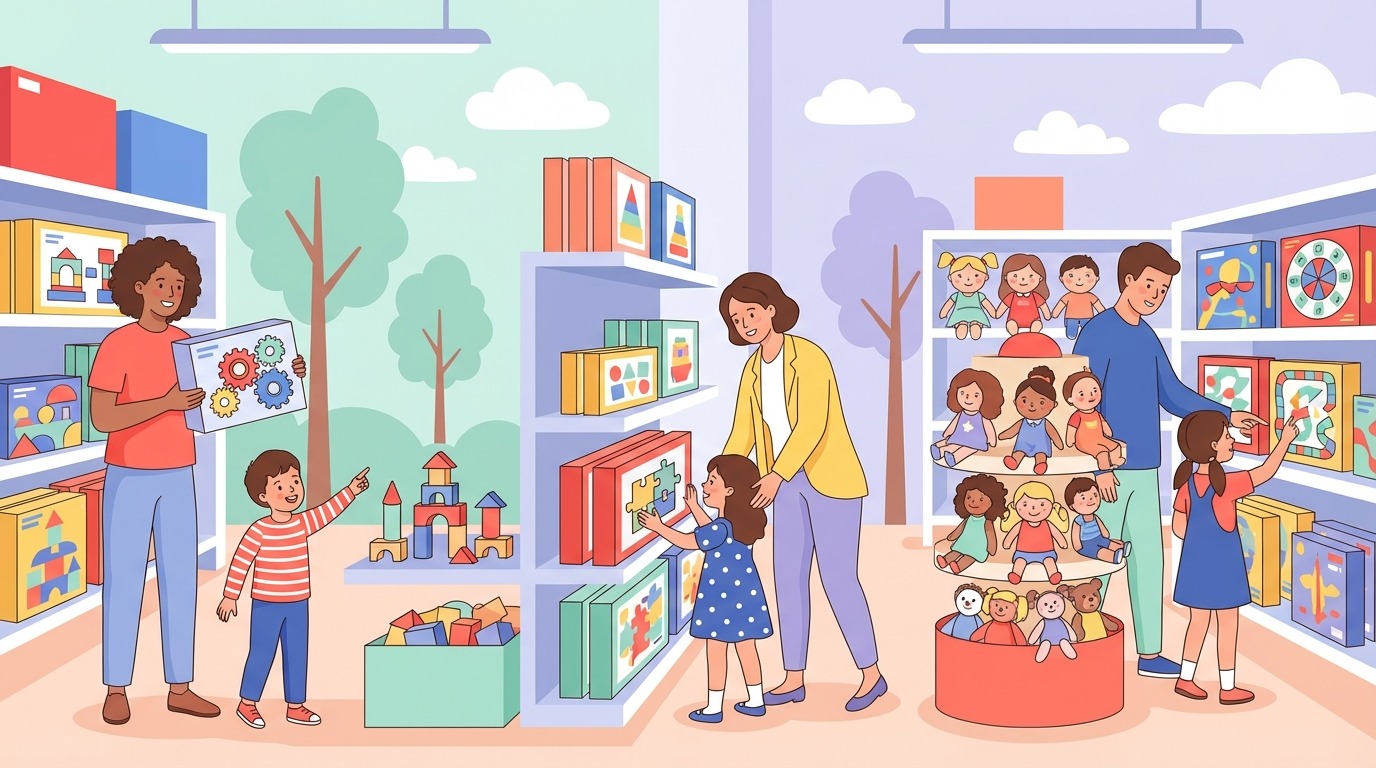
A toy that lets the child take control naturally stimulates creativity. Blocks, figurines, non-electronic cars, kitchen sets or costumes open worlds. The child tells stories, negotiates roles, explores causes and effects. This play grammar prepares reading, logic, and empathy.
Recent research confirms the weight of non-directed games. Less scripting, more ideas. In daycare as at home, a “construction” corner and an “imitation” corner are already enough to nourish a rich week. Leisure becomes a platform for education.
Adapt according to real development, not just the written age
Benchmarks for appropriate age guide well, but observing development also counts. To illuminate the choice, these milestones remain useful: the 3-4 years development shows the explosion of language and symbolic play. Between 3 and 5, fine motor skills and storytelling progress, as described in this overview of achievements. A toy that fits these dynamics is better used, therefore more profitable.
Classics maintain their power when combining quality and safety. The example of the famous rubber giraffe illustrates this link between simplicity and efficiency. This feedback nourishes many birth lists, as recalled in this article on Sophie la girafe and parents’ choices. The best toy is not always the loudest. It is often the most expressive.
Concrete ideas, from preschool to elementary school
For a child entering the “pretend play” phase, a set of tools or kitchen creates endless scenarios. With a construction board, the instructions remain open: build a house that stands with three supports, invent a bridge that carries three cars. These micro-challenges teach planning and adjusting.
And if school or library offers workshops, family-collective continuity strengthens learning. A citizen tool even exists to reflect on responsible buying, with 11 activity sheets and mini-projects. It also addresses advertising, fashion effects, and overpackaging. Your turn to play, because choosing a toy is also voting for a more sober world.
To fuel inspiration, a well-chosen video helps compose a basket focused on curiosity.
A toy that gets the child talking already does part of the educational work. The rest follows, without forcing.
Quality and durability: safe materials, eco-design and responsible second-hand
Materials that reassure and last
Quality is felt by touch and smell. Smooth wood without splinter, textile fibers that don’t pill, paint without aggressive odor: this is a solid base. Plastic is not banned, but it must resist shocks and not split into sharp elements. Tight seams and sturdy fastenings indicate superior durability.
Minimal packaging is a good sign. Overpackaging adds no use value. On the contrary, a clear guide and available spare parts prolong the toy’s life. This logic is part of more responsible consumption, without sacrificing pleasure.
Refurbished and second-hand: a good deal under conditions
The second-hand market has exploded. It is a real opportunity for the budget and carbon footprint. But the demand for safety remains. A damaged toy is not repaired for a child. Caution requires checking product recalls, seam integrity, presence of instructions, and condition of screwed battery compartments. A missing piece sometimes changes the game, sometimes the risk.
For wooden toys, run your hand over the entire surface. No roughness should catch. For puzzles and board games, validate completeness. As for plush toys, a high-temperature wash is mandatory before adoption. Second-hand then becomes an ally, not a lottery.
Eco-design and environmental education
Some manufacturers detail the origin of materials, repairability and recyclability of components. This is an asset for durability. When a child understands why packaging is reduced, they incorporate a civic gesture. Small projects at home can prolong this message: build a puppet theater with cardboard, create a figurine box from empty jars, design mission cards for blocks.
A public educational tool offers 11 cross-disciplinary sheets to approach these themes. The child reflects, then acts. Adults find concrete support to resist marketing sirens. The game gains meaning. This coherence avoids redundant purchases that disappoint quickly.
In the end, a solid, simple, and repairable toy in adult workshops lives longer. The planet and wallet both benefit.
Controlled budget: use value, toy rotation and ad blocking at home
When “low price” costs dearly
A toy at a very low price may seem tempting. But if it breaks quickly, the budget rises with replacements. Use value acts as a compass: how many times will it be used, by how many children, in how many contexts? A brick set, a pretend workbench or figurines span ages. These buys are lent, passed on, combined. The cost per hour of play drops.
Advertising sometimes creates artificial urgency. Setting a waiting list at home changes the game. A toy desired for three weeks proves its value. A 24-hour whim doesn’t. This rule calms the section and soothes the child.
Rotation, a lever that costs nothing
Put part of the toys away, then rotate weekly, relaunching interest without spending. Objects look new again in the child’s eyes. Shelves breathe and attention focuses. This method suits all appropriate age groups, with thematic baskets.
To organize rotation, an explanatory video gives ideas for baskets and shelves.
Game libraries and lending between families reinforce this effect. A tracking notebook notes what works, what bores and what deserves an extension rather than yet another duplicate.
Short case study: Léa, 4 years old, and Noé, 7 years old
Léa and Noé’s family set a quarterly purchase basket. By prioritizing an evolving construction set and a cooperative board game, disputes decreased. Shared playtime increased. Impulse buys halved. The older gained patience, the younger language. Only one electronic toy was kept, combined with figurines to enrich imagination. Result: more useful recreation, less waste.
To deepen the link between purchases and development, this guide on toys and child development summarizes the stakes well. It channels enthusiasm where it truly matters.
When the basket fills with versatile objects, the home echoes with stories, not beeps.
Organization and home safety: chest, maintenance, house rules and end of life
The toy chest, not a trap
The chest must breathe. Side openings or a lid that doesn’t close completely ensure ventilation. An anti-fall device prevents the lid from slamming on small fingers. An anti-pinch system completes the range. This trio turns a simple storage into a safety ally.
Open bins at child height favor autonomy. Pictures or pictograms on the front guide sorting: vehicles, figurines, blocks. Less disputes, fewer box falls, more desire to play.
Maintenance, sorting and house rules
A simple calendar avoids clutter. Every two months, a sorting removes broken toys. They go to the trash, no tinkering. Gentle maintenance extends the rest: washing plush, wiping blocks, checking batteries. A clear rule applies: play, tidy, move safely on the floor.
For toddlers, the play area remains visible and airy. Motor spaces are freed of small objects. Older kids participate in sorting, choosing what rotates out. The home becomes a living toy library.
Short list of concrete actions
- 🧺 Sort every 60 days, throw away any damaged toy
- 🧽 Wash plush and disinfect handles and cases
- 🪫 Replace or remove batteries before storage
- 📦 Collect small parts in zip bags
- 🚪 Install a ventilated chest, with slow-closing lid
- 🧒 Display 3 visual rules of play and tidying
Finally, remember that vision is preserved. 3D screens are not toys for little ones. A sober reminder avoids early exposure. To link these actions to daily development, this file on emotional development 5-6 years shows the importance of stable benchmarks at home. Consistency reassures the child and simplifies choices.
When logistics are smooth, the child plays better and longer. It is the best quality indicator.
“In the toy section, the best purchase doesn’t dazzle: it enlightens.”
Quel jouet polyvalent conseiller autour de 3-4 ans avec un petit budget ?
Miser sur des blocs de construction, des figurines non électroniques et une mallette de dessin. Ces objets soutiennent langage, motricité fine et imagination. Ils traversent les âges et se combinent entre eux. Pour situer les besoins, consultez ce repère clair sur le développement 3-4 ans et adaptez le panier en conséquence.
Le reconditionné, est-ce une bonne idée pour les jouets ?
Oui, si l’intégrité est parfaite. Vérifiez rappels produits, coutures, pièces manquantes et boîtiers à piles vissés. Passez la main sur les jouets en bois pour exclure toute écharde. Lavez les peluches à haute température avant usage. En cas de doute ou de dommage, renoncez : la sécurité prime.
Comment tester rapidement une peluche en magasin ?
Tirez doucement sur les poils, les oreilles, le nez et les yeux. Rien ne doit bouger ni s’arracher. Malaxez pour vérifier que le rembourrage ne s’échappe pas par une couture faible. Une peluche de qualité reste intacte après ces vérifications.
Faut-il autoriser la 3D et la réalité virtuelle aux enfants ?
Pas avant 6 ans, et usage modéré jusqu’à 13 ans. Ces technologies perturbent la convergence des yeux et l’accommodation. Mieux vaut privilégier des jeux ouverts, moteurs et symboliques. La vue se construit au fil du temps, sans accélérateur technologique.
Que faire d’un jouet cassé ?
On ne répare pas pour un enfant. Direction poubelle, pour éviter pièces détachées et risques coupants. Si le jouet est complet et intact, on peut au contraire le donner, le prêter ou le revendre. La règle est simple : sécurité d’abord.