Affective 5-6 Years: The affective development of children aged 5-6 years.
| Short on time? Here is the essentials ✨ |
|---|
| 🧠 At 5-6 years old, the child refines their emotions, strengthens attachment, and builds their emotional security. |
| 👪 The parent-child relationship nourished by rituals and listening boosts self-confidence. |
| 🗣 The expression of feelings is conveyed through words, gestures, and non-verbal communication. |
| 🧩 Role-playing games develop empathy and conflict resolution. |
| 🌱 Emotional autonomy is built through daily, concrete, and consistent tools. |
Between 5 and 6 years old, the child reaches a decisive milestone: they put words to what they experience, explore nuance, and seek a framework that supports without stifling. In this phase, emotional landmarks become more precise, and each micro-event – a quarrel in the yard, a bedtime cuddle, frustration at the table – becomes a living learning ground. This age requires attentive listening, clear responses, and consistent gestures, because stability nourishes a solid emotional security.
This development does not happen in isolation. It unfolds within the family, at school, with grandparents, and at the heart of very concrete activities. Children read the world through tone of voice, gaze, and time organization. Well-supported, they gain self-confidence, empathy, and a sense of others. They learn to name their emotions, to ask for help, and to make small decisions that matter a lot. 🌟
Emotional development at 5-6 years: understanding emotions, attachment, and emotional security
At 5-6 years old, the child is at a crossroads: they can recognize anger, joy, or sadness, but especially discover subtle fear, pride, shame, or disappointment. This emotional subtlety is anchored in recurring and understandable experiences. When adults name the sensation and show how to act, they validate the experience and offer a path to calm.
The emotional framework is organized around attachment. A reliable, predictable, and warm adult becomes a secure base that allows exploration. This foundation builds an emotional security that reduces outbursts and enables better recovery after a conflict.
Let’s illustrate with Lina, 5 and a half years old. When she spills her juice, her parent breathes, names the mistake, and proposes a simple solution. This micro-scene protects self-esteem, prevents guilt from growing, and establishes a reparative logic.
The social brain also develops. At this age, the child notices the effect of their actions on others and seeks a form of justice. This sensitivity prepares the nascent morality, already sketched earlier, and clarified today by explained rules.
The emotional routine plays a key role. Regular transitions, bedtime rituals, and warm greetings mark the day. Thanks to these landmarks, the child anticipates, prepares, and better regulates their emotions.
Developmental resources help understand the trajectory. By comparing earlier stages, such as those detailed for younger children, one reads continuity and qualitative leaps. For a global perspective, this file on development of 3-5 year olds provides a useful foundation.
Earlier traces also leave marks. The differences observed between 13 and 18 months regarding the quest for reassurance still shed light on certain relational automatisms. A look back at emotional development of 13-18 month olds puts into perspective the importance of quick and consistent parental responses.
In practice, it is relevant to translate emotion into action: “You are frustrated, you can tear paper in the anger box,” “You are proud, go stick a star on your notebook.” Each concrete option inscribes a regulatory path. Thus, the experience becomes clearer and gains control power.
Final point of attention: the 5-6 year old child alternates autonomy and regression, especially during periods of change. It is then appropriate to increase presence and simplify expectations, until the storm calms. The heart learns quickly when the framework is stable, simple, and warm.
Parent-child relationship and self-confidence: rituals, limits, and encouragement
Rituals that anchor and reassure
Routines are not constraints, they are compasses. A gentle wake-up, a clear goodbye, a calming return after school, then a bedtime story: this framework reassures. With stable landmarks, the child anticipates and better engages their choices.
Building the day around meaningful gestures saves emotional time. The brain no longer struggles against uncertainty and can invest in bonding, play, and learning. The parent-child relationship thus becomes smoother, more joyful.
Explicit and embodied limits
At 5-6 years, rules make sense if they are explained with simple words and clear consequences. Saying “We speak quietly in the library to respect others” links the norm to empathy. The child then understands the social impact of their actions.
Consistency is better than severity. When a rule is applied calmly, emotional security remains intact. The message becomes: “You matter, so does the rule.”
Encourage without inflating the ego
Self-confidence is nurtured by precise feedback. Saying “You waited your turn, that helped your friends” reinforces an observable skill. In contrast, vague praise fades quickly and creates external dependence.
An additional support concerns nascent morality. To refine this sense, a detour through the child’s moral conscience articulates rules, values, and concrete consequences.
To visualize these principles in action, this video research is inspiring.
After viewing, it is wise to choose a single ritual to strengthen for two weeks. This pace allows appropriation and highlights visible progress. Then, a second ritual can be added without overloading the family.
- 🧸 Strengthen a soothing “comfort phrase” at separations.
- 📚 Create a visual card of evening routines, simple and colorful.
- ⏳ Install an hourglass to pace waiting for the turn to speak.
- 💌 Slip a heart-note in the bag on school outing days.
- 🎯 Set one key rule per week, clear and doable.
These targeted gestures avoid scattering. They draw a readable and supportive educational line. Embodied rituals grow confidence and soothe daily life.
Expression of feelings and non-verbal communication: concrete tools and role-playing games
Put simple words on intensity
Expression of feelings is not limited to emotional labels. It involves measuring intensity: a homemade “thermometer” from 1 to 5 makes regulation more accessible. The child points to the level, then chooses an associated strategy.
It becomes useful to link words and gestures. For example, “level 4 anger” may call for “hands pressed on the cushion” and “glass of water.” This repeated association creates protective automatisms.
Read non-verbal communication
Non-verbal communication structures the relationship. Voice tone, posture, and gaze influence the message reception. By modeling a calm voice and broad gestures, the adult offers a bodily tutoring.
A quick exercise is to guess together the mood of a silent character in a picture book. The child learns to decode the face, shoulders, body orientation. They train their social radar without pressure.
Play to tame
Role-playing games work like an emotional simulator. One replays a playground quarrel, then swaps roles to experience the other point of view. This inversion fosters empathy and flexibility.
To equip the game, material supports help. Thematic sets presented in this guide on toys serving development open rich scenarios. Likewise, a mirror can reinforce bodily awareness; this file on mirror and development shows the benefits.
Nursery rhymes provide rhythmic support for self-regulation. A soft song to slow breathing facilitates emotional descent. For ideas, explore these awakening nursery rhymes which inspire brief and effective rituals.
Practical scenario: an “emotion box” contains face cards, mini accessories, and an hourglass. One draws an anger card, chooses an accessory (red mask), and plays a repair scene. Then, roles are swapped to test another outcome.
Progress tip: alternate mastered scenes and slightly more difficult situations. The graduated challenge avoids panic and supports boldness. Every success nurtures self-confidence.
For some families, a reminder of earlier stages clarifies current needs. This article on development 31-36 months describes milestones that still resonate here. The thread is visible: same strategy, enriched vocabulary, more social stakes.
Last landmark: associating word, gesture, and gaze produces leverage effect. The message becomes whole and reassuring. When the body speaks with words, the child integrates faster and deeper.
Empathy, friendships, and conflict management at school: practical cases and mediation
Birth of an active social conscience
Friendships form, are tested, and sometimes get bruised. At 5-6 years, the group strongly influences choices. This context stimulates empathy, but also rivalries, inevitable and formative.
A three-step model clarifies intervention: recognize the emotion, name the need, seek a feasible solution. This sequence turns tension into learning.
Playground scenes: from conflict to solution
Case of Max and Naïm who want the same ball. The adult announces: “You are angry, you want to play now.” Then, they propose two outcomes: a timer to alternate, or cooperate to invent a rule for two. Guided choice preserves fairness.
Second case: Inès feels excluded from a game. Her pain is validated, a clear request is suggested: “I want a spot when Noah leaves.” Negotiation becomes concrete and respectful.
It is useful to model these mediations. A short video search can spark inspiration and provide simple scripts.
After viewing, suggest a ground rules charter: “We describe, we ask, we choose.” This phrase is posted near the play area. Children refer to it before calling the adult.
Table of cooperative games and targeted skills
| Role-play / cooperative game 🎲 | Socio-emotional skill 🌈 | Observable indicators 👀 |
|---|---|---|
| “The calm leader” | Self-regulation, non-verbal communication | Calm voice, slowed gestures, active listening |
| “The kindness machine” | Empathy, cooperation | Offerings of help, shared smiles |
| “The ideas market” | Negotiation, flexibility | Formulation of choices, quick compromise |
| “Emotion chairs” | Reading emotions, respect for turn-taking | Regulated waiting, clear reformulation |
This framework equips adults and values children. It creates a common culture that reduces shouting and increases cooperation. The climate calms, the class learns better.
Finally, warning signs must be taken seriously: persistent isolation, frequent outbursts, very disturbed sleep. A shared assessment with school and family then clarifies needs. Empathy is better taught when adults practice what they preach.
Emotional autonomy at 5-6 years: calming rituals, symbolic play, and toolbox
Simple and effective self-soothing rituals
Emotional autonomy is built through short, repeated, and chosen gestures with the child. A “quiet corner” with cushion, hourglass, and breathing card becomes a landmark. One goes there before “overflowing,” like drinking before becoming very thirsty.
A repertoire of graduated actions helps choose quickly. At home, three cards suffice: move, breathe, ask for a hug. At school, the child points to an image, then returns to the group after a minute.
Symbolic play: re-enact to digest
Symbolic play digests strong events. Replaying the doctor’s visit or morning separation releases tension. A doctor’s kit or a “house-school” cabin serves as stage and shelter.
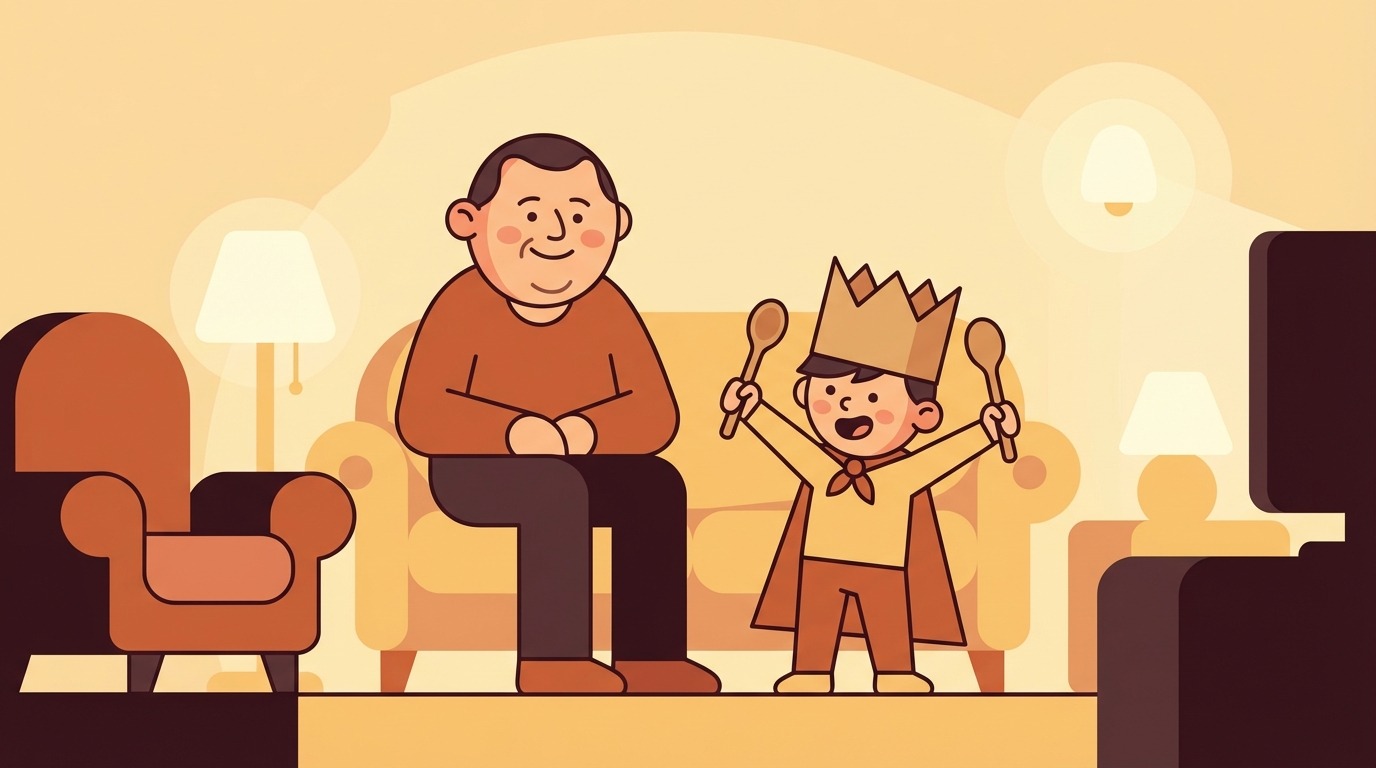
Accessories don’t need to be sophisticated. A spoon becomes a microphone, a blanket becomes a cape. What matters is the shared story and the possibility to change the ending.
Concrete tools and educational continuity
Assembling an “emotion toolbox” strengthens family coherence. One slips in a pride notebook, request cards, a small breathing mirror, and a timer. This continuity stabilizes responses and reassures the child.
To complete the set, a detour through playful resources structures choices. Guides for targeted play material illuminate useful and evolving purchases. Thus, each object finds a precise function.
Some children respond better to sensory support: stress ball, motor course, soft music. The idea is to offer varied doorways, then refine what works. The child discovers themselves, gains mastery and pleasure.
For curious families about earlier trajectories, this link on development 13-18 months recalls the strength of quick and warm responses. The trace of these experiences is often found in the quality of self-soothing.
In institutions, a “I need…” sheet allows the child to signal without speaking. This alternative respects modesty and avoids explosion. Gradually, speech takes over.
Key point: joyful repetition. We do again often, in short times, valuing every small success. Chosen rituals become protective and liberating reflexes. 🌿
“Emotions are messengers; when we listen to them, they show the way.” Growing up with an open heart is learning to understand oneself to better love others.
How to help a 5-6 year old child name what they feel?
Offer simple vocabulary (joy, anger, fear, sadness) then nuances (disappointed, proud, jealous). Use a thermometer from 1 to 5 for intensity. Associate each level with a concrete action (breathe, ask for a hug, take a break).
What to do in case of frequent crises?
Tighten routines, reduce demands, and anticipate transitions. Create a quiet corner with timer and action cards. If crises persist or worsen, discuss with the school and consult a professional.
How to strengthen self-confidence without overvaluing?
Give precise feedback on observed behavior (you waited your turn). Set concrete and short objectives. Avoid global labels (you are the best) and prefer effort and the strategy used.
Are role-playing games suitable for all children?
Yes, but vary the format. Some prefer to stage a stuffed animal, others to play themselves. Respect the child’s pace, propose short scenarios, and switch roles to foster empathy.
What is the role of school in emotional autonomy?
A simple charter (I describe, I ask, we choose) and a shared quiet corner create a common language. Adults model calm voice and quick repair. Home-school coherence accelerates progress.