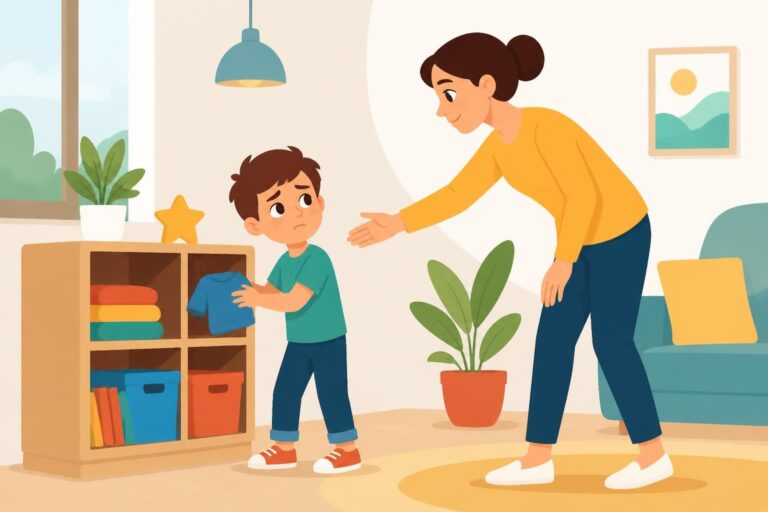
Leaving Child Alone at Home: Leaving your child alone at home: at what age? (5-8 years).
Between the desire for child independence and the duty of protection, many parents wonder when it is appropriate to consider a short moment with a child home alone, especially between 5 and 8 years old. In France, no law sets a precise age, unlike Quebec which mentions 12 years old. This lack of an official threshold places the decision at the heart of parental supervision and maturity assessment. At this age, the issue is not to set up regular care but to test, step by step, a few minutes of secure autonomy. With clear guidelines, careful child home preparation, and a structured environment, these micro-absences can build children’s confidence and ease adults’ concerns.
But how to untangle the true from the unclear, when daily life presses and caution remains the golden rule? First, by understanding what the law says, and especially what it does not say. Then, by observing concrete indicators of child confidence and discernment. Finally, by marking the house with simple house rules, reassuring rituals, and flawless logistics. This guide offers actionable guidelines, adapted for 5-8 year olds, to gradually combine child safety age, family serenity, and learning autonomy. Because, ultimately, the goal is not to “leave a child unsupervised,” but to orchestrate short, controlled trial moments to prepare the future without skipping steps.
| Short on time? Here’s the essential ✨ |
|---|
| No legal age in France; the decision depends on maturity and context 🧭 |
| Between 5 and 8 years: a few minutes at most, during the day, and nearby ⏱️ |
| Prepare an emergency plan, visible numbers, and a neighbor spotter ☎️ |
| Ban kitchen, balcony, hazardous products; child domestic safety first 🧯 |
| Test progressively and debrief after each trial 🧩 |
| Never at night, never in charge of a younger child; child responsibility adjusted 🌙 |
| If in doubt, prefer a trusted childcare solution 🤝 |
Parents, from what age is it reasonable to leave your 5-8 year old child alone for a few minutes?
In France, the law does not set any age threshold for a child home alone. However, parental authority requires guaranteeing safety and well-being at all times. In this legal gray area, common sense becomes the compass. Between 5 and 8 years old, it is only about very brief absences, measured in minutes, the time to take out the trash or pick up a package. No more. No evening, no whole hour, and certainly no care of a younger sibling.
The contrast with Quebec, where the reference age of 12 is often cited, sheds light on the French approach: here, the clock does not decide. Only maturity matters. In 2026, professionals agree on a responsible progression: experimenting short sequences when the child is calm, reassured, in a secure home, with a reachable and nearby adult. This parental latitude is however not immunity. Neglect of a minor can be invoked if the child is exposed to an objective danger.
Legal framework, risks and concrete guidelines
The Civil Code reminds of the protection owed to the child. Everything therefore depends on the context: duration, environment, ability to call, and proximity of a reliable third party. Concretely, parents who are away for two minutes with a turned-on phone, an informed neighbor, and a calm child, are not in the same situation as those who leave for 45 minutes without instructions. Judges consider child domestic safety as much as duration.
To clarify, a practice is emerging: before 9-10 years, we talk about micro-absences during the day only. At 7-8 years, some personalities handle five minutes without stress, others do not. In any case, the child must not be afraid, nor caught up in a risky task. This moment is a supervised parenthesis, never a lasting delegation.
This logic protects child confidence. It shows that autonomy is not an injunction, but training. Moreover, the next step concerns emotional and practical maturity, the cornerstone of any decision.
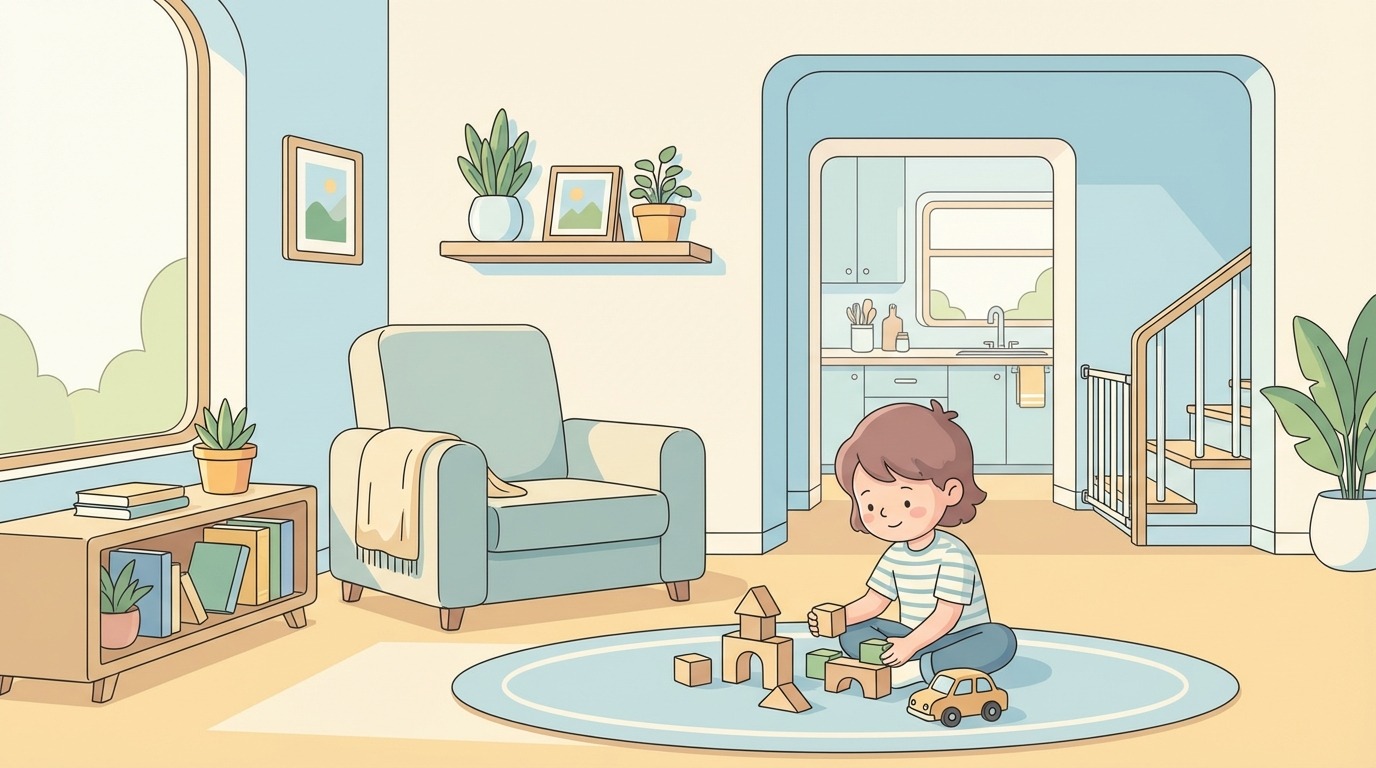
Child safety age 5-8 years: evaluating maturity without error
The ability to stay alone for five or ten minutes is read in simple gestures. Does the child follow a rule without reminder? Does he keep calm when a noise surprises him? Can he dial an emergency number or that of a relative? This discernment grid, more reliable than the legal age, helps avoid a hasty decision.
Pragmatic observation grid
- 🧠 Emotional regulation: expresses fear without panic, accepts a short delay.
- 📞 Practical skills: knows how to use a phone and give his address.
- 🚪 Safe behaviors: does not open the door to a stranger, locks the door, stays in allowed rooms.
- 🧩 Sustained attention: can play quietly for 10-15 minutes without seeking risk.
- 🗣️ Clear communication: rephrases the house rules, commits to respecting them.
- 🤝 Acceptance of the framework: asks for agreement, does not experience absence as punishment.
To reinforce this basis, knowledge of development helps. Understanding body rhythm, impulsivity, and the notion of danger feeds adapted decisions. A detour via child psychomotor development usefully illuminates this field. Moreover, children aged 5-8 progress quickly when the issue is concrete. Thus, posting useful numbers near the phone, repeating a mini-emergency scenario, and ritualizing a “go” signal reduce uncertainty.
A telling example: Inès, 7 years, very cautious, first simulated a micro-absence with a 3-minute timer, mom on the landing. Then, after a calm debrief, the family tried 5 minutes, always with a reachable adult. As soon as anxiety appeared, they went back. This reversible approach protects the child safety age and strengthens parental supervision without tension.
Last point: fatigue distorts reactions. In the evening, impulsivity rises. Avoid any test when the child is exhausted remains a golden rule. In summary: the “ideal” age does not exist. Maturity is read, cultivated, and verified before each attempt.
Child home preparation: protocols, rituals and child domestic safety
Moving from idea to action requires a clear plan. Child home preparation is built like a positive checklist. The home must be tidy, risk areas closed off, and the call scenario well oiled. This organization, far from being anxiety-inducing, reassures the child: he knows what to do, when, and who to talk to in case of unexpected events.
Essentials for a secure framework
- 🔒 Lock the door and forbid opening it to strangers.
- 🧯 Block access to the kitchen, cleaning products and tools.
- 📍 Display a sheet with address, keypad code and three priority numbers.
- 📶 Keep a charged, ringing phone that is easy to access.
- 👀 Inform a neighbor or an available relay person.
- 🕒 Limit the duration: 3-10 minutes at 5-8 years, during the day, parent nearby.
- 🧸 Provide a calm activity: coloring, reading, puzzle.
To avoid boredom and channel energy, reading is an ally. A calming book corner, chosen by the child, turns waiting into pleasure. The benefits of reading on attention and imagination strengthen behavioral safety. Conversely, screens excite, isolate and blur the perception of time. It’s better to ban them during these trials.
Another concrete lever: assign a micro-mission, rewarding and not risky. Water a plant, sort crayons, feed the fish. These tasks set a framework and nurture child confidence. For more active children, a ready-to-use creative kit works very well. Simple, tested and validated craft ideas can be found via this selection of creative videos.
Finally, the organization benefits from relying on a departure ritual and a return ritual. Say the scheduled time, remind the key rule, show the phone, then greet with an agreed sign. Upon return, congratulate, debrief, and note what worked well. This learning loop perpetuates child domestic safety and turns a tiny absence into a great emotional victory.
A solid preparation reduces risk and raises competence. It teaches that freedom is inseparable from responsibility, even at 7 years old, when everything begins gently.
Practical scenarios 5-8 years: case studies, mistakes to avoid and clever tools
Staging concrete cases helps to project oneself. Take Léa, 6 years old, shy but diligent. First test: 3 minutes, parent on the landing, coloring activity. She remains calm, checks the door, does not touch the kitchen. The following week, 5 minutes with a small mission: sorting her felt-tip pens by color. The feedback is positive: a precise compliment anchors success. On the other hand, a very tired evening, the test is canceled. This consistency avoids emotional ups and downs.
Another profile: Noah, 8 years old, curious and quick. He knows the address, can call grandma, but gets bored quickly. For him, providing a short list of safe actions is key: read a story, feed the cat, then listen to a song. Screens remain prohibited. A magnetized “to do” board helps him navigate. To boost his motivation outside these moments, supporting concentration with these tips to motivate a child to do homework complements the approach.
Common mistakes to avoid
- ❌ Extending the duration “because it’s going well”. Progress must remain slow.
- ❌ Forcing solitude on an anxious child. Agreement and serenity prevail.
- ❌ Forgetting to inform a trusted adult. The relay reassures everyone.
- ❌ Starting a test in the evening. Fatigue increases impulsivity.
- ❌ Entrusting the care of a younger child. At 5-8 years, this is impossible and dangerous.
In the same spirit, a stable sleep rhythm protects emotional regulation. The guidelines from a bedtime routine improve mental availability for these daytime micro-challenges. Thus, the home becomes a learning ground, without pressure, thanks to clear and achievable objectives.
Over the course of the trials, parents realize that autonomy is not decreed: it is scripted. The keyword remains regularity: same gestures, same instructions, same rewarding feedback. This consistency builds a lasting inner security.
Leave a child unsupervised? Safe alternatives, technologies and trusted relays
At 5-8 years, the rule is simple: no autonomous care. If the situation requires an absence longer than a few minutes, it is better to rely on an adult. A retired neighbor, an available aunt, or a trained babysitter. Innovative childcare services, including those combining play and awakening, offer agile solutions depending on schedules. Exploring paths like this focus on innovation in childcare can inspire flexible and secure formats.
Technology helps but does not replace presence. A one-button video intercom, a connected smoke detector, and a video doorbell provide useful signals. However, no device dispenses with effective parental supervision. Devices complement a human plan, they do not found it. Moreover, multiplying notifications can stress the child. A balance is required.
Checklist “fallback solution” for busy parents
- 🧭 Identify two relay persons, with visible numbers.
- 📅 Anticipate busy days; block a childcare slot if necessary.
- 🏠 Keep a spare key with a trusted neighbor.
- 🧼 Secure kitchen, balcony, bathroom before any absence.
- 🧃 Prepare an accessible snack to avoid the temptation to cook.
On the whole, these choices illustrate a guiding principle: protect the child without restricting their drive. It is better to give up a test on a fragile day and schedule a trial on the weekend, in a calm context. The parental ethic here is a long-term art. Each successful micro-absence prepares the next, and child independence weaves smoothly.
Ultimately, the majority alternative remains the presence of an adult. Devices and rituals are only safeguards. At 5-8 years, these nets reassure and later allow for authentic, chosen autonomy.
What is the minimum age for a child home alone in France?
No age is set by law. Between 5 and 8 years old, it is only about micro-absences of a few minutes, during the day, with a reachable and nearby parent.
What house rules should be established before a first test?
Lock the door, do not open to anyone, stay in allowed rooms, ban the kitchen, post useful numbers, keep the phone charged, and inform a neighbor relay.
How to know if the child’s responsibility is not too heavy?
If the child shows fear, agitation or refusal, postpone. Maturity is seen in obedience to instructions, ability to call for help, and managing a short calm time.
Can a 7-year-old child be entrusted with caring for a younger sibling?
No. At 5-8 years old, it is forbidden to entrust care of a younger child. Priority remains safety and absence of burden.
Maximum duration at 5-8 years old?
From 3 to 10 minutes depending on maturity, only during the day, with a reachable and immediately nearby parent. Beyond that, rely on a trusted adult.
“A child’s autonomy grows like a plant: drop by drop, in the light of trust, never in the shadow of haste.” 🌿