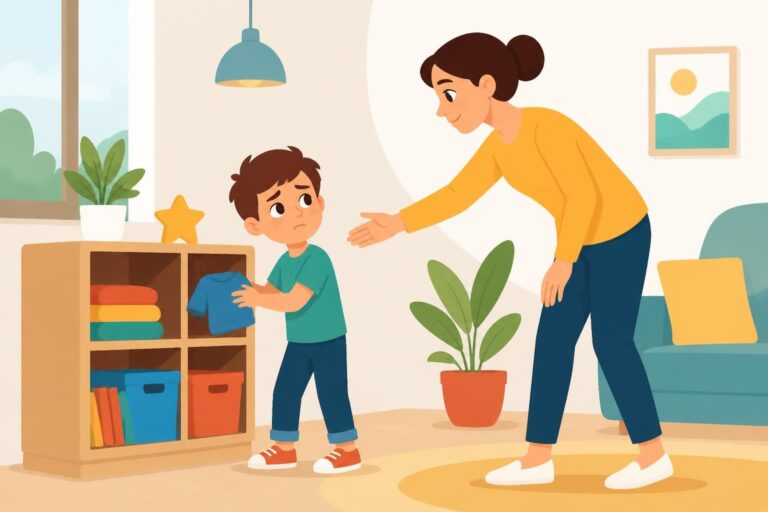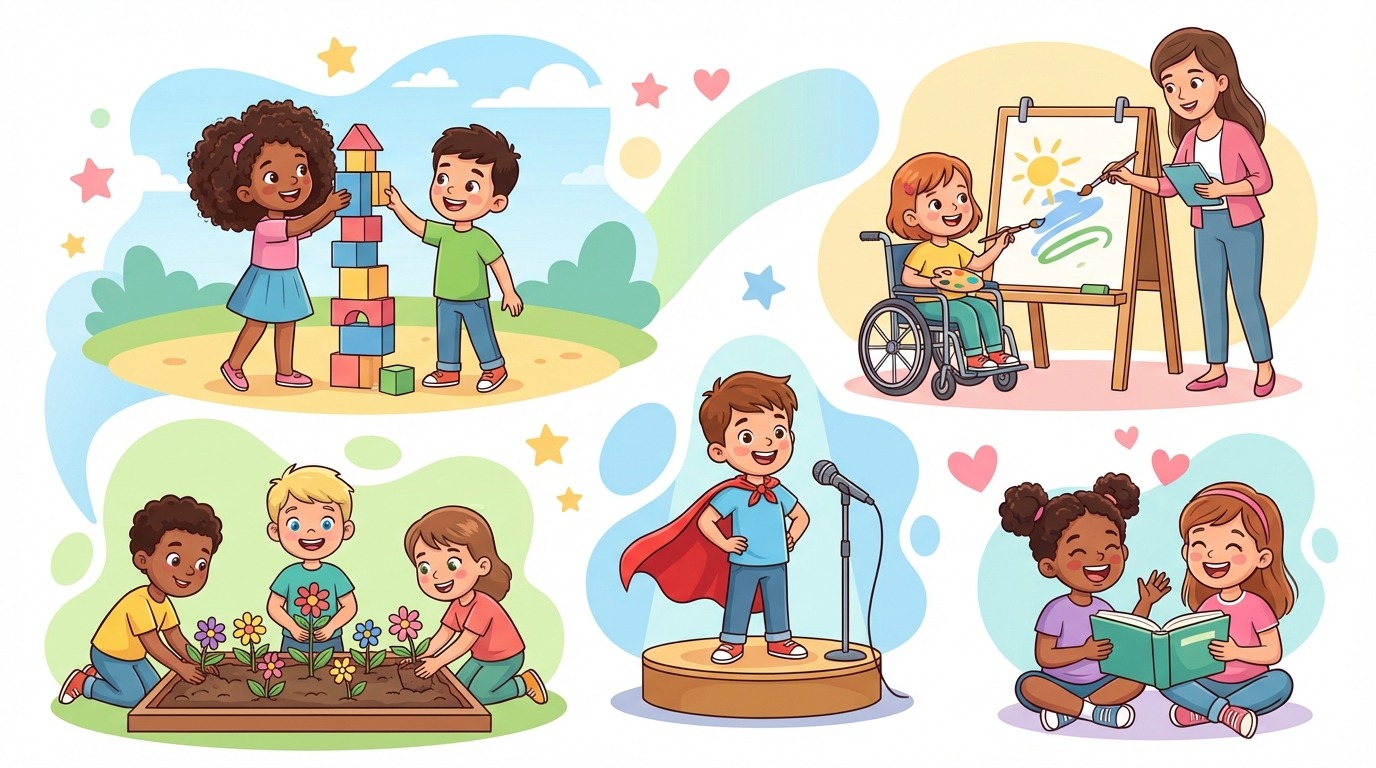
Self-Esteem Children: Self-esteem in children aged 5 and over.
| Short on time? Here’s the essentials ✨ |
|---|
| Valuing effort rather than the grade boosts children’s self-confidence 💪 |
| Observing without judging helps to spot early signs of fragile self-esteem 👀 |
| Encouraging the expression of emotions supports emotional development from preschool age 💬 |
| Strengthening strengths increases motivation and spreads ease towards more difficult areas 🌱 |
| Creating concrete rituals (pride notebook, “warm shower”) anchors a positive self-image 📘 |
| Offering adapted choices nurtures autonomy and self-assertion 🧭 |
| Consulting if necessary in case of withdrawal, anxiety, or persistent devaluation 🩺 |
Developing the self-esteem of children aged 5 and above requires clarity, patience, and concrete daily actions. The early school years crystallize comparisons, labels, and social challenges. Yet, dynamic self-confidence acts as a protective shield against criticism and failure. By focusing on the process rather than the result, each progress becomes an inner victory. This article gathers precise markers, everyday examples, and proven tools to transform doubts into springboards for personal growth.
In a child’s life, self-image is shaped at the crossroads of family, school, and peer gazes. Spotting subtle signals, understanding the origins of fragile self-esteem, then establishing positive self-evaluation rituals form a winning strategy. From the “warm shower” to cooperative games, from puppets to the small steps method, each lever supports emotional development and strengthens self-assertion. The links between autonomy, motivation, and psychological well-being then become obvious, and the educational trajectory is thus eased.
Spotting fragile self-esteem early in children aged 5 and above
Self-esteem is often read in the choices children make when facing something new. At 5 years old, then at the start of primary school, some avoid challenges. Others copy “so as not to make mistakes.” This reflex of constant imitation is not a mere coincidence. It often betrays a fear of error and a shaky self-image. A child convinced they won’t succeed clings to external models. They observe, reproduce, and wait for approval before daring.
Warning signs are concrete. Extreme sensitivity to criticism can turn into rapid discouragement. Phrases like “I’m worthless” or “I’ll never make it” are clear indicators. Added to this is sometimes a systematic request for help before trying. When these behaviors become recurrent, early action prevents the installation of a devaluation pattern. Close monitoring is then essential to protect self-confidence.
Recurring behavioral signs not to minimize
A child who always seeks adult validation before acting sends a message. They do not allow themselves to have their own internal reference. Furthermore, avoidance of new games or open instructions reveals a fear of making mistakes. Constant comparison with peers structures the view of oneself. Instead of nuanced self-evaluation, the child assesses themselves according to an external standard. This mechanism undermines self-assertion and slows intrinsic motivation.
Emotions provide another thermometer. Intense crying at the slightest obstacle, disproportionate irritation to remarks, or frequent mutism in a group point to fragile self-esteem. It is not about pathologizing normal reactions. It is about spotting their frequency, intensity, and impact on psychological well-being. Gentle, regular, and contextualized observation allows distinguishing between a passing phase and an established problem.
Case study: Lina, 6 years old, and the fear of making mistakes
Lina loves coloring. Yet, in class, she always copies her neighbor’s house before drawing her own. When the teacher proposes a free activity, Lina asks: “Is this okay like this?” Adults decide to change their approach. They highlight her ideas, not just the final result. Gradually, she allows herself personal trials. Her drawings gain originality. Above all, she begins sharing her discoveries with a friend, a sign of emerging self-assertion.
Along the same lines, a parent can transform performance anxiety into curiosity. Questions like “What did you like about what you did?” encourage self-evaluation. Competence then becomes a path. The child replays their efforts and discovers that their abilities grow. Repeating this ritual establishes a more reliable internal reference than others’ judgment. The virtuous circle begins.
Positive micro-indicators to amplify
A child who dares to propose a rule in a playground game takes a step toward self-assertion. Another who recounts frustration without judging themselves progresses emotionally. These micro-signs deserve to be highlighted. A descriptive compliment such as “I saw that you persevered” nurtures self-confidence without locking the child into a label. This way of encouraging consolidates self-image sustainably.
To go further, playful tools enliven observation. A “pride notebook” where the child notes one success per day marks progress. Creative supports further accelerate the effect. For example, valuing puppet shows encourages expression and symbolization. On this subject, simple ideas are proposed here: the power of puppets in children. In conclusion to this first step, spotting early is already beginning to repair.
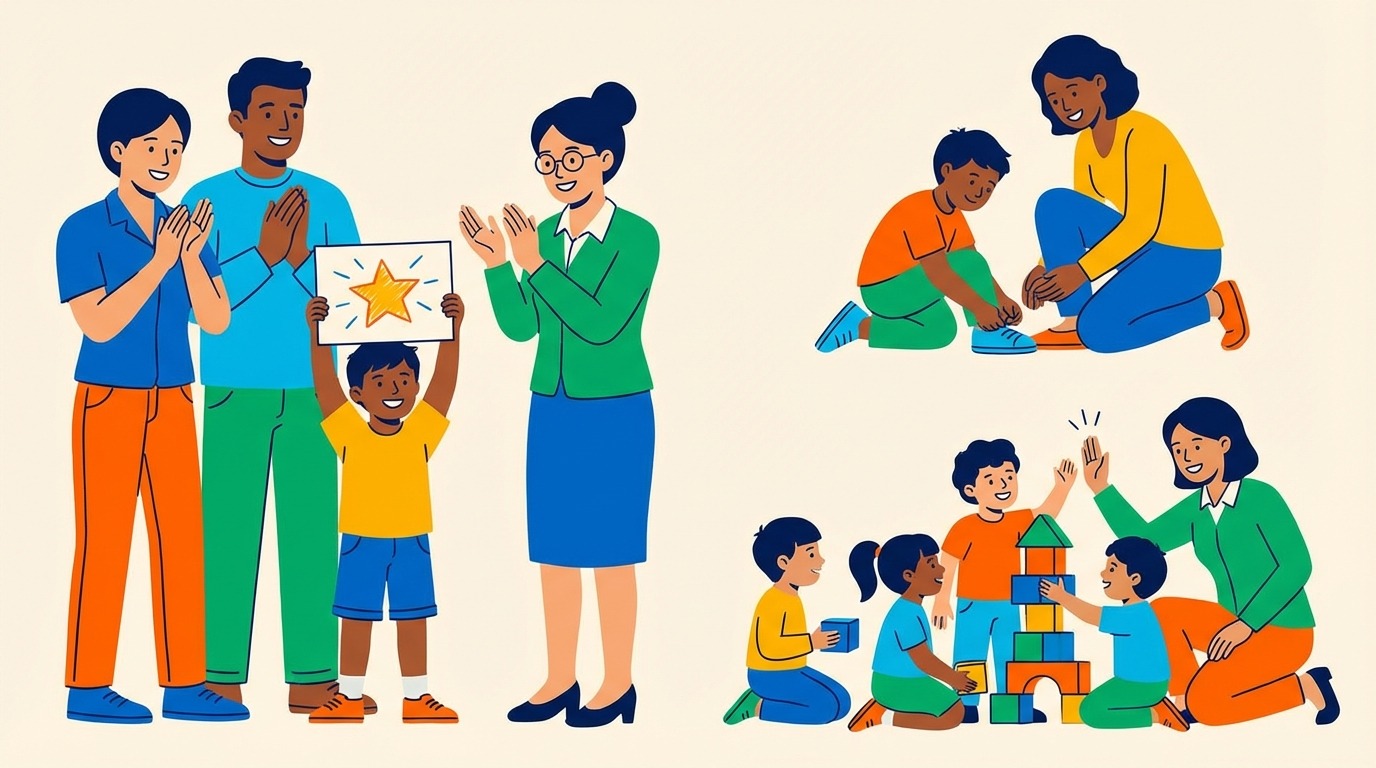
Parents, teachers, relatives: postures that strengthen self-confidence
At the heart of the home or the classroom, the adult’s posture shapes the child’s inner climate. Prioritizing the process is rehabilitating the attempt, error, and iteration. The results then become steps, not verdicts. This approach leads to a profound change: the child learns to love what they do before judging what they have done. Motivation follows because the pleasure of learning survives setbacks.
The key also lies in personalizing expectations. Everyone has different intrinsic potential. Aligning activities with natural talents avoids imposing too narrow paths. A child sensitive to the artistic might enter mathematics through drawing patterns, for example. Thus, self-assertion is strengthened on familiar ground before venturing into more demanding domains.
Transforming compliments to nourish self-image
Descriptive compliments signal what was observed, not what the child “is.” This nuance allows them to evolve. Saying “you are the best” traps them in a fragile label. Saying “I noticed your patience” solidifies a reusable skill. The child integrates that they can reproduce an effective attitude. Their emotional development gains stability.
Family rituals anchor these gestures. The “warm shower” in a circle, where each member whispers a quality into another’s ear, deposits positive mnemonic traces. This experience supports cohesion and psychological well-being. In class, an effort wall highlights attempts, not rankings. Everyone progresses at their own pace. Preschool and early primary especially benefit from these encouraging environments.
20 useful daily phrases
- 💖 “I love you because you are you.”
- 🧩 “You haven’t succeeded yet, keep going.”
- 🔎 “I saw that you persevered.”
- 🎯 “What small step will you take today?”
- 🧠 “What did you learn from this experience?”
- ⏳ “Your patience made the difference.”
- 📘 “Let’s note this success in your pride notebook.”
- 🎨 “Your house has original lavender shutters.”
- 🤝 “Can you explain your method to your friend?”
- 🌟 “I believe in you.”
- 🧭 “You advance at your own pace, on your path.”
- 💬 “What does your intuition tell you?”
Attachment bonds remain essential. The father’s role, for example, can support boldness and initiative-taking. For further reading, this article offers insights on trust: paternal love and trust. Finally, playful supports facilitate recognizing progress. A tool to discover: a symbolic “certificate” to value self-esteem. The good adult posture becomes contagious: it inspires the child to believe in their capacity to grow.
Understanding the origins of fragile self-esteem to better rebuild it
Self-esteem is built from birth, then reorganized at each major milestone: preschool age, entry to grade one, teacher changes, new groups of friends. Family interactions lay the first bricks. School feedback, sibling dynamics, and house rules shape the inner voice. When criticism is repeated, and comparisons become the norm, the child internalizes suspicion towards themselves. Their self-image is tinged with doubt.
Over the years, unsupported experiences of failure sediment a pessimistic vision. Perfectionism can mask this fragility: as long as it’s perfect, the world holds. But as soon as errors appear, confidence collapses. To prevent this oscillation, it is necessary to normalize the attempt, to talk about “experience” rather than “failure.” This simple semantics encourages motivation. It opens a safer learning space.
When the social environment weighs too heavily
Mockery about appearance, accent, or interests harshly affects self-perception. Social networks sometimes heighten comparison, even among the youngest exposed to older content. Putting words on feelings, supporting emotions, and reminding the diversity of talents lessen the impact. A child must feel they have nothing to prove to deserve their place. This foundation soothes reactivity and supports self-assertion.
“Problem” behaviors often indicate inner tension. For example, biting in kindergarten is not always “meanness.” It may signal emotional overload or a need for structure. Concrete markers exist to manage these sensitive moments: when children bite: better understand and act. Respectful support restores internal security. The child learns to regulate their impulses, with help.
Identifying limiting beliefs to reconfigure them
Beliefs like “I am not athletic,” “others are smarter” settle early. A benevolent interview maps out these certainties. Contexts where they appear are identified, then confronted with lived counter-examples. The goal is not to deny feelings. It is to show that other stories exist. This work redraws self-evaluation. It consolidates an explorer’s stance.
For some children, fear of disappointing parents stiffens everything. Here, the clear message “you have nothing to prove to be loved” acts like a balm. It frees cognitive energy wasted on control. Motivation then returns to the service of learning. In parallel, guided readings allow identification with resilient heroes. These stories expand the imagination of possibilities.
If needed, a child development professional can support this reconstruction. Warning signs to watch include prolonged social withdrawal, sleep disorders, negative verbalizations over several months. Consulting early offers a shortcut to adapted strategies. Calm vigilance beats worried waiting.
Finally, certain learning stages, like writing, trigger vivid comparisons. Offering practical bridges helps maintain confidence. On this subject, useful markers exist to support the acquisition of graphic gestures: learning to write at school. Preventing the spiral “I can’t do it” protects the inner path. Every micro-success counts.
Betting on strengths: how targeted excellence spreads to weaknesses
Strengthening first what works may seem counter-intuitive. Yet, when a child excels in one area, their overall confidence rebounds. This strength acts as a lever. It unlocks engagement in more difficult zones. Focusing on the best does not mean ignoring gaps. It means building an inner loudspeaker capable of saying “I know how to learn.” Once this message is anchored, the child dares more.
An example clarifies this principle. A child comfortable in drawing but less confident in math can approach problems via diagrams they invent. Their visual talent structures thought. They regain the feeling of effectiveness. The transfer happens: success in drawing nourishes perseverance in problem-solving. The brain then links effort to a positive outcome. Motivation consolidates.
The Kaizen method: small steps that make big waves
Rather than aiming for a big leap, progression by micro-goals secures the path. One “small step” observable every day is enough. Noting these steps on a home dashboard creates a continuous progress narrative. The child visualizes their curve. They discover they become the person who acts, not the one who undergoes. This personal story nourishes self-assertion without artificial shine.
Household responsibilities adjusted to age amplify this effect. Setting the table, preparing their schoolbag, watering a plant give meaning and power to act. Tasks are passed on as know-how. Acquisition is checked without judging the person. The child feels useful. Their place becomes tangible in everyday life. This discreet cement solidifies self-image.
Expanding the comfort zone through loving challenges
Learning to ride a bike without training wheels perfectly illustrates this mechanism. We break down the steps, celebrate balancing for three seconds, then ten, then one minute. The day the child rides alone, their face says it all. They have moved their horizon. For preparing this moment, pragmatic advice exists: removing training wheels gently. Again, technical success reinforces inner backbone.
On the socio-emotional level, cooperative games multiply opportunities to act with and for others. Altruism nourishes recognition of personal strengths. Offering help, explaining their method, sharing their snack trigger positive loops. The child feels they have something to offer. Their worth no longer depends on a ranking.
| Age 🧒 | Activity 🎯 | Targeted skill 🧠 | Motivational tip 🚀 |
|---|---|---|---|
| 5-6 years | Puppets | Emotional expression | Topics chosen by the child to maximize engagement |
| 6-7 years | Pride notebook | Self-evaluation | A 🌟 sticker per notable effort, not just for success |
| 7-8 years | Bike without training wheels | Management of perceived risk | Time ⏱ the “small steps” and celebrate each level |
| 8-9 years | Creative projects | Planning | A simple Kanban board ✅ to visualize progress |
When adults strengthen strengths, the child sees themselves acting competently. This image fuels the courage to learn elsewhere. Transfer then becomes a natural consequence, not an imposed obligation. This is the beauty of betting on strengths.
Tools, games and rituals to cultivate robust self-esteem
Games structure emotional training without heaviness. Puppets, for example, help the child play out their fears, joys, anger, then find creative solutions. This distancing protects and frees speech. To find story and staging ideas, explore this insight: the power of puppets. Play becomes a laboratory of solutions, a safe space where the child experiments with self-assertion.
The “warm shower” strengthens bonds and self-image. Each group member whispers qualities to the beneficiary, who welcomes them with closed eyes. The feeling of being seen and recognized impresses itself durably. Establishing this weekly ritual at home or in class transforms the atmosphere. We talk about efforts, impulses, progress. Motivation is maintained without pressure.
Breathing, relaxation and bodily anchors
Two-minute breathing breaks are enough to soothe the nervous system. A guided text, such as “enchanted sky,” invites the child to visualize themselves competent and calm. The star yoga posture, arms spread, legs solid, symbolizes the expansion of their presence. These micro-practices anchor a self-representation bigger than fear. They become portable tools usable before a dictation, a game, or a speech.
Some children benefit from concrete and playful supports to ritualize progress. Symbolic rewards, encouragement certificates, or pride boards reinforce memory of successes. An inspiring resource stages this idea: a “Chaminou” certificate for self-esteem. The important thing remains to praise the path, not to install a dependence on “bravo.”
Learning and self-esteem: useful bridges
During the first writing gestures, progressive strategies limit comparison. We segment the goal, vary supports, value holding the pencil, then the shape, then endurance. Teachers and parents find concrete markers here: supporting writing step by step. In parallel, the child keeps a “journal of small steps.” They draw a star for each milestone reached. This visualization feeds self-confidence and structures self-evaluation.
Finally, some somatic or dietary issues influence mood and endurance. Understanding a possible gluten sensitivity, for example, can shed light on unexplained fatigue. Further reading: gluten intolerance in children. Inner serenity also rests on the body. A child comfortable in their body engages more easily in mental effort. The simplest tool remains the first: an adult who listens without judging and sincerely believes in the child’s potential.
Mapping progress and adjusting daily support
Without measurement, progress evaporates. A simple map helps to objectify them. Three columns suffice: current abilities, weekly achievements, ongoing challenges. Every Friday, these are completed together. This self-evaluation ritual consolidates the perception of competence. It replaces “I’m worthless” with “here’s what I’m learning.” The child watches their inner movie evolve week by week.
To guide this follow-up, three guiding questions prove precious. How does the child feel capable today? What place do friends and their network occupy? What responsibilities do they assume at home? These angles offer quick levers. Listing know-how, nurturing social ties, delegating concrete tasks create repeated victories. Motivation then recharges by capillarity.
Examples of indicators and adjustments
Abilities: the child prepares their sports gear alone three nights out of five. Adjustment: display a visual checklist near the bag. Network: two regular friends during recess. Adjustment: offer an invitation home on Wednesday. Responsibilities: watering plants done gladly. Adjustment: add preparing a simple snack. These micro-changes multiply experiences of reliability. Self-image benefits.
Chosen language matters as much as the tool. Favor action verbs, avoid fixed labels, question the strategy rather than the person, protect confidence. For example: “What other idea do you want to try?” instead of “Why can’t you do it?” This nuance shifts the light towards the how. It establishes a culture of tryouts. The child grows in a space where they have the right to learn.
Educational alliances and adult coherence
Messages gain power when they respond to each other between home, school, and extracurricular activities. Sharing clear goals (e.g., “dare to raise your hand once a day”) creates coherence experienced by the child. The teacher notices the step taken, the parent values the intention in the evening, the coach includes them in a responsibility role. The learning loop closes harmoniously.
In some contexts, original supports help lift motor or postural blocks linked to early history. Tonus quality, bodily comfort, and self-perception are intertwined. Information on plagiocephaly care, for example, enlightens parents from the first months: treating a flat head in baby. By caring for the body early, one prepares a calmer ground for the mind. Closing the body-mind loop means giving the child every chance to proudly walk their own path.
How to distinguish temperament shyness from low self-esteem?
Shyness is a trait, self-esteem is an evaluation of one’s worth. A shy child can feel capable and happy with themselves. Mainly watch for lasting avoidance, self-devaluation, and fear of mistakes. Offer small group interactions and value every initiative without forcing.
What simple rituals to install from preschool age?
A daily pride notebook, one minute of breathing before an activity, a choice between two options, and a descriptive compliment in the evening. These micro-rituals structure self-evaluation, self-assertion, and psychological well-being.
How to praise without creating dependence on compliments?
Describe the effort or strategy (“I saw your patience”) rather than the person (“you are the best”). Invite the child to self-evaluate (“what are you most proud of?”). Celebrate progress, not just results.
When to seek professional advice?
If marked withdrawal, sleep disturbances, diffuse anxiety, or negative statements persist for several months. A psychologist specialized in child development will offer concrete tools and a reassuring framework.
Can a child who compares themselves a lot really change?
Yes. By shifting attention towards their own progress, using a journal of achievements and graduated challenges, external comparison decreases. Activities valuing their strengths reignite motivation and stabilize self-image.
“Nurturing a child’s self-esteem is lighting an inner light that does not depend on any spotlight.”