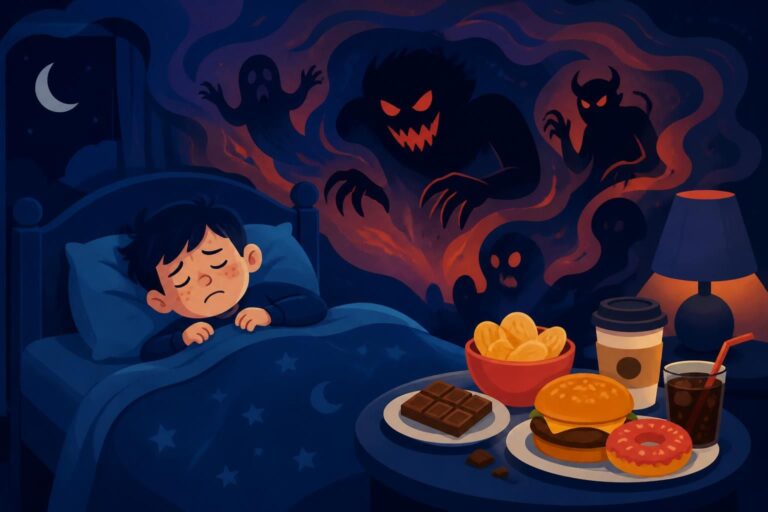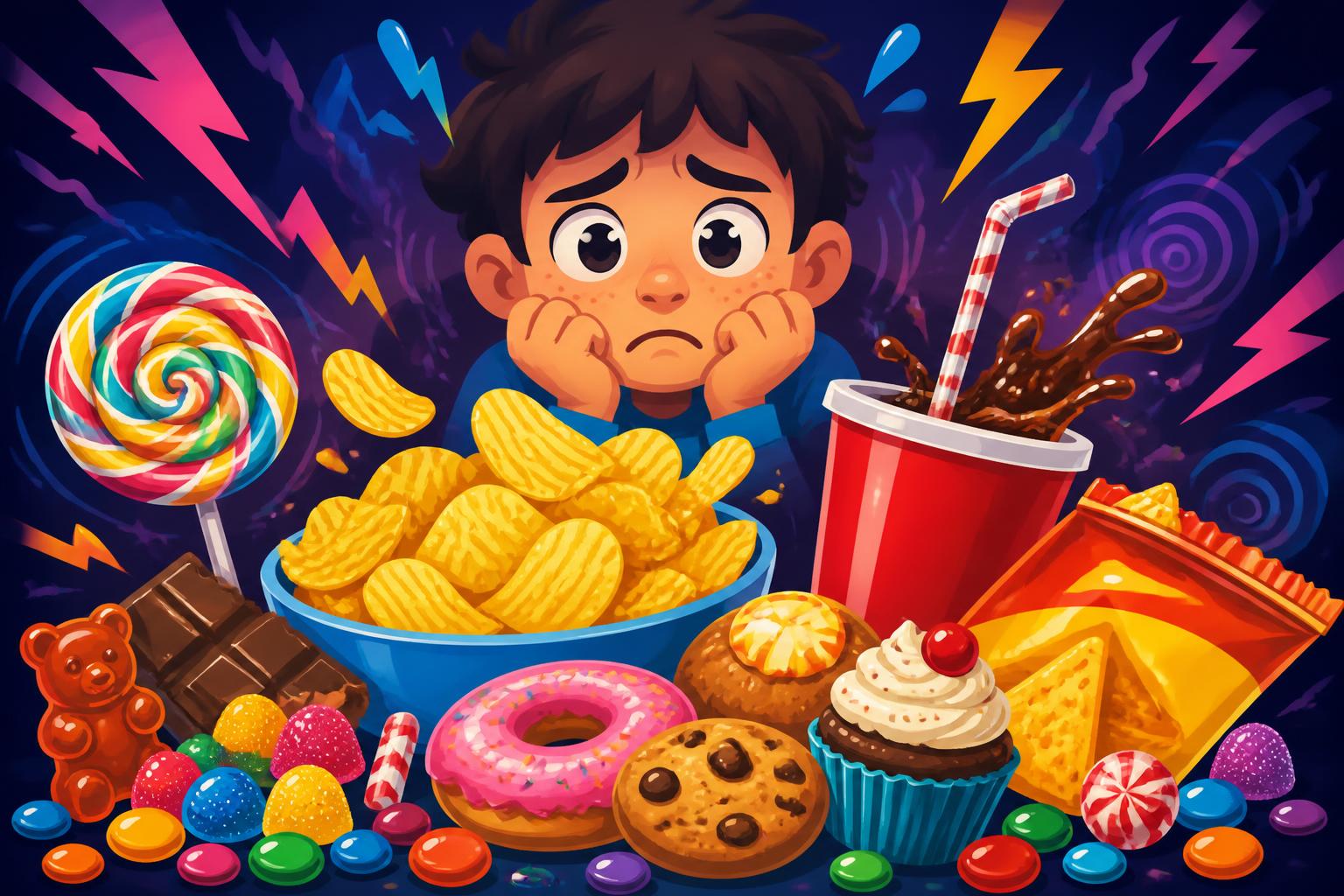
These foods favored by children could increase anxiety and agitation, reveals a study
In Brief
- According to a study published in JAMA Network Open on May 15, 2024, 2,077 Canadian children (CHILD cohort) were followed to link diet at 3 years old with behavior at 5 years old.
- At 3 years old, ultra-processed foods represented on average 45.5% of daily energy intake, based on data analyzed through a questionnaire covering 112 foods.
- A 10% increase in calories from ultra-processed products was associated with more symptoms of anxiety, restlessness, hyperactivity, withdrawal, and aggressive behaviors at 5 years old.
- Sweetened and artificially sweetened beverages stand out as categories particularly linked to these associations.
- The researchers’ simulation indicates that replacing 10% of ultra-processed calories with minimally processed foods was associated with better emotional and behavioral scores, without proving causality.
On May 15, 2024, a study published in JAMA Network Open brought a very concrete topic back to snack time: what children eat early on could be reflected, a few years later, in their behavior. Canadian researchers relied on the CHILD cohort (Canadian Healthy Infant Longitudinal Development) to follow 2,077 children, observing their consumption at 3 years old and then evaluating, at 5 years old, signals such as anxiety, restlessness, withdrawal, hyperactivity, or certain aggressive behaviors. The result may raise an eyebrow among parents who thought that the “little industrial dessert once in a while” didn’t really matter.
In this analysis, the share of ultra-processed foods approaches half of daily calories. The point is not to guilt a cupboard full of biscuits but to understand possible mechanisms and realistic margins for maneuver. Nutrition does not act alone on mental health, but the study suggests potential side effects of a high consumption of ultra-processed foods. And the most useful thing in this story is not fear: it is the ability to gradually replace some “convenient” foods with rawer options, without turning the kitchen into a suspense TV show.
Ultra-processed foods in children: what the study published in JAMA Network Open measures
The study published in JAMA Network Open on May 15, 2024, is based on an observational protocol: the researchers do not “force” children to eat in a certain way; they observe what happens in real life. Here, diet was documented using a detailed questionnaire covering 112 foods. The goal is to estimate the share of ultra-processed foods in energy intake, then relate it to emotional and behavioral indicators measured two years later.
The central figure is clear: at 3 years old, these products represented on average 45.5% of the daily energy intake of the children followed. The list of frequently consumed categories includes industrial desserts, processed cereals, some meat-based products, ready-to-heat meals, and sweetened beverages. This panorama closely resembles what one finds in most supermarkets, in the “special kids” section as elsewhere: foods designed to be quick, stable, and incredibly easy to eat… sometimes easier than spinach.
On the behavior side, the evaluation is based on a recognized pediatric questionnaire, covering dimensions such as anxiety, restlessness, aggressiveness, or emotional difficulties. This point matters: it is not a Monday morning parent’s impression, but a structured measurement, even if it remains based on declarations and therefore exposed to perception biases.
It is also necessary to recall the status of this type of work: observational does not mean “false,” but “cautious.” The authors cannot conclude a direct cause-effect link because other factors may influence both consumption and behavior (sleep, family stress, physical activity, social environment, etc.). However, the association is strong enough to fuel a public health discussion on nutrition for the youngest.
Which products are typically classified as “ultra-processed” in this type of analysis
The term “ultra-processed” generally refers to industrial foods formulated from refined ingredients and additives, with optimized textures and flavors. In children’s daily life, this can cover highly sweetened cereals, flavored dairy desserts, nuggets or reconstituted sausages, microwavable meals, sweetened beverages, and some biscuits and candies.
The interest of the study is not to point to a unique product as the “official snack villain,” but to look at the overall consumption. A child can very well eat an industrial compote and otherwise have a diet generally rich in fruits, vegetables, legumes, and raw products. The topic becomes more sensitive when ultra-processed foods hold a structural place during several moments of the day: breakfast, snack, dessert, rushed dinner.
In practice, a useful benchmark is to observe the repetition of the same families: if sweetened beverages and packaged snacks come back automatically, the energy share quickly rises. And children don’t need a spreadsheet to understand this: they mostly notice the regularity… and defend their favorite aisle with an energy that could power a small town.
A frequent research topic is also overall quality: fibers, vitamins, minerals, fatty acids. Ultra-processed foods often have high energy density and lower nutritional density. This combination can affect satiety, energy stability during the day, and indirectly behaviors such as irritability or restlessness, especially when glycemic spikes become routine.
Anxiety, restlessness and behavior: associations observed at 5 years old
The most commented result of the study published in JAMA Network Open on May 15, 2024, lies in a dose-response relationship: a 10% increase in calories from ultra-processed foods was associated with more emotional and behavioral symptoms at age 5. The cited signals include anxiety, withdrawal, hyperactivity, restlessness, and aggressive behaviors. In other words, the higher the share of these foods, the more scores tend to worsen, on average.
A specific point stands out: sweetened and artificially sweetened beverages seem particularly involved in these associations. This detail aligns with the experience of many parents: sweetened beverages are consumed quickly, add up easily, and do not provide lasting satiety. In a child’s day, they can be added to sweetened cereals in the morning, an industrial dessert at noon, then a packaged snack for the afternoon, making total intake higher without giving the impression of “too much.”
Possible mechanisms remain debated. The study mentions factors such as high sugar, salt, and saturated fat content combined with a lack of fiber and nutrients useful for brain development. Another axis concerns inflammation and gut microbiota, which attract growing interest in the scientific literature on mental health. Packaging and exposure to certain chemicals are also mentioned as hypotheses to explore because diet is not limited to content: it sometimes includes the container.
In real life, these associations can translate into very concrete situations: a child who loses focus more quickly, a more “electric” return from school, a more complicated bedtime. These are not diagnoses. They are signals which, when added to other factors, encourage paying attention to what’s on the plate with the same care as what’s in the backpack.
What the study doesn’t say, and why it matters for mental health
The key point is methodological: an observational study establishes an association, not causality. The authors of JAMA Network Open on May 15, 2024, remind that other elements may explain part of the results. A child who consumes more ultra-processed foods may also have less access to fresh foods, less family time devoted to meals, or a more fragile sleep routine. These factors can influence behavior and mental health.
However, the lack of proven causality does not prevent practical interest. In public health, we often work with convergent indices: if high consumption is associated with less favorable scores, and if ultra-processed foods are already linked to other risks (overweight, metabolic health, cavities), the balance leans towards reduction, especially in children, without waiting for the “perfect moment” of absolute proof.
There is also a classic trap: believing that diet explains everything. Children’s behavior is multi-factorial. Stress, school life, screens, physical activity, family relationships, and individual temperaments matter. Nutrition becomes a lever because it is modifiable, accessible, and it can reduce part of the side effects related to already busy days.
Replacing 10% of calories: realistic daily nutrition changes
One of the most “actionable” aspects of the study published in JAMA Network Open on May 15, 2024, is the substitution simulation: replacing 10% of calories from ultra-processed foods with minimally processed foods was associated with better emotional and behavioral scores. The important detail is the modesty of the substitution. We are not talking about a total shift but a visible and feasible adjustment.
Specifically, 10% could correspond to a sweetened drink replaced by water, a highly flavored dairy product replaced by plain yogurt with a fruit, or part of the snack shifted to bread, cheese, unsweetened applesauce, a handful of nuts (if age and allergy absence permit), or a fruit. These swaps have an advantage: they often reduce free sugar and increase fiber and protein, affecting satiety and energy stability.
To avoid table battles, the most effective strategy is often to work by “environmental habits” rather than speech. If the kitchen automatically offers a jug of water and child-height washed fruits, consumption follows. If the cupboard contains only ultra-processed snacks, the outcome is less mysterious than the contents of a backpack on a rainy Friday evening.
Examples of simple substitutions (without turning the kitchen into a construction site)
- Breakfast: highly sweetened cereals replaced part of the days by oatmeal, whole wheat bread, or plain yogurt with fruit.
- Snack: filled biscuits replaced by bread + dark chocolate in small portion, or cheese + fruit.
- Beverage: soda or fruit drink replaced by water, sparkling water, or milk depending on habits.
- Rushed dinner: ready-to-heat meal replaced by omelet + plain frozen vegetables + simple starch.
- Dessert: industrial cream dessert replaced by plain yogurt + cinnamon, or unsweetened applesauce.
These examples do not seek nutritional perfection but regularity. A stable change is better than a great burst of motivation that fades at the first rainy Wednesday. The potential behavioral benefit is indirect, but the effect on overall diet quality is immediate.
Table: comparing common foods and their possible effects on energy and restlessness
To help spot what “weighs” in daily consumption, a simple comparison allows visualizing the difference between highly processed options and less processed alternatives. Nutritional values vary according to brands and recipes, but the orders of magnitude help understand why certain choices may favor energy spikes followed by slumps, sometimes confused with restlessness.
| Common option | Degree of processing | Frequent profile (tendency) | Minimally processed alternative | Expected impact on satiety (tendency) |
|---|---|---|---|---|
| Sweetened beverage | High | Rapid sugar, little fiber | Water / milk / sparkling water | Low to moderate |
| Highly sweetened cereals | High | Sugar + flavorings, sometimes low fiber | Oat flakes + fruit | Moderate to high |
| Filled biscuits | High | Sugar + fats, low micronutrient density | Bread + peanut butter (if tolerated) + fruit | High |
| Ready-to-heat meal | Variable to high | Salt + possible additives, sometimes limited vegetables | Omelet + plain vegetables + starch | High |
The table does not “demonize” a product; it helps to spot combinations. A biscuit can live peacefully in a balanced week, while daily sweetened beverages weigh heavily without seeming to “nourish.” For anxiety and restlessness, the issue is often stability: less rollercoaster, more steady fuel.
At home and at school: reducing side effects without moralizing children
Changing ultra-processed food consumption in children rarely depends on a single decision. It involves organization, shopping, and simple rules that avoid endless negotiations. Children test limits like they test trampolines: to check if they bounce back. A clear framework can reduce conflicts, thus decreasing part of restlessness linked to family climate around meals.
At home, the most effective approach is often minimal planning: having two or three snack options “ready” that are not ultra-processed products, and keeping very sweet foods for defined occasions. The important point is consistency. If the speech says “no soda” but the fridge is full of it, the child doesn’t learn a rule; they learn a soap opera.
At school, the question becomes collective: cafeteria, birthdays, outings. The realistic goal is not to control every bite but to prevent sweetened beverages from becoming the norm and snacks from being the only snack option. School food policies vary by country and community. In all cases, coherence between home and school facilitates daily life.
Concrete benchmarks to limit ultra-processed foods without permanent frustration
A simple benchmark is to reserve a “base” of minimally processed meals: breakfast and dinner, for example, then keep some flexibility for social moments. The child better understands a repeatable framework than a changing rule. For mental health, reducing sugar spikes and increasing fiber and protein may also improve energy regularity, which sometimes reflects on attention and restlessness at the end of the day.
Language matters too. Talking about “fuel for the brain” often works better than “it makes you nervous,” as this avoids putting an emotional label on the child. The goal is to link nutrition and functioning, not to create fear around food. Children already have enough reasons to be dramatic: between a “itchy” sock and a “not curved enough” banana, imagination knows how to operate.
In the logic of the study, even a partial decrease in the share of ultra-processed foods is a reasonable target. Replacing 10% of calories, as simulated by the researchers (JAMA Network Open, May 15, 2024), gives a concrete direction without requiring an unrealistic lifestyle. A doable change is more likely to last and produce observable effects on behavior.
What Do We Say?
The most useful reading of the study published in JAMA Network Open on May 15, 2024, is to target a progressive reduction of ultra-processed foods, especially via sweetened beverages, rather than an impossible “big night” dietary overhaul. The warning sign is not a single biscuit but consumption nearing half of calories, like the average observed (45.5%) in 3-year-old children. The best practical lever remains substitution: replacing 10% of ultra-processed calories with minimally processed foods, as suggested by the simulation, is a realistic target. For anxiety and restlessness, the promise is not magic, but the potential gain on energy stability and overall nutrition quality is worth trying.
How to know if a product is part of ultra-processed foods?
A simple benchmark is the ingredient list: the longer and more technical it is (flavors, colorants, emulsifiers, sweeteners), the greater the level of processing. Highly formulated products (sweetened drinks, industrial desserts, packaged snacks, certain ready-to-heat meals) often fall into this category. Comparing with a “raw” version helps: fruit vs candy, plain yogurt vs flavored dessert.
Does the study prove that these foods cause anxiety and restlessness?
No. The study published in JAMA Network Open on May 15, 2024, is observational: it observes associations between consumption at 3 years old and behavior scores at 5 years old. This means a direct cause-effect link is not demonstrated, as other factors may intervene. However, the dose-response association strengthens the interest in reducing exposure, especially in children.
What to replace sweetened beverages with without triggering a snack time trench war?
The idea is to avoid the void: offer a stable and available alternative. Fresh water, sparkling water, milk, or homemade flavored water (orange slices, mint leaves) are often better accepted if they are the “default” drink at home. Keeping sweetened drinks for specific occasions limits consumption without permanent prohibition.
What quick nutrition improvements can help energy and behavior at school?
Work on stability: a breakfast with protein and fiber (plain yogurt, eggs, oat flakes, fruit) and a less sweet snack reduce energy peaks then crashes. Adding a fruit and a protein source to the snack (cheese, plain yogurt) often improves satiety. These adjustments can reduce irritability confused with restlessness.