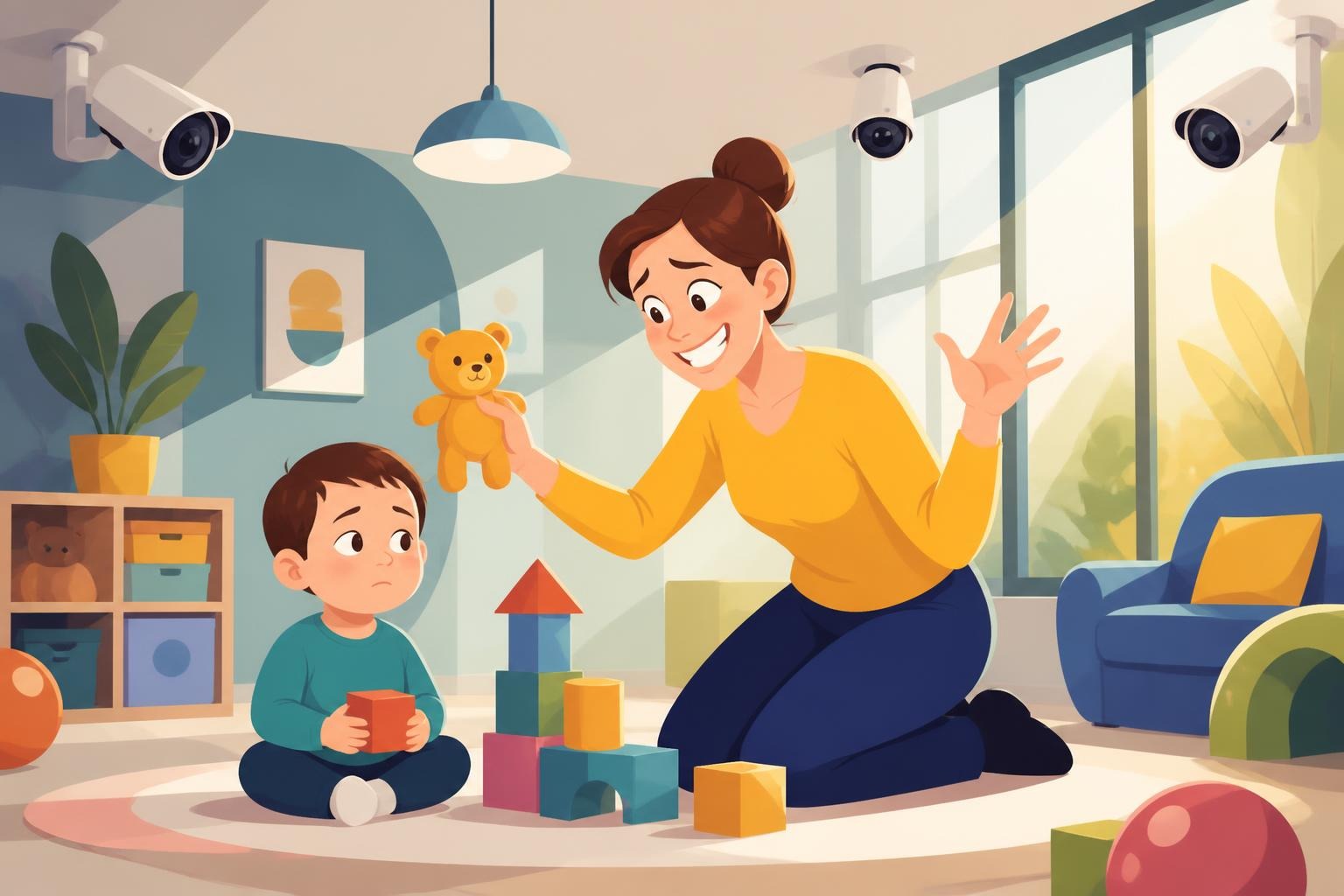
Nanny under camera: when the presence of cameras influences gestures more than the child’s well-being
In Brief
- The Labor Code (article L1222-4) requires clearly informing an employee (including a nanny) before implementing any monitoring system, including a home camera.
- The CNIL reminds in its practical sheets (continuously consulted on its official website) that continuously filming a person at work, especially with sound, exposes them to disproportionate surveillance.
- The Court of Cassation (social chamber, ruling of November 10, 2021, no. 20-12.263) ruled that evidence obtained from an illicit surveillance method is not automatically excluded, but must be subject to a proportionality check.
- In practice, the presence of a camera often changes adult behavior: “cleaner” gestures, more cautious interactions, but sometimes less spontaneous with the child.
- The GDPR (Regulation (EU) 2016/679) applies as soon as a person is identifiable in images, with requirements on purpose, minimization, and retention period.
The debate over nannies under cameras has settled in households as Wi-Fi cameras have sold like everyday objects, to be placed on a shelf between a security blanket and a baby monitor. On paper, the idea reassures: surveillance would help prevent violence and check that all is well. In real life, the presence of the lens changes the scene, like a spotlight that makes everyone play a different role. Parents watch images looking for signs of well-being. The professional may feel continuously evaluated, even when performing ordinary gestures: wiping a child’s nose, negotiating pants, managing knee-level tantrums. And the child, at the center, often picks up more than imagined: restrained voices, hesitant arms, attention shifting to the camera rather than their emotion.
This discrepancy has a paradoxical effect: video protection can improve certain reflexes (more caution, less anger), while degrading the trust relationship that makes childcare truly stable. The issue is not just “to film or not to film,” but understanding what the camera really influences: visible gestures, way of speaking, handling the unexpected, and the feeling of emotional security. When the screen becomes a third adult in the living room, the question of the child’s well-being deserves more than a simple “record” button.
Camera and nanny at home: what French law allows (and what causes problems)
Installing a camera at home is not prohibited per se, but filming a nanny at work without clear rules opens the door to legal and relational troubles. The starting point on labor law is simple: the Labor Code provides, in article L1222-4, that no information concerning an employee personally may be collected by a system not previously brought to their knowledge. Concrete translation: if a camera is used to monitor activity, the information must be explicit, prior, and understandable.
The subject is not limited to work. As soon as a person is identifiable, the GDPR (Regulation (EU) 2016/679) comes into play without asking permission. Defined purpose, minimization (filming only what is necessary), access security, limited retention duration: these are basic principles. The CNIL continuously publishes educational content on video surveillance and video protection, and regularly stresses the disproportionate nature of intrusive devices, notably when people are filmed permanently or with sound activated.
Inform, limit, secure: the three words that prevent turning the living room into a courtroom
In home childcare, the temptation is to frame broadly: the sofa, the kitchen, the play area, “just in case.” The problem is that the wider the field, the more surveillance becomes permanent observation of the professional, with images that can be taken out of context. The minimization principle encourages limiting the field of view to relevant areas: access, entrance, infant sleeping area if a concrete reason exists, and still ensuring not to film overly intimate spaces.
Access security is a frequently overlooked aspect. A connected camera streaming on an app with a weak password is a risk of image leaks. Here, it is no longer just about trust between parents and nanny, but about protecting the child whose images may circulate. Keeping recordings “just in case” for months without documented reason increases exposure. The GDPR requires a logic of adapted duration: keep little, and for a precise purpose.
Evidence, dispute, proportionality: the camera does not erase rules
Some parents install a device after doubt, hoping to obtain indisputable evidence. The judicial reality is more nuanced. The Court of Cassation, social chamber, in a ruling of November 10, 2021 (no. 20-12.263), reminded that evidence from an illicit process is not automatically rejected, but a judge must assess proportionality and balance the right to evidence and respect for privacy. It is not a “camera free pass,” it is a case-by-case examination that does not exempt having acted properly at the start.
In criminal abuse cases, images can play a role, but the initial question remains: should the tool be installed in permanent “safety net” mode or in response to an identified risk, with strict rules? Balance is better built when the nanny is informed, the system is limited, and the relationship is not reduced to a video stream. The law does not solve everything but reminds a very concrete idea: a home is not a no-law zone for surveillance.
When surveillance changes gestures: the “camera” effect daily
A camera does not just record. It influences. In childcare, this is first seen in the simplest gestures: carrying, comforting, redirecting, playing. A nanny who knows she is filmed tends to adopt more “presentable” behaviors: straighter posture, calmer voice, more polite instructions. The result can look positive on screen, but does not always tell the full story: was the child understood, or merely managed cleanly?
The presence of a visible device also changes how surprises are managed. A child who throws themselves on the ground, a spilled bottle, refusal of a nap: these moments rely on adult spontaneity. Yet the camera often pushes caution, sometimes slowing down, because every gesture can be replayed, commented on, captured in screenshots. In caregiving, this brake can reduce ease: fewer tickles, less physical play, more distance. The child’s well-being is not just the absence of incidents; it feeds on warmth, consistency, and availability.
The “playing for the camera”: when the screen becomes an audience
In some households, the nanny ends up anticipating the parental gaze behind the app. This can create a form of staging: “photogenic” activities (puzzle, quiet reading) are favored at the expense of messier but useful activities (painting, cooking, outdoor motor skills). Adult behavior shifts toward what is defensible, commentable, exportable. Over a week, the child may receive fewer varied experiences because anything overflows becomes risky.
The impact is even more noticeable when sound is activated. Words used in a child’s tantrum become replayable material. The tone rises a notch, and the adult may hold back, sometimes too much. It can happen that discipline is delayed or formulated overly cautiously, which can blur limits for the child. A clear limit, calmly explained, is often more reassuring than endless negotiation under surveillance’s eye.
Real-time parental gaze: micromanagement and mental load
Modern cameras often allow remote viewing, at the office or in transit. The risk is turning childcare into commented performance: a message at 10:12 about “the coat,” another at 11:03 about “the snack.” The nanny may feel directed by the minute, which blurs adult authority with the child. A little one quickly understands who really decides and may test accordingly.
Permanent surveillance can also increase parents’ mental load. Watching clips all day exposes them to ordinary moments interpreted as warning signs: a grimace, a cry, a cut-off sentence. The image sometimes reassures but can also feed anxiety and over-interpretation. The camera thus influences the filmed adult’s gestures and the behavior of the observing adult, which eventually reflects on the child via contradictory instructions or diffuse tension.
An example of public debate evolution often appears around violence prevention. Media content has relayed proposals to install cameras in care facilities; Madmoizelle notably mentioned professional reactions around these ideas in an article on nursery cameras, citing the opposition of the National Union of Early Childhood Professionals (SNPPE). Even when it concerns nurseries and not homes, the logic is comparable: filming does not solve means, training, or work climate issues.
Child’s well-being: what the camera almost never captures
A child’s well-being is rarely seen from a fixed angle. A recording shows facts, not necessarily the quality of the relationship. A baby may be fed on time without the look being attentive. A toddler may play “wisely” while being hypervigilant. The camera freezes a scene but does not measure attachment, emotional security, or how the adult repairs a difficult moment. Surveillance favors the visible: no screams, no shakes, no sudden gestures. This is useful to exclude some risks but insufficient to assess childcare quality.
Another rarely discussed point concerns the child’s perception. Even without understanding the technical object, they often understand that an “eye” is there. Families post a sticker “smile, you are being filmed.” In a house, this can become background noise: an adult repositioning, a glance at the shelf, a conversation stopping. The child picks up these micro-breaks. Over time, this influences their behavior: some seek adult attention more (since it is less available), others become more discreet.
Autonomy, exploration, and “right to make mistakes”
Development goes through exploration. Climbing, spilling, failing, retrying: it’s the living room’s laboratory. Yet a space under camera can become a “clean” space, with fewer risks taken, because the adult anticipates judgment. The result is sometimes a child less free to try. Anything that could be interpreted as lack of vigilance is avoided, which may reduce opportunities for motor learning or autonomy.
The camera gaze can also shift priorities: the adult makes sure “it shows well” that they are doing correctly, rather than finely adjusting to the real child. A classic situation is diaper changing: the recording shows a flawless routine but not tone, softness, quality of attention. Yet those details build trust.
Images and privacy: the child also has intimacy
The privacy issue does not concern the nanny alone. Images of a child, especially in light clothing, at bath or diaper change, pose a huge risk if poorly secured. The subject then becomes data protection. Basic instructions: avoid intimate zones, deactivate permanent recording, limit image access, choose robust passwords, and maintain a short retention logic.
The family setting adds a layer: an older brother passing by, a visitor, a personal conversation captured. The camera turns the house into a recorded space, which can freeze daily life. In this context, well-being also plays out in the feeling of inhabiting a “normal” place, not a scene under constant control.
Trust parents-nanny: set clear rules rather than constant suspicion
Trust is not decreed; it is organized. A camera installed without discussion easily turns the relationship into an implicit contract of suspicion. Conversely, a negotiated framework can reduce tensions and make the system more coherent with the child’s well-being. The first step is often simpler than it seems: say exactly why the camera is there. Is it to monitor an entrance? To check restless sleep? To reassure after a specific event? A vague purpose calls for broad surveillance, and broad surveillance ends up spoiling the atmosphere.
The most stable practice is to treat the subject as part of the work contract, even when the employment is simply managed through family habits. Describing the camera location, activation period, presence or absence of recording, access to images, retention duration, and the nanny’s possibility to ask to turn off during certain moments (diaper change, home medical visit, private conversation) helps avoid conflicts. The CNIL regularly emphasizes proportionality: this word becomes a good domestic safeguard.
What to discuss concretely before turning on the camera
To avoid the “surprise, there’s an eye in the teddy bear” effect, a few elements are better laid out clearly. A list helps get out of uncertainty and avoid unspoken resentments turning into bitterness.
- Precise placement and field of view: sleeping area, entrance, or limited play space.
- Activation: continuous, scheduled time, or only during prolonged absence.
- Sound: deactivated by default, unless clearly justified need.
- Storage: directly on the device, provider’s cloud, or no recording.
- Access: who can view (both parents, one only, no one else), and on which devices.
- Retention duration: a few days max if any, with automatic deletion.
This type of framework has an immediate effect: it turns the camera into a defined tool, not total surveillance. The nanny knows what is observed. Parents know what they are really looking for. The child benefits from a less tense environment.
Practical table: choosing a setting that limits intrusion
| Video protection scenario | Filmed area | Sound | Recording | Retention duration |
|---|---|---|---|---|
| Access surveillance | Entrance / hallway | Deactivated | Motion detection | 24 to 72 hours |
| Infant sleep (baby monitor type) | Bed / room (tight frame) | Deactivated or limited | None or short clips | 0 to 24 hours |
| Nanny activity control | Living room | Activated | Continuous | 7 to 30 days |
| After specific alert (temporary frame) | Relevant area, restricted field | As needed | Scheduled time | 48 hours to 7 days |
This table does not replace legal advice but highlights a reality: the closer to continuous activity control, the more the camera influences gestures and the more rigid the relationship becomes. Stability in childcare is rarely built on a maximalist system.
News stories also remind why some families seek proof. Actu.fr reported that a 50-year-old nanny was tried at the Bayonne court on Tuesday, June 3, 2025, for serious violence against children cared for at home, with a conviction reported by the media. Such cases explain the temptation to film. In most situations, however, the issue remains daily: building a framework where trust is the norm and where the camera does not become the main domestic management tool.
Cameras, cookies, apps: surveillance does not stop at the lens
A connected camera is not just an object; it is a digital service. It involves an app, an account, sometimes remote storage, and privacy settings. In many ecosystems, users face consent screens similar to those of major platforms: cookie acceptance, audience measurements, personalization, service improvements. This is not trivial: if the camera app or associated service collects usage data, the home also becomes a collection site.
Consent banners, like those popularized by Google services, generally explain several purposes: service maintenance, fraud protection, engagement measurement, product improvement, content and ad personalization depending on settings. In a “camera + app” use, these logics exist too: usage statistics, notifications, event recognition. Parents often only see the video, but the technical background can multiply digital traces.
Settings to check to limit data capture
The most useful setting is often the simplest: reduce what leaves the home. If the camera can work with local storage, exposure decreases. If a cloud is imposed, at minimum activate strong authentication, limit access sharing, and avoid connections on public devices. Software updates also matter: they sometimes fix vulnerabilities. The idea is not to become a network engineer between two laundry loads but to take seriously that images of children are sensitive data.
The risk is not only spectacular leaks. There is also banalization: leaving video access open on a tablet, showing clips to relatives, commenting on a scene in a discussion group. Once images circulate, confidentiality evaporates. The nanny becomes a subject of social observation, and the child, content. This shift directly affects trust and dignity of all.
Reasonable video protection: a technical framework supporting well-being
A reasonable use of video protection resembles a security system more than a control stream. Camera at the entrance to check arrivals, baby monitor limited to sleep, and no permanent family life recording. This reduces the temptation for micromanagement and gives the nanny the necessary space to work properly without playing a role.
When the system is thought of as an alarm, not a series, the child benefits from a more stable environment. The camera has not disappeared, but it stops being the center. Gestures become natural again because they serve the child before serving the screen.
What do we say about it?
The camera can secure a specific point, but used as continuous surveillance, it mainly influences the nanny’s gestures and ends up damaging trust. The healthiest scenario is to clearly inform, limit the field of view, deactivate sound, and avoid permanent recording, because the child’s well-being depends on a stable relationship, not replay. Parents who watch all day rarely gain serenity and risk shifting to micromanagement. Framed, discussed, and technically secured video protection protects better than a maximalist system.
Is it mandatory to notify the nanny if a camera films during care?
Yes, if the camera allows monitoring activity or collecting information about the employee, article L1222-4 of the Labor Code requires prior information. Even at home, filming a nanny without their knowledge exposes to legal risks and breaks trust. A written agreement with location, hours, and image access limits conflicts.
Can we only film the child’s room with a video baby monitor?
This is often the least intrusive setup, provided the framing is tight on the bed, intimate moments (changing, bathing) are avoided, and access to the app is secured. The GDPR applies if a person is identifiable. The most protective option is no recording or very short retention with automatic deletion.
Does sound really change the perception of surveillance?
Yes, sound greatly increases intrusion because it captures exchanges, emotions, and private information. It can push the nanny to speak “for the camera,” and parents to overinterpret phrases out of context. Practically, deactivating sound reduces pressure and limits sensitive data collection.
Can camera images serve as evidence in case of conflict?
They can be discussed, but their admissibility depends on context. The Court of Cassation (social chamber, ruling of November 10, 2021, no. 20-12.263) indicated that evidence obtained illegally is not automatically excluded: the judge assesses proportionality and balances the right to evidence and privacy. Better to legally frame from the start.