A study reveals that the early introduction of eggs into infants’ diets could reduce allergy risks
In Brief
- A study published by JAMA Pediatrics on March 15, 2021 links early introduction of eggs to a reduced risk of allergies in some infants.
- Infant nutrition recommendations emphasize the idea of early and regular exposure to certain food allergens, with increased vigilance in cases of severe eczema.
- Prevention also depends on the form of the food: well-cooked egg, small quantities, gradual progression, and observation of reactions.
- Warning signs (hives, vomiting, breathing difficulties) require stopping and contacting a healthcare professional, especially in at-risk infants.
- Eggs provide useful nutrients (proteins, vitamins, choline), making them a common candidate in dietary diversification.
On June 7, 2026, the question of early egg introduction resurfaces strongly in parents’ discussions, between homemade purees, “baby-special” compotes, and debates on the best spoon (silicone or bamboo, a highly sensitive topic). Beyond table jokes, one point clearly emerges: a study on infant feeding, and more broadly on infant nutrition, suggests that earlier exposure to eggs could help reduce certain allergy risks. The idea is not to turn breakfast into industrial omelets but to understand how allergy prevention plays out from the start of diversification, with simple, regular actions adapted to the child’s profile.
This movement fits into an evolution of practices over several years: where allergen avoidance once dominated, the current logic focuses more on immune learning. In real life, this looks less like a grand strategic plan and more like a series of mini-decisions: when to offer, what texture, what cooking, what frequency, and especially how to stay calm when baby makes a funny face (spoiler: it’s not always an allergy, sometimes it’s just… discovery).
What the study says about early egg introduction and allergy reduction
The basis of the debate rests on a simple idea: the infant’s immune system learns by encountering foods, and certain windows in early childhood seem particularly favorable for this “education.” According to an Australian study published in JAMA Pediatrics on March 15, 2021, earlier introduction of egg in infants’ diet is associated with a decreased risk of egg allergy during childhood. The work fits into a broader set of research evaluating prevention via regular exposure to food allergens.
This association does not mean egg becomes an allergy talisman. It rather suggests that prolonged avoidance may, in some children, leave the ground more “favorable” to a reaction upon late exposure. The practical interest is clear: egg is a common food, easy to cook, and relatively simple to dose in small amounts, which helps build a realistic routine.
What “early” concretely implies in infant nutrition
In the language of modern recommendations, “early” refers to the diversification period, when infants begin to discover something other than milk (breast or formula). This period is usually around 4 to 6 months, depending on the child’s maturity and the opinion of the healthcare professional following the family. The goal is not a race to the first food but a steady and controlled progression.
In families, this translates into micro-portions: a little well-cooked egg mixed into a vegetable puree, for example. The “camouflage” aspect is sometimes a parental survival strategy, especially when baby has decided that the spoon is a decorative object and not a feeding tool.
Why regularity matters as much as timing
In allergen introduction studies, repetition is a key element: the body does not “memorize” much from a single exposure followed by nothing for three months. The logic is therefore to introduce, then maintain a frequency compatible with daily life. A realistic suggestion can be to offer egg several times a week, in adapted amounts, once initial tolerance is observed.
This framework also avoids a common trap: the child tasted it once, everything went well, then the food disappears. When it returns late, parents feel that “it’s out of the blue” if a reaction occurs, whereas the feeding routine had simply changed.
How to introduce eggs into infants’ diets without turning the kitchen into a lab
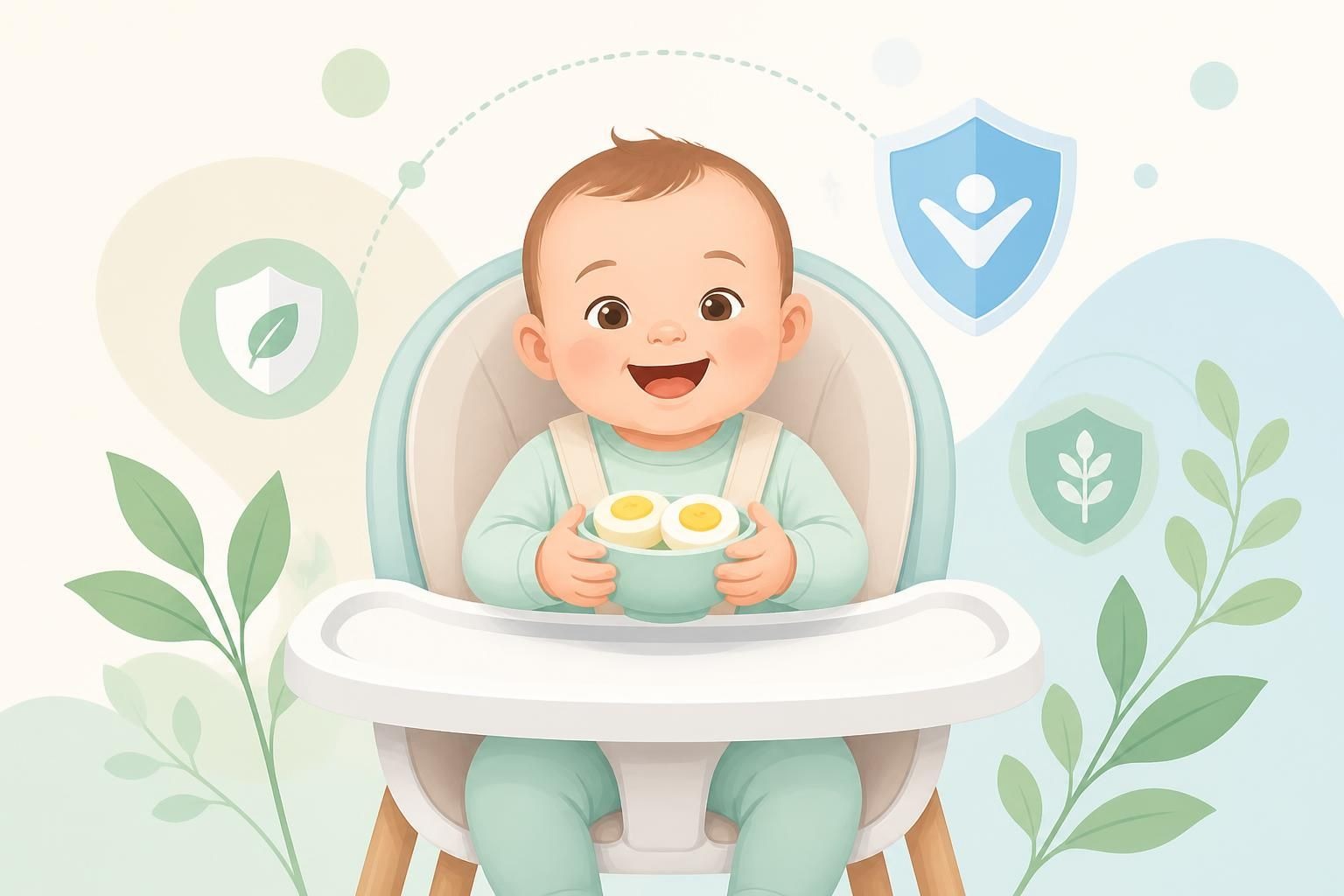
Introducing eggs into infants’ diets can remain very simple, provided a few common-sense rules are followed. The most important concerns cooking: to reduce microbiological risks (notably linked to Salmonella), the egg must be well cooked during initial proposals. A hard-boiled egg, a well-set omelet, or well-cooked scrambled eggs are common options. The “soft-cooked” version can wait, and it’s not a tragedy for baby’s social life.
The second rule concerns dosing: first exposures should be small. A teaspoon of crumbled or mixed cooked egg is enough to start, then the quantity progressively increases according to tolerance. This gradual increase avoids ending up with a baby eating half an omelet on the first day, which impresses everyone except their t-shirt.
A simple protocol, compatible with a normal daily life
Families appreciate concrete markers. Here is a pragmatic way to organize early introduction, leaving room for adaptation:
- Choose a moment when the child is in good shape (no fever, no severe gastro ongoing).
- Offer well-cooked egg in small quantity, preferably during the day rather than the very last meal, to more easily observe a reaction.
- Avoid introducing another new food the same day, to limit confusion if symptoms appear.
- Repeat exposure several times per week if all goes well, varying preparations (cooked omelet, mashed hard-boiled egg, incorporated into a puree).
- Briefly note the date and form offered if the child has an allergic background, to facilitate discussion with the doctor.
This method has an advantage: it reduces mental load. Parents do not need to keep a dashboard worthy of a space mission, while keeping a useful record in case of doubt.
Practical table: quantities, textures, and cooking during first exposures
The table below offers concrete markers, designed for diversification. It does not replace medical advice, especially for infants already monitored for severe eczema or family history of allergies.
| Stage | Indicative quantity | Texture | Cooking | Indicative frequency |
|---|---|---|---|---|
| Discovery | 1 teaspoon | Mixed into a smooth puree | Well cooked (hard-boiled egg/well-set omelet) | Once, then retry 2–3 days later |
| Establishment | 2–3 teaspoons | Finely mashed, soft texture | Well cooked | Twice a week |
| Consolidation | 1/4 egg | Small melting pieces | Well cooked | 2–3 times per week |
| Routine | 1/2 egg as appetite | Pieces adapted to age | Well cooked, variations possible depending on medical advice | Several times a week |
Risks, warning signs, and special cases: what prevention must not mask
Talking about allergy prevention must not make us forget that an allergic reaction remains possible, including during a well-managed early introduction. Typical signs include hives (itchy red spots), swelling of lips or eyelids, rapid vomiting after ingestion, unusual cough, wheezing, or unexpected deep drowsiness. In these cases, the food must be stopped and medical advice sought quickly.
Infants with moderate to severe eczema make up a group often mentioned in recommendations because they may have a higher risk of food allergies. In practice, this means that egg introduction can be discussed with the pediatrician or family doctor, especially if eczema started early, is widespread, or resists usual treatments. This precaution avoids turning a diversification gesture into a stressful moment.
Allergy, intolerance, dislike: three reactions with different stories
Mealtime often mixes several phenomena. An infant may refuse egg for texture or smell reasons, without it being an allergy. A digestive intolerance can also cause bloating or altered stools, without an IgE-type immune mechanism. Allergy often expresses quickly and systemically, though forms may vary.
This sorting is not always obvious at home, especially when baby has the talent to express any discomfort with the same dramatic grimace. Medical follow-up then becomes the most reliable tool, especially if symptoms repeat or worsen.
What “well cooked” really changes
Cooking is not just a culinary detail. It reduces infection risks and can modify the structure of certain proteins, influencing tolerance sometimes. In real life, the simple advice is: at the start, avoid preparations where the white is runny or barely set. Foods like homemade mayonnaise with raw eggs are not suitable for infants, regardless of allergy concerns.
Care also extends to storage: an egg-based dish should not linger at room temperature “while finishing an episode.” Hygiene rules remain part of the “infant nutrition” package.
Why eggs are an interesting food in infant nutrition (beyond the allergy debate)
Eggs are often central to diversification because they are nutritionally dense. They provide good quality proteins, lipids, and micronutrients like vitamin B12 and choline, a nutrient involved in brain development. In infant feeding, this profile is useful, especially when quantities ingested remain small and every bite counts.
Practically, eggs have another advantage: they come in many forms. Mashed hard-boiled egg with a bit of vegetables, well-cooked omelet cut into thin strips for children who eat with their fingers, incorporated in a sweet potato puree for a softer texture. This flexibility helps maintain regular exposure, which matches the prevention logic mentioned above.
Concrete examples of preparations suitable for little ones
“Baby” cooking need not be dull. Simple recipes are often the most effective since they remain doable on a Tuesday evening:
- Well-cooked omelet, cooked without salt, then blended with zucchini puree.
- Hard-boiled egg finely mashed, mixed with carrot puree to soften the texture.
- Small bites of well-set omelet, cut into strips, offered with melting vegetables for children who grasp.
- Well-cooked rice with a touch of well-cooked scrambled egg, for a firmer texture.
These examples have a secondary benefit: they avoid the “all or nothing” pitfall. Regularity becomes easier when egg is not an exceptional event, but a normal ingredient in meal planning.
A useful reminder about overall dietary balance
Egg is not intended to replace everything else. Infant nutrition is built with progressive variety: vegetables, fruits, starches, protein sources, adapted fats. The goal is to support growth while laying the foundations of a peaceful relationship with food.
Within this framework, early egg introduction fits as a piece of the puzzle: interesting for allergy prevention, and also for nutritional density. Coherence is judged over the week, not per isolated meal, helping to put “spoon strike” days into perspective.
Parent, baby, and online data: the essential detour via cookie management
In 2026, seeking information on infant feeding often happens between two bottles, via a search engine, a video, or a health site. This digital reality has a side effect: parents constantly encounter cookie consent windows. The standard text of some services explains that cookies and data are used to provide and maintain services, track outages, fight spam, fraud and abuse, measure engagement and statistics, then, if agreed, personalize content and ads.
This topic may seem unrelated to eggs and allergies, but it concretely influences the quality of the information consumed. A parent clicking “Accept all” often sees “recommended” content resembling medical advice while sometimes being marketing. Conversely, refusing some options reduces personalization, which can limit the tunnel effect where the same anxiety-inducing content appears on loop.
What “personalization” changes when searching for allergy info
Platforms usually explain that personalization can rely on past browser activity, such as previous searches, and that non-personalized content depends more on what is viewed and the general location. In a prevention context, this means a search for “egg allergy infant” can lead to an avalanche of similar results, sometimes more alarmist than necessary.
A useful reflex is to diversify sources, favor institutional or hospital sites when possible, and spot reliability cues: identified authors, update dates, study references. This sorting saves time and avoids confusing a viral anecdote with solid recommendations.
Two simple gestures to keep control of your searches
Without going into technical details, two habits can help. The first is to use the “More options” choices offered by consent banners to limit ad personalization when the goal is to get information on infant nutrition. The second is to keep a few bookmark pages (hospitals, health organizations) to avoid starting from scratch at every doubt.
Parental information search is already an endurance sport; best avoid adding a permanent slalom between serious advice and opportunistic content.
What do we say about it?
Early egg introduction during diversification has credible interest in an allergy prevention logic, especially when exposure becomes regular and in well-cooked form. For infants with significant eczema or allergic history, the safest option remains to plan the strategy with a healthcare professional rather than improvising. In practice, a small quantity, complete cooking, and gradual progression reduce avoidable risks and simplify daily life. The operational recommendation is to treat the egg as a normal food of infant nutrition, not as a one-off test.
At what age should eggs be offered during diversification?
In many situations, egg can be offered during the diversification period, often around 4 to 6 months depending on the child’s maturity and the opinion of the healthcare professional. The important thing is to start with a small amount of well-cooked egg, then maintain regular exposure if the child tolerates it well.
Should one start with the egg yolk only?
Some practices start with the yolk, but egg allergy often involves white proteins. For a coherent approach, small quantities of whole well-cooked egg, introduced gradually, are often more relevant. In case of risk factors (severe eczema, history), medical advice helps adapt the strategy.
What symptoms should stop the egg and prompt consultation?
Hives, facial swelling, rapid vomiting after ingestion, unusual cough, wheezing, or marked drowsiness require stopping the food and contacting a healthcare professional. In case of breathing difficulty, urgent medical help must be sought.
What form of egg is safest at the beginning?
At the start, the egg must be well cooked to limit microbiological risks and facilitate the management of initial exposures. Mashed hard-boiled egg, well-set omelet, or well-cooked scrambled egg work well. Preparations based on raw or lightly cooked eggs are not suitable for infants.