Safety alert: a popular stroller available in several stores presents a risk of injury to your child
In Brief
- On December 12, 2026, the official site RappelConso reported a product recall targeting strollers sold in several stores in France, with a risk of injury to the child.
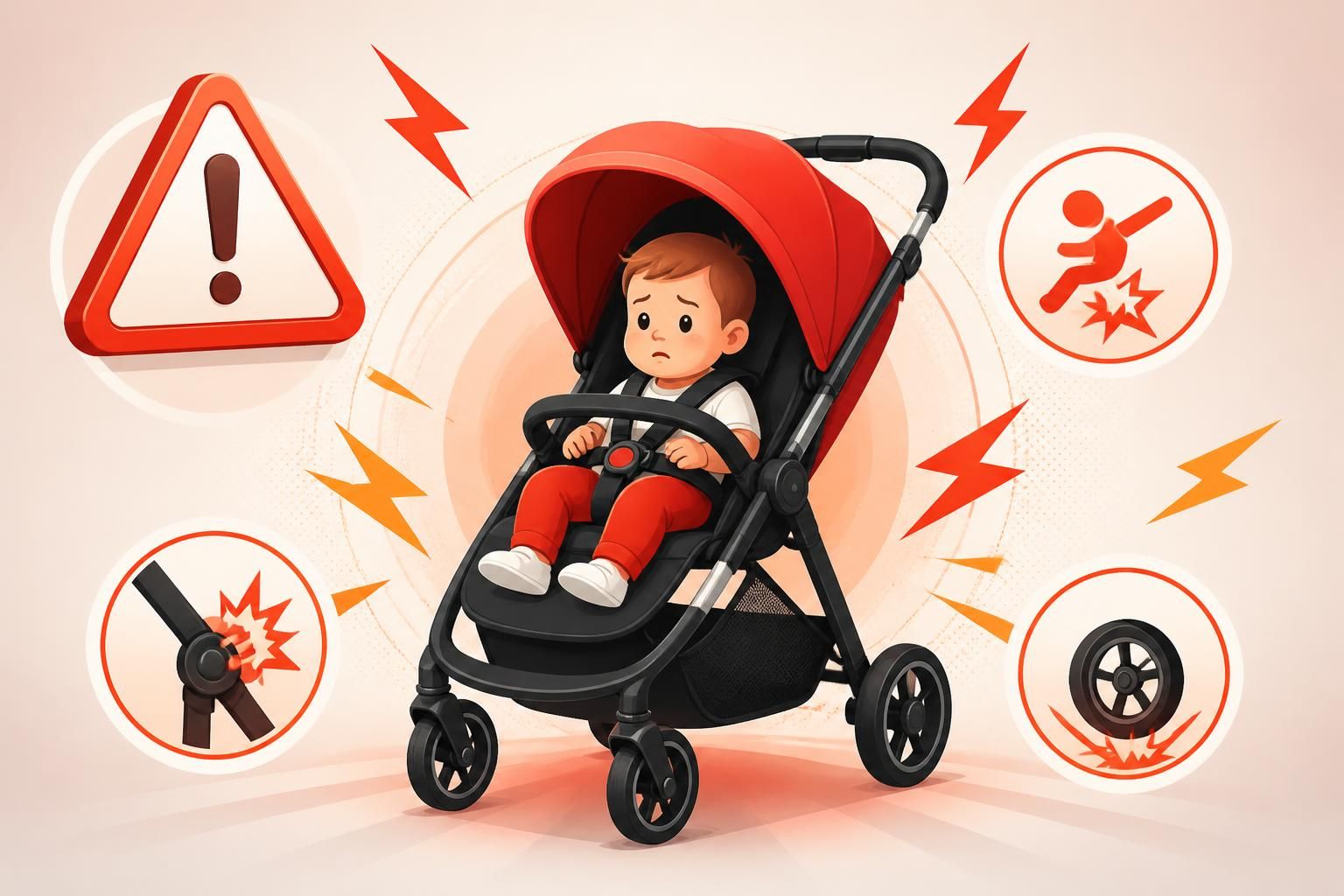
- The defects mentioned in alerts of this type often concern brakes, wheels, or safety straps, with an increased danger during folding, descending a curb, or sudden stops.
- A safety alert should trigger simple reflexes: stop using, identify the exact reference, check the batch number, and follow the return or repair procedure.
- Families can centralize their steps via RappelConso, customer services of retailers, and by monitoring wear signals (play in wheels, approximate locking, poorly adjusted harness).
- Prevention also involves proper use: harness fastened on every trip, load respected, regular visual inspection, and folding out of the child’s reach.
A safety alert concerning a stroller sold in several stores is not a mere administrative detail: it is a concrete signal, with a risk of injury that can occur in an ordinary daily gesture. A rear wheel unlocking, a parking brake failing, a missing or poorly fixed strap: it only takes a mechanical weakness to turn a “quick” outing into a decidedly less fun moment. In reality, these situations affect a very used, therefore highly stressed object: curbs, buses, cobblestones, car trunk, repeated folding and unfolding, and sometimes capricious weather. The typical scenario is rarely spectacular, but it is ruthlessly realistic: the stroller moves when it should remain still, or the child slips because the support is not complete.
Recalls do not mean that all units will break at the same place and time. They indicate that a defective product may present a danger under certain predictable conditions of use. The goal is prevention, not panic. The challenge is to quickly identify the model concerned, understand the type of defect, and choose the right action: return to store, replacement of a part, repair, or immediate stop. And in the process, to review two or three reflexes that avoid many scares, even with a stroller not concerned by a product recall.
Stroller safety alert: understanding what a product recall in-store means
A product recall is not a simple “update” like for household appliances. In the case of a stroller, the object is used to transport a child, so tolerance for defects is close to zero. A safety alert published on an official channel or relayed by a retailer indicates that a danger has been identified: risk of injury by fall, pinching, tipping over, or loss of control. Concretely, the recall is based on a combination of factors: consumer reports, internal checks, workshop returns, or batch conformity checks.
According to the official site RappelConso, in its publication dated December 12, 2026, a stroller sold in France is subject to a report for a defect that may cause a risk of injury. The mechanics of recalls are generally the same: the consumer must check a reference (brand, model), sometimes a barcode or batch number, then follow a procedure (return, exchange, refund, or repair).
Why strollers are often concerned by alerts
A stroller endures constraints that few “everyday” objects do: chassis twisting during a curb climb, vibrations on uneven ground, load variations (nappy bag, shopping), frequent folding, and sometimes one-handed use. The slightest weakness in a lock, wheel axle, or brake may worsen over time.
The problem is that some defects do not appear when opening the box. They show up after a few weeks of use, when a part becomes loose or a clip deforms. Hence the importance of not being satisfied with a “looks solid” at first glance, even if the item looks like it came out of an ad.
What “sold in several stores” means
When an alert concerns several stores, it means distribution was wide: supermarkets, specialized stores, sometimes online sales. This complicates families’ lives, as the stroller may have been purchased in another city, or given as a gift. Hence the useful reflex: keep a record (receipt, invoice, confirmation email), or at least note the exact reference on the product label.
A practical detail: some strollers exist in almost identical variants (color, accessories, year of manufacture) with different codes. A reference confusion can waste time. Verification must be done from product identifiers, not from “it’s grey, so it’s that one”.
Risk of injury: most frequent defects on a stroller and their effects
In alerts related to a stroller, three families of problems often recur: child support, stability, and braking. The final result is unfortunately repetitive: fall, slip, tip over, or finger pinching. The common point is that the danger appears during a normal action: fastening, folding, descending a curb, stopping at a pedestrian crossing, or taking a bus.
Harness and straps: when “almost fastened” is not enough
The harness is a complete system: shoulders, waist, and support at the thigh level. When a strap is missing or poorly adjusted, the child can slip forward, especially if the backrest is reclined or if the road vibrates. It’s not an action movie: it is a simple pelvis movement, and gravity does the rest.
A common example: a parent loosens the harness to put on a jacket, then forgets to retighten properly. If, additionally, the stroller has a slightly slippery seat, the child can “slide down” and end up in an unstable position. Alerts concerning a missing strap or insufficient fixing target precisely this type of situation.
Wheels and axles: the small “click” that should never exist
A rear wheel fixing defect can cause misalignment, blockage, or partial disengagement. In all cases, the stroller no longer behaves as intended. The injury risk occurs when the adult compensates by pulling on one side or when the stroller tips over on encountering an obstacle.
RMC relayed, in an article dated December 12, 2026, a recall concerning a stroller sold at Carrefour, mentioning a rear wheel fixing defect. In real life, this may translate into a “wobbly” wheel sensation or unstable behavior on an otherwise ordinary surface. This is not a comfort detail: it is a risk of falling.
Brakes: the illusion of secure parking
The parking brake is supposed to prevent any movement. A brake problem that disengages can cause the stroller to roll on a slight slope, a platform, or even a sloping curb. Again, the scenario is simple: the adult lets go of the handle briefly to open a bag, and the stroller moves.
Some recalls also mention brakes that “catch” poorly depending on angle or wear. In this case, immediate prevention is to test the brake on a flat surface before each outing. A two-second check avoids turning a stop into a slide.
Video demonstrations of checks (brakes, harness, locking) are useful provided they are applied to the exact model. Correct handling on a compact stroller does not always transfer to a trio model, and vice versa.
What to do immediately in case of safety alert: concrete steps for parents
When a product recall concerns a stroller, the priority action is to stop using the potentially concerned model, at least until verification. This is when the brain loves to bargain (“just to go to daycare, it’s okay”), while a mechanical defect does not know family schedules. Once the object is stopped, the steps can be quick if done in the correct order.
The verification checklist (without spending the night on it)
- Note the exact brand and model on the product label (often under the seat, on the chassis or near the basket).
- Note the batch or serial number if indicated, as well as the barcode if necessary.
- Compare with the references mentioned in the product recall notice (not just a photo).
- Check if the notice requires a return to stores, immobilization, or installation of a repair kit.
- Keep proof of purchase if available, but do not block the process in its absence: some retailers offer a solution even without a receipt.
This sequence seems obvious, but it avoids two common traps: immobilizing a product that is not concerned or continuing to use a defective product thinking it is another variant.
Returns, exchanges, refunds: most common scenarios
A product recall can lead to three main outcomes: refund, standard exchange, or repair (wheel change, lock reinforcement, brake replacement). The choice depends on the defect and the brand’s ability to fix the part.
An often forgotten point: a repair must be traceable. If a retailer provides a kit, it must be checked that it corresponds to the exact model, and the instructions kept. In case of resale, this becomes important child safety information, on par with the product’s age.
Practical table: quick check and warning signs at home
| Area to check | 30-second test | Measurable abnormal sign | Preventive action |
|---|---|---|---|
| Parking brake | Brake, push gently forward | Visible displacement > 2 cm | Immobilize and contact Customer Service |
| Rear wheels | Shake each wheel laterally | Perceptible lateral play + “click” noise | Stop use and check batch/model |
| Harness | Pull on straps after closing | Buckle opens under moderate traction | Do not use, request replacement |
| Folding lock | Fold/unfold empty, check the click | Lock fails 1 time out of 3 | Stop use, technical check |
These tests do not replace an official recall. They serve to spot an immediate danger while waiting for a response from the brand or store.
To save time, it is useful to prepare a photo of the label (model and number) and an overall photo of the stroller. Customer services often request these elements from the first contact.
Child safety and prevention: good practices even outside product recalls
A safety alert draws attention to a specific model, but daily prevention concerns all strollers. Incidents often occur by accumulation: slight wear + bad habit + rushed situation. The good news is that several child safety actions cost mostly… ten seconds and a minimum of anticipation.
Usage rules that avoid bad surprises
The harness must be fastened on every trip, even short ones. “Just downstairs” outings are where adults relax vigilance, because the brain classifies that as “it doesn’t count.” Except the stroller does not differentiate between 30 meters and 3 kilometers.
The maximum load indicated by the manufacturer (child’s weight and sometimes basket weight) deserves respect. An overloaded basket modifies stability, especially when climbing curbs. Bags hung on the handlebar also increase the risk of tipping backward when stopped.
Simple maintenance: what families can do without a workshop
Light cleaning of wheels and axles reduces dirt that may hinder braking. Visual checks of rivets, screws, and clips after a train or plane trip is not excessive: shocks and handling can loosen a part.
Folding must be done away from the child’s hands. Pinching happens at “practical” moments, when the adult wants to go fast and the child wants to help. Prevention here relies on organization: fold empty, then settle the child in another secure space.
Caution with second-hand and lending among close ones
The second-hand market is very active for strollers, especially compact or trio models. Before buying, checking the recall history linked to the model is a useful reflex. A product may have been recalled then resold without repair, simply because the first owner never saw the notice.
When lending, passing on original accessories (hoop, complete harness, instructions) limits makeshift fixes. An “adapted” belt with a buckle from another product is a fix that can create a real danger.
Privacy and online shopping: cookies, recall pages and searching for reliable information
Searching for a safety alert on a stroller often passes through a search engine, a retailer site, or a product information page. In this journey, a concrete point must be understood: cookie banners are not there to decorate the page. They sometimes change how content and ads are displayed, and can influence result personalization.
What “Accept all” and “Reject all” choices generally cover
In many online services, cookies serve to maintain the service (security, fraud prevention, audience measurement), and, if the user authorizes, to personalize content and ads. Typical options include: measuring engagement, improving services, showing more relevant ads based on browsing history, and adapting the experience for a minor audience when necessary.
The practical point: refusing personalization does not block access to product recall information, but it may reduce the “overlay” of recommendations and targeted ads. For a precise search (model, batch, store), it can even make the page more readable, with fewer distractions around.
Limiting confusion: search methods that work
To find useful information, it is more efficient to use exact queries: brand + model + “recall” + “batch” + “RappelConso.” Adding the color (“grey/black”) sometimes helps, but the product identifier remains more reliable. In case of model homonyms (versions 2, 3, “plus,” “lite”), the code on the label should be prioritized.
A common trap is falling on content that repeats old alerts without updates. Verification should be done on an official page or direct communication from the distributor. People.com, in an article dated February 27, 2026 on consumer product recalls, recalls that procedures and scopes can vary according to batches, even when the product name is identical. This type of detail avoids applying wrong instructions.
Info sharing among parents: useful, but to frame
Discussion groups help quickly spread an alert, especially when it targets frequented stores. The risk is distortion: one model becomes “the whole brand,” one specific defect becomes “dangerous stroller,” and the official instruction is replaced by a screenshot without reference.
To remain useful, a share should include the reference, date of the notice, and the official channel. Screenshots without links or identifiers mostly create noise. The goal is to protect the child, not organize a fear contest.
What’s the Take?
A safety alert on a stroller must be treated as a priority topic, because the risk of injury concerns daily usage and often rushed situations. The most reasonable action is immediate stop of use until the reference and batch have been checked, even if the defect seems “rare.” Retailers and official channels give simple instructions, and families save time by preparing photos and product identifiers before contacting Customer Service. For prevention, regular checks of brakes, wheels, and harness are the best filter against everyday incidents.
How to know if the stroller at home is concerned by a product recall?
Verification is done with the exact reference: brand, model and, if requested, batch number or barcode. This information is generally on a label fixed to the chassis or under the seat. You must compare these identifiers with the official recall notice and follow the indicated procedure (return to store, exchange, repair).
Should I stop using the stroller before confirming it is recalled?
Yes, if the model closely resembles the one targeted and the reference has not yet been verified. Temporary stop reduces the danger during verification. An alternative is to use another already available means of transport (compliant baby carrier, another stroller) while awaiting official confirmation.
What signs may indicate an immediate danger on a stroller?
A brake that does not firmly hold, a wheel with lateral play, an uncertain folding lock, or a harness buckle that opens under moderate traction are warning signs. In these cases, use must be stopped and contacting customer service or the store is recommended.
Can a second-hand purchase be concerned by an old safety alert?
Yes. A second-hand stroller may have been the subject of a product recall without having been repaired or withdrawn. Before purchase, it is advisable to request a photo of the label (model and number) and check if the model appears in an official recall database. The presence of instructions or proof of repair may also help.