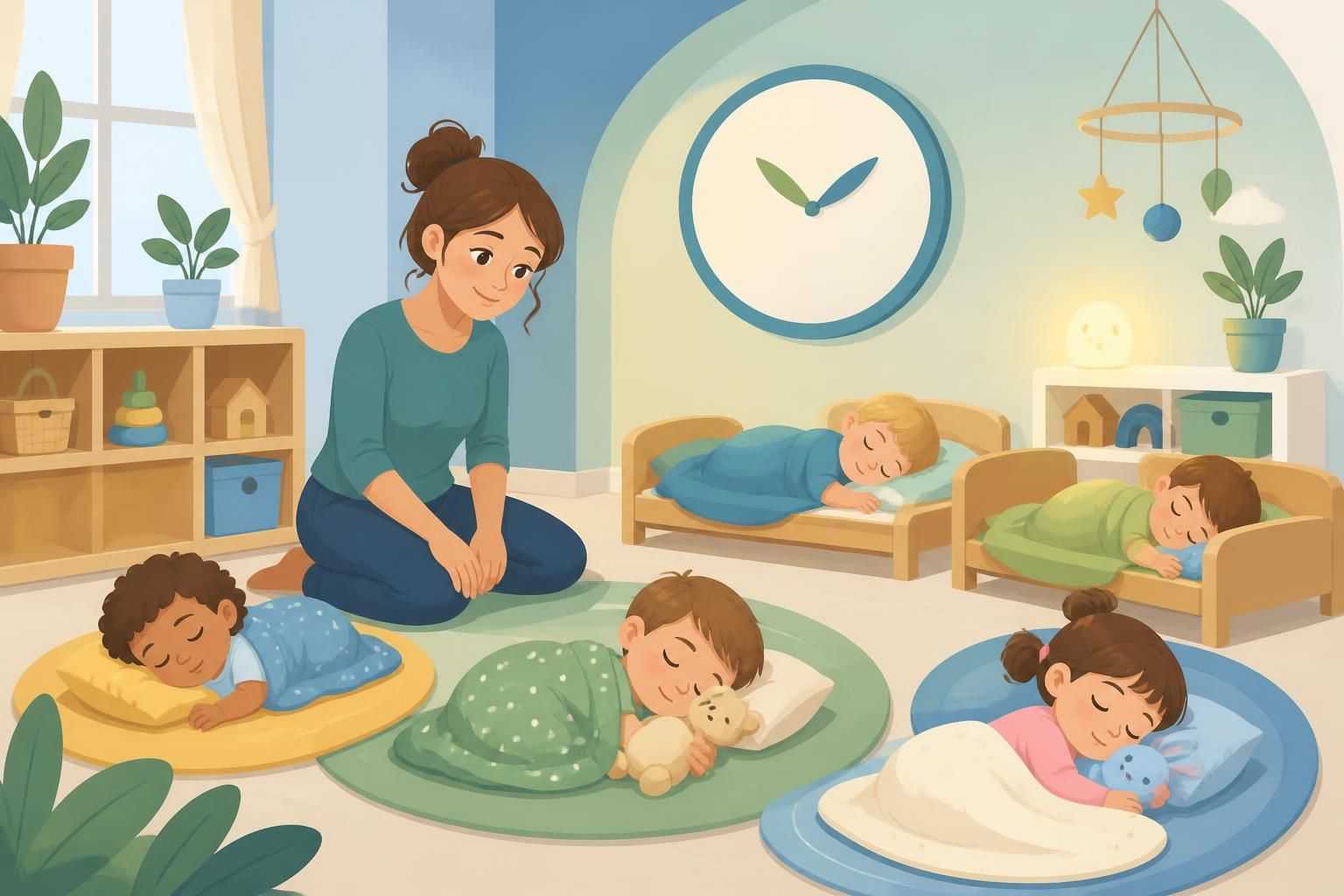
Is it possible to set nap times for a childminder?
In Brief
- The legal framework for care with a childminder primarily relies on the employment contract and the care arrangements, not on a “minute-by-minute schedule” imposed.
- Setting nap times is only possible if it is realistic, written, and compatible with the child’s well-being and the host household’s daily organization.
- Nap regulations in preschool are often used as a reference (nap in early afternoon, about 1h30 cycle), but they do not apply outright to home care.
- Nap times can be discussed as an educational practice, but the priority remains rest time adapted to children’s needs, especially before age 3.
- The most effective lever is a clear protocol (ritual, environment, max duration, gradual wake-up) rather than an unmanageable fixed time.
Care with a childminder has that little magical power: to turn a baby who is as regular as clockwork at home into a little party animal at the nanny’s, or vice versa. Behind sometimes tense exchanges about nap times, there is primarily a real question of organization and legal framework: how far can a parent set schedules, and how far can the childminder keep their margin of maneuver to manage several children, meal logistics, outings, and a home that is not an annex to the family bedroom.
In reality, a nap is not a medical appointment at exactly 10:12 am. Sleep varies with age, growth spurts, teething, travel, and even the weather (yes, rain can make one drowsy). Yet, asking for precise nap times is not absurd: a rest period that is too late can shift the night, falling asleep too early can shorten the afternoon, and a sudden awakening can turn snack time into an international negotiation. The right method is to transform a schedule demand into a written, testable agreement, and above all centered on the child’s well-being.
Legal framework and employment contract: how far can nap times be set?
The first useful reflex is to look at the employment contract signed with the childminder. In individual care, this document and its annexes (often called “care provisions” in practical guides) serve as a compass: arrival and departure times, meals provided or not, authorized outings, health instructions, and sleep habits. Setting nap times can therefore be discussed contractually, but it is necessary to distinguish a reasonable instruction from micromanagement that would make the day unmanageable.
A concrete point: if the contract provides for a presence window from 8 a.m. to 6 p.m., asking for a “nap at 1:30 p.m.” makes sense if the child shows signs of fatigue at that time. Conversely, demanding sleep at a fixed time, with a fixed duration accurate to the quarter-hour, quickly becomes untenable as soon as the childminder cares for several children of different ages. Real life does not follow an Excel sheet, even when it is very well color-coded.
The legal framework also protects health and safety. A childminder must be able to adapt the daily organization to watch over the group, respect sleeping rules (in practice: recommended sleep position, absence of dangerous objects, appropriate supervision), and manage unforeseen events. This is where the notion of “adapted” rest time takes precedence over the obsession with the perfect schedule.
What preschool nap regulations say… and what they don’t say about home care
Preschool nap regulations are often cited in discussions because they provide fairly concrete references. Educational resources from the National Education relayed on Eduscol (section “New school rhythms: good practices in preschool,” recommendations published in 2015) emphasize a nap placed in early afternoon, with a duration close to one cycle, often around 1h30. This framework concerns school, not care by a childminder at home.
For parents, these references remain useful: a nap too late can delay bedtime, and too long a rest can cause a cranky awakening. For the childminder, the key point is elsewhere: a care home must reconcile several rhythms, sometimes a baby and a 2-year-old, with a meal to prepare and diaper changes. Imposing the logic of a preschool class on a house often ends up as a farce, but without the applause.
A winning agreement is therefore a written compromise: a proposed window (for example “quiet time between 12:30 and 1:30 p.m.”), a reasonable duration target, and adjustment criteria (signs of fatigue, previous night, illness). This agreement remains compatible with the legal framework because it describes a practice, not an impossible constraint.
Daily organization at the childminder’s: real constraints, and why fixed time quickly falters
A childminder does not handle a single nap: she manages an ecosystem. The daily organization depends on staggered arrivals, meals (bottles, purees, chunks), outings (school, park), and the number of children present. In this context, a “locked” nap time can put everyone in difficulty, including the child concerned.
A concrete example: two children sleep in different rooms, a third needs a longer ritual, and a baby has to eat every 3 or 4 hours. If a parent demands a 12:00 p.m. sharp bedtime, this can clash with meal preparation or the bedtime of another child already nearing shutdown. The result is often the opposite of the goal: agitation, irritability, slower falling asleep, and shorter awakening.
The often underestimated point is the transition to sleep. For many children, the falling asleep window is short: if put to bed too early, they play; too late, they get upset. Rather than setting times to the minute, it is more effective to agree on landmarks and rituals: dimming lights, calm activity, a short story, transitional object. At preschool, the texts also remind that a transitional object is accepted in the resting room, which gives an idea of the continuity of needs.
Practical table: times, duration, and observable impacts on the night
To avoid discussions in “it’s better because it’s better” mode, a simple table allows objectifying effects. It does not replace observation, but it helps speak the same language between parents and childminder.
| Measurable parameter | Common reference | What is seen in the child | Risk if poorly timed |
|---|---|---|---|
| Start of quiet time | Between 12:00 and 1:30 p.m. | Yawning, eye rubbing, decreased activity | Overexcitement if too late |
| Duration of rest time | 1h15 to 1h30 | More stable awakening, better mood at snack | Difficulty waking if too long |
| Wake-up time | Before 4 p.m. (common reference) | Smoother falling asleep in the evening | Late bedtime if woken too late |
| Falling asleep time | 10 to 30 minutes | Independent or semi-assisted falling asleep | Too demanding sleep association if ritual endless |
This type of tool also helps spot what really concerns nap times and what concerns the environment: a room too bright, hallway noises, a too abrupt transition between play and bed. Many conflicts are resolved by changing the “how,” without turning the childminder into an air traffic control tower.
Child well-being: sleep markers, nap duration, and signs that matter more than the clock
Child well-being is the strongest argument, and also the most verifiable in daily life. A rested child is not judged by the minute they fall asleep, but by concrete signals: appetite, quality of interactions, end-of-day tantrums, ease of falling asleep in the evening, night wakings. These indicators are worth more than a schedule posted on the fridge with a fluorescent marker.
Regarding duration, many references revolve around a sleep cycle of about 90 minutes, frequently mentioned in practical advice about preschool naps. In individual care, this reference can guide a gentle wake-up policy: allow the child to complete a cycle when possible, avoid exceeding a duration that compromises the night, and adapt according to age. A 10-month-old child is not playing in the same league as a 2-and-a-half-year-old.
Another concrete point: a child who “does not want to sleep” sometimes needs rest time without sleep. This also exists in preschool, where teachers organize quiet time for those who no longer sleep. In care with a childminder, a reading corner, soft music, or rest time on a mattress can preserve the group’s balance without turning nap time into an arm-wrestling match.
Examples of realistic compromises on nap times
A realistic compromise is not a promise of result, it is a promise of means and observation. For example: bedtime within a 45-minute window, target duration, and adjustment if the night was bad. Such an agreement protects the child, and it also protects the adult-to-adult relationship, which is already a form of migraine prevention.
Phrasings that work better in an employment contract or an annex: “rest time proposed after lunch,” “wake-up no later than such time unless signs of great fatigue,” “stable 10-minute ritual.” Phrasings that often trigger tension: “mandatory falling asleep at 12:40 p.m.” or “wake-up at exactly 2:10 p.m.” because they ignore the normal variability of sleep.
The discussion becomes easier when adults follow a short written observation period: three to five days with quiet time start, estimated falling asleep time, duration, mood upon waking, bedtime. Decisions then rest on facts, not on a vague memory from last Tuesday.
Setting nap times without antagonizing the childminder: negotiation method and useful clauses
Setting times can be done without turning the discussion into a summit duel. The most effective method is to start from the host home’s constraints, then formulate a request focused on the child and logistics. A childminder caring for several children often has to synchronize lunch, diaper changes, and bedtimes, or risk spending the afternoon trying to put someone to sleep while others climb the couch.
The main lever is writing: an annex to the employment contract, with simple and measurable terms. Elements well suited to a clause: bedtime window, environment (shutters, white noise if used, transitional object), maximum nap duration not to be exceeded except exception (illness, marked fatigue), and wake-up method. The clause must also leave room for adaptation: a child is not a timer.
Another area to clarify is communication. A liaison app, a notebook, or an end-of-day summary message can record observed nap times and events explaining a shift (unusual outing, medical appointment, sick child). This avoids “by feel” reconstruction at 7 p.m. when everyone is tired.
Concrete action list to include in care arrangements
- Define a rest window (e.g., 12:45–1:30 p.m.) instead of a fixed time.
- Indicate a target duration (e.g., 1h15–1h30) and a latest wake-up time compatible with bedtime.
- Describe the ritual (short reading, comfort object, light, adult presence) and what to avoid.
- Provide a “quiet time” option if the child does not sleep after 30 minutes.
- Decide on a method to track nap times (notebook, app, paper sheet) and a check-in frequency (e.g., every weekend).
- Frame exceptions (illness, teething, adaptation period) with a simple communication rule.
This type of list has an immediate effect: the discussion becomes operational. The childminder does not feel subjected to a diktat, and the parents achieve enough coherence to stabilize nights. The legal framework is respected since the agreement concerns care and organization, without contradicting safety obligations.
Special cases: siblings, adaptation, child who does not sleep, and managing disagreements
Conflicts over nap times often explode in three situations: adaptation period, siblings with external constraints, and child who “skips” the nap. In these cases, wanting to set rigid schedules is tempting because it gives the illusion of control. The reality quickly reminds that the child does not sign the contract.
During adaptation, sleep is often disturbed: new place, new smells, new noises, separation. A temporary protocol can be established: shorter nap accepted the first week, more presence support, and planned checkpoint. Written follow-up prevents confusing a lasting problem with an adjustment phase.
For siblings, school release time or a big sibling’s activity can push adults to want to set the small one’s nap “so that everything runs smoothly.” The risk is creating sleep debt and difficult evenings. A compromise is aiming for a coherent main rest period, and accepting a micro-nap in the stroller if the day requires it, monitoring the impact on the night.
When the child does not sleep, the healthiest option is to institutionalize quiet time. This protects the child from conflict and protects the group. The goal is no longer “sleep at all costs,” but to recover physical and mental fatigue, with a calm environment.
Parent and childminder in disagreement: what to do without turning the nap into minutes
A persistent disagreement is handled as a service quality issue: facts, trial, adjustment. Three concrete steps: collect information over a week, test a new rest window for a few days, then decide. If the parents’ request remains incompatible with the daily organization or the child’s well-being, the childminder must be able to say so clearly, and parents must be able to reassess the compatibility of the care mode with their constraints.
To frame the argument, a useful reference remains schooling starting at age 3 introduced by Law No. 2019-791 of July 26, 2019. At this age, families already encounter collective organizational rules at school, sometimes with fixed schedules and few adaptations. This recalls a concrete point: the more collective the environment, the more the schedule is an acceptable approximation, and the less total the personalization.
A conflict over nap time is rarely “just” a conflict over nap time. It often hides a lack of information, parental fatigue, or difficulty with bedtime. Treating the issue as a practical problem, with simple measures, avoids turning the comfort object into a diplomatic issue.
What do we say about it?
Setting strict nap times for a childminder is rarely feasible because care relies on group organization and unforeseen events. However, formalizing a rest window, a target duration (often around 1h15 to 1h30), and a latest wake-up time in the care provisions brings real stability. The most solid solution is a written agreement linked to the employment contract, with a one-week follow-up to objectify effects on the night. If the parental requirement remains incompatible with the operation of the care home, it is better to change the care framework than to install daily tension.
Can nap times be written into the childminder’s contract?
Yes, provided it stays on realistic and measurable elements: a rest window, a target duration, and a latest wake-up time. Writing mainly serves to align practices and communication. In practice, an obligation to fall asleep at an exact minute is difficult to maintain and may harm the child’s well-being.
What nap duration should be targeted to avoid shifting the night?
A commonly used reference is a nap around one cycle, often 1h15 to 1h30, especially early afternoon. Wake-up time also matters: a nap that is too late increases the risk of difficulty falling asleep in the evening. It is best to observe over a few days and adjust according to mood upon waking and quality of nights.
What to do if the child does not sleep at the childminder’s?
Planning quiet time is often more effective than forcing sleep. The child can rest with the same ritual (soft light, comfort object, short reading), even without falling asleep. This also protects the daily organization, as the childminder must be able to manage the group without repeated battles around the bed.
Do preschool nap rules apply to the childminder?
No, preschool nap regulations do not automatically apply to home care. School recommendations can provide useful references (nap in early afternoon, duration close to a cycle), but individual care depends on an employment contract and care arrangements. The important thing is rest time adapted to the child’s needs.