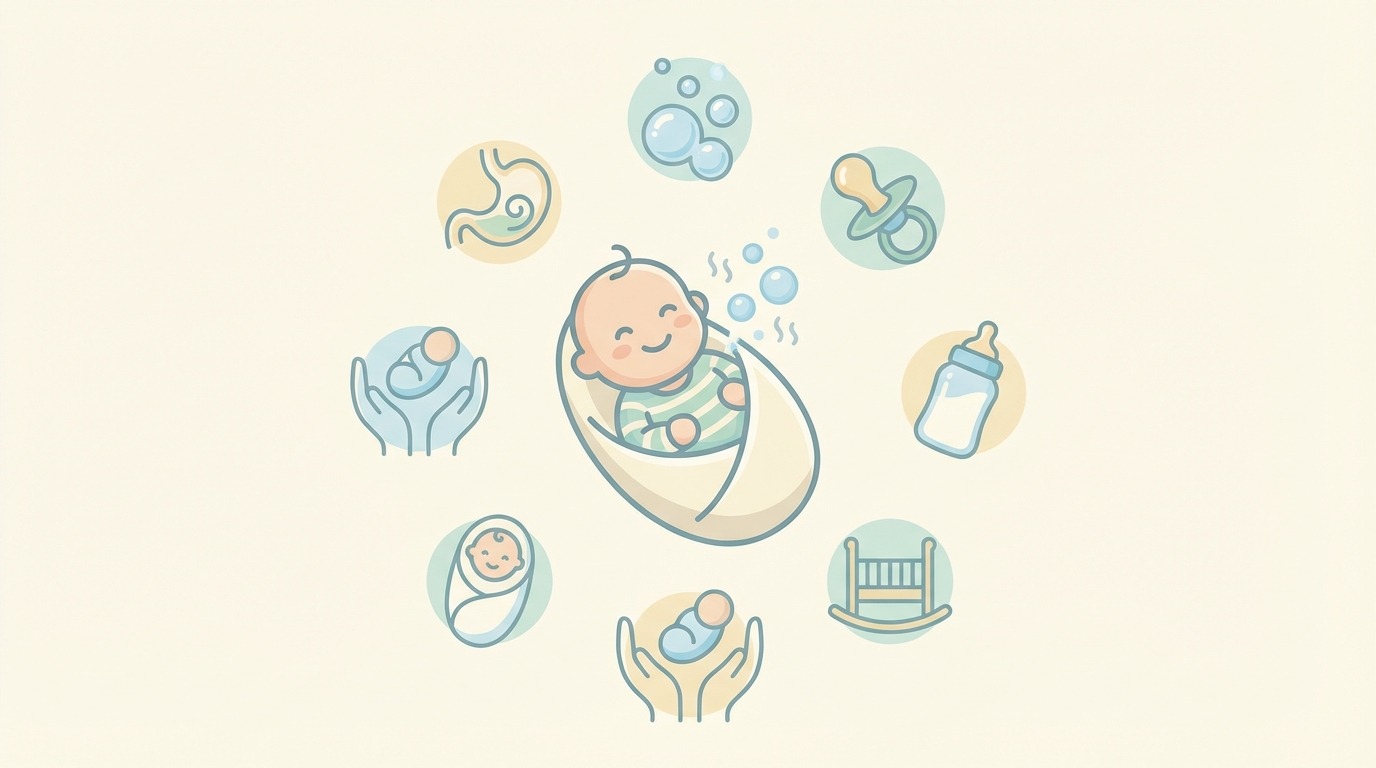
All about infant hiccups: causes, solutions, and advice
| In Brief ⚡ |
|---|
| Infant hiccups are common and generally harmless 😊 |
| Main triggers: rapid feeding, swallowed air, temperature changes, crying 🍼🌬️ |
| Helpful actions: pauses during feeding, upright position, burping, calm 🤱 |
| Watch for: hiccups very frequent + vomiting, weight loss, breathing difficulty 🚩 |
| Seek advice if in doubt: pediatrician or PMI. This guide does not replace medical advice 👩⚕️ |
Infant hiccups intrigue as much as they worry. Yet, this reflex, linked to the diaphragm, often accompanies the first months of life and is sometimes even observed in utero. Parents notice rhythmic “hiccups” after a bottle fed too quickly, during a temperature change, or following crying. Although the phenomenon is ordinary, it calls for concrete and reassuring responses. This file brings together clear explanations, proven solutions, and markers to decide calmly when to consult.
In real life, situations differ: one baby calms at the breast, another needs a pause and burp, a third finds relief thanks to carrying or a walk in a Baby Stroller. In 2026, childcare recommendations favor gentle gestures and keen observation of signals. Concrete examples, easy-to-implement tips, and preventive advice punctuate these pages. The goal is simple: to help each family understand, prevent, and relieve hiccups, while protecting the child’s comfort and rhythm.
Baby has hiccups: understanding the mechanisms and particularities of the infant
Hiccups result from brief, involuntary contractions of the diaphragm, followed by closure of the glottis producing the characteristic “hic” sound. In infants, this reflex often occurs after a meal or strong emotion. The diaphragm, a key muscle for breathing, reacts to stimulation, for example stomach dilation, and contracts rhythmically.
Why are babies so frequently prone to them? Their nervous and digestive systems remain immature. The phrenic nerve, which controls the diaphragm, runs along the esophagus and can be stimulated by swallowed air or rapid swallowing. Moreover, infants eat often during the day, which multiplies occurrences of minor gastric distensions.
Hiccups exist from fetal life. From the second trimester, regular jerks may be felt. They likely participate in training circuits involved in swallowing and breathing. This reality is reassuring: hiccups accompany development without harmful consequences by themselves.
A story helps visualize this. Lina and Marc notice “hiccups” in their son Nino, especially after the evening bottle. Nino drinks quickly, fusses at the end of feeding, and swallows air. When they introduce systematic pauses and burping mid-meal, episodes shorten notably. The mechanism was clear: air and swallowing speed favored the diaphragmatic reaction.
Non-digestive triggers also exist. A shift from warm to cold can surprise a baby and activate the reflex. A moment of excitement, laughter, or prolonged crying can also stimulate the phrenic nerve–diaphragm axis. Observing these contexts guides simple adjustments, such as lightly covering after the bath or reducing stimuli.
Contrary to popular belief, hiccups are not a sign of thirst. They do not harm the throat. Most of the time, the child is not bothered. When discomfort appears, it is indirect: fatigue linked to crying, unmet hunger, associated reflux. Understanding this functional link helps act at the right point.
Identify, note, adjust
A small notebook such as The Birth Book allows recording times, durations, and contexts. Within a few days, a pattern emerges: too rapid feeding, cold period, intense stimulation. This homemade mapping guides tailored solutions and strengthens parental confidence.
The guiding principle is clear: infant hiccups are primarily a normal reflex, amplified by immaturity. The goal is not to eradicate it, but to reduce duration and frequency when baby seems uncomfortable.
Causes of hiccups in babies: feeding, phrenic nerve, temperature, and emotions
Many factors intertwine. Feeding is foremost. A poorly angled bottle, too fast a nipple, agitated sucking, or poorly paced weaning cause milk and air intake. The stomach dilates, the phrenic nerve activates, and hiccups follow. Baby X, for example, hiccupped after each bottle finished in four minutes. A slower flow and pauses were enough to calm the situation.
The immature nervous system also explains frequent episodes during the first three months. The diaphragm reacts quickly, sometimes too much. Over weeks, this hyper-reactivity decreases, as seen with the Moro reflex or sucking-swallowing coordination.
Ambient temperature influences the phenomenon. A cold draft after a bath or an overheated room creates a sudden contrast. The infant’s body, still poorly able to thermoregulate, may react with diaphragmatic jerks.
Emotions also matter. Intense crying changes breathing and brings air into the stomach. Excitement during play can do the same. Baby Y, very expressive, showed hiccups after tired crying. A calming pause, gentle rocking, then slower feeding broke this cycle.
Gastroesophageal reflux (GER) sometimes appears. A still “loose” lower esophageal sphincter lets gastric contents rise. Acid contact irritates and stimulates nerves near the diaphragm. Physiological GER, frequent and brief, differs from complicated GER, associated with pain, weight delay, or sleep disturbances.
Secondary factors intervene marginally: change of formula, suspected cow’s milk protein allergy, or medications that alter digestive motility. Each case requires personalized advice, especially if symptoms are multiple.
Concrete examples to guide observation
— After a bottle taken in the car, varying angles and jolts add air. Result: hiccups upon arrival. Installing the seat then feeding reduces this risk.
— During a walk in a Baby Stroller, the cold surprises. A leg cover and a light sleep sack limit thermal contrast on the route.
— At day’s end, excitement around a Fisher-Price toy becomes intense. Introducing a quiet time before meals sometimes suffices to make episodes disappear.
This mapping of causes directs towards targeted solutions. The next step is choosing simple, effective gestures adjusted to age.
Immediate solutions to gently soothe infant hiccups
Most episodes resolve spontaneously. However, concrete gestures shorten the crisis and increase comfort. First step: slow down. Whether breastfeeding or bottle-feeding, taking a pause of 30 to 60 seconds helps breathing resume a calm rhythm. Many families use nipples with adapted flow, such as from Avent or Dodie, to avoid milk overflow.
Next, the upright position works wonders. Against the shoulder, belly supported on the forearm, or in a “koala” hold on the thigh, baby better releases air. A burp after 2 to 3 minutes of sucking reduces stomach distension and thus diaphragm stimulation.
Skin-to-skin contact soothes the nervous system. Gentle warmth, familiar scent, and parent’s regular heartbeat calm spasms. Some families add a delicate back massage with a small amount of neutral care product like Mustela. Gestures remain slow, with no pressure on the belly.
Soothing distraction also works. A gentle lullaby, dimmed light, a non-nutritive pacifier, a favorite cuddly toy, and the cycle of “hic” sometimes breaks sharply. Low-volume Fisher-Price sensory toys can refocus attention without overstimulation.
Practical checklist during the crisis
- 🍼 Take a pause and offer burping
- 🤱 Upright gentle positioning of baby
- 🎵 Whisper, rock, dim the light
- 🧸 Offer soothing sucking if needed
- 🌡️ Check room temperature (around 19–20 °C)
Some remedies circulate. A spoonful of sugared water can interrupt the crisis through sucking and taste effect. It is reserved for occasional situations, in small amounts, never routinely. A drop of lemon, only after 3 months, is discussed with a health professional. Conversely, no intentional scares, no cold objects on the back, and never honey before age one.
Equipment helps regulate flow. Brands offer various choices. The NUK Bottles 2025 Guide presents nipples by age stages and texture. Families also adjust bottle angle and favor calm during feeding. This combination reduces swallowed air and hiccups follow.
For awake times, a soft mat and flexible clothes from Petit Bateau limit pressure on the abdomen. After the bath, a soft cape and breathable cotton pajamas from Vertbaudet or Natalys avoid harsh thermal contrasts.
Quick resources to watch
When preferring to see the gestures, a video reassures and guides. The queries below direct to adapted demonstrations.
After this visual learning, the markers are more concrete for the next meal. Let’s now move on to daily preventive habits.
Preventing hiccups daily: feeding rhythm, environment, and useful equipment
Prevention starts with rhythm. Offering a meal before extreme hunger reduces rush. Practically, it is better to start feeding at the first signs of food awakening: mouth movements, hands to mouth, searching for the breast. A less hungry child feeds more calmly and swallows less air.
Choice of nipple flow matters greatly. A model too fast encourages milk overflow. Conversely, too slow a flow irritates and increases crying. Ranges like Avent, Dodie, or NUK offer age-related markers, but observation is key. If the bottle finishes in under five minutes, slow down. If it stretches beyond twenty, reassess.
Environment counts. Calm favors regular sucking. Soft light, a comfortable chair, a table within reach to place bottle and cloth, all facilitate the moment. A calm walk in a Baby Stroller like Bébé Confort can also regulate tone before meals.
Ergonomic carrying after feeding, for fifteen to twenty minutes, limits reflux. Soft fabrics leave the abdomen free. Organic cotton sets from Petit Bateau or Vertbaudet avoid compression. To track progress, a notebook like The Birth Book helps follow evolution and effective adjustments.
Feeding equipment is carefully chosen. Adjust the nipple, check bottle angle, and use comparison benchmarks. This NUK 2025 Bottle Comparison details nipple shapes and effectiveness. The objective remains constant: reduce swallowed air and respect baby’s rhythm.
Summary table of triggers and preventive gestures
| Common Trigger 🧩 | Preventive Gesture ✅ |
|---|---|
| Too rapid feeding | Slower flow nipple, regular pauses 🍼 |
| Swallowed air | Bottle angle, burping mid-meal, upright position 🤱 |
| Cold after bath | Warm towel, quick dressing, room at 19–20 °C 🌡️ |
| Hunger crying | Offer before extreme hunger, prior quiet time 🕊️ |
| Excitement before meals | Gentle play, dimmed light, reassuring cuddly toy 🧸 |
An additional useful step is to check equipment maintenance. A damaged or dirty nipple disrupts flow and encourages strong sucking. Replace without delay. On textiles, soft bodysuits from Natalys facilitate quick changes, limiting irritation before feeding.
Finally, having a plan B soothes everyone: a backup lullaby, a soft rattle from Fisher-Price, a cloth within reach, a cozy corner. With these routines, hiccups lose their startling character and regain their place: a common reflex, quickly resolved.
After these preventive markers, a key question remains: when to consult without delay and whom to contact?
When to worry: warning signs, complicated GER, and professionals to contact
Hiccups alone do not worry. However, certain warning signs require medical advice. Noisy or difficult breathing, blue lips, repeated forceful vomiting, weight loss, or painful awakenings at each feeding must be reported. In these cases, hiccups are not the cause but a marker of a broader discomfort.
Complicated GER is identified by abundant and frequent regurgitations, visible pain during or after meals, and sometimes a stagnant weight curve. A pediatrician then assesses feeding history, clinical exam, and proposes measures: thickeners, flow adaptation, or treatment if necessary.
Sucking disorders may coexist. A restrictive lingual frenulum, difficulty positioning at the breast, or still fragile sucking-swallowing-breathing coordination favor air aspiration. A certified IBCLC lactation consultant, a midwife, or PMI can refine support.
Complementary therapies find their place when basic gestures are insufficient and a trained professional offers them. Pediatric osteopathy, infant acupuncture, or sometimes a psychomotricity approach aim for overall relaxation. Competence and gentleness of care are ensured.
Regarding lifestyle, chronic overstimulation sometimes sustains episodes. Reducing noise, structuring routines, and choosing simple reassuring equipment helps a lot. Sleep sacks, cloths, and comfortable sets from Petit Bateau or Vertbaudet facilitate these transitions. Mustela care products help create a soothing ritual after the bath.
When parental anxiety rises, a chronological marker reassures. If hiccups last more than 10 to 15 minutes accompanied by inconsolable crying, check hunger, burp, diaper, temperature. If daily repetition occurs with other symptoms, contacting the pediatrician quickly clarifies the situation. The information provided here supports understanding but never replaces medical advice.
Who to contact and how to prepare for the consultation
— Pediatrician / General practitioner: to analyze all symptoms and family context.
— PMI: for global support, weigh-ins, and daily advice.
— Lactation consultant: to optimize milk transfer and sucking.
Before the appointment, gather some notes in The Birth Book: feeding times, durations, tested positions, and hiccup frequency. These data ease a tailored action plan and reassure the whole family.
With these safeguards, every parent knows when to calm, when to prevent, and when to ask for help. The goal remains baby’s safety and comfort, without dramatizing an often harmless reflex.
Does hiccuping hurt the baby?
In most cases, no. The infant is not bothered by isolated hiccups. Discomfort mainly occurs if other factors combine, such as intense hunger, crying, or associated reflux. Soothing actions (pauses, burping, upright position) quickly reduce discomfort.
Which bottles and nipples limit hiccups?
An age-appropriate flow rate matched to the sucking rhythm remains essential. The Avent, Dodie, and NUK ranges offer several flow rates and shapes. It is necessary to observe baby and adjust. Comparisons like the NUK 2025 bottle guide help choose based on flow and nipple softness.
Should feeding be stopped when hiccups start?
It is better to take a short break, offer burping, then calmly resume if the baby still wants to feed. Abruptly stopping a feeding in a hungry child often maintains agitation. The goal is to soothe, not frustrate.
Are sugar or lemon recommended?
These tips may work occasionally but do not constitute treatment. Slightly sugared water is reserved for rare cases, and lemon drops only after 3 months. Ask a healthcare professional before trying.
What daily accessories can help?
A stable Baby Stroller for calm walks, soft clothing (Petit Bateau, Vertbaudet), gentle Mustela care products, and soothing Fisher-Price toys help reduce stress and overstimulation, which indirectly decreases hiccup episodes.