Help Speak Adults: Helping the child from 1 to 3 years old speak to adults.
| Short on time? Here is the essentials ✨ |
|---|
| 👶 In early childhood, hesitation to talk to unfamiliar adults is normal. Respecting the pace reduces pressure. |
| 🗣️ To help the child express themselves, offer real situations where they must ask themselves (e.g. say “hello,” order at a café). |
| 🧩 Use concrete supports: closed choices, beginning of a word, yes/no question, and kind reformulation. 💬 |
| 📚 Focus on language awakening with nursery rhymes, books, gestures, pretend play, and daily exchanges. |
| 🚦 Do not force, do not apologize on their behalf, value every attempt (even a smile). ✅ |
| 📵 Limit screens and pacifiers during the day; encourage adult-child interactions and oral language in context. |
| 🩺 If the child remains silent in a specific context for more than a month, consult a doctor and, if necessary, a speech therapist. 🔎 |
| 🔗 To understand the stages, see social development and language in children. 🌱 |
Between 1 and 3 years old, a child may chatter at home and suddenly become very quiet in front of an unfamiliar adult. This reserve rarely stems from stubbornness. It mainly reflects a balance in progress between emotional security, language acquisition, and the emergence of shyness. However, the ability to talk to adults is nurtured. It improves when concrete opportunities for interaction and simple supports to dare to respond are offered. During this period of language development, every micro-victory counts, provided communication remains light and pleasant.
The goal is not to turn a quiet child into an orator. The challenge is rather to create conditions for confident child communication with various adults. Thus, routines, symbolic play, reading, and gestures contribute to early education in language. At the same time, a few safeguards avoid undue pressure: do not force repetition, do not apologize for them, and know when to answer on their behalf when they freeze. This guide equips families with concrete strategies, examples of situations, warning signs, and useful resources to progress step by step.
Helping the child aged 1 to 3 speak to adults: understanding mechanisms and respecting the pace
Why a toddler often hesitates before an unfamiliar adult
In early childhood, the child initially feels comfortable with familiar figures. Around 12-24 months, separation anxiety increases caution toward strangers. Then, around 3 years, embarrassment and shame appear. These emerging emotions complicate speaking. Thus, the child may express themselves perfectly at home yet remain silent at the doctor’s.
This caution is not an obstacle to language development. It indicates healthy socio-emotional maturation. The first experiences of adult-child interactions outside the close circle build progressively. To better situate these stages, it is helpful to explore social development and how it supports speech directed at others.
Normality, variability, and contextual factors
Each child progresses at their own pace. Some speak quickly to everyone, others observe first then take the plunge. Environment also plays a role: noise level, number of people, unfamiliar space, rituals. A warm welcome and realistic expectations reduce pressure. For example, an adult who gets down to the child’s level and asks a simple question facilitates the response.
Cognitively, the child selects what they understand, what they want to say, and how to say it. This orchestration requires great energy. In a new context, the child conserves resources and observes. This observation time prepares for a calmer speech delivery later.
When should one really worry?
As long as the child is not completely mute for over a month in a specific context, the situation is generally normal. However, constant silence in daycare or with a professional, despite appropriate support, deserves medical advice. The doctor may refer for evaluation of language, hearing, and sensory profile.
It is also important to distinguish shyness, selective mutism, and language disorder. To deepen understanding, consulting reliable resources on children’s language issues helps mark the path. The key remains avoiding any blame. Respecting the pace protects the pleasure of exchange, the foundation of progress.
Key insight
Trust precedes directed speech. By securing the child, we free their voice, first by small steps, then consistently.
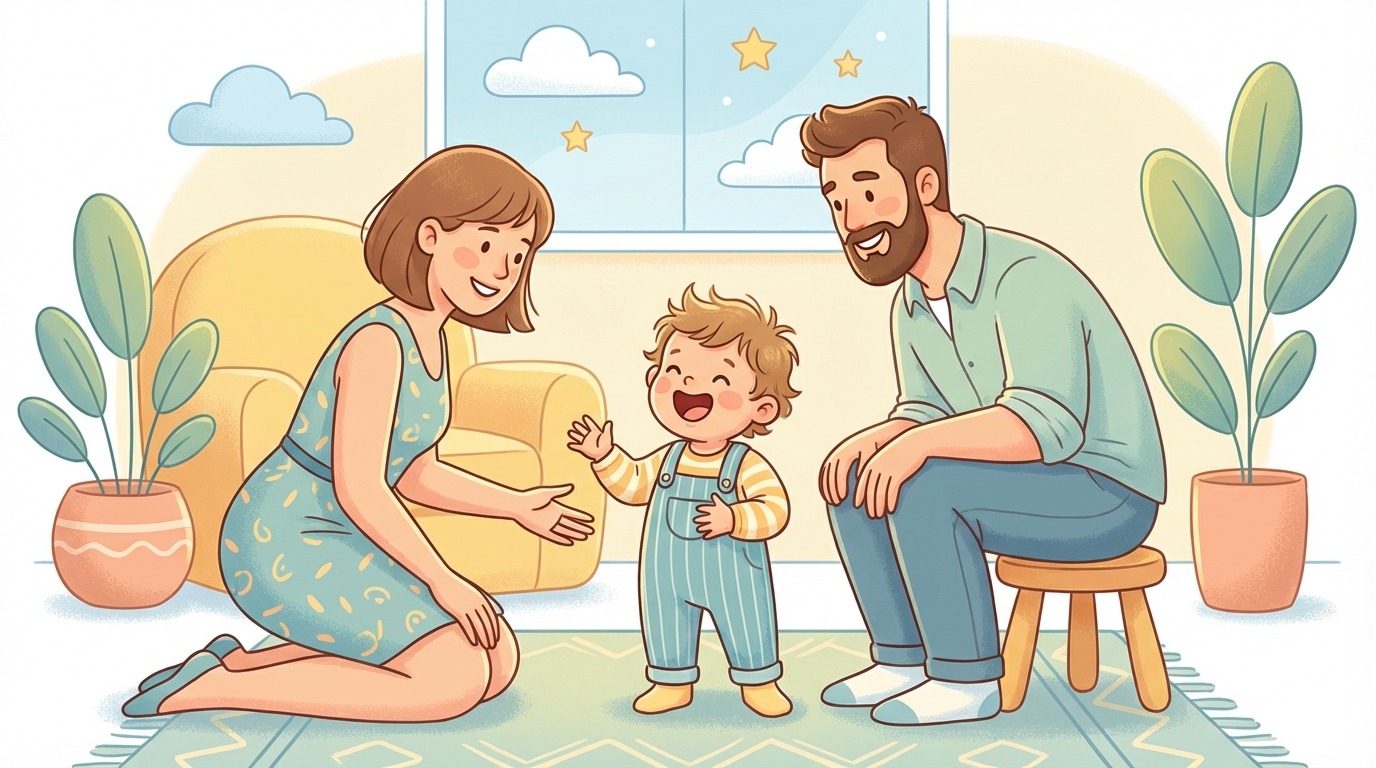
Preparing the home ground: routines, gestures, and models that trigger speech
Daily micro-habits that change everything
To help the child express themselves with various adults, training begins at home. Describing daily gestures, naming what is seen, anticipating steps provide a rich bath of oral language. Short sentences, expressive voice, and pauses invite the child to take over. Nursery rhymes and picture books reinforce this linguistic soil.
From 10-12 months, joint attention and pointing pave the way to language acquisition. To locate these milestones, consulting the markers of development between 10 and 12 months is relevant. Even earlier, care and direct address to the baby plant firm roots, as this guide on newborn care recalls.
Modeling without pressure: reformulation that values
When the child attempts a sentence, gentle reformulation provides the right model. It is not necessary to make them repeat. Forced repetition creates tension and can block child communication. Instead, offering an enriched version and continuing the exchange maintains the desire to speak.
Likewise, limiting the pacifier during the day promotes clear articulation. Additionally, reducing screens frees time for play, manipulation, and discussion. These moments build a foundation of early education where speech flows naturally.
Express checklist to ritualize language awakening
- 🎵 1 nursery rhyme per day, with simple gestures and pauses to let the child complete.
- 📖 10 minutes of shared reading, with open questions and images to name.
- 🧸 Imitation play (tea set, cuddly toy), to replay “hello,” “thank you,” “please.”
- 👋 Train “saying hello” at the door, first to a close person, then to a neighbor.
- 🗯️ Reformulate their words, without harsh correction or demanding repetition.
- ⏸️ Screens off during playtime, pacifier reserved for sleep. ✅
Useful video resource
To visualize practical applications, a targeted search on speech therapy and language routines is very instructive.
Golden rule: multiply small chances to speak, without performance stakes, creates a positive spiral that spreads later to other adults.
Facilitating dialogue between the child and other adults: concrete scenarios and effective supports
Real, progressive, and benevolent contexts
The transition from home to exchange with an unfamiliar adult takes place in real conditions. The most effective approach is to create situations where the child has a small clear objective. For example, asking for a croissant at the bakery or giving their name to the educator. Start with warm interlocutors, then gradually widen the circle.
A mediating adult can initiate the exchange. They introduce the child, give an interest clue (a cuddly toy, a passion), then slightly step back to leave space. This orchestration reassures and encourages speaking.
What to do if they freeze? The “stair steps”
When the child remains mute, there are concrete supports. Offering a closed choice simplifies the answer. Starting a sentence or the beginning of a word unlocks an utterance. Transforming the question into yes/no provides a possible non-verbal alternative. And if nothing comes, answering once on their behalf, as a model, restarts the positive cycle.
It is also important to avoid excuses like “they are shy.” This label creates an unnecessary norm. Conversely, valuing a sign of engagement, even a look or a smile, maintains motivation. To deepen these references, resources on children’s language questions are rich and accessible.
Mini case study
Lina, 2 years old, observes the doctor. The referring adult announces: “Lina wants to show you her bunny cuddly toy.” The doctor gently comments on the object. Then, the adult asks: “Do you want to say its name or nod your head?” Lina nods, then whispers “Bunny.” The model, choice, and kind validation were enough. In the following weeks, Lina will say “hello” then “goodbye” on her own initiative.
This type of progress builds self-confidence and social skills. It nurtures the ability to talk to adults without pressure or avoidance. Repeating scenarios in varied contexts establishes lasting competence.
Key insight
The more concrete and predictable the situation, the more the child dares. Clear tasks lower the threshold of entry into exchange.
Play and fun activities to trigger expression addressed to adults
Pretend play and “Hello – Ask – Thank” scenarios
Pretend play offers a safe rehearsal room. Setting up a tea set and playing “order,” “pay,” “thank” trains social scripts. The child memorizes verbal routines they will reuse later with real adults. Pausing and smiling encourage participation.
Role plays with puppets or figurines also serve as a springboard. An adult puppet asks a simple question. The child answers with a word, gesture, or sound. The script gradually becomes more complex, without evaluation.
Books, songs, and “seek-and-find” to enrich vocabulary
Shared reading exposes to useful social vocabulary: greetings, polite phrases, emotions. Nursery rhymes pace speech turns with a reassuring framework. Seek-and-find games train joint attention and description. This trio directly feeds speech addressed to others.
To link language and thought, exploring intellectual development helps understand why sorting, categorizing, or comparing activities support expression. By stimulating cognition, the relevance of exchanges is increased.
Reducing barriers: screens, pacifier, and overload
In front of a screen, the child is often passive and hypnotized. During this time, they do not practice exchange. It is better to reserve these moments and protect periods of free play rich in dialogues. Likewise, keeping the pacifier for sleep frees the mouth to speak clearly.
Varying play contexts broadens conversation topics. Park, kitchen, bath, shopping—all become excuses to interact. This diversity accelerates language awakening in realistic conditions.
Inspirational video resource
To discover play ideas and politeness scripts adapted to 1-3 years, this search can help.
Red thread: play first, talk later. Pleasure opens the door to words.
Warning signs and stress-free professional support
When to seek advice: signs that should alert
Complete silence in a given context for over a month, despite support, justifies a consultation. Other signals include comprehension difficulties, lack of communicative gestures, or marked vocabulary weakness after 2 and a half years. It is better to assess early and reassure the family.
It is useful to distinguish a simple delay, selective mutism, and a specific disorder. To learn more, see the file on developmental language disorder and particularities of oral language. An evaluation may also check hearing or sensory integration.
Care pathway and relay
The primary point of contact remains the general practitioner or pediatrician. They refer for a speech therapy assessment if necessary. Sometimes, an ENT opinion is required to rule out hearing loss. Then, support centered on language acquisition and social confidence is put in place, always with concrete and playful goals.
To anticipate the next steps, markers on development between 5 and 8 years clarify future evolution. Likewise, understanding expectations around development at 5 years helps position objectives.
Educational alliances and continuity of support
Alignment between family, early childhood professionals, and speech therapist multiplies effects. Sharing common scripts, benchmark gestures, and realistic expectations avoids contradictory messages. Follow-up becomes more effective when each adult values effort rather than performance.
Finally, reassuring the child about the possibility to speak “later” maintains the bond. The return of a positive experience strengthens the next attempt. This is how directed speech becomes durable and fluent.
Orientation video resource
To spot the stages of a calm pathway and useful signals, here is a relevant video search.
Final point of the approach: detect early, act lightly, and keep the pleasure of exchanging. It’s the winning trio.
“A toddler’s voice opens when they feel heard without being rushed: less pressure, more conversation.”
My child talks at home but is silent with the nanny. Is it serious?
This situation is very common between 1 and 3 years. The child is testing a new environment and conserving their resources. Provide concrete supports (closed choices, beginning of a word, yes/no) and value small steps. If total silence persists for more than a month despite these aids, seek medical advice to refer, if necessary, for a speech therapy assessment.
Should a badly pronounced word be repeated?
No. It’s better to reformulate the message correctly and continue the exchange. Forced repetition adds pressure and can break the dynamic. With clear and regular models, the child will appropriate correct forms at their own pace.
What games stimulate language addressed to adults?
Pretend play (tea set, puppets), dialogued readings, nursery rhymes with gestures, seek-and-find, and “hello – ask – thank” scenarios. Favor simple, concrete, and predictable tasks, with pauses that invite the child to respond.
Can screens help speaking?
Screens do not foster conversation. They reduce active exchange time. It is better to limit them and protect moments of interactive play, shared reading, and face-to-face discussions.
When to consult a specialist?
In case of constant mutism in a specific context for more than a month, if comprehension seems limited, or if communicative gestures are rare. The doctor will evaluate the situation and may prescribe a speech therapy assessment to clarify needs.