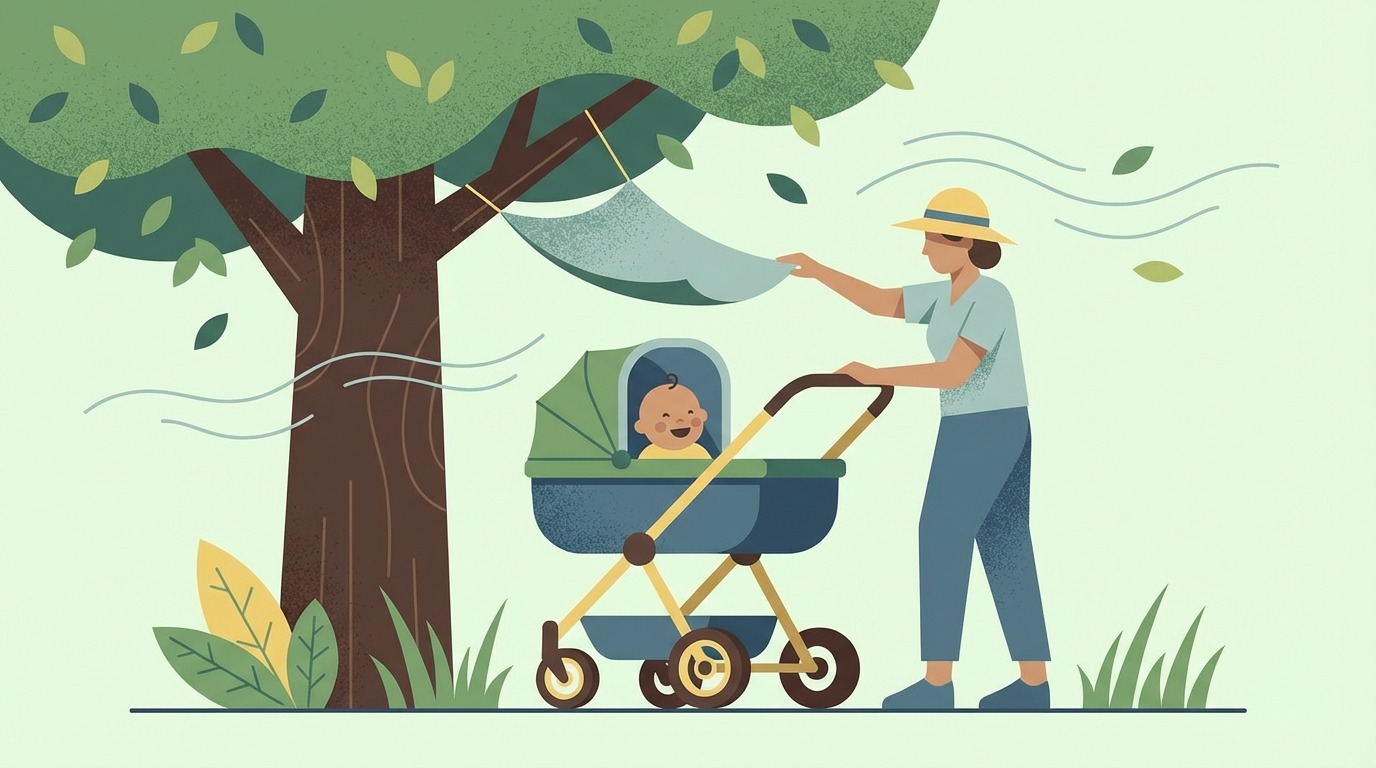
Baby Playing Outside: Helping baby play outside from 0 to 12 months.
| Short on time? Here’s the essentials ⏱️ |
|---|
| Playing outside from birth stimulates sensory awakening and promotes better sleep 🌿 |
| At 12 months, appropriate games support motor development and curiosity 🚶♂️ |
| Outdoor safety relies on parental supervision, shade, hydration, and controlled paths 🛡️ |
| The 4-season angel nest ensures comfort and car-to-stroller transitions all year round 🧣 |
| Alternate short and frequent outdoor activities: park, forest, sea, farm, balcony 🌞 |
Going out with a baby turns every day into a concrete adventure. The outdoors stimulates sensory awakening, strengthens the biological clock, and nurtures the attachment bond. From the first weeks, a stroller ride to the park or a moment on the balcony is enough to vary sounds, smells, and lights. Yet, every discovery benefits from being simple, brief, and supervised: a reassuring framework, suitable attire, and a clear goal to keep pleasure at the center.
At 12 months, exploration accelerates. Hands touch the grass, feet seek balance, the voice makes sounds to name moving things. To optimize these moments, appropriate games guide motor development while respecting each child’s own pace. The winning angle remains constant: active parental supervision, anticipated outdoor safety, and a contact with nature orchestrated as a series of positive experiences.
Baby playing outside from 0 to 6 months: sensory awakening, outdoor safety, and first gestures
From 0 to 6 months, the outside world acts like an open book. Light contrasts, gentle breezes, and natural sounds create a rich backdrop. This period suits very short, regular, and targeted outings. The goal isn’t to “do a lot,” but to establish a stable ritual where sensory awakening remains the priority. Thus, a few minutes of observation under a tree are enough to nurture attention.
Comfort remains central. A 4-season angel nest facilitates indoor–outdoor transitions. It helps manage temperature variations without waking the infant. Additionally, a hat, a shaded area, and controlled hydration provide effective protection. Sun exposure times are limited, and the skin stays covered. For clothing and accessories, a soft and practical selection simplifies daily life: flexible sets, easy booties, and a breathable blanket. Useful ideas can be found at family-oriented brands 👶.
The sensory framework is modulated by micro-activities. For example, listening to a fountain, stroking a cotton gauze scarf, smelling a non-allergenic flower from a distance. These brief moments help the nervous system integrate new information without overload. Moreover, adult mobility adjusts the distance to stimuli. In babywearing, the child perceives the heartbeat, which reassures and encourages visual exploration.
Outdoor safety is built meter by meter. A stable surface, a shaded area, a braked stroller, and dedicated supervision are enough. In practice, it is advisable to avoid small, sharp, or irritating plant objects. If discomfort arises, a simple soothing routine helps defuse the situation. Concrete markers to quickly calm an infant are detailed in these tips for soothing tears 💤.
Inspiring example: “Lina, 3 months” discovers a park corner. First, hood, shade, 8 minutes listening to the wind. Then, a texture change under the hand: a soft blanket, then a dry leaf held by the adult. Finally, return to the stroller for a micro-nap. This scenario shows how a short loop creates a pleasant appointment with the outdoors.
Mini list of ideas for 0–6 months
- 👂 Listen to birdsong then softly name the sound
- 🍃 Let them smell an aromatic herb from a distance, watching their reaction
- 💧 Observe light shimmering on water while staying in the shade
- 🧣 Pass a soft scarf over the hand, then the foot, to vary sensations
- 🛏️ Offer a nap in the stroller during a neighborhood walk
To deepen the implementation of outdoor routines, this YouTube search gathers many demonstrations.
In short, the 0–6 month period benefits from staying simple: proximity, shade, softness, and measured variety of stimuli. Thus, a solid foundation is established for what comes next.
Helping baby play outside at 12 months: motor development, appropriate games, and contact with nature
Around 12 months, curiosity blossoms. The child crawls quickly, stands up, sometimes walks. This turning point requires appropriate games to support motor development. The aim is to offer short, safe, and rewarding challenges. The goal remains to train balance, hand–eye coordination, and leg strength without forcing. A simple topography helps a lot: short grass, flat path, small slope.
Clear markers facilitate progression. First, a stable starting zone. Then, a colorful visual target a few steps away. Finally, an object to catch, then to put in a basket. This sequence motivates walking and structures attention. It can be done with cups, soft balls, or motor skill cones. To better understand milestones, consult this guide on baby motor development 📈.
The outdoors also serves as a rich ground for language. Naming textures (smooth, rough), colors (green, yellow), or actions (push, pull) strengthens mental associations. Moreover, the hand explores material: wet sand, smooth bark, large pebble. Everything is done with active adult presence and simple rules: no mouthing, hand washing after activity, water available.
Appropriate games for 10–14 months: progression and fun
| Activity 🧩 | Goal 🎯 | Practical tip 💡 |
|---|---|---|
| Zigzag grass path | Balance and changing direction | Place colorful cones to touch 👉 |
| Transfer pine cones | Coordination and fine grip | A low, stable basket 🧺 |
| “Find and show” hunt | Joint attention and vocabulary | First a leaf 🍁, then a pebble |
| Push a mini cart | Walking with support | Avoid steep slopes ⛰️ |
Certain developmental toys perfectly complement these outings. Light or sound modules encourage rhythmic initiation and cause–effect understanding. Inspiring ideas are found in this selection of electronic developmental toys and in these baby game ideas 🎶. On cloudy days, they also serve as quick alternatives under shelter.
Outdoor safety remains the priority. The adult marks the space, anticipates obstacles, and shows limits. A prevention approach guides every step. For uneven terrain, advice to prevent falls helps adapt the path. Finally, parental supervision stays constant and close, especially near water or animals.
Group games become possible, short in duration. A simple ring, passing the ball, or imitating an animal’s cry. At this age, sharing the space comes before sharing the object. A visual timer and quick rotation of roles reduce frustration and strengthen cooperation. Some very simple early titles here can support these moments: see ideas for board games 1–3 years 🎲.
In summary, towards one year, the child gains confidence when benefiting from a predictable environment, playful objectives, and patient guidance. The outdoors then becomes a real natural gym.
Essential outings: park, sea, farm, and forest for playing outside from 0 to 12 months
The park remains a classic. Safe paths, benches, and tree shade offer an ideal setting. For little ones, listening to a fountain or watching clouds is enough. For older children, stepping on grass, touching bark, or rolling a ball down a gentle slope creates a simple motor challenge. A basket of natural “treasures” that are not sharp broadens the sensory palette.
The beach offers a range of experiences. The sound of waves, salty breeze, and freshness of water on feet constantly stimulate. However, protection remains strict: shaded area, suitable cream, regular hydration, beach at gentle hours. A well-anchored parasol and a thick towel make a stable base. For thermal comfort, the 4-season angel nest remains relevant during trips or cool wind.
The educational farm awakens sensory curiosity. Animal sounds, variety of pelts, and observation gestures boost joint attention. First we look, then we name, finally we stroke if allowed. The adult presents the rule: stroke gently, wash hands, keep indicated distance. This stable framework reassures the child and values the encounter.
The forest adds the depth of smells, thickness of mosses, and play of lights. A wide path, a simple map, and a short loop structure the adventure. Moreover, active listening enriches a lot: recognizing the crackle of a branch, the breath of the wind, or a bird’s song. After the walk, a quiet calming time closes the experience, consolidating sensory integration.
Concrete examples for planning a typical week
- 🗓️ Monday: 10 min at the park, shade and listening to birds
- 🌊 Wednesday: 20 min on shaded beach, feet in water
- 🐑 Friday: educational farm, 25 min observation
- 🌲 Sunday: 30 min in the forest, textures to touch with adult
These sessions remain adaptable depending on sleep and weather. To complete the experience, some families enjoy preparing a “mission”: find three different greens, find a round pebble, listen to two new sounds. For siblings, a mini-scenario with figurines supports cooperation; see ideas of family games with figurines 🧸.
Looking for visual inspiration to organize inclusive nature outings with a baby? This video search offers itineraries and useful equipment.
In the end, varying places multiplies neural connections and positive emotions. Each site becomes an open-air classroom.
Smart planning: equipment, outfits, and micro-rituals for calm outdoor activities
A well-prepared outdoors becomes simple. Equipment forms a tripod: mobility, comfort, safety. A stable stroller, a physiological baby carrier, and a 4-season angel nest cover most cases. Then come modular essentials: hat, water bottle, wipes, care kit, thin blanket. This kit fits in a compact bag to leave within minutes.
The outfit makes the difference. Breathable clothes, comfortable diapers, and swim pants for water babies support autonomy. Baby-oriented brands offer suitable and durable options; checking out young child equipment specialists saves time 🧺.
Ready-to-go checklist
- 🍼 Hydration and snacks suited to age
- 🧴 Sun protection: hat, sunglasses, high protection cream
- 🧻 Mini-care kit: compresses, saline solution, bandages
- 🧸 Comfort object: cuddly toy, pacifier if needed
- 🧣 4-season angel nest for transitions and naps
- 🌦️ Windbreaker/rain cape light
Time structures the experience. Short and frequent outings are better than one long session. Thus, the nap–meal rhythm guides the schedule. A three-step routine works well: arrival and observation, targeted activity, return to calm. This predictability reassures the child and facilitates falling asleep afterward.
On capricious days, shelter remains strategic: kiosk, pergola, tree with wide shade. Babywearing protects from wind and maintains reassuring posture. When agitation rises, a breathing pause, a soft lullaby, and a change of scenery help. Depending on the situation, effective soothing tips are detailed in these tips to calm a baby 🌙.
Finally, the adult keeps focus: a simple goal, reduced equipment, gentle progression. With this winning trio, the outdoors becomes accessible daily.
Parental supervision and outdoor safety: preventing risks without hindering exploration
Safety does not oppose pleasure. It makes it lasting. An active, close, and caring parental supervision is the first measure. It rests on three verbs: observe, anticipate, adjust. First, frame the perimeter. Then, identify sensitive points: water, slopes, sharp objects, plants to avoid. Finally, adjust activities to the child’s level.
In the sun, the golden rule boils down to shade, gentle hours, covering fabrics, and suitable cream. In cold weather, breathable layering avoids overheating. Near water, controlled distance and adult bent-knee posture speed up reaction if needed. With animals, follow the site’s instructions and show the “gentle” gesture with the child’s hand.
The ground deserves a minute of inspection. Pick up small objects, check for absence of thorns, spot holes. For new walkers, stability is key. Fall prevention relies on firm support, visible obstacles, and constant presence. A useful reminder is found in these tips to reduce fall risk 🛟.
Emotions also regulate through the environment. A tired child stumbles more. An overstimulated child grumbles, bites, throws. Prevention passes through calm transitions, clear activity, and measured duration. When emotional storm arises, “stop, breathe, cuddle” recenters and restarts exploration in good conditions.
Finally, the basic kit remains accessible: compresses, saline, bandages, mild disinfectant. A routine of handwashing after each floor activity limits discomforts. Thus, the child learns that the outdoors is both free and marked. This dialectic feeds his/her confidence and inner safety.
In short, the best protection is to prepare the ground and stay attentive. The freedom to move then grows within an explicit framework.
Ideas for outdoor activities by season: vary pleasures without complicating
Spring calls for progressive explorations. Flowers, slow insects, and soft grass create an ideal scene. A typical session mixes listening to sounds, guided walking, and handling chosen natural objects. The adult shows, names, then lets the child initiate. This alternation builds trust and curiosity.
Summer demands a freshness strategy. Shade, fine mist sprayers, gentle hours, and supervised water spots. Simple games work very well: transferring water between two buckets, rolling a ball in the shade, drawing water traces with a brush on a slab. To accompany these games, some sturdy developmental accessories can enrich the range; see ideas on the interactive outdoor toys 🔆.
Autumn multiplies textures. Leaves, pine cones, bark, puddles to observe. An “autumn colors” ring motivates walking: look for yellow, red, brown. Short looped paths reassure because return is quick if fatigue comes. For families who like to punctuate with a calm moment, some ultra-simple titles help to wait afterward; explore options for very short games for toddlers 🍂.
Winter does not rhyme with stopping. Outings remain precious to regulate sleep and mood. Short moments are targeted, breathable layers are superposed, and the 4-season angel nest is used for the stroller. The winter outdoors teaches cold, breath vapor, quiet silence. Two or three micro-activities suffice: watch breath vapor exiting the mouth, listen to snow, touch a trunk.
Throughout the year, one principle guides organization: simple, clear, regular. General ideas of games to draw from and adapt outdoors are listed in these selections of baby games and progressive developmental games 🌈. This idea reservoir helps renew without complicating.
Ultimately, seasons are not obstacles but frameworks. They color the same fundamentals: curiosity, safety, and shared pleasure.
“The world becomes a playground when a baby marvels at it, and nature is its most beautiful teacher.”
{“@context”:”https://schema.org”,”@type”:”FAQPage”,”mainEntity”:[{“@type”:”Question”,”name”:”Combien de temps jouer dehors avec un bu00e9bu00e9 de moins de 6 mois ?”,”acceptedAnswer”:{“@type”:”Answer”,”text”:”Visez 10 u00e0 20 minutes, une u00e0 deux fois par jour, selon la mu00e9tu00e9o et lu2019u00e9tat de veille. Des sorties courtes et ru00e9guliu00e8res optimisent lu2019u00e9veil sensoriel et respectent la fatigue.”}},{“@type”:”Question”,”name”:”Quels jeux proposer u00e0 12 mois pour soutenir le du00e9veloppement moteur ?”,”acceptedAnswer”:{“@type”:”Answer”,”text”:”Privilu00e9giez les parcours simples (herbe, ligne droite), le transvasement du2019objets naturels, pousser un chariot stable, et les activitu00e9s de u00ab trouve et montre u00bb. Ces jeux adaptu00e9s renforcent u00e9quilibre, coordination et attention conjointe.”}},{“@type”:”Question”,”name”:”Comment assurer la su00e9curitu00e9 extu00e9rieure sans brider lu2019exploration ?”,”acceptedAnswer”:{“@type”:”Answer”,”text”:”Du00e9finissez un pu00e9rimu00e8tre clair, u00e9liminez les petits dangers visibles, privilu00e9giez lu2019ombre et lu2019hydratation, et restez proche. La surveillance parentale active permet du2019ajuster en temps ru00e9el sans couper lu2019u00e9lan.”}},{“@type”:”Question”,”name”:”Quu2019emporter systu00e9matiquement pour des activitu00e9s en plein air ?”,”acceptedAnswer”:{“@type”:”Answer”,”text”:”Un nid du2019ange 4 saisons, une gourde, une protection solaire, une trousse de soins, des lingettes, une couverture fine et un change. Lu2019ensemble tient dans un sac compact pour partir vite.”}},{“@type”:”Question”,”name”:”Des idu00e9es pour gu00e9rer une montu00e9e de pleurs au parc ?”,”acceptedAnswer”:{“@type”:”Answer”,”text”:”Ru00e9duisez les stimuli, faites une pause cu00e2lin, hydratez, puis proposez une activitu00e9 tru00e8s simple et familiu00e8re. Des techniques du2019apaisement efficaces sont du00e9taillu00e9es dans des guides du00e9diu00e9s.”}}]}How long to play outside with a baby under 6 months?
Aim for 10 to 20 minutes, once or twice a day, depending on weather and alertness state. Short and regular outings optimize sensory awakening and respect fatigue.
What games to offer at 12 months to support motor development?
Favor simple courses (grass, straight line), transferring natural objects, pushing a stable cart, and “find and show” activities. These appropriate games strengthen balance, coordination, and joint attention.
How to ensure outdoor safety without hindering exploration?
Define a clear perimeter, remove visible small dangers, favor shade and hydration, and stay close. Active parental supervision allows real-time adjustment without cutting momentum.
What to systematically bring for outdoor activities?
A 4-season angel nest, a water bottle, sun protection, a care kit, wipes, a thin blanket, and a change of clothes. All fits in a compact bag for quick departure.
Ideas to manage a crying fit at the park?
Reduce stimuli, take a cuddle break, hydrate, then offer a very simple and familiar activity. Effective soothing techniques are detailed in dedicated guides.