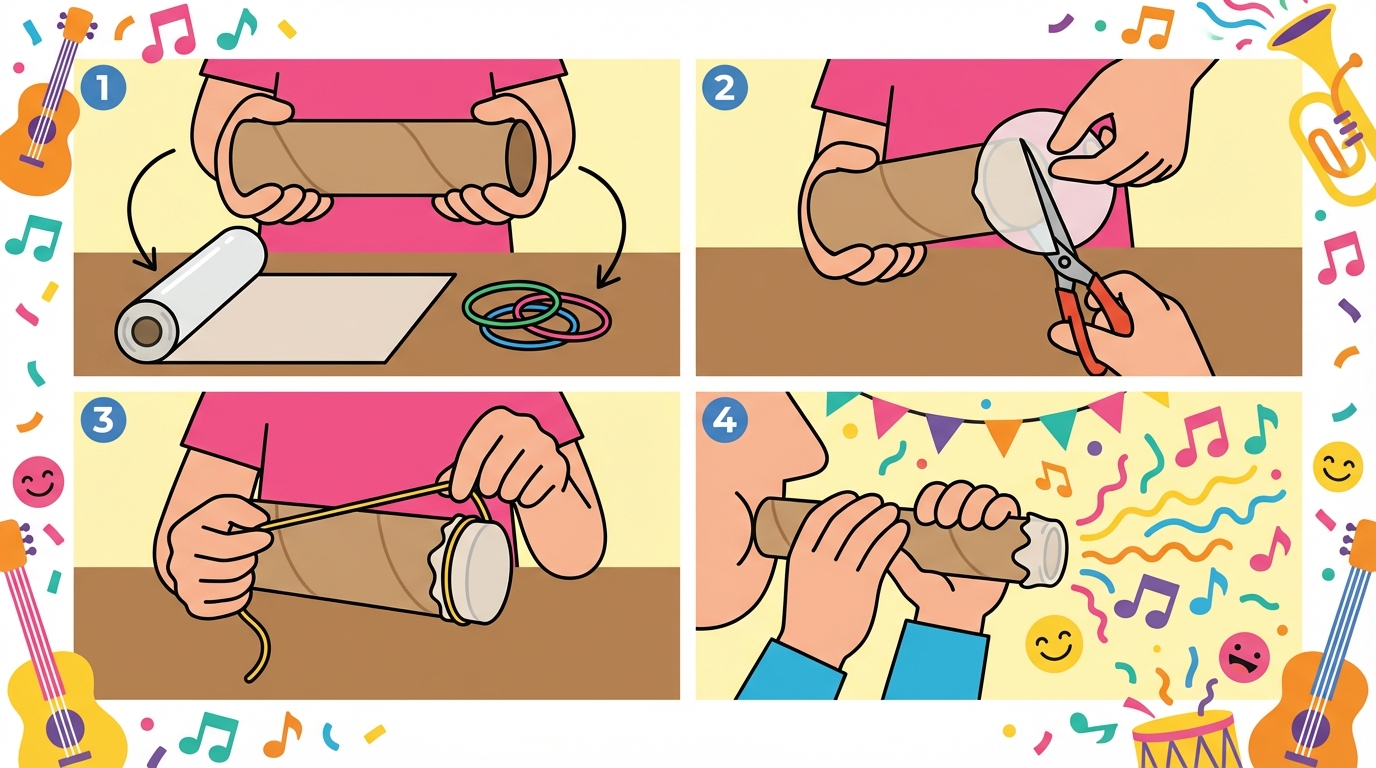
Easily make a kazoo for the music festival: the step-by-step guide
| In Brief ⭐ |
|---|
| 🎯 Objective: Make a simple and sturdy kazoo for the Music Festival. |
| 👶 Audience: 6-8 years, 9-11 years, 12-14 years, 15-17 years. |
| 🏠 Location: Indoor, cleared and safe table. |
| 🧰 Materials: 10 cm garden hose, cutter, scissors, thin plastic, elastic band/tape. |
| ⏱️ Duration: 15 to 25 min per kazoo depending on age. |
| 🧠 Interest: musical awakening, sound exploration, pride in creating before playing. |
| ⚠️ Safety: use of cutter under adult supervision. |
| ♿ Accessibility: possible adaptations for motor, visual, auditory, mental, and psychological disabilities. |
The Music Festival is approaching and the workshops are already buzzing with ideas. One activity brings together young and old, while remaining fun and quick: homemade kazoo. This instrument transforms the voice thanks to a vibrating membrane. The result is joyful, slightly mischievous sounds, perfect for a school parade, an extracurricular time, or a library event. The workshop works well indoors, on a safe table, and emphasizes the pleasure of creating before learning to play.
In Lila, Sami, and Nour’s group, everyone discovers the same challenge: shaping a sound object with little material. First, the technical gesture reassures. Then, exploring the sound opens the imagination. By playing with the membrane tension and the tube size, children compare their results, laugh, and enrich their musical vocabulary. The activity develops fine motor skills, cooperation, and listening. Above all, it values inventiveness: each one leaves with a unique instrument, ready to chirp in the street on June 21st.
Materials, safety and preparation to make a kazoo for the Music Festival
Making a kazoo relies on a few simple elements. A piece of garden hose about 10 centimeters per person will do. A cutter and scissors serve for cutting. A thin plastic (clean bag or cling film) becomes the membrane. Elastic bands or adhesive tape ensure fastening. With this little, the sound comes to life. For a smooth workshop, each pair shares a sharp tool to keep a safe pace.
Before starting, preparing the space reassures everyone. It is advisable to set up a clear workspace, stable, and well lit. A plastic sheet protects the table. Plastic scraps are picked up as they accumulate. This way, everyone stays focused, without clutter. A “cutter zone” pictogram placed in front of the adult marks where delicate cuts are made. This visual marker prevents hasty gestures.
Safety is based on few rules, but they must be clear. The cutter is not shared between children. An adult makes the slit in the tube, or a trained teenager does it under supervision. For the youngest, it is better to leave membrane cutting only to rounded-tip scissors. Elastic bands are handled calmly, as they can snap. A prior demonstration reduces stress, and everyone gains autonomy.
Because the Music Festival attracts families, a stroller area might be useful. It’s possible to store materials in a sturdy Baby Stroller, or in a Petit Bateau beach bag. Wipes and a hand cream like Mustela help after handling plastic. The little ones sometimes arrive with a Dodie pacifier or an Avent sippy cup. These logistical details smooth transitions, especially on busy days.
Some families like familiar brand landmarks. All-purpose baskets spotted at Vertbaudet or Natalys organize the work stations. A folded Fisher-Price play mat protects the floor in case of crowding. For the most curious, The Book of Birth can inspire a quiet reading corner for siblings. This creates a welcoming atmosphere, conducive to a calm musical workshop.
To close preparation, a ritual helps: we show a finished kazoo, listen to its timbre, then state the schedule. This appetizer seals the promise: to make a funny, safe instrument, proud to be played in public.
Quick checklist before starting
- 🧽 Clear table, protective sheet, good lighting.
- ✂️ Tools counted and assigned to an adult or a pair.
- 🧴 First aid kit visible, rules reminded.
- 🗃️ Materials stored in bins (tubes, plastics, elastics, tape).
- 🎵 A model kazoo ready to sound to motivate the group.
With these elements in place, the workshop can start with confidence and good humor.
Detailed steps: making a kazoo from garden hose step by step
The heart of the activity consists of a few precise gestures. Lila’s group follows the instructor, step by step. Each child progresses at their own pace. Pauses allow testing the sound, then adjusting. Here is the complete method, designed for quick successes and rich variations.
First, we cut a piece of hose about 10 centimeters long. A miter saw or a cutter under control is suitable. Then, 2 centimeters from one end, we make a notch just over half the diameter. This opening serves as an air chamber for the membrane. The cut must stay clean, without burrs, to avoid injuring the lips.
Then, we prepare the thin plastic membrane. We cut a square slightly larger than the hose diameter. We place the plastic on the end closest to the notch. We stretch the membrane. Not too much, or it won’t vibrate. Not too little, or it will float without effect. An elastic band wraps around twice. Alternatively, tape is used to wrap completely, tightly.
Next is the sound test. We put the mouth on the other end, the mouthpiece. We hum or talk with the mouth slightly closed. The kazoo is not blown like a flute. It amplifies the vibration of the voice. From the first notes, laughter bursts out. The children compare their sounds and try different tunes. The instructor suggests “Frère Jacques” to measure clarity.
Want to refine? We can retighten the membrane by a millimeter, or change the plastic. A thinner bag produces a lighter timbre. A slightly thick bag produces a rougher sound. Cutting the hose at 8 centimeters gives a higher pitch. At 12 centimeters, the sound becomes rounder. Thus, everyone personalizes their instrument. At the end of the workshop, each kazoo bears a colored mark to identify its owner.
Steps to follow, quite simply
- 🟢 Cut 10 cm of garden hose.
- 🟡 Open a notch 2 cm from one end.
- 🟣 Cut a square of thin plastic, slightly wider than the tube.
- 🔵 Place, stretch, then fix the membrane with an elastic band.
- 🟠 Test by humming into the mouthpiece, adjust the tension.
For the more visual, a quick search helps anchor the gestures before practice. Observation strengthens safety and precision of movements.
After watching, the group resumes building with more confidence. Sound trials become mini-concerts. The Music Festival atmosphere is already spreading in the room.
Understanding the kazoo sound: membrane, air and tuning tips
Why does this little tube make such an effect? The principle is simple and fascinating. The membrane vibrates when the voice moves the air. This tremble colors the timbre. The pitch mainly comes from the voice, while the membrane changes its texture. Children hear a “robot voice” or a soft buzzing. This discovery often triggers a flood of questions.
To explore, the instructor suggests three experiments. First, change the membrane tension. A firmer notch produces a clearer sound. A looser notch gives a veiled timbre. Then, vary the tube length. Short tubes shine more. Long tubes resonate more broadly. Finally, modify the notch shape. A slightly wider opening lets more air through, influencing responsiveness.
Sami’s group loves the challenge “find your sound signature”. Each duo notes their settings on paper. They connect sensations to simple words: clear, warm, metallic, soft. This nourishes language and perception. What if we recorded? A smartphone captures samples. We listen, compare, laugh. The activity becomes a joyful mini-lab.
Useful settings depending on desired effect
| ⚙️ Setting | 🎧 Sound effect | 💡 Tip |
|---|---|---|
| Very tight membrane | Clear, responsive sound | Add a second elastic for stability 😊 |
| Loose membrane | Veiled, funny timbre | Remove one elastic turn, test phrase by phrase |
| 8 cm tube | Higher pitch | Ideal for short, rhythmic solos 🥁 |
| 12 cm tube | Rounder sound | Good for choirs, slow spoken voice |
| Widened notch | Faster response | File softly, check at each step 🧪 |
Once these markers are integrated, children improvise. Voice speaking and singing alternate. Body percussion is tried to support the rhythm. Then a “call and response” in duo is invented. The kazoo becomes an excuse to listen to the other, breathe together, and smile.
This concrete understanding encourages going further. Settings make sense. The sound becomes a playground, and the group gains joyful cohesion.
Accessibility and pedagogical differentiation: a kazoo for all children
The Music Festival is inclusive by nature. The kazoo workshop becomes so too thanks to some adjustments. With a motor disability, the tube is stabilized in a foam educational vise. A human helper holds the elastic while the child guides the gesture. Large-handle scissors are favored. The workspace stays at a good height. In a wheelchair, passage must be clear. Everyone participates fully.
For a visual disability, the notch is marked with a dried hot glue dot or a contrasting colored elastic. The tube edge receives a soft mouthpiece sleeve. Each step is described in short sentences. Then time is given to explore the sound. Vibrations at fingertips help feel what’s happening. This sensory approach creates beautiful moments of shared listening.
With a hearing disability, the kazoo becomes a surprising tool. Vibrations are felt by touch. Hands gently placed on the tube sense the resonance. Singing voice is not necessary to play. A buzzing suffices. Visual cues are added: pictograms “tighten,” “loosen,” “sing.” Tempo can be transmitted by a flashing light or visual metronome.
For a mental or psychological disability, the action is broken down. One card per gesture: cut, open, place, stretch, fix, test. Every success is valued. A calm time is planned, with cushions and short books. There, a work like The Book of Birth keeps a brother or sister busy. Transitions happen gently, with a visual hourglass. Each child remains active, without pressure.
Adapt the workshop by age
- 6-8 years 👧: large guided gestures, cutter reserved for adults, quick and playful tests.
- 9-11 years 🧒: participation in the notch under supervision, discovery of sound settings.
- 12-14 years 🧑: growing autonomy, creative variations, mini-concert at session end.
- 15-17 years 👨🎓: possible co-facilitation, advanced sound research, recording.
Families appreciate smooth logistics. A baby changing corner, with Bébé Confort bag and Mustela products, helps parents. Avent bottles are stored in a soft cooler. A Vertbaudet tote gathers finished kazoos. A poster inspired by Natalys gives the timing. A musical nightlight Fisher-Price soothes the youngest during listening.
In the end, the workshop brings together diverse profiles. Everyone discovers a lever of success. The kazoo becomes a simple, accessible, and joyful tool of expression.
Creative variations, decoration and eco-friendly gestures for a unique kazoo
Once the “garden hose” version is mastered, variations open new doors. The toilet paper roll works well. A small oval opening is made a few centimeters from one edge. A piece of tissue paper or thin plastic is stretched over the other end. It is taped firmly. The timbre is light, ideal for a children’s choir. One can also try a wide straw with a mini-membrane, for a comic effect.
For decoration, solvent-free paints, stickers, and acrylic markers are favored. A strip of masking tape identifies instruments before the dress rehearsal. Names are written on a cardboard tag attached to the elastic. Themes are very popular: animals, rainbow, constellations. The parade becomes colorful, sonorous, and very photogenic.
Eco-friendly gestures give meaning. Clean bags are reused for membranes. Non-cutting delivery tubes are recycled. Scraps are sorted into dedicated boxes. A poster reminds the goal: make music and make sense. Children understand that a simple object can sound beautiful. This awareness strengthens pride in the gesture.
Practically, family brands often come up in conversation. A Petit Bateau cover protects kazoos during transport. A Vertbaudet type organizer separates variations and tools. A notebook from a list like The Book of Birth serves as a sound logbook. Parents smile: we talk music, family, and memories. Everything keeps a tender and effective tone.
Ideas to go further
- 🎙️ Create a temporary “studio”: record a kazoo song, then listen.
- 🎨 Make cases: decorated rigid cardboard, elastic closure.
- ♻️ Test other membranes: baking paper, biodegradable bag, cling film.
- 🎼 Write a short parade: verse/chorus, file entrance, group finale.
- 🛠️ Try a 12 cm version for a “bass” stand and 8 cm for “highs.”
By varying shapes and uses, the workshop becomes modular. Curiosity is fed, and the pleasure to play again grows session after session.
Workshop scenarios and musical games for the Music Festival
A good kazoo only lives in music. Here are three simple scenarios, adaptable according to time. The first emphasizes discovery. The second values coordination. The third creates a festive scene. All invite listening, laughter, and complicity.
Scenario 1, “chirp and respond.” A child launches a short pattern, the group answers. We start by speaking into the kazoo. Then we sing a single syllable: “la.” We vary durations. We move to mini-melodies. With 10 minutes, the group already sounds together. We conclude with a “glitter finale,” a long, very soft collective whistle.
Scenario 2, “sound detective.” Each duo chooses a setting. Others must guess whether the membrane is tight or relaxed, the tube long or short. A test time, a listening time. We note hypotheses. This game sharpens attention. It also stimulates verbalization. Children love to be mistaken and learn while laughing.
Scenario 3, “kazoo parade.” We arrange by sections: bass, mid, treble. Supervisors mark the tempo with claves. We move forward slowly. We play a repetitive chorus, inspired by a nursery rhyme. Families follow in the room. Strollers find their place at the back. We feel a quiet pride, like a little successful concert.
Simple mini-repertoire for kazoo
- 🌟 Frère Jacques (ideal to coordinate the group)
- 🌟 Ah! vous dirai-je, Maman (beautiful timbre variations)
- 🌟 Ode to Joy, opening motif (guaranteed “choral” effect)
- 🌟 Very soft “beatbox” rhythms, to work articulation
To structure the session, a goals table clarifies the highlights. Supervisors refer to it to keep energy and focus.
Objectives by session time
| ⏰ Time | 🎯 Objective | 🎵 Success indicator |
|---|---|---|
| 0-10 min | Make a safe kazoo | Membrane fixed, audible sound test ✅ |
| 10-20 min | Guided trials | Two settings tested, simple vocabulary |
| 20-30 min | Group play | Call-and-response in rhythm, smiles 😄 |
| 30-40 min | Small presentation | Solid common chorus, adherence to instructions |
These pathways transform a craft into a real musical adventure. The Music Festival gains a troupe ready to play and share.
{“@context”:”https://schema.org”,”@type”:”FAQPage”,”mainEntity”:[{“@type”:”Question”,”name”:”Pourquoi mon kazoo ne sonne-t-il pas ?”,”acceptedAnswer”:{“@type”:”Answer”,”text”:”La membrane est souvent trop tendue ou trop lu00e2che. Desserre lu2019u00e9lastique du2019un cran, puis fredonne au lieu de souffler. Vu00e9rifie aussi lu2019encoche: si elle est trop petite, u00e9largis-la lu00e9gu00e8rement et teste u00e0 chaque u00e9tape.”}},{“@type”:”Question”,”name”:”Quel plastique choisir pour la membrane ?”,”acceptedAnswer”:{“@type”:”Answer”,”text”:”Un sachet fin et propre fonctionne tru00e8s bien. Le film alimentaire est efficace aussi. u00c9vite les plastiques trop u00e9pais, qui vibrent peu. Teste plusieurs u00e9paisseurs et garde celle qui donne un timbre clair.”}},{“@type”:”Question”,”name”:”Peut-on fabriquer lu2019atelier avec des 6-8 ans ?”,”acceptedAnswer”:{“@type”:”Answer”,”text”:”Oui, avec un adulte qui ru00e9alise le cutter et qui guide la fixation. Les enfants du00e9coupent la membrane aux ciseaux, posent lu2019u00e9lastique, puis testent la voix. Fractionne les u00e9tapes et valorise chaque ru00e9ussite.”}},{“@type”:”Question”,”name”:”Comment nettoyer le kazoo apru00e8s usage ?”,”acceptedAnswer”:{“@type”:”Answer”,”text”:”Essuie lu2019embouchure avec un chiffon doux. Un spray du00e9sinfectant lu00e9ger sur un chiffon convient. u00c9vite lu2019eau u00e0 lu2019intu00e9rieur du tube pour ne pas du00e9tendre la membrane. Remplace la membrane si elle su2019abu00eeme.”}},{“@type”:”Question”,”name”:”Quelles variantes simples essayer ?”,”acceptedAnswer”:{“@type”:”Answer”,”text”:”Le rouleau de papier toilette avec papier soie, une paille large avec mini-membrane, ou un tube plus long pour une sonoritu00e9 ronde. Joue aussi sur la tension de la membrane pour affiner le timbre.”}}]}Pourquoi mon kazoo ne sonne-t-il pas ?
La membrane est souvent trop tendue ou trop lâche. Desserre l’élastique d’un cran, puis fredonne au lieu de souffler. Vérifie aussi l’encoche: si elle est trop petite, élargis-la légèrement et teste à chaque étape.
Quel plastique choisir pour la membrane ?
Un sachet fin et propre fonctionne très bien. Le film alimentaire est efficace aussi. Évite les plastiques trop épais, qui vibrent peu. Teste plusieurs épaisseurs et garde celle qui donne un timbre clair.
Peut-on fabriquer l’atelier avec des 6-8 ans ?
Oui, avec un adulte qui réalise le cutter et qui guide la fixation. Les enfants découpent la membrane aux ciseaux, posent l’élastique, puis testent la voix. Fractionne les étapes et valorise chaque réussite.
Comment nettoyer le kazoo après usage ?
Essuie l’embouchure avec un chiffon doux. Un spray désinfectant léger sur un chiffon convient. Évite l’eau à l’intérieur du tube pour ne pas détendre la membrane. Remplace la membrane si elle s’abîme.
Quelles variantes simples essayer ?
Le rouleau de papier toilette avec papier soie, une paille large avec mini-membrane, ou un tube plus long pour une sonorité ronde. Joue aussi sur la tension de la membrane pour affiner le timbre.