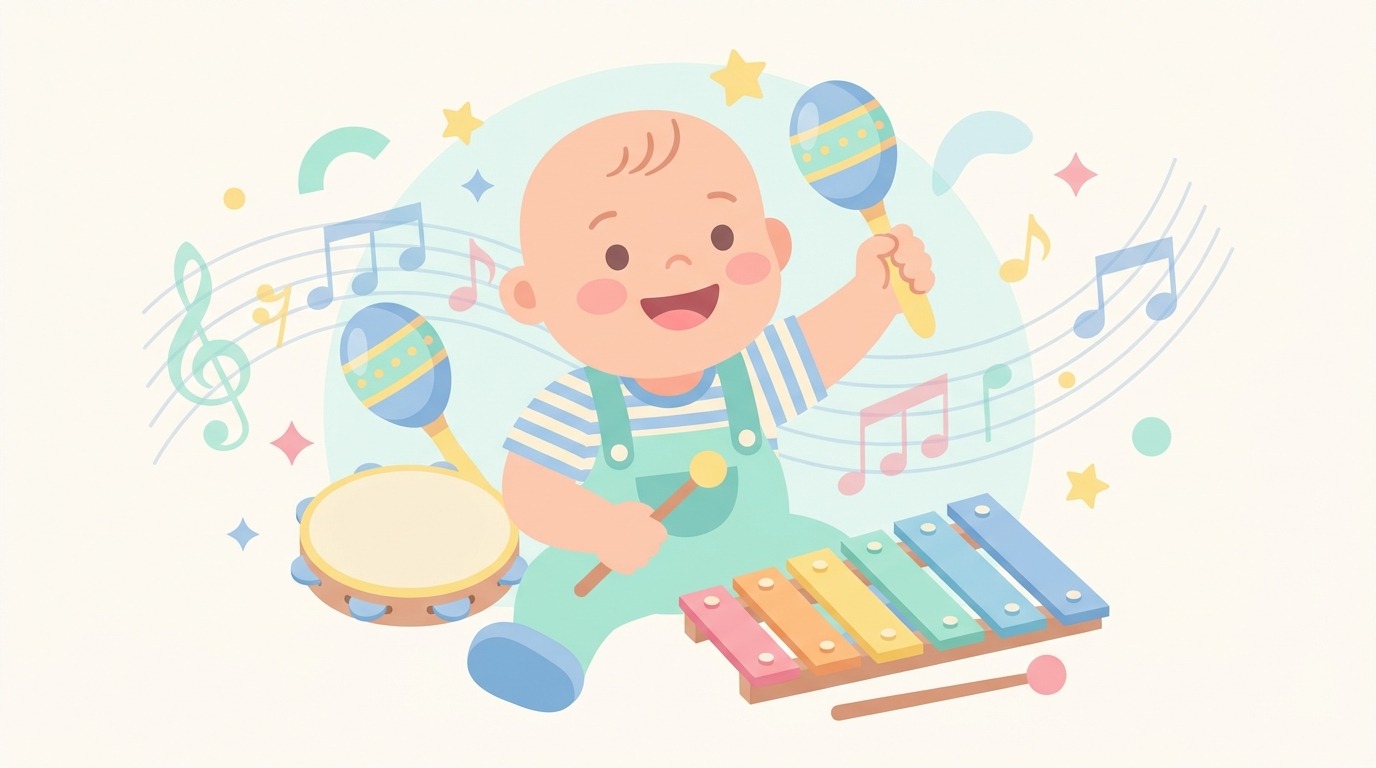
Baby Video: Musical awakening for baby.
| Short on time? Here’s the essentials ⏱️ |
|---|
| 6-18 months: ideal window for musical awakening 🎯 |
| Soft sounds and childlike rhythm for effective auditory stimulation 🎵 |
| Daily playful activities: nursery rhymes, voice games, homemade maracas 🥁 |
| Educational video + parent singing = increased attention and soothing 📹 |
| Enhanced sensory development, language, coordination, and emotional bonding 🌟 |
| Favor safe instruments, moderate volumes, and short durations 🔉 |
| Create a cozy musical corner, refreshed every week 🧸 |
| Observe baby, follow their preferences, and keep pleasure as your compass ❤️ |
Between 6 and 18 months, music opens a unique door to the world. Thanks to soft sounds, simple rhythms, and soothing routines, musical awakening transforms each day into a sensory exploration playground. Images, educational videos, and nursery rhymes guide the baby’s attention and strengthen non-verbal communication. This approach promotes harmonious overall development while nurturing the joy of shared musical play.
Neuroscience confirms the value of these special moments. When the voice sings, the toddler’s brain activates like a constellation. Nursery rhymes structure memory, motor skills refine with tambourines, and curiosity expresses itself through auditory stimulation. Daily, a simple musical ritual, an embracing dance or a homemade maraca are enough to create a rich, safe, and deeply relational environment.
Baby musical awakening: why baby music accelerates sensory development
Recent research shows a strong and measurable impact of music on young children. First, singing simultaneously engages hearing, movement, attention, and emotions. This synergy strengthens learning and develops lasting neural circuits. Furthermore, singing rituals structure time and reassure the child, who anticipates what is coming.
Cognitive effects and language
Repetitive nursery rhymes help memorize sequences and sounds. Thus, phonological awareness builds very early, which later aids reading. Alternating long and short syllables, music sharpens the listening to sound contrasts. Also, refrains promote anticipation and sustained attention.
A study from the University of Montreal highlights that babies stay calm longer when an adult sings. This observation holds true daily. A couple of parents note their child, Malo, 10 months, prolongs attention when the mother hums a simple tune. Conversely, continuous speech captures less attention.
Motor skills and coordination
Musical play mobilizes the body. Shaking a rattle, hitting a tambourine, or swinging the arms matches an easy-to-imitate childlike rhythm. Then, eye-hand coordination improves with graspable instruments. This sensorimotor experience strengthens tempo perception, even with soft sounds.
To support this progress, a stable mat provides a safe support point. A short cycle of 3 to 5 minutes is enough at first. Then, a break is added before resuming with another timbre to maintain interest. This alternation prevents fatigue and keeps curiosity alive.
Emotional bond and daily rituals
Music is also a language of the heart. A lullaby ritual before bedtime anchors internal security. Next, a song even during the bath helps anticipate gestures. Finally, a small musical greeting in the morning establishes a relational routine coordinating gaze, voice, and touch.
- 🎶 Nursery rhymes with gestures to synchronize voice and hands
- 🧸 Short lullaby to soothe and regulate excitement
- 🥁 Soft tambourine to practice a simple tempo
- 📹 Educational video of 2 to 4 minutes to vary supports
In short, baby music is a global lever: cognition, language, motor skills, and attachment progress together. This foundation perfectly prepares for future explorations.
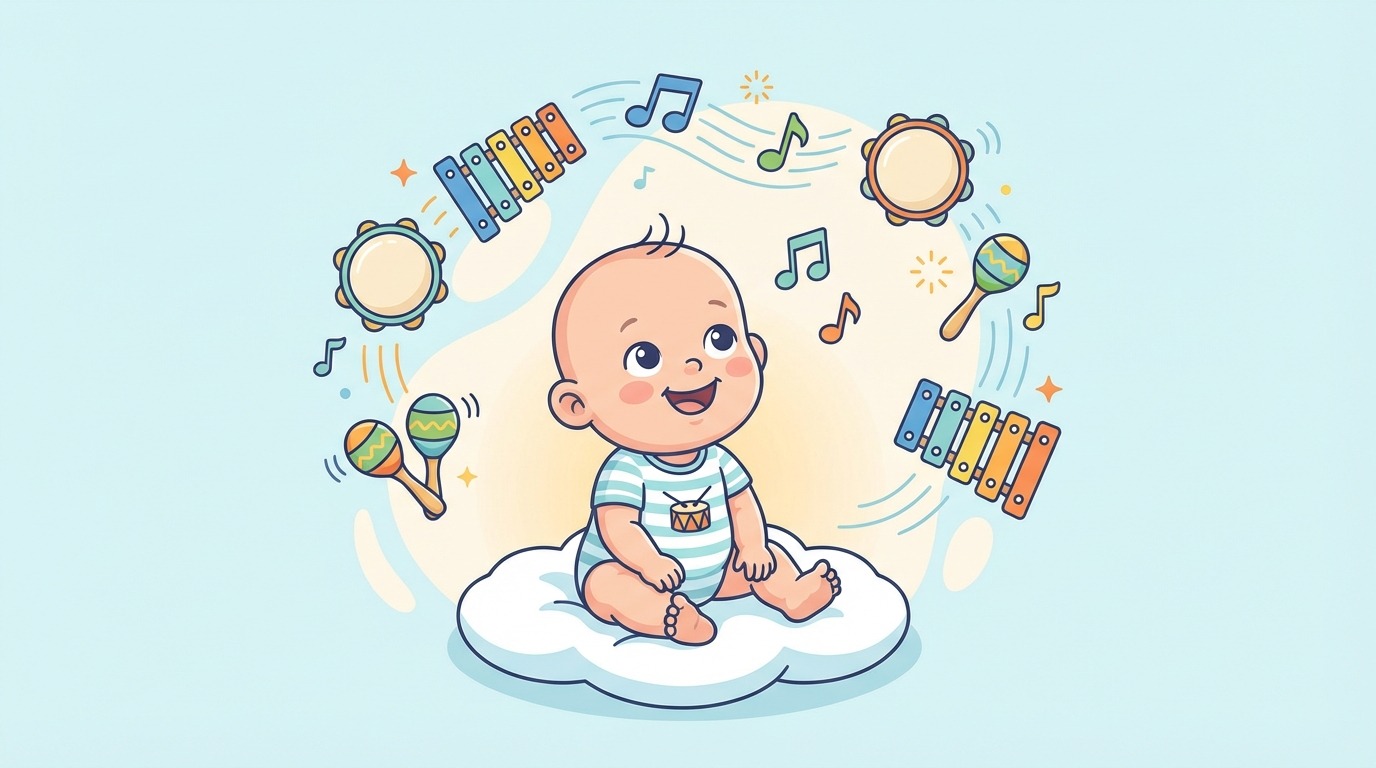
From 6 to 18 months: key stages of musical awakening in video and play
Each age group calls for specific proposals. Between 6 and 12 months, the goal is to awaken the senses and encourage spontaneous responses. Then, between 12 and 18 months, exploration becomes voluntary and inventive. This progression guides the choice of playful activities and supports, including educational video.
6 to 12 months: sound awakening and first responses
At this age, baby turns head, smiles, and babbles in rhythm. A light rattle stimulates grasping and curiosity. Thus, a session can start with a very simple song, followed by a silent moment to listen to a jingle bell. It ends with a gentle rocking that anchors relaxation.
Malo, 10 months, reacts to a hanging bell. First, his eyes follow the movement. Then, his hand searches for the grip. Finally, he shakes and stops to listen. This silence/sound alternation becomes a natural musical game that establishes joint attention. Parents can reinforce the gesture with a smile and a little “tadada”.
To sustain interest, a short educational video with contrasting visuals and calm music can complement the session. The image supports listening, but the voice of a nearby adult remains the most effective cue. The video then serves as variation, not as a substitute.
This visual resource often offers simple gestures. After watching, the parent can resume the same structure with a stuffed toy. The “see-do-redo” loop solidifies learning and encourages imitation. Screen time stays short, targeted, and always mediated by the adult.
12 to 18 months: active exploration and preferences
The toddler taps, shakes, blows, and invents sounds. He chooses a song and recognizes its refrain. Then, he associates a movement to a precise sequence. This intentionality shows significant maturation. Instruments can then be varied, but safe and well-sized.
Building a small family playlist helps a lot. A post like baby’s favorite titles gives ideas for renewing without saturating. Then, a weekly ritual “discovery of a timbre” maintains enthusiasm. One listens to a chime, then a tambourine, and compares together: “it’s long,” “it’s dry.”
On rainy days, it remains simple to bring music to the house. This guide on activities when it rains inspires sensory paths with scarves and sound boxes. Thus, exploration stays joyful, rhythmic, and safe. Diversity nourishes listening and body expression.
In short, age modulates the proposal, but the common thread remains shared pleasure. The child feels competent because he creates sound and silence.
Playful activities at home: soft sounds, childlike rhythm and safe musical play
The home is full of simple ideas to animate a session. First, the voice. It suffices for everything, especially for babies. Then, some common objects become improvised instruments. Finally, a short educational video, carefully selected, can rekindle interest. The golden rule remains safety and proximity.
Songs, voice games and nursery rhymes with gestures
Nursery rhymes structure time and multiply landmarks. For example, start gently with “Hello,” then continue with a nursery rhyme with gestures to involve the body. For inspiration, this dossier on nursery rhymes and development gathers very practical ideas. The parent modulates pitch, plays with whisper, then returns to the original melody.
One piece of advice is worth repeating. Better to repeat the same songs often. The infant brain likes to recognize and anticipate. Then introduce one novelty per week. This rhythm supports consolidation without saturating listening. This patience gives quick results on attention and participation.
Everyday objects turned into instruments
The kitchen offers a fanfare. A wooden spoon, a airtight box, and a colander form a light drum set. To vary, make a maraca with a small bottle and lentils. Making it involves the child, which increases engagement and pride. To go further, here’s a clever tutorial to make a kazoo in a few minutes.
The bath also becomes a studio. Punctured cups create singing drops. Then, listen to the glug-glug of an empty bottle plunged into water. This water/air contrast stimulates auditory discrimination. In other words, the house is enough to build a rich sound palette.
Safety and reassuring framework
Safety always comes first. Keep volume level, room size, and sturdiness in mind. Additionally, check the sleep environment. This reminder on banned crib bumpers helps avoid risky accessories. Music comforts, but the framework protects.
- 🛡️ Non-toxic materials and rounded edges
- 🔉 Moderate volumes and short durations
- 👀 Constant supervision and tidying after play
- 🎯 One activity at a time to avoid overload
To complete inspiration, adapted sound toys exist. This selection of educational games offers calibrated products for toddlers. Always alternate between household objects, song, and more structured instruments. This mixture maintains balance between simplicity and novelty.
After this type of video, select a single idea and expand on it. Then observe baby’s reactions. If he laughs and returns to the object, reinforce. If he turns away, lighten the activity. This fine listening guides progress without pressure.
Instruments and listening space: choosing, arranging, protecting hearing
A good environment invites exploration. First, arrange a simple, cozy, and bright musical corner. Then choose a few safe and expressive instruments. Finally, watch over auditory health. This triptych supports serene and rich moments.
The musical corner that invites
A small stable mat, a basket with 3 or 4 instruments, and a visual panel suffice. This base clarifies space use. To consolidate comfort, a recent guide on baby play mats in 2026 helps choose a firm, washable, and non-slip support. Add a “conductor” plush toy to start the session with a greeting.
Rotating objects avoids saturation. Each week, replace one instrument with another. Thus, interest remains lively. Also, a small audio player adapted for kids eases listening to a short playlist. The parent comments: “this bell rings long,” “this drum is dry.” This verbalization enriches sensory vocabulary.
Adapted instruments and controlled volumes
For 6 to 12 months, favor soft rattles, light maracas, and a soft tambourine. Between 12 and 18 months, add a small xylophone, a simple drum, and a rain stick under supervision. Instruments should withstand falls, without detachable parts. Safety supports freedom to explore.
Volume is easily monitored. Move the sound source away from the ear. Limit simultaneous hits of multiple hard objects. Then allow silences. Silence is part of music. It rests the ear and strengthens rhythm perception when it returns.
Interactive toys can serve as a springboard. A selection like VTech educational games offers light effects and short sounds. Use them sparingly to spark interest, then return to singing and simple percussion. Balance remains key.
Playlists and listening moments
A short list of pieces facilitates routine. Choose 4 to 6 titles. Then keep a fixed order for a week. This predictable structure reassures and allows observing preferences. This testimony on a baby’s favorite songs shows how a family builds a home repertoire.
In practice, play the same lullaby at bedtime. Reserve a “tidying up” song to conclude the session. Then slip in a rhythmic piece before the bath to channel energy. These details script daily life and make music immediately useful.
Ultimately, space, objects, and volume compose a caring sound ecology. Baby progresses there, confident and curious.
Workshops, resources, and sensory projects to extend musical awakening
After first discoveries, new paths maintain momentum. First, parent-child workshops offer precise gestures and ideas to reproduce at home. Then, media libraries schedule very accessible musical readings. Finally, the music and visual arts combo stimulates overall creativity.
Guided workshops and socialization
A small-group musical awakening session brings unique energy. Children look at each other, imitate, and wait their turn. This micro-sociability prepares ground for other collective experiences. Meanwhile, parents leave with concrete sequences, usable from the same evening.
For specific needs, music therapy offers adapted frameworks. Goals are defined à la carte: sensory regulation, non-verbal exchange, bodily relaxation. Guided listening and soft percussion serve as main thread. Pleasure remains the first marker.
Seasonal rituals and musical journal
Projects throughout the seasons keep motivation alive. In autumn, rub dry leaves to create crackling. In winter, listen to crystalline bells. In spring, collect water sounds. In summer, sing outdoors and play with echoes. A “musical journal” notes reactions, liked pieces, and discoveries.
To enrich imagination, an activity mixing drawing and sounds fascinates toddlers. This step-by-step around music, drawing, and comfort toy offers a back-and-forth between lines and rhythm. Draw long lines when the note stretches, then dotted lines when the music jumps. The child sees music and hears it better.
Useful videos and golden rules
The educational video can inspire a new sequence. Choose a short format, clear images, and baby music without saturation. Then reproduce only one or two ideas. The parent’s presence keeps the course, puts words, and validates emotions.
To keep it light, set three rules: brief durations, moderate volumes, and a calm time afterwards. Thus, auditory stimulation remains adjusted and enthusiasm lasts. Additionally, on rainy days, this guide on home activities suggests very simple motor + music paths. A small sound box passes between hands, then dance with scarves.
With these resources, the family builds a living sound culture. The child grows at the heart of rich, yet always soothing, atmospheres.
Practical bonus: mini-checklist to start today
This list allows action without delay. It adapts to any home and schedule.
- 🎵 Choose 4 nursery rhymes and sing them daily
- 🥁 Prepare a homemade rattle and a soft tambourine
- 🧸 Set up a musical corner on a stable mat
- 📹 Select a short educational video to vary
- 🔉 Set a soft volume and plan silences
- 📝 Note a striking reaction in the musical journal
Simple, clear, and flexible enough to adapt to the day’s mood. Pleasure guides the pace.
{“@context”:”https://schema.org”,”@type”:”FAQPage”,”mainEntity”:[{“@type”:”Question”,”name”:”How long should a musical awakening session last for a baby aged 6 to 18 months?”,”acceptedAnswer”:{“@type”:”Answer”,”text”:”Aim for 5 to 10 minutes of focused activity, followed by a break. Chain up to two blocks maximum. Brevity nourishes attention and protects hearing.”}},{“@type”:”Question”,”name”:”Which instruments should be favored at the start?”,”acceptedAnswer”:{“@type”:”Answer”,”text”:”Soft rattles, small light maracas, soft tambourine, rain stick under supervision. Prefer non-toxic materials, without small parts, and easy to grasp.”}},{“@type”:”Question”,”name”:”Is educational video a good idea?”,”acceptedAnswer”:{“@type”:”Answer”,”text”:”Yes, if it remains short, calm, and accompanied by the adult. Use it as a trigger for a real activity, never as a substitute for singing and shared play.”}},{“@type”:”Question”,”name”:”How to protect baby’s hearing?”,”acceptedAnswer”:{“@type”:”Answer”,”text”:”Set volume low, space sound sources, limit simultaneous percussion, and insert silences. Watch for signs of fatigue or annoyance.”}},{“@type”:”Question”,”name”:”Are many instruments needed?”,”acceptedAnswer”:{“@type”:”Answer”,”text”:”No. Three or four well-chosen objects suffice. Weekly renewal maintains curiosity without creating overstimulation.”}}]}How long should a musical awakening session last for a baby aged 6 to 18 months?
Aim for 5 to 10 minutes of focused activity, followed by a break. Chain up to two blocks maximum. Brevity nourishes attention and protects hearing.
Which instruments should be favored at the start?
Soft rattles, small light maracas, soft tambourine, rain stick under supervision. Prefer non-toxic materials, without small parts, and easy to grasp.
Is educational video a good idea?
Yes, if it remains short, calm, and accompanied by the adult. Use it as a trigger for a real activity, never as a substitute for singing and shared play.
How to protect baby’s hearing?
Set volume low, space sound sources, limit simultaneous percussion, and insert silences. Watch for signs of fatigue or annoyance.
Are many instruments needed?
No. Three or four well-chosen objects suffice. Weekly renewal maintains curiosity without creating overstimulation.
“Music not only educates baby’s ear, it awakens joy, illuminates gestures, and sculpts memories that dance.”