Peanut Allergy: Understanding and Managing Peanut Allergy.
| Short on time? Here’s the essential ⏱️ |
|---|
| Peanut is a legume (not a tree nut) and contains major allergenic proteins (Ara h 1, 2, 3, 6) ⚠️ |
| Adrenaline/epinephrine is the first-line treatment for anaphylaxis 🚑 |
| Antihistamines relieve skin symptoms but do not treat anaphylaxis 💊 |
| Strict avoidance + label reading + emergency kit with two auto-injectors ✅ |
| Diagnosis = medical history + prick tests + specific IgE ± oral food challenge in a specialized setting 🔬 |
| Prevention in at-risk infants: supervised introduction of peanut-based products between 4 and 6 months 🍼 |
| Innovations 2024–2026: oral immunotherapy (Palforzia), epicutaneous patch, biological adjuvants such as dupilumab 🧪 |
Invisible to some, decisive for others, peanut allergy requires precise actions and informed choices. Families quickly learn to distinguish the innocent from the enemy: a puree, a biscuit, a candy. Yet, there is no fatality. Knowledge has progressed, tools have been refined, and allergy management now relies on clear protocols, reliable emergency treatments, and validated prevention strategies. Between school, outings, and home cooking, the routine becomes a field of mastery, not fear. And when a allergic reaction occurs, every minute counts, but each learned action reassures.
Today, the landmarks are structured: peanuts belong to legumes, the difference between allergy and food intolerance becomes clearer, and monitoring is organized around epinephrine, antihistamines, and written action plans. Innovations (oral immunotherapy, patches, antibodies) change the horizon, especially for children. But the essentials remain practical: reading labels, educating the environment, and anticipating risky situations. This guide brings together mechanisms, symptoms, diagnosis, and 2026 advances, with a simple guiding thread: replacing worry with confident and effective organization.
Understanding and managing peanut allergy: mechanisms, risks, and misconceptions
It all starts with a common confusion: peanut is not a nut. It belongs to legumes, like chickpeas. This clarification changes the game, as cross-allergies are not automatic. Next, one must distinguish allergy from food intolerance. Intolerance does not involve IgE and does not expose to anaphylaxis. Conversely, IgE-mediated hypersensitivity can trigger a systemic reaction after minute traces.
On the immunological level, the body mistakenly recognizes peanut proteins as threats. Dendritic cells present these fragments, then T lymphocytes steer the response towards a Th2 profile. Next, B cells produce specific IgE that bind to mast cells. Upon re-exposure, degranulation releases histamine and other mediators. This cascade explains urticaria, coughing, or blood pressure drop.
Major allergens to know
Four allergens weigh heavily on the balance: Ara h 1, Ara h 2, Ara h 3, Ara h 6. Their heat and digestion stability promote more severe reactions. IgE assays targeting these components guide clinical risk. Thus, Ara h 2 is often associated with more clear-cut reactions. This data is not a verdict but a useful marker to prioritize vigilance.
Who is most exposed? Children with early severe eczema, poorly controlled asthma, and an atopic family background present increased risk. Recent studies also suggest HLA variations modulate susceptibility. In practice, genetic fatality does not decide, but the global strategy: supervised introduction in at-risk infants, informed environment, and immediate access to epinephrine.
Allergy vs. misconceptions: restoring priorities
Two myths hinder allergy management. First, “a small amount will do no harm.” This is false: a quarter of patients react under 100 mg. Second, “smell alone always triggers a crisis.” Inhalation of particles may bother some subjects, but anaphylaxis remains linked to ingestion. Furthermore, refined peanut oil contains very few proteins, although caution prevails when traceability is unclear.
Ultimately, understanding the mechanism helps decide quickly: high suspicion, epinephrine first; isolated skin symptoms, antihistamines possible. This logic, simple and structured, saves precious time during an emergency.
Symptoms of peanut allergy: recognizing severity and acting without delay
Clinical presentation varies according to ingested dose, age, and associated asthma. Skin symptoms predominate: urticaria, itching, swelling of lips or eyelids. Often, digestive signs follow: abdominal pain, vomiting, diarrhea. Finally, the respiratory sphere demands urgency: cough, wheezing, tightness, dyspnea.
The spectrum extends to anaphylaxis. This life-threatening emergency combines at least two organ involvements or isolated respiratory or hemodynamic trouble. Specifically, low blood pressure, hoarse voice, stridor, or confusion should alert. Onset is often rapid, but a late phase remains possible after 4 to 12 hours.
Warning signs never to neglect
- 🚨 Swelling of lips, tongue or throat with difficulty swallowing
- 😮💨 Wheezing, chest tightness, hoarse voice, persistent cough
- 🤒 Malaise, pallor, dizziness, confusion, blood pressure drop
- 🤢 Repeated vomiting, severe abdominal pain
- 🌡️ Generalized urticaria associated with another systemic sign
In children, body language prevails. A little one who “scratches their tongue”, suddenly refuses to eat, or describes “a strange taste” may signal a reaction. Likewise, poorly controlled asthma increases risk of complications. The golden rule remains constant: when in doubt, treat as anaphylaxis.
Immediate action plan
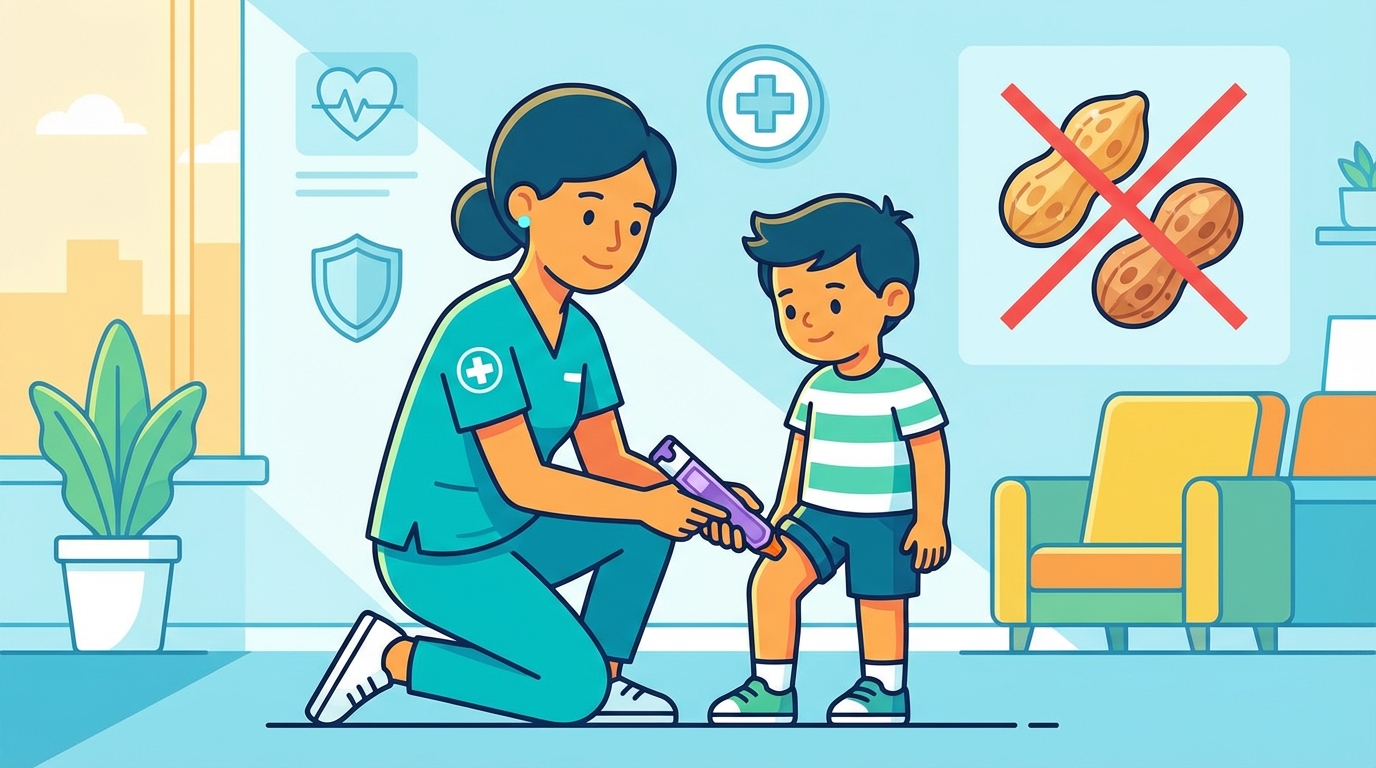
In case of severe allergic reaction, inject epinephrine into the thigh without delay, through clothing if necessary. Lay the person down, elevate legs, and call emergency services. Repeat dose after 5 to 10 minutes if no clear improvement. Antihistamines and corticosteroids never replace adrenaline but complement care.
For illustration, one family chose to place an emergency kit at the entrance, kitchen, and school bag. Result: at daycare, intervention was quick, with recovery without complications. This scenario proves preparation beats panic.
Diagnosis of peanut allergy: from clinical history to provocation tests
A reliable diagnosis begins with a precise interview. The clinician retraces the chronology: suspected food, time of onset, nature of symptoms, need for epinephrine. Next, they map the allergic background: eczema, asthma, rhinitis, family history. This framework guides tests and avoids confusion with food intolerance.
Prick tests are first-line. A wheal exceeding the saline control by 3 mm suggests sensitization. However, a positive test alone is insufficient to conclude. It is one piece of the puzzle, not the final picture. Specific IgE assays add another piece. Again, the value alone does not predict severity.
Allergenic components: refining risk interpretation
The molecular profile changes anticipation. Elevated IgE against Ara h 2 often correlate with clearer clinical reactions. This information refines prevention, education about epinephrine, and follow-up. However, a marker never cancels clinical observation. The combination of indices shapes decision-making.
Oral provocation test (oral food challenge) remains the gold standard. It involves administering increasing doses under specialized supervision. Because it may trigger a allergic reaction, it is reserved for situations where diagnostic benefit outweighs risk. The procedure sometimes downgrades a presumed allergy, avoiding unnecessary avoidance.
Case study: clarifying a complex history
Imagine Lina, 6 years old, longstanding eczema, exercise-induced cough. After a biscuit, she shows urticaria and vomiting within 20 minutes. Prick tests and IgE are positive, with marked Ara h 2. Diagnosis is supported without immediate challenge, as history is typical. The team prescribes two auto-injectors, a written plan, and organizes school. Three months later, the family manages a birthday meal without incident.
This step-by-step approach protects against overdiagnosis and delayed care. It combines science, caution, and education. In summary, the right test is the one that supports a useful and safe decision.
Treatments and innovations 2026: epinephrine, antihistamines, immunotherapies, and new hopes
The foundation does not change: avoid peanuts and have an emergency kit. Label reading becomes a habit. “May contain” warnings indicate a real risk of cross-contamination. When in doubt, it is better to abstain. Moreover, the environment learns to spot symptoms and use the auto-injector.
In emergency, epinephrine is first-line. It reverses bronchospasm, supports blood pressure, and stabilizes laryngeal edema. Antihistamines relieve itching and urticaria. They do not prevent anaphylaxis. Oral corticosteroids remain possible adjuncts to limit late-phase reactions.
Oral and epicutaneous immunotherapy: where do we stand?
Standardized oral immunotherapy (e.g., peanut allergen powder) aims at desensitization. It raises the tolerance threshold in a majority of patients, especially children. However, reactions during escalation are not rare, hence rigorous selection and strict supervision. The epicutaneous patch seeks progressive skin exposure. Results are encouraging for safety, with variable responses.
Recent years have seen the emergence of biological adjuvants. Dupilumab, well known in dermatology, may improve tolerance and reduce adverse effects during oral immunotherapy in children. This approach does not erase risk but makes it more predictable. It promotes personalized medicine, adapted to molecular profiles and comorbidities.
Building a realistic strategy
Should one embark on immunotherapy? The answer depends on age, IgE profile, asthma, and family goals. Desensitization is not a cure. It mainly aims to reduce risk in accidental exposure. Meanwhile, education about epinephrine remains non-negotiable, even during immunotherapy.
Practically, a family may set three priorities: secure the food environment, master emergency response, and evaluate threshold-increasing therapy. This hierarchy protects daily life, then opens the door to innovations.
Prevention and daily life: schools, restaurants, travel and informed allergy management
Prevention starts early. In high-risk infants (severe eczema, egg allergy), supervised introduction between 4 and 6 months reduces the probability of later peanut allergy. This approach is not improvised. It is prepared with the allergist, sometimes after tests. When feasible, it protects in the long run.
At school, a written plan formalizes conduct. Staff knows the kit, warning signs, and emergency number. Collective catering adapts menus, separates utensils, and signals allergen risks. On school outings, the emergency kit follows the child, not vice versa.
Restaurants and shared meals: from theory to practice
Menus evolve, but vigilance remains key. Asking the restaurateur about ingredients, frying oils, and contamination management truly protects. Requesting separate preparation limits risks. Sometimes, bringing a safe meal avoids unnecessary anxiety. The goal is not deprivation but anticipation.
When traveling, three reflexes reassure: allergy documents translated, double emergency kit, and mapping nearby hospitals. On flights, some airlines offer peanut-free alternatives. Informing crew before boarding improves responsiveness if needed.
Home routine: creating a protective environment
- 🧺 Separate utensils, cutting boards, and preparation areas
- 🧴 Wash hands and clean surfaces immediately after use
- 📦 Store risky products out of reach and well labeled
- 🧾 Reread labels with every purchase, even for usual brands
- 🧰 Keep two accessible and unexpired auto-injectors
The emotional dimension matters. Some children develop a fear of eating. Brief psychological support often suffices to restore a calm relationship with food. In families, serene communication transforms instructions into habits, not injunctions.
Resources and community
Allergy associations provide practical sheets, auto-injector usage workshops, and support groups. This mutual aid reduces isolation and accelerates learning. Together, they share concrete solutions: birthday snacks, school projects, and cafeteria tips. Daily life becomes smoother, and allergy management gains confidence.
Underlying it all, a simple idea prevails: prevention does not forbid living. It gives levers to choose, explain, and enjoy with safety.
Emergency protocols, labeling and informed decisions: turning knowledge into reflexes
A written action plan changes the fate of a tense situation. It describes when to inject epinephrine, whom to call, and how to monitor after the crisis. This document fits on one page and accompanies the child at school, sports, and holidays. The more visible it is, the more useful.
Labeling requires careful reading. The word “peanut” sometimes hides behind technical formulations. “Traces” disclosures inform of a real contamination risk during manufacture. In mixed workshops, caution applies. For example, a peanut-free biscuit recipe may remain risky if it shares a line with peanut products.
Three-step decision chain
- ⏱️ At the first systemic symptoms: inject epinephrine, lay down, alert
- 📞 Call emergency services, monitor 6 hours if anaphylaxis suspected
- 🧭 Update action plan, debrief, restock kit
It is tempting to rely solely on antihistamines. However, they do not stop progression to severity. They have a place for comfort, not vital safety. Adrenaline saves lives and has no alternative in severe allergic reaction.
Finally, think of tomorrow. Regular appointments with the allergist reassess tolerance, therapeutic education, and immunotherapy interest. This follow-up keeps strategy current and anchors reflexes. Deep down, predictability becomes your best ally.
{“@context”:”https://schema.org”,”@type”:”FAQPage”,”mainEntity”:[{“@type”:”Question”,”name”:”What is the difference between peanut allergy and food intolerance?”,”acceptedAnswer”:{“@type”:”Answer”,”text”:”Allergy involves an IgE response with risk of anaphylaxis, even at very low doses. Food intolerance does not involve these immunological mechanisms and does not expose to shocks. The management differs completely.”}},{“@type”:”Question”,”name”:”When to use epinephrine compared to antihistamines?”,”acceptedAnswer”:{“@type”:”Answer”,”text”:”As soon as a respiratory, cardiovascular sign or several simultaneous involvements appear, adrenaline is priority. Antihistamines relieve urticaria but do not treat anaphylaxis.”}},{“@type”:”Question”,”name”:”Does oral immunotherapy cure peanut allergy?”,”acceptedAnswer”:{“@type”:”Answer”,”text”:”It is not a cure. It raises the reaction threshold and reduces accident risk, at the cost of strict follow-up and possible side effects. The emergency kit remains essential.”}},{“@type”:”Question”,”name”:”Should peanuts be avoided during pregnancy or breastfeeding?”,”acceptedAnswer”:{“@type”:”Answer”,”text”:”Current recommendations do not impose systematic avoidance in the absence of maternal allergy. Early and supervised introduction in at-risk infants remains the key strategy.”}}]}What is the difference between peanut allergy and food intolerance?
Allergy involves an IgE response with risk of anaphylaxis, even at very low doses. Food intolerance does not involve these immunological mechanisms and does not expose to shocks. The management differs completely.
When to use epinephrine compared to antihistamines?
As soon as a respiratory, cardiovascular sign or several simultaneous involvements appear, adrenaline is priority. Antihistamines relieve urticaria but do not treat anaphylaxis.
Does oral immunotherapy cure peanut allergy?
It is not a cure. It raises the reaction threshold and reduces accident risk, at the cost of strict follow-up and possible side effects. The emergency kit remains essential.
Should peanuts be avoided during pregnancy or breastfeeding?
Current recommendations do not impose systematic avoidance in the absence of maternal allergy. Early and supervised introduction in at-risk infants remains the key strategy.
“In the face of peanut allergy, knowledge saves minutes, and those minutes save lives.” ✨