Child Playing Clown: The child who plays the clown: understanding this behavior (3-5 years).
| Short on time? Here’s the Essentials 🌟 |
|---|
|
Laughter cascading at the table, funny faces during bedtime stories, and small improvised scenes in class: between 3 and 5 years old, a child likes to clown around. This attitude charms but quickly raises questions when it crosses boundaries. Should we applaud the sense of humor, or see a discreet call for help? The balance is between shared pleasure and need for attention, between open curiosity and fear of failure. Above all, this age is a key period of social learning, where imagination acts as an accelerator for the expression of emotions.
In the reality of families and classrooms, laughter bonds, but it can also mask. Sometimes, the child averts their gaze to avoid mistakes. Sometimes, they ease the atmosphere at home when tensions rise. Rather than muting it, it is useful to understand the function of this behavior and provide concrete landmarks. The outcome: a calm climate, confident socialization, and creative energy directed toward structuring games.
Child who clowns (3-5 years): decoding behavior and its functions
Between 3 and 5 years, laughter becomes a powerful social compass. The child tests roles, imitates adults, and observes reactions. Thanks to play, they understand what connects, what surprises, and what brings people together. What adults call “clowning around” often reflects a subtle exploration of group codes. It is not a tantrum; it is a living social experiment.
In a kindergarten yard, for example, Leo, 4 years old, makes faces upon arrival. He seeks looks, not blame. Peer laughter tells him: “You exist here.” Often, these little scenes become socialization rituals. When the room laughs, the child feels competent. This feeds their short-term self-esteem and motivates them to repeat it.
Humor as pleasure: a driver of curiosity and expression
Shared pleasure strengthens learning. When the child wields humor, they play with sounds, contrasts, and surprise. They exercise their mental flexibility. Additionally, imagination unfolds: invisible hats, pirate voices, fanciful scenes. This staging develops language, sequence memory, and perspective-taking.
Regarding emotions, humor soothes tension. After frustration, a short joke can turn a storm into sunshine. This quick shift teaches regulation without denial. Provided, however, that laughter doesn’t systematically erase sadness or anger. Hence the importance of alternating jokes and truthful words.
Humor as shield: what the mask can hide
The same gesture can, some days, serve as defense. Making others laugh diverts attention when the child feels fragile. Before a difficult instruction, they may multiply clowning antics. This bypass is not provocation: it reduces anticipated anxiety. The path needs securing, not suppression.
A common scenario: a 5-year-old girl gets fidgety as soon as the group reads in front of the class. She exaggerates imaginary falls and chases away laughs. Yet, when the teacher suggests paired reading, tension drops. The clown disappears, and confidence returns. The behavior mainly reflected the context.
Underlying needs: attention, belonging, competence
Three levers dominate: being seen, belonging, feeling capable. The clown child captures attention, ensures a place, then avoids failure. They therefore need daily doses of calm attention, clear signs of belonging, and accessible challenges. Thus, jokes are no longer the only recognition channel.
In short, humor is a resource. It benefits from being understood, placed within a clear framework, and nurtured by varied success experiences. The role of entertainer then stops being a crutch and becomes a springboard.
To visualize these functions in context, a short video on humor and child development can illuminate the mechanics of shared laughter.
Differentiating normal exploration and alarm signals without labeling
The boundary between a carefree joker and discreet alarms is read through repetition, intensity, and impact. If the child easily alternates, laughs without overflowing, and returns to activities, there is nothing to worry about. Conversely, if they avoid all demanding tasks or stiffen as soon as asked to stop, support is needed.
To avoid hasty judgments, the strongest approach is to avoid behavioral labels. The word “clown” can box the child into a role. Describing observable facts opens, on the contrary, a useful dialogue: when, where, how long, with whom?
When it’s healthy play supporting socialization
Laughter comes, then fades on demand. The child agrees to switch to painting, puzzles, or group time without crisis. They understand alternation: “we laugh, then we concentrate”. The joke doesn’t erase their emotions; it highlights them. In these moments, the group gains cohesion.
Reassuring signs: inventing skits, offering turns to others, welcoming group ideas. Their humor remains varied, not only loud. They even listen to non-verbal cues: if a peer is not in the mood, they adapt.
When clowning signals vulnerability
Indicators require increased attention. For example: agitation that rises when a complex instruction comes, repeated provocations toward a specific adult, or laughs that suddenly turn into tears as attention drops. This gap speaks of a need for safety or latent stress.
Another sign: the child becomes the life of the party with no other possible recognition. Outside clowning, they fade away. In this case, the goal is to restore spaces where they shine differently. Humor must not become a sole social passport.
Guide questions to refine observation
To structure analysis, here are some simple and effective questions:
- 🕒 When does the behavior appear? More upon arrival, before a task, or at the end of a session?
- 🧑🤝🧑 With whom? A specific adult, siblings, or a highly admired peer?
- 📍 Where? Living room, playground, motor skills room, quiet workshop?
- 🎯 What effect? Calming, conflict, activity avoidance, exclusion?
- 🧭 What happens when a clear alternative is proposed?
These markers transform ambiguity into concrete clues. They prevent emotional escalation and open adjusted solutions.
For further insight, a video on emotional regulation signs in preschool age provides useful images easily shared with the educational team.
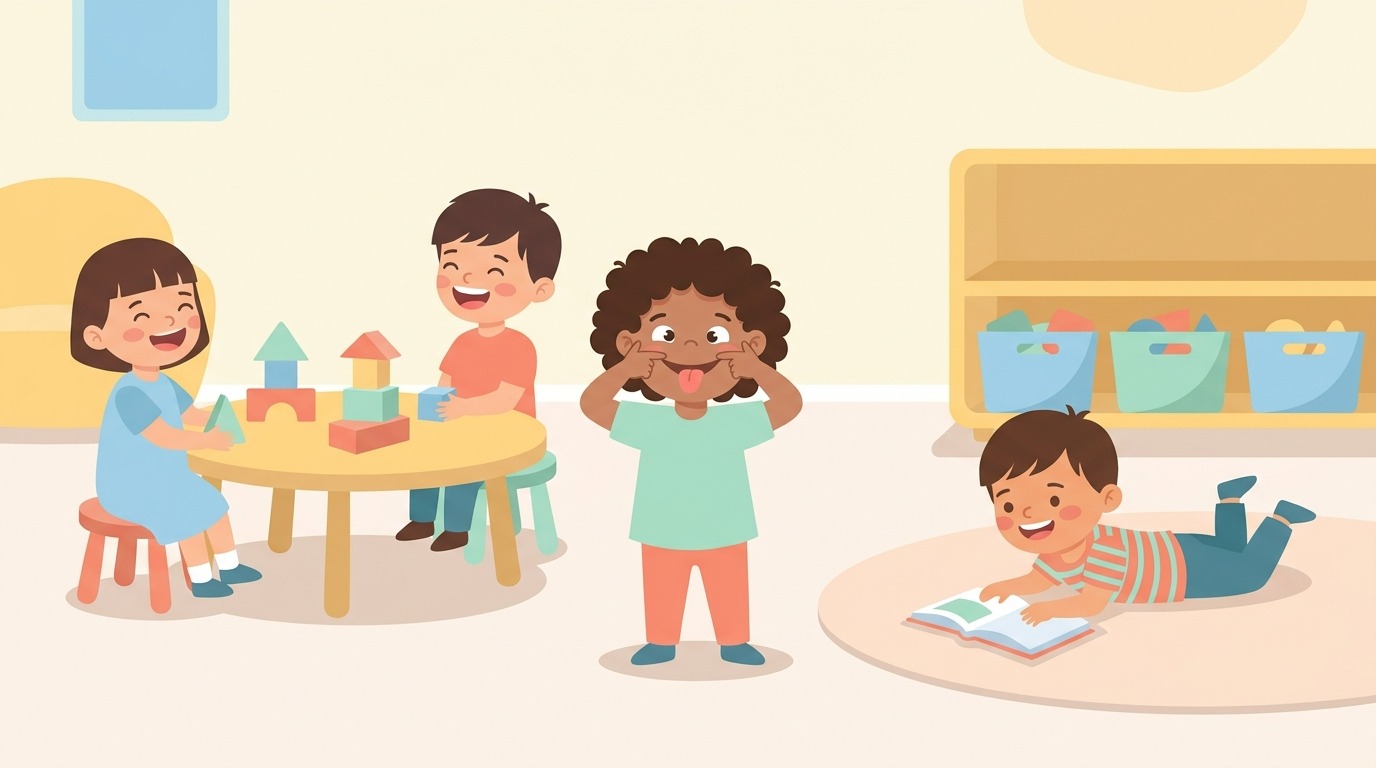
Channeling without stifling: practical strategies at home and school
The tightrope is clear: support expression and imagination, while establishing a predictable framework. Specifically, the adult shows when to laugh loudly and when to whisper, when to improvise and when to follow the plan. This signaling makes the child autonomous and secures the group.
A simple tool is to ritualize “showtime” moments. Announce: “after snack, five minutes of stage.” The child prepares their act, then applauds others. Next, switch to a calm activity. This predictable alternation strengthens voluntary inhibition without breaking the desire.
Valuing beyond humor
Since the entertainer first captures attention with laughter, multiply occasions to shine otherwise. You can praise a helpful act, three minutes of focus, or an original idea in progress. Reinforcement should remain descriptive: “You tidied up the blocks quickly, thank you.” This realism nurtures perceived competence.
Exclusive micro-moments of attention count greatly. Two minutes, focused gaze, activity chosen by the child. Paradoxically, the less they need to provoke attention, the calmer their humor becomes and the more genuine the sharing.
Setting clear and kind boundaries
Limits are stated early and calmly. “You can make people laugh during showtime. Now, we read.” The message stays short, the gesture firm, the prompt quick. The child understands the adult doesn’t extinguish joy, they channel energy at the right moment.
Visual aids help: “clown” (allowed) and “calm” (necessary) cards, two-minute sand timer, colored dots. The material makes abstraction concrete. Gradually, the child anticipates the transition without rebellion.
Co-education and team coherence
Between home and school, a shared approach avoids misunderstandings. A brief communication notebook, with three columns “When / What / Help”, suffices. Adjust together. If the child turns away from acts when a sad friend arrives, it’s a remarkable social progress. This nuance must be voiced, not overlooked.
Coherence reduces the temptation to exist only by jokes. It frees creativity for concrete projects: puppet theater, “poet’s minute,” or discovery presentations. Then, the clown becomes author, and energy turns into learning.
Key insight: predictable framework + attention rituals = calm humor and strong relationship.
Concrete tools for ages 3-5: games, imagination and emotions serving learning
To nurture momentum without overflow, a selection of targeted activities works wonders. The common thread: transform the desire for the stage into language, motor skills, and emotional regulation levers. Create a “palette of laughs” where every color has its place.
Puppet theater, for instance, channels expression within a reassuring framework. Characters carry the emotion instead of the child. Narration becomes easier. The adult can slip in “fail-success” scenarios to de-dramatize mistakes and foster self-encouragement.
Key activities easy to implement
- 🧸 Mirror puppets: imitate joy, fear, anger, then name the felt state.
- 🎵 Code nursery rhymes: sing loud, then whisper on signal; work on inhibition.
- 🧘 “Statue” minute: after a joke, hold still for 10 seconds; strengthens attention.
- 🎲 “Stop & Go” games: move like a robot, stop suddenly; regulation and active listening.
- 📚 Fill-in-the-blank stories: child invents the ending; imagination and speaking skills.
- 🎭 Accessory box: cardboard red nose, fabric hat; the “role” stays in the box afterward.
Emotion cards also support affective language. Draw a “jealousy” card, then imagine a little sketch. The child learns to say “I would have liked” instead of diverting. Thus, humor no longer masks pain; it welcomes and transforms it.
Finally, alternate intensity and calming down. A short guided relaxation, a gentle book, or a breathing exercise close the exciting parenthesis. Young children’s brains favor regular rhythms: measured excitement, secured soothing.
Moreover, some children fade away by blending in. Opposite the life of the party, sometimes called a “chronic gray child”. Exploring these two extremes helps adjust adult responses without imposing a single mold.
To anchor these gestures daily, here is a synthetic visual reminder to keep on the fridge or in class.
Golden rule: always close playtime with a word about the felt emotion and a perspective (“tomorrow, you will show me your new dance”). This little phrase stabilizes the bond and prepares the next step.
When and how to ask for help: converging signals, procedures and reassuring words
Most clowning in 3 to 5-year-olds is part of harmonious development. However, some clusters of signs invite consultation. The goal is not to label but to open an additional door. Asking for help is offering a safe space to understand what is truly happening.
Converging signs can alert: lasting refusal of any demanding activity, hypersensitivity to others’ gaze, very restless sleep, or repeated conflicts with peers. If laughter often turns into anger or sadness, a professional can help unfold the scene.
Who to contact and how to prepare the exchange
The pediatrician or family doctor remains a first point of reference. Then, the educator, kindergarten teacher, or psychologist specialized in early childhood can refine. Preparing some factual notes (when, where, intensity, calming responses) saves time and avoids vagueness.
With the child, simple words suffice: “We’re going to see someone who helps understand big emotions and funny ideas.” This phrasing focuses on resources and removes shame. No blame or punishment is sought.
Talking with the teacher without dramatizing
A brief meeting with the teacher, focused on observations, aligns practices. You can suggest a small weekly chart where the child chooses a goal: “raise hand before joke” or “offer a kind idea to a sad friend.” Progress is strengthened by a wink, not a tangible carrot.
This approach builds over time. Two to four weeks usually suffice to observe a shift. If nothing changes, refine the plan. Sometimes, changing the seat, using picture instructions, or individualized welcome time unlocks the situation.
Preserving the child’s dignity at every step
The child must always feel their humor is valued. We distinguish substance (their joy, creativity) from form (the moment, volume). This separation avoids shame and supports the desire to try differently. The adult becomes a safety tutor, not a laughter controller.
Ultimately, when the playful behavior enriches with other ways of existing, learning breathes and the relationship deepens. This is the best indicator of a positive trajectory.
“A little one’s humor is a spark; well guided, it lights confidence without ever burning the momentum.”
My child clowns around all day: should I be worried?
Not necessarily. Between 3 and 5 years, humor serves exploration and socialization. Rather observe flexibility: can they stop on cue, alternate with a calm activity, and express their emotions differently? If task avoidance becomes systematic or tears follow laughter, seek advice.
How to respond without stifling their creative momentum?
Validate joyful intention, then set boundaries: “Your joke at the end of the story.” Offer ritual “showtime” moments, encourage successes beyond humor, and use visual aids (timer, cards). The message: expression is welcome, timing is learned.
Which activities help regulate energy?
Stop & Go games, statue minute, emotion puppets, code nursery rhymes, feather breathing, and fill-in-the-blank stories. Alternate intensity and calming down, and always close with naming the felt emotion.
How to talk with the teacher?
Propose a brief exchange based on facts: when, where, effect on group. Suggest shared routine (showtime, visuals, two-step instruction). Agree on a small weekly goal and simple feedback.
When to consult a professional?
If the child freezes outside the entertainer role, persistently avoids effort, or shows sleep and social troubles, a specialized opinion clarifies and reassures. The goal: understand needs, not label.