Development 10-12 Months: The stages of child development from 10 to 12 months.
| Short on time? Here’s the essentials ✨ |
|---|
| Between 10 and 12 months, Motor development accelerates: standing up, moving on all fours, Walking with support 🧗♀️ |
| First words emerge, often with gestures that also count for communication 🗣️👉 |
| Hand-eye coordination improves thanks to stacking, blocks, and water play 🎲💧 |
| Sensory exploration becomes a powerful learning driver with textures, sounds, and lights 🪵🔔 |
| Focus on Self-feeding: fingers, small spoons, first attempts at the cup 🥄🥛 |
| Imitation games and Socialization multiply, but Stranger anxiety may reappear 🤝😯 |
| Cognitive development relies on object permanence and joint attention 🧠👀 |
| Securing the environment and encouraging without forcing remain the best strategies 🛡️💬 |
Between 10 and 12 months, every day feels like a living laboratory. The child repeats, experiments, sometimes falls, then tries again with astonishing determination. This phase builds an essential foundation where tone, balance, listening, and attention strengthen in tandem. Benchmarks remain broad because not everyone walks at the same time, and some prioritize language or crawling before taking the leap. This unique rhythm deserves respect because it guarantees a solid, confident base.
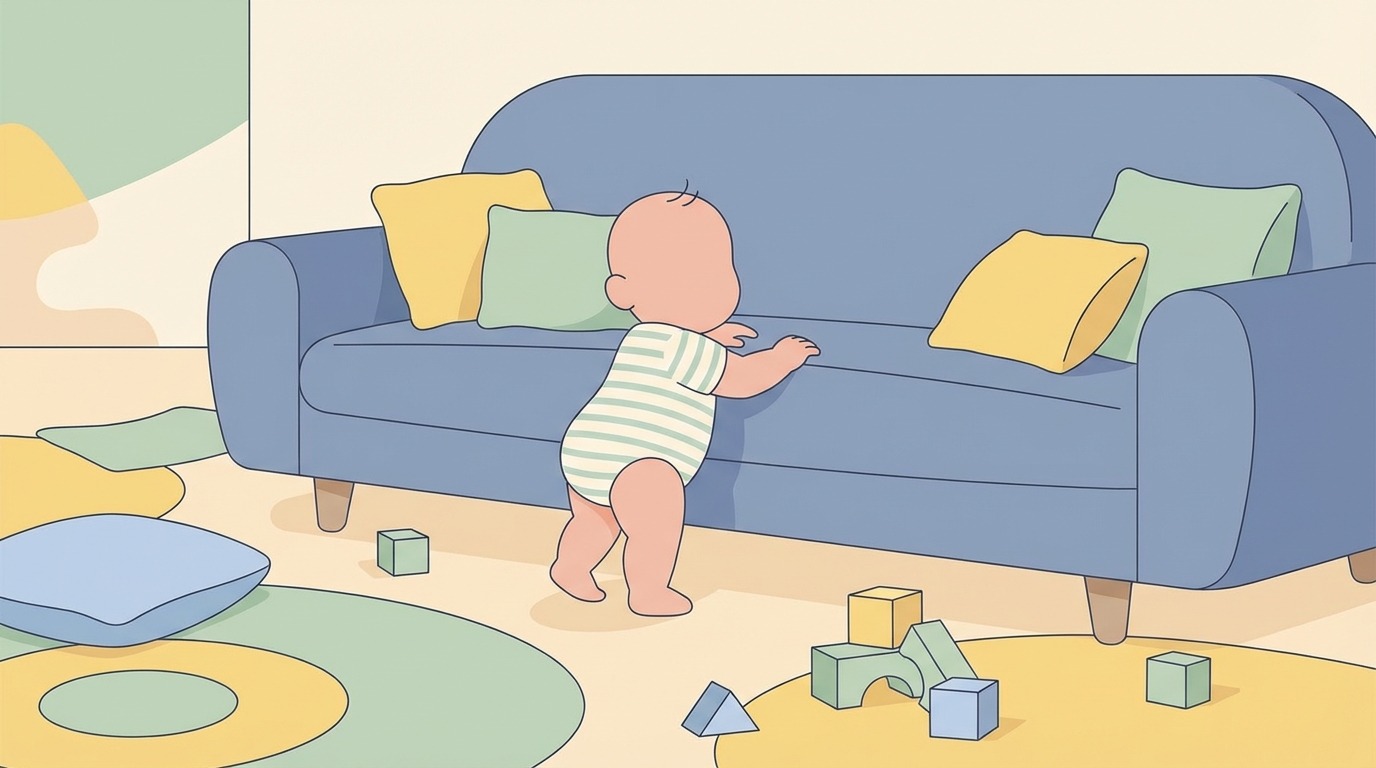
In families, two scenes often recur. In the first, Noah, 10 months old, moves swiftly between the rug and the coffee table, straightening up and “shuffling” toward the couch with two hesitant steps. In the second, Lea, 11 months old, stacks cups, points to a picture of a cat, and waits for an adult to name the animal. These moments reveal the heart of learning at this age: moving to understand, imitating to communicate, and trying to do things alone. The following sections detail these milestones with concrete examples and practical advice.
Motor development 10-12 months: standing up, walking with support, and securing exploration
At this age, the body becomes the preferred tool. Motor development manifests through smooth transfers between positions and repeated attempts to maintain balance. The child sits alone, gets on their knees, then pulls up to a vertical position using available support. Each movement builds automatic systems that will serve independent walking.
Standing up without forcing: the art of transfers
Standing appears when the foundational blocks are solid. First, sitting is stable. Then, moving to knees happens without tension. Finally, pushing on the legs completes the rise. Offering varied support surfaces helps a lot: coffee table, couch, low step. The role of the adult is to set the stage rather than carry the body. This strategy stimulates balance and postural control.
Why avoid “making them do it” too early? Because the brain builds motor maps autonomously. When an adult holds the child under the armpits, this process is bypassed. Instead, placing a desired object within reach triggers effective and safe transfers. This logic makes learning more robust.
Walking with support: from shuffling to first steps
“Shuffling” describes those two or three daring steps between pieces of furniture. This activity builds confidence, especially if the floor is non-slip and clear. Walking with support by pushing a stable cart also prepares propulsion and alignment. Ride-on toys stimulate trunk coordination and direction, but balance remains different from walking. Walkers are discouraged due to risks of falls and postural illusions.
Independent walking often occurs between 12 and 18 months. Before that, a variety of movements is more than enough. Crawling, moving on all fours, standing up, pivoting, descending: these sequences sharpen proprioception and spatial sense. Each child favors a “motor path” that suits them.
Going down, climbing, and going down again
Many children master backing down stairs before letting go of hands to walk. This skill protects against falls and increases vigilance. It can be encouraged by placing a cushion at the foot of a step and calmly demonstrating the movement. Very quickly, the back arches and hands find the floor without help.
Mini obstacle courses at home work wonders. For example, a slightly thick rug, a sturdy box, and a giant cushion. The child crosses, goes around, then repositions their body. They gain a detailed reading of supports. These simple games rival expensive equipment.
Active safety: prevent without restricting
Around 12 months, autonomy explodes, as does exposure to dangers. Table corners soften with protectors, outlets get plugged, and household products move out of low cupboards. Stair gates secure exploration, but the adult also shows safe descent. This alliance between prevention and demonstration supports freedom to act.
Balance builds through variety, not performance. Encouraging every transfer nourishes confidence and installs a researcher’s posture. This quiet courage will turn attempts into first steps.
Cognitive development and sensory exploration: understanding, searching, solving
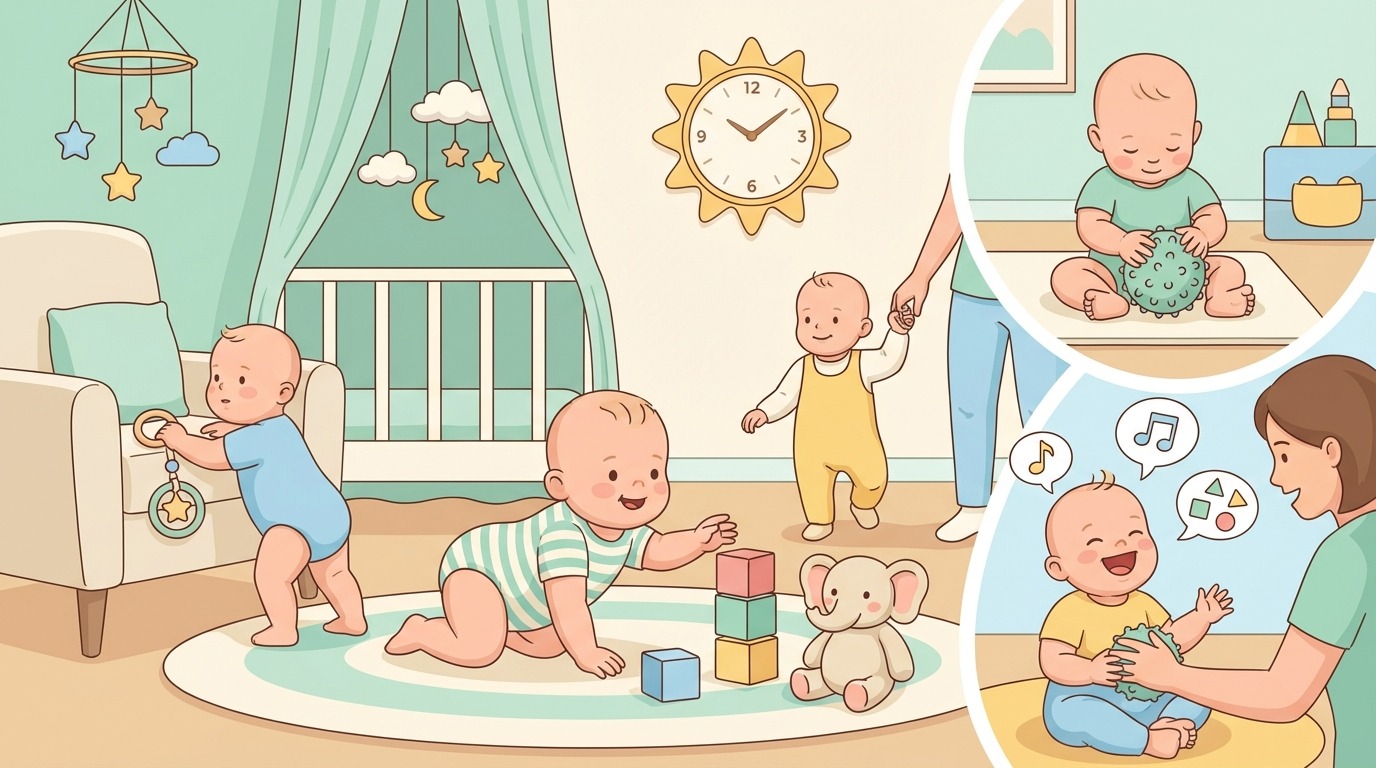
From 10 to 12 months, connections between action and thought thicken. Cognitive development relies on sensory exploration and fine manipulation. Touching, shaking, opening, closing: each gesture poses a hypothesis. The child observes the outcome and adjusts their plan. This back-and-forth weaves memory and logic.
Object permanence and little investigations
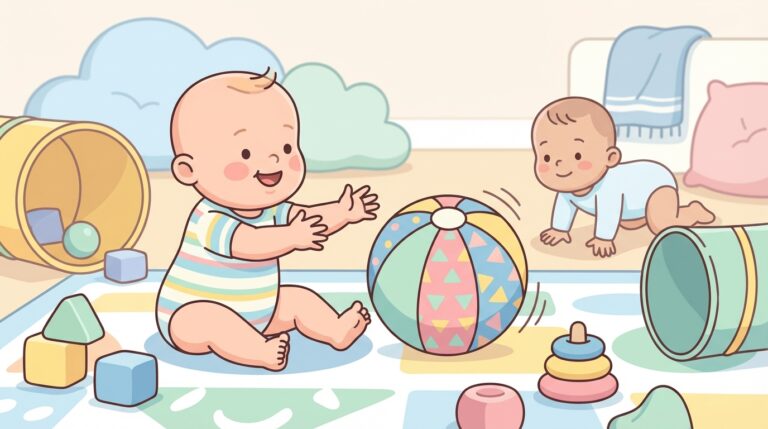
When a toy disappears under a cloth, the gaze continues to search. This is a decisive turning point called object permanence. It can be strengthened with shape sorters, baskets to empty, and lids to lift. For example, Noah slips a ball into an opaque tube and watches for it to come out. He laughs, then tries again with another ball. The brain now maps the invisible.
This taste for investigation nourishes attention. It also prepares language, as words describe what the eye doesn’t always see. “Where is the car?” triggers a search guided by mental representation, not just vision.
Hand-eye coordination: aiming, fitting, releasing
Hand-eye coordination advances through short and varied challenges. Stacking two or three blocks requires aiming, deliberate release, and axis correction. Rings to thread and nesting cups develop precision. Water play adds a fluid variable: filling, pouring, spilling. The child anticipates trajectory and resistance.
Releasing becomes a gesture on its own. Around 11-12 months, giving an object on demand shows blossoming inhibitory control. This mastery opens the door to turn-taking and symbolic exchange, cornerstones of social life.
Guided sensory exploration: textures, sounds, lights
Varying textures sharpens the senses without overload. A discovery basket might include a natural sponge, a wooden spoon, a satin ribbon, and a textured ball. Simple sounds, like a bell or a tambourine, focus attention and introduce cause and effect. Soft lighting games at sunset calm and reinforce landmarks.
However, an excess of stimuli harms the quality of exploration. It’s better to alternate calm and active times. A clean environment allows the brain to prioritize information and memorize better.
Imitation and early logical rules
At this age, the brain loves copying. Rubbing with a small sponge, closing a box, clapping on demand: everything becomes a reproducible scenario. This imitation prepares more complex imitation games in the next quarter, like feeding a doll or answering a toy phone. It also gives meaning to simple instructions, as the gesture models understanding.
Over the weeks, the child anticipates short sequences. They pull a pull-string, wait for the effect, then try again if they like the result. This trial-and-error loop establishes sound and lasting logical foundations.
In short, thinking and feeling advance side by side. By respecting slow and rich exploration times, the adult plants seeds of curiosity that will nourish what follows.
To continue this cognitive playground, a selection of educational videos helps vary proposals. The important thing remains adjusting to the day’s mood and the current attention span.
Language 10-12 months: first words, gestures, and joint attention
Around 10-12 months, language explodes silently before being heard. First words rarely burst out in a rush. Often, they arrive as distorted syllables, noises, or onomatopoeia. Yet they count as soon as the same sound designates the same object or action.
Gestures that speak, words that anchor
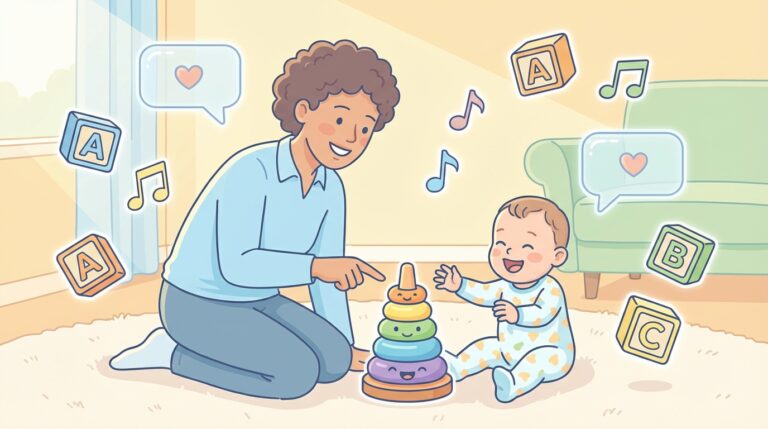
At this age, a gesture can sometimes replace a word. Pointing, reaching out, shaking the head to say no—all communicate. “Joint attention” builds when the child looks at a picture, then seeks the adult’s gaze to share interest. Lea points to the dog in the book, waits for a reaction, then proudly vocalizes. The message flows both ways.
Linking a gesture to a sound strengthens memorization. For example, showing a cup while saying “drink” builds a semantic bridge. Very soon, the child tries to anticipate the expected word and practices reproducing it.
Encouraging emergence without pressure
Routines help by reducing background noise. Naming meal steps, singing a short song at bath time, commenting on putting on pajamas: these rituals structure time and multiply repetition opportunities. Reading short picture books with clear images improves recognition and production.
Screens are best avoided during active waking phases. They cut off exchange and disrupt attention. In contrast, nursery rhymes, finger games, and board books provide lively material for dialogue.
Small reassuring indicators
Between 9 and 12 months, responding to their name, understanding simple requests, and saying one or two stable sounds depicts a typical trajectory. Some children speak little but gesture a lot. Others say “no” before “mama” because they test limits and distances. This path remains very personal.
If no vocalization is heard by 12 months, professional advice might be helpful. Hearing, oral-motor skills, and exchange quality will be evaluated. Most delays catch up with gentle, regular support.
Imitation games to strengthen speech
The toy phone, the bear you say “hello” to, the doll to put to bed: these scenes stimulate prosody, meaning the melody of speech. Imitation games invite the first, even babbling, dialogues. They train the child to take turns speaking, then wait for a response.
Language never advances alone. It anchors to joint attention, orofacial motor skills, and shared emotions. When the gaze lights up, the word finds its place.
Socialization, emotions, and stranger anxiety: accompanying without rushing
The 10-12 month-old child expands their circle but remains attached to their security base. Stranger anxiety can reappear, sometimes strongly. It signals a finer reading of faces and relational distances. This vigilance protects because it prompts checking for a familiar figure before exploring.
Security base and frequent returns
In a new place, a back-and-forth sets in. The child moves away a few steps, then returns to touch the adult’s knee, before going off again. This emotional “check-in” stabilizes discovery. Gradual arrivals, clear handovers, and a transitional object ease separation.
For adults, tone of voice plays a major role. A warm but firm intonation reassures. Instructions stay simple and concrete. They avoid cluttering the mind with abstract explanations.
Socialization and early rules of living together
Sharing becomes possible but only for very short times. At 11-12 months, giving an object on demand already shows social progress. The adult can model exchange by saying “your turn,” “my turn,” without expecting perfect reciprocity. This scripting installs codes that will endure.
Meeting other children offers a wonderful school of gestures and sounds. Parallel play dominates, with quick imitations. The child observes, picks up an idea, then reuses it in another context. Thus, socialization builds little by little, without overstimulation.
Managing strong emotions: frustration, anger, bursting joy
Emotions are intense and sincere. Frustration appears when an object resists or an adult intervenes. Naming the emotion, proposing an alternative gesture, then showing a solution calm without stifling momentum. A “I see you’re angry, let’s breathe, try another way” often suffices.
Consistency in adult reactions helps the child predict. Clear, constant, and few rules work better than a flood of prohibitions. The home thus becomes a readable territory where it’s good to experiment.
Stranger anxiety: sign of maturation, not alarm
This fear reflects fine discrimination of faces. It means “I know who belongs to me.” To get through it, slowly introduce new people at a respectful distance. The child adjusts contact at their pace and curiosity takes over.
Deep down, emotions form a compass. Welcomed calmly and clearly, the adult opens the way to more confident encounters.
This video resource offers guidelines to recognize signs of emotional overload and establish gentle transitions during daily separations.
Daily autonomy: self-feeding, sleep, safe imitation games
Between 10 and 12 months, the child seeks to do things alone. Self-feeding improves with grasping, the small spoon, and attempts at the cup. Meanwhile, dressing becomes a motor training scene, and the bathroom a sensory playground. These routines, repeated with kindness, build confidence.
Eating like a big kid: textures and easing gestures
Soft chunks stimulate chewing and tongue motor skills. Stick-shaped foods, easy to grasp, strengthen the thumb-index pinch. The spoon is offered alternately with fingers. The adult stays patient with spills, as they teach measurement and adjusted movement.
Drinking from a cup is practiced with micro-sips. A small rigid plastic cup, without a handle, encourages upright posture. Spillages remind us that mouth and hand learn together. There’s no rush because coordination requires hundreds of attempts.
Dressing, washing: motor rituals
Putting the arm through the sleeve, reaching the foot toward the shoe, holding the hairbrush: these gestures amplify autonomy. Bath time offers rich sensory exploration. Filling, squeezing, splashing trigger clear cause-and-effect sequences. Non-slip mats and water at the right temperature ensure safety.
Imitation games and fine coordination
Putting the cap on a bottle, making “vroom vroom” with a small car, pushing a doll in a miniature stroller: imitation games exercise planning. They also sharpen wrist precision. We see hand-eye coordination at work, as every millimeter counts to succeed.
Practical ideas to slip into the week
- 🍽️ Offer a “to work on” food at each meal (ripe banana, roasted sweet potato) for self-feeding.
- 📚 Read a picture book 5 minutes, twice a day, to support first words.
- 🧩 Set up a mini motor course with cushion, box, and improvised tunnel for motor development.
- 🛁 Put two cups of different sizes in the bath for pouring and strengthening hand-eye coordination.
- 🤝 Organize parallel play with another child to encourage socialization.
Simplicity pays off. Everyday objects are enough to create suitable challenges, as long as the adult observes and adjusts the difficulty level.
Framework and safety: trust without complacency
The home is thought of in zones. A free access, very secure zone allows extended exploration. A supervised zone offers finer challenges. Household products go up high, and low drawers empty of dangerous contents. Safety frames, it does not slow down.
After a rich day, sleep organizes better. Simple, repeated routines prepare body and mind. For example, soft light, a short massage, and a story. The child calms in predictability. The final message is clear: autonomy is learned better when the structure is stable.
Concrete progress landmarks
To help visualize acquisitions, here is a non-normative mini observation grid. It illustrates trends without fixing a calendar.
| Key milestone at 10-12 months 🗂️ |
|---|
| Stands with support, then tries 2-3 steps to “shuffle” 🧍♀️➡️🪑 |
| Gives on demand and begins turn-taking 🤲 |
| Stacks 2-3 blocks and aims for a fitting hole 🎯 |
| Says 1-3 stable sounds and points to be understood 🗣️👉 |
| Drinks from a cup with help and eats with fingers 🥛🍅 |
These landmarks energize daily observation. They reflect a milestone: growing skills by nurturing curiosity.
The suggested video offers simple balance game ideas and shows how to position furniture to encourage safe transfers.
At 12 months, the child doesn’t walk yet: should we worry?
No, not if other movements progress. Independent walking often occurs between 12 and 18 months. Crawling, getting on knees, shuffling, and going down backwards are very good signs. Consult if independent sitting remains difficult or if mobility stagnates several weeks.
My baby doesn’t point yet: how to help?
Set up moments of joint attention. Show an image, name it, wait for their gaze, then offer to reach out. Object hide-and-seek games, picture books, and imitation scenes encourage this gesture. If pointing doesn’t appear by 12-13 months, professional advice can refine support.
How to react to stranger anxiety?
Introduce new people slowly, at a comfortable distance. Stay available without forcing contact. A transitional object, stable routines, and regular visual returns reassure. Social caution at this age is a sign of maturation, not alarm.
Which toys to favor for hand-eye coordination?
Stacking cubes, nesting cups, rings to thread, shape boxes, and water pouring games. Choose simple, contrasting objects, easy to grasp. Alternate textures and resistances to enrich sensory exploration.
Self-feeding makes a mess: continue anyway?
Yes, because the gesture and chewing develop this way. Limit quantities served at once, use a washable mat, and offer soft foods. Offer the spoon alternately and accept spills; they are part of learning.
“Between 10 and 12 months, every attempt is an invisible victory that prepares big visible steps.”