Playing Ball Ball: Playing with a ball or a ball: activities for 6-12 months.
| Short on time? Here’s the essentials ⚡ |
|---|
| ✅ At 6-12 months, a soft and light ball stimulates motor skills, coordination, and listening through a very simple playful activity. |
| 🧠 Handling, looking at, and following a ball activates baby’s vision, hands, and attention all at once. |
| 🧴 Prefer foam/fabric; totally avoid latex balloons (choking hazard) ❌. |
| 🕒 5 to 10 minutes is enough; it’s better to play often rather than extend a session. |
| 🏡 Alternate firm floor indoors and grass/sand outside to vary sensations. |
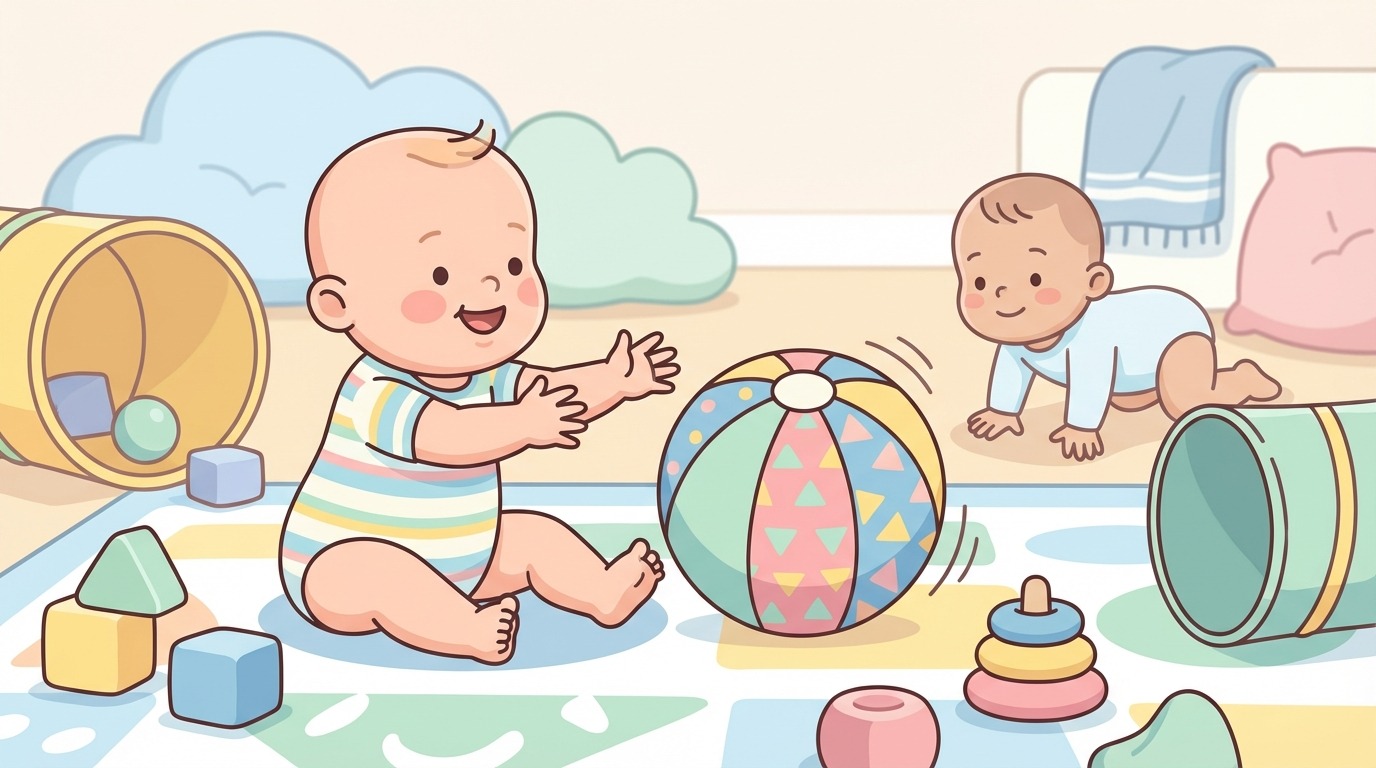
| 🔁 Key games: rolling towards the adult, foot tapping, putting the ball into a box, crawling to catch it. |
| 💬 Name the action: “roll”, “push”, “stop”; associate clear gestures to support language. |
| 🔒 Set up a clear area, kneel near baby, and stay within their field of vision. |
At the age of first rolls and more secure support, the ball becomes a wonderful engine of exploration. A simple round object invites pushing, following, touching, looking, then repeating. This joyful repetition structures coordination, maintains listening, and strengthens the adult-child bond. By betting on a short but frequent playful activity, daily life gains quality without material overload.
Between 6 and 12 months, every micro-progress counts. Following a ball with the eyes, reaching out and grasping it, is weaving connections between vision, touch, and balance. Indoors, a mat and a soft ball suffice; outdoors, the lawn cushions and slows the trajectory. In both cases, the game remains simple, paced by keywords and clear gestures. The goal is never performance, but development step by step, in the pleasure of playing together.
Playing with ball at 6-12 months: neuro-motor foundations and shared pleasure
Why a ball so early? Visible and rooted benefits
A ball mobilizes several systems at once. The gaze follows the trajectory, the hand opens then closes, the torso adjusts to keep balance. This triple stimulation feeds motor skills and joint attention. Psychomotricity follow-ups show that babies regularly exposed to ball games gain gesture precision faster than their peers.
The rolling sphere creates accessible suspense. Speed varies, distance changes, and repetition reassures. This back-and-forth calms, especially when an adult verbalizes the action. Saying “it’s playing… it’s rolling… stop!” sets temporal landmarks and clear expectations. The gesture-word bond strengthens listening and initiates understanding of simple instructions.
Age by age: what baby can explore
Around 6-8 months, visual tracking improves. Lying on the stomach, the child watches the ball roll and tries to stretch out the arm. At 8-10 months, they sit up better, pivot on their bottom, and can push the ball with the palm. Between 10 and 12 months, they crawl quickly or walk with support and try to retrieve the object, sometimes placing it in a container.
These milestones vary from child to child. The important thing is to offer challenges close to their abilities. Bring the ball closer if the task is too hard, and move it away a bit when success becomes obvious. This gradual adjustment supports a harmonious development curve.
Signs baby is ready to play with a ball
- 👀 Follows a moving object for several seconds.
- ✋ Opens and closes the hand on a soft toy.
- 🧍 Sits up with support and maintains sitting position for a while.
- 🗣️ Reacts to repeated short words: “stop”, “come”, “give”.
- 🙂 Shows curiosity and pleasure when the ball approaches.
When these signs appear, the encounter with the ball becomes rich, motivating, and highly constructive.
Safety and equipment: choosing the right ball for 6-12 months
Dimensions, texture, and weight: the winning trio
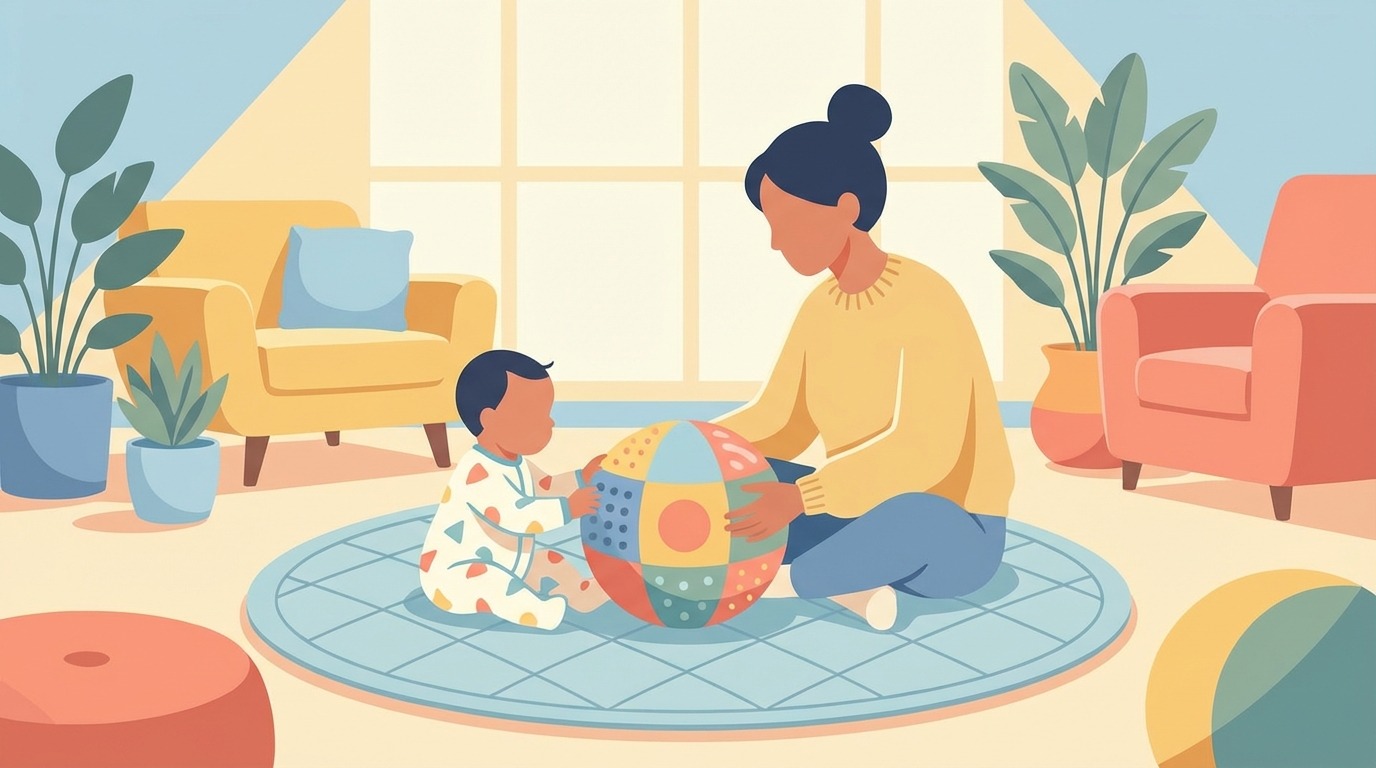
At this stage, a ball of 10 to 14 cm, made of dense foam or padded fabric, fits well in the hand and doesn’t bounce too much. A textured surface grips fingers and prevents slipping. Avoid hard materials and small balls less than 4.5 cm in diameter, which are incompatible with infant safety.
Transparent balls with internal rattle attract attention without startling. Test the sound from a distance, then bring it closer. The volume should remain soft, as listening is also built through auditory comfort. A color contrast supports visual tracking, useful in both natural and artificial light.
Good practices for setup and hygiene
Installing a firm mat limits loss of balance. Remove obstacles within 2 meters, close low drawers, and stay within reach. The adult kneels to share baby’s field of view. After the session, a wipe with disinfectant suitable for toys or washing with soapy water is enough.
To vary contexts, grass slows the ball, sand cushions its course, and carpet creates a quiet roll. Outdoors, a hat in summer and warm clothing in winter allow going out to play outside with a baby without sacrificing comfort. The setting evolves the difficulty without changing the equipment.
Absolutely avoid: latex balloons
Latex balloons, even if supervised, remain a major risk. Upon bursting, their fragments form an aspiration hazard. Therefore, prefer foam or fabric balls, which are much more suitable. Valves and small decorative parts are also excluded from the play area.
To deepen the links between equipment choice and motor skills acquisition, a detour through child psychomotor development clarifies each decision. Betting on quality is securing exploration and pleasure.
| Age 🍼 | Type of ball 🎯 | Targeted actions 💪 | Caution 👀 |
|---|---|---|---|
| 6-8 months | Foam 12-14 cm, soft texture | Follow, touch, push with palm | Avoid small parts, keep at 50 cm |
| 8-10 months | Padded fabric, discreet rattle | Roll towards adult, pivot to catch | Clear area, moderate sounds |
| 10-12 months | Medium foam, light resistance | Crawl to retrieve, put in a box | Close supervision, no sharp edges |
With these markers, the adult secures the environment and nurtures the desire for lasting playful activity.
Activities 6-9 months with a ball: sensory awakening and gentle coordination
Tummy-roll: bringing the ball to life on the tummy time
Lying on the stomach, baby watches the ball approach slowly. The adult rolls it toward the hand, then moves away. Comment: “here it comes… roll… stop.” This predictable alternation reassures, encourages arm extension, and strengthens the shoulder girdle.
Over tries, the hand touches then pushes. Specific praise: “great, you pushed with your right hand!” This precise feedback reinforces success and solidifies eye-hand coordination.
Feet tap: activating the posterior chain through play
On the back, the ball gently touches the soles of the feet. An extension reflex appears, then a small voluntary “kick.” We laugh, repeat, and name: “foot, tap, ball.” This leg-object connection prepares future supports, while remaining gentle.
After a few minutes, the adult places the ball farther to encourage hip flexion. The effort stays brief. Pleasure is kept front and center, no rush.
Duo kneeling: mini pass and shared gaze
Two adults or an adult and an older child kneel facing each other, baby sits in the middle. The ball rolls slowly from one to the other, brushing the little hands. The child eventually stops it. We allow time, then suggest: “push.”
This scene creates a healthy social triangulation. The gaze moves from the ball to the face, then back. Turn-taking settles. This is the foundation of listening and calm interactions.
These easy proposals fit into the routine. A few daily minutes are enough to establish landmarks and a desire to play again.
Activities 9-12 months: rolling, aiming, crawling, and cooperating gently
Close pass: baby’s throw-catch version
Sitting face to face, knees almost touching, the adult sends a ball very gently. Baby holds it against their belly, sometimes with elbows. Then they release and push it. Distance is reduced if needed. Success fuels motivation.
When the gesture becomes fluid, simple commands are introduced: “stop” and “go.” The temporal coordination progresses, as well as tolerance for waiting.
Target box: cause-effect and precision
A large rounded-edge box becomes a basket. The adult demonstrates: place the ball inside then clap. Baby quickly imitates, as the effect is clear and rewarding. The height is varied by a few centimeters to avoid boredom.
A large storage crate works very well. Other ideas exist to repurpose containers, found in these tips around games with boxes and cartons, adapted with wide openings and always under supervision.
Crawl-and-chase: gentle cardio and curiosity
From sitting position, the adult rolls the ball slowly and plans an artificial stop against a cushion. Baby goes on all fours and gains endurance without discouragement. Success is celebrated with each retrieval.
A mini “tunnel” can be created with two chairs and a sheet to provide a goal. The journey enriches proprioception and maintains the desire to move.
Musical stop-and-go: listen to act
To soft music, the adult rolls. When the sound stops, we say “stop” and block the ball. Then “go” and we start again. The action-stop loop supports listening, managing waiting, and reading the sound context.
On rainy days, these variations are easily practiced in the living room. Other home ideas add here, simplified for under-one-year-olds: indoor games for rainy days.
After the first birthday, new challenges take over. A useful overview of upcoming milestones is found in this guide on development 13-18 months.
Language, cognition, and rituals: when the ball makes gestures speak
Key words and associated gestures
Saying and showing together anchors meaning. Three effective pairs: “roll” (hand movement forward), “push” (palm moving forward), “stop” (open hand still). Repeated with the ball, these signals clarify intention and support understanding.
Each success deserves a descriptive phrase: “you pushed the ball gently.” This wording nourishes the foundation of language. To deepen, these practical guides on how to help baby develop language offer easy-to-integrate tips.
Inspired and adapted little cognitive games
Hide-the-ball under a cloth: the adult covers the ball, places the hand on it, and asks “where is it?” We lift the cloth together. Object permanence gains ground, and the positive surprise holds attention.
Textures to name: the adult lets the child touch two balls—foam and fabric—and says “soft” then “fluffy.” Concrete adjectives are better remembered when the body experiments. We repeat later, in another context, to consolidate.
Short, regular, and joyful rituals
A visual timer, two landmark songs, and a “ball greeting” close the session. This stable framework reduces end-of-activity crying, eases transition, and creates a positive memory. A few minutes after waking from a nap form an ideal moment.
Outdoors, the same routine applies with a washable ball and a foldable mat. Daylight stimulates awakening. The body senses other supports, which finely nurtures postural development.
When gesture meets word, play becomes language. And when language weaves through action, listening naturally progresses.
Which ball to choose for a baby 6-12 months?
Choose a ball 10 to 14 cm, made of dense foam or padded fabric, light and textured. Avoid anything small, hard, or detachable. Latex balloons are prohibited.
How long to play with a ball at this age?
5 to 10 minutes is enough, one to three times a day depending on baby’s mood. Short and regular sessions are better than one long tiring block.
What are the first really useful games?
Roll the ball towards the adult, push with the palm, catch while crawling, and place it in a large box. These simple actions strengthen coordination, listening, and confidence.
Can we play outside with a baby?
Yes, on grass or sand, in mild weather, with a washable ball. Provide shade or warm clothes and stay close. Useful pointers here: playing outside with a baby.
And if baby is not interested in the ball?
Change texture, add a discreet jingle, vary the floor, and place the ball closer. Show the gesture, name it, then let the child decide the pace.
“A simple ball, and suddenly the baby’s world is rounded with gestures, laughs, and leaps towards tomorrow.”