Helping Baby Language: Helping baby develop their language (0-12 months).
| Short on time? Here’s the essentials ⏱️ |
|---|
| ➡️ Talk often to your child and describe what you are doing throughout the day. |
| ➡️ Respond to babbling as if it were a real conversation to nurture communication 🗣️. |
| ➡️ Create language routines during diaper changes, bath time and meals to stabilize landmarks 🔁. |
| ➡️ Read every day picture books and short stories to enrich vocabulary 📚. |
| ➡️ Focus on sensory games and face-to-face interaction to anchor sounds and gestures 🎲. |
| ➡️ Bilingualism is not a hurdle: one language = one speaker reassures and structures 🌍. |
| ➡️ Watch out for warning signs (few reactions to sounds, no prolonged babbling) and consult if needed ⚕️. |
| ➡️ Prioritize a calm atmosphere and quality sleep, drivers of awakening and expression 😴. |
The first months of a 0-12 month baby are a sound and relational adventure where every exchange counts. By talking, singing and playing, the adult plants the seeds of language, understanding and expression. Thus, a simple description of the bath or a “well done” in response to babbling becomes a rich experience that nourishes communication and overall development. During this period, the brain shows amazing plasticity, and regular interactions guide the circuits that will support listening, sounds, and future vocabulary.
Because language emerges in the relationship, daily routines provide reliable supports. However, every child progresses at their own pace, with no need for comparison. Therefore, the goal is clear: to offer a warm environment, simple words, associated gestures and varied sensory games. Moreover, some landmarks help to gauge progress, without pressure, while staying attentive to key signals. This approach, both enthusiastic and structured, transforms each day into a ground for interaction and sensory awakening.
Developing baby’s language from 0-12 months: key stages and first sounds
From birth cries to the first “mama,” progression follows a precise logic. First, crying structures primary communication, as it informs about hunger, discomfort or the need for closeness. Then, around 2-3 months, vocalizations emerge with prolonged “oo” and “aa,” while the baby observes faces and matches parental intonations.
From crying to cooing: the basis of communication
Why do these cries matter so much? Because they train the adult to decode and respond, which sets up a rapid and predictable interaction cycle. Thus, the child learns that their sound emissions have an effect, an essential driver of the motivation to communicate. Then, cooing appears, often during calm moments, and intensifies when the parent imitates the sound produced.
This imitation is not just a simple game. In reality, it constitutes a validation that reinforces the conversational “turn-taking.” Gradually, the child modulates duration and intonation, refines oral-motor skills and opens up to the rhythm of the mother tongue. Meanwhile, joint attention sets in when the adult names a pointed object, laying the foundation for understanding the word-thing link.
Babbling, joint attention and word recognition
Between 4 and 6 months, canonical babbling develops with sequences like “babababa.” Then, the child varies sounds and experiments with combinations. At the same time, they begin to recognize their name, respond to simple commands, and orient toward the sound source. These advances show that active listening is setting in.
Between 6 and 9 months, understanding progresses further when an adult associates a word with a gesture and an object. For example, “bottle” accompanied by a look and the corresponding movement. Thus, associative memory strengthens. From 9 to 12 months, word approximations appear, sometimes close to onomatopoeia like “woof” for dog, which shows a functional link between sounds and meanings.
Imitation and first words: a touching milestone
The first words are not necessarily clear, but they are intentional. The child says “pa” and looks at their father; they produce “da” while reaching out for a toy. Indeed, meaning takes precedence over perfect articulation. This intentionality should be welcomed enthusiastically, as every attempt feeds the motivational loop.
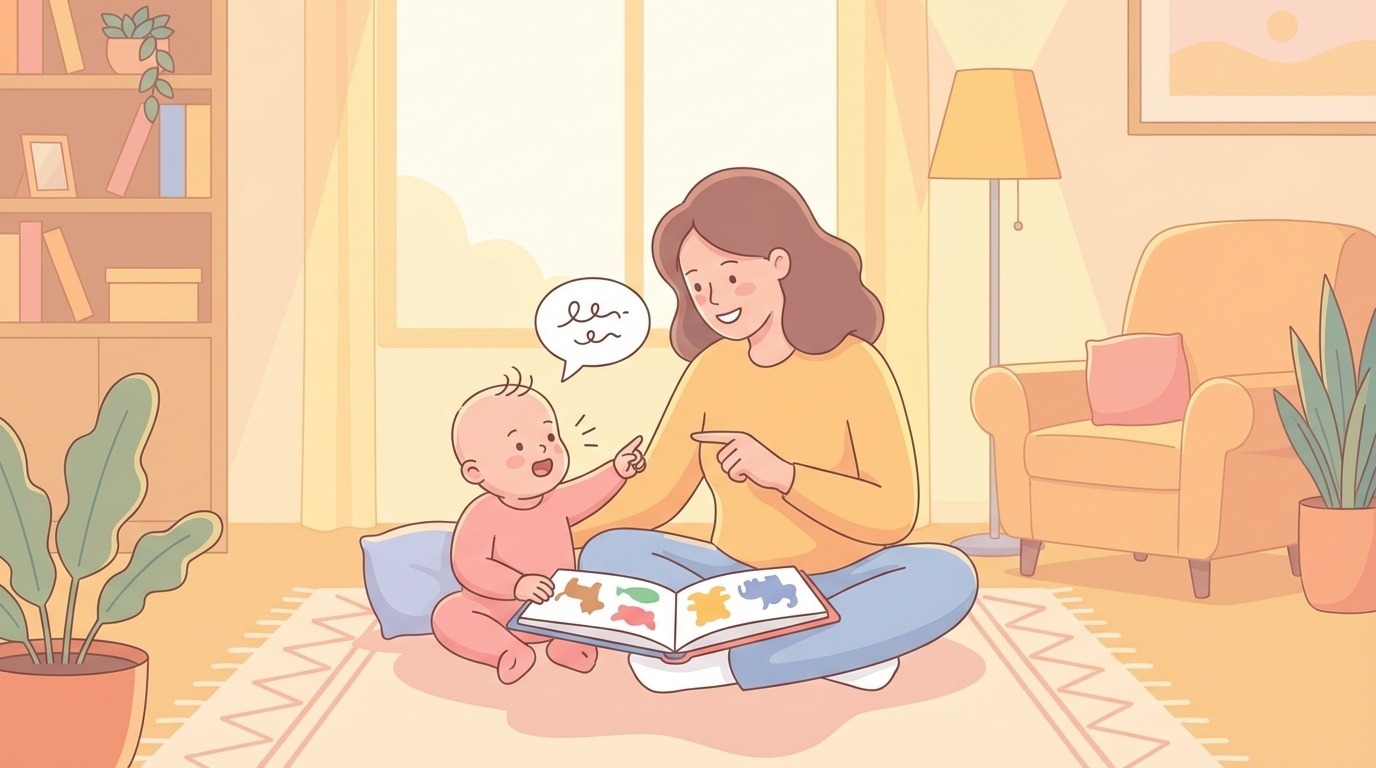
A concrete example often speaks louder than theory. Imagine Noé, 10 months old, babbling in front of a book. The adult responds, slowly turns the page and names the image. Noé repeats a syllable and smiles. Immediately, a mini-conversation unfolds. Thus, communicative competence is woven, stone by stone, on a foundation of shared awakening and pleasure.
To follow this final period of the first year, consult milestones between 10 and 12 months that help observe expression without unnecessary worry.
In short, the trajectory goes from reflexive calls to intentional speech, supported by quick and warm parental responses.
Talking with baby daily: routines, intonation and gestures that speed up learning
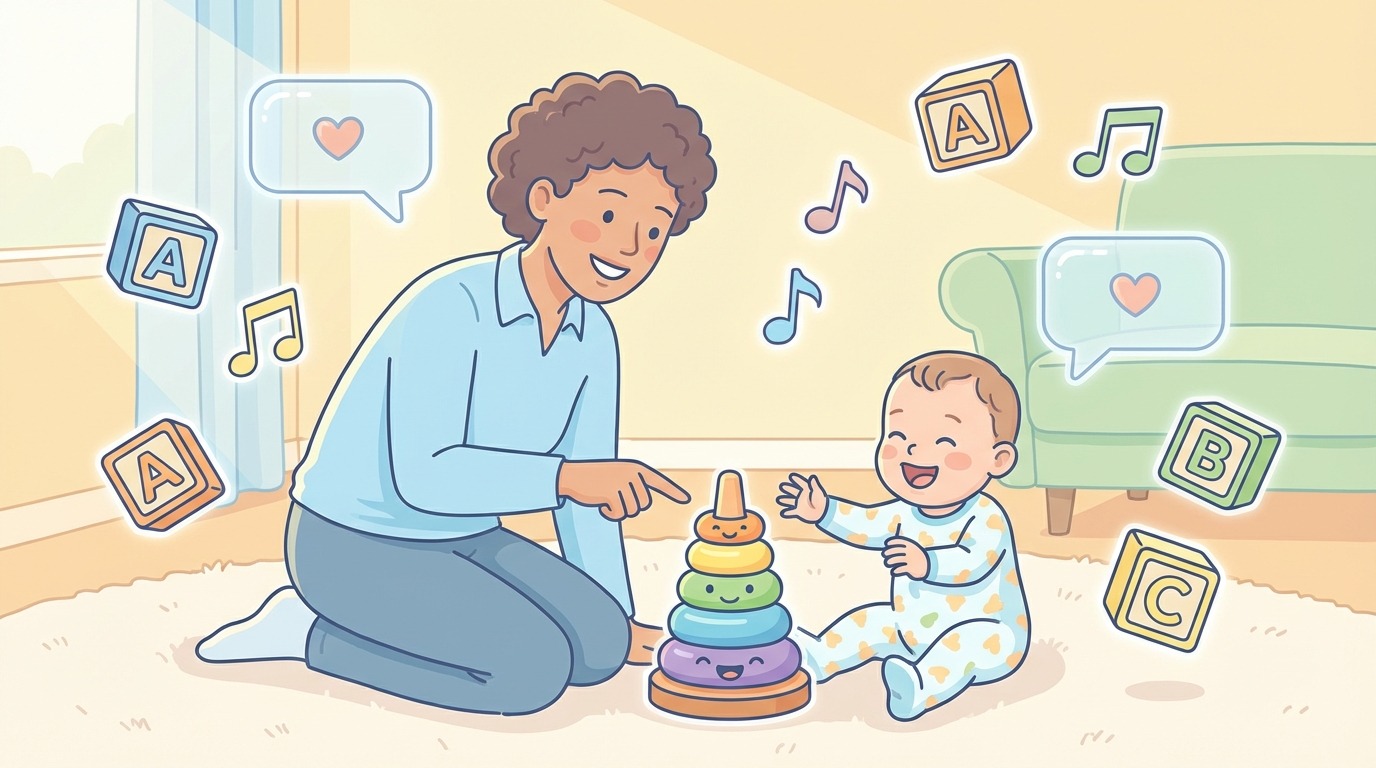
Conversation with a toddler begins before words. In other words, it’s about putting sentences on their actions, waiting for a reaction, then restarting. This simple dynamic nurtures language without sophisticated material. Consequently, every diaper change, every meal and every walk become communication laboratories.
Daily narrated dialogues
The “sportscasting” technique works very well. Just describe the gestures: “We open the diaper, we clean, we close.” Thanks to repetition, the child associates words with concrete sequences. Then, they anticipate, then try to imitate a key sound. This granularity of routines facilitates encoding.
To structure the day, you can ritualize small landmark sentences. For example: “It’s bath time, splash!” or “We put on the soft pajamas.” These short, rhythmic, and sometimes sung formulations attract attention. Thus, prosody becomes a powerful mnemonic guide.
Engaging intonation and message clarity
A warm and marked intonation, often called “sing-song speech,” catches the eye and stimulates listening. However, clarity remains essential: short sentences and concrete nouns help vocabulary to bloom. Also, frequent pauses give the child time to respond with a look, gesture or sound.
Repetitions are not redundant for a child. On the contrary, they secure and cement learning. Still, slightly varying the wording maintains curiosity. So, “Look at the ball” can become “The red ball rolls!” The child records the category and its attributes.
Associating gestures with words
Pointing, showing, making a “bye-bye” gesture: these signals anchor meaning. Because the brain better integrates a word accompanied by a visual and motor cue, simplified “signs” can be added from 6-8 months. This reduces frustration and speeds up intentional expression.
Here is a mini-list of effective supports to easily integrate:
- 👀 Regular face-to-face to lock gaze, mouth and breath.
- 👆 Point to the object while naming it, then wait for a reaction.
- 👐 Use 3-4 useful signs (again, drink, sleep, finished) without forcing.
- 🎵 Sing nursery rhymes with gestures, linking rhythm and sounds.
- 🔁 Repeat the same key phrase in a stable routine.
For inspiration with images and songs, video searching can help you take action today.
Practical tip: alternating a very predictable routine with an unexpected game maintains motivation. As a result, the child learns to anticipate, then adapt, two skills useful for speech.
In sum, short messages, clear intonation and coherent gestures lay solid tracks for language development.
Sensory games and interactions that boost communication
Games are not extras; they are the training ground for language. Thanks to turn-taking, silence/emission alternation and micro-rules, the child practices the basics of conversation. Thus, a “peek-a-boo” already works joint attention and signal waiting.
Social games and turn-taking
Short, repeated and very expressive games attract toddlers. For example, hiding a comforter under a transparent cloth, then waiting for a questioning look. Then, unveiling with exaggerated intonation. This simple dramaturgy encourages the child to vocalize or point.
The mirror game deserves a special place. By imitating facial expressions, the adult strengthens awareness of mouth movements. By extension, oral-facial control gains precision, which facilitates the transition from babbling to stable syllables.
Nursery rhymes, music and rhythm
Nursery rhymes structure time and breath. Because they organize syllables and rhymes, they support phonological perception. Moreover, a regular tempo helps stabilize sounds sequences. Finally, associated gestures form a bridge between action and meaning.
To vary without getting bored, it is wise to alternate gentle nursery rhymes and rhythm games involving hand claps. Thus, the child associates an auditory signal, a gesture and a social expectation. This triad prepares the entry into directed speech.
A short video selection of signed nursery rhymes can simplify session setup at home or daycare.
After viewing, it’s better to keep 2-3 “favorite” nursery rhymes and repeat them. Consequently, the child anticipates parts and tries to participate, even with a syllable.
Objects, peek-a-boo and object permanence
Object peek-a-boo games invite the child to search and signal. This search triggers the look/point/vocalization alternation, a fundamental trio of voluntary communication. Then, the adult verbalizes: “You found the ball!” to label the successful action.
Similarly, passing a toy slowly from hand to hand allows for visual tracking and turn-taking. Thus, patience and coordination develop, two qualities that improve engagement in “conversation.” In short, playing is speaking with the body and preparing for words to come.
Conclusion of this stage: short, repetitive and rhythmic games create natural conditions for language awakening.
Reading with a toddler: enriching vocabulary and joint attention
Shared reading acts as an accelerator for vocabulary and expression. By naming, pointing and letting the child handle, the adult establishes solid associations. Moreover, books open worlds that everyday life doesn’t always offer, which amplifies the diversity of words encountered.
Choosing books suitable for babies 0-12 months
Thick cardboard, clear images, strong contrasts and little text: here’s the foundation. Then, you can introduce textured books, flap books and soft sound books. These multisensory elements hold attention and invite interaction. Thus, the child participates with their hands, eyes and voice.
Everyday picture books (food, bath, family, animals) are great stepping stones. Thanks to their simplicity, they allow numerous repetitions, without boredom. Then, over weeks, action verbs are enriched: “roll,” “jump,” “open.” This progression nourishes understanding long before production.
Dialogic reading
Rather than “reading it all,” it is strategic to converse about the images. Ask open questions, wait for a look, then reformulate: “Are you showing the cat? Yes, the cat!” With this pattern, the child feels like an actor in the story. Consequently, motivation rises.
Another useful tip: mark micro-pauses to encourage a sound or a gesture. Then, praise the attempt with enthusiastic echoing. This co-construction cuts short passivity and turns the page into an interactive stage.
Adapting to ages and bilingualism
Before 6 months, emphasis is on contrasts and the music of words. Between 6 and 12 months, place is given to very short stories and everyday scenes. For bilingual families, a simple rule secures: one speaker per language. Thus, codes remain clear without restricting enthusiasm.
To locate expected achievements and adjust playful proposals, the milestones described here for 10-12 months offer concrete supports. Then, calmly continue after 12 months by maintaining the same principles of shared awakening.
Key idea to remember: reading is not a performance, it’s an alliance around images and words.
Milestones, variations, and when to seek advice without stressing
Individual rhythm varies, and that’s normal. However, milestones help decide when to worry. The goal is not to label, but to support early if needed. Thus, confidence is protected and the pleasure of interaction maintained.
Attention thresholds and warning signs
Before 6 months, the child turns toward voices and reacts to sudden noises. Between 6 and 9 months, they babble and explore several syllables. Then, between 9 and 12 months, they point, imitate and try 1-3 approximate words. If these trends are absent, a professional opinion is appropriate.
Red flags exist: little or no shared gaze, persistent absence of babbling after 8-9 months, weak reactions to sounds, or loss of acquired skills. In these cases, consultation with a pediatrician or speech therapist clarifies the situation and offers concrete paths.
Bilingual babies: understanding specifics
Bilingualism may slightly delay word production, but it does not hinder communication. On the contrary, it enriches cognitive flexibility. To stabilize landmarks, it is better to associate each language with one person or context. Thus, the child knows when to hear and use each system.
It is also common to observe “mixing” in toddlers. This code-switching is not an error; it is an exploratory stage. The important thing remains the regularity of input and quality of exchanges, not perfect phrase purity.
Healthy habits, emotional bond and secure environment
The brain learns better in calm. Therefore, regular sleep and screen-free breaks are worth gold for language development. In case of difficult nights, some useful guidelines are offered when sleep goes awry, as fatigue slows awakening and availability for exchanges.
The emotional bond feeds on contact, carrying and smiles. This inner security frees exploration, thus curiosity, thus the desire to speak. Moreover, gentle body play and soothing baths put the child in good conditions to listen and respond.
Finally, keep in mind a simple principle: better little but often. A few well-engaged minutes each day are worth more than a long and rushed session.
Final key point: observe, encourage, and seek advice if doubt persists, without losing the pleasure of shared play.
To consolidate these milestones and prepare the next phase, explore activity ideas and milestones for the next age range via dedicated resources like ages 3-5 years, keeping the same thread of kindness and consistency.
“A word is born from a received look, a heard gesture, and shared joy.” ✨
At what age do the first words appear?
Often between 9 and 12 months, intentional approximations emerge (e.g. “pa” for papa). Meaning takes precedence over pronunciation. If no approximate word appears by 12 months, observe overall progression and discuss with the pediatrician if other signals worry you.
How to stimulate language without overloading my baby?
Focus on short and repeated routines (diaper change, bath, meals), simple sentences, warm intonation and associated gestures. 5 to 10 minutes of sensory games spread throughout the day are enough, as long as pleasure remains central.
Does bilingualism really delay speech?
Production may sometimes start a little later, but comprehension progresses in both languages. If possible, associate one speaker per language and be consistent: bilingualism strengthens cognitive flexibility and does not harm language.
When to seek a specialist opinion?
If the baby reacts little to sounds, does not babble after 8-9 months, does not point around 12 months, or loses skills, a pediatric and/or speech therapy consultation will help to objectify and support calmly.
Which books to choose first?
Board picture books, with contrast, one image per page and little text. Gradually add textured and flap books, then everyday scenes. Read every day, even 2 to 3 minutes, dialoguing around the images.