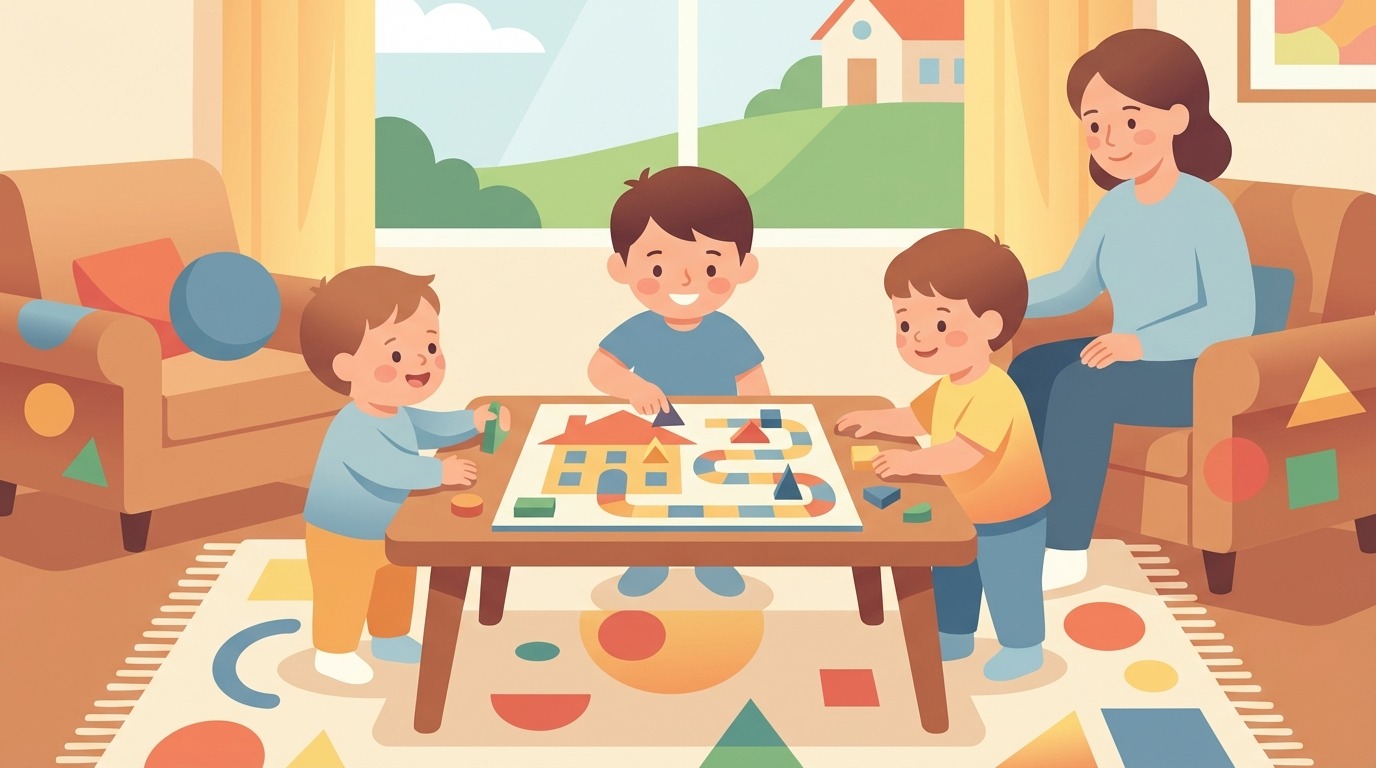
En Route Maternelle: Game: On the way to kindergarten for 3-5 year olds.
| Short on time? Here’s the essentials ⏱️ |
|---|
| A complete box set for school preparation of children aged 3-5: colors, shapes, language, body schema 🎒 |
| More than 10 progressive activities that support awakening, motor skills, and socialization 🤝 |
| Evolutionary educational game, designed for playing alone or with two, with simple and adaptable rules 🎲 |
| Short and regular rituals promote learning and strengthen the child’s confidence 🌱 |
| Adaptation options if needed: shyness, prematurity, health, family transitions 🧩 |
At the heart of families, the transition to kindergarten concentrates hopes, questions, and a thousand small victories. A well-designed educational game channels this energy and transforms shared moments into a springboard for learning. The “On the Way to Kindergarten” box set is part of this momentum: it mobilizes the natural curiosity of children aged 3-5 and directs it towards key skills, exactly those that preschool values every day.
Because each journey is unique, the progressive approach invites adjusting the challenges. Sometimes we sort colors, sometimes we explore the house or play friends. Each activity targets a specific skill while nurturing awakening, motor skills, and socialization. Families quickly observe a double benefit: a gentle school preparation and shared moments conducive to rich dialogue about emotions, language, and autonomy.
Educational Game “On the Way to Kindergarten”: Objectives and Measurable Benefits for Children 3-5 Years Old
This box set is not just a collection of cards and boards. It is a concrete method, based on short, easy-to-reproduce activities that reinforce the prerequisites for kindergarten. In practice, visual attention is stimulated, the discrimination of shapes and colors is refined, and language is structured through the names of objects, actions, and body parts.
To capture interest, everything starts with a familiar setting. The house backgrounds, friend characters, and everyday objects anchor learning in reality. This proximity reduces cognitive load and encourages the child to try, propose, and self-correct. The play-based approach also helps integrate rules, patience, and listening.
Cognitive Skills and Language: Naming, Categorizing, Memorizing
The color lotto and shape sorting initiate categorization, a foundation of logical thinking. By manipulating, the child builds reference points: “round,” “square,” “blue,” “red.” Then, the house and friends’ games enrich the vocabulary and invite describing scenes. One moves from isolated words to simple sentences, then to small stories.
A typical scene helps measure progress. Lila, 4 years old, starts by placing pieces randomly. After a few rounds, she spots the visual clues, listens to the oral clue, then verbalizes each choice. Her attention span lengthens, her working memory exercises, and her sentences gain precision.
Fine Motor Skills and Coordination: Grasping, Turning, Placing
Manipulating tiles, layering and aligning exercise the pincer grip, eye-hand coordination, and lateralization. These micro-movements prepare for writing, cutting, and dressing. The sturdy boards allow repeated attempts without frustration. With each success, motivation rises.
Emotions, Confidence and Autonomy: The Invisible Engine
The box set values taking initiative. The child chooses a game, announces a rule, and decides to stop when feeling tired. This sovereignty frames effort and enhances perseverance. Adults guide with open questions rather than dry corrections.
- 🎯 Clear objective per game to secure activity entry
- 🗣️ Positive reformulation of instructions to support self-esteem
- 🧠 30-second active breaks to maintain momentum
- 🏅 Mini celebration ritual to anchor success
Over sessions, the child understands that effort pays off. This sense of personal efficacy becomes a major asset at school start.

Box Contents: Colors, Shapes, Body Schema and Big House Game
The educational richness comes from the variety of materials. Activities cover the main areas of development in preschool, while remaining playful. Each can be played alone or with two to discover cooperation and role alternation.
The Color and Shape Lotto: A Reinvented Classic
Boards are distributed, pieces are drawn, and the target element is announced. Quickly, the child understands clues and anticipates. Guidance can be progressive: first color alone, then shape and color combined. This complexity build maintains interest and strengthens divided attention.
Game of 4 Friends: Social Language and Short Stories
Four characters, four everyday universes. Their clothes are named, accessories identified, and a short narrative constructed. Children love giving a voice to each friend. Social skills grow as the child learns to listen to the other player and build on their ideas.
Big House Game: Spatial Landmarks and Autonomy
The house becomes an exploration ground. Objects are placed, a route followed or a mission imagined. This staging works on topology (“above,” “below,” “next to”) and planning. Morning, meal or bedtime routines take shape and meaning.
To vary, a one-minute challenge can be set. For example, “find a round object in the house kitchen.” The timer makes the scene exciting, and the child gains analysis speed without losing precision.
Additionally, a short video sequence often helps adults visualize rule variants. A visual reference frees imagination and facilitates adaptation to the day’s mood.
The box set stands out for the amount of material. Pieces are easy to handle and hold up well to repeated use. The child can replay their favorite activity without waiting, consolidating learning. Ultimately, the content aligns with kindergarten expectations, while keeping a playful spirit.
School Preparation and Socialization: Rituals, Cooperation, Managing Shyness
School preparation goes beyond academic skills. Socialization, listening, and managing emotions count just as much. Two-player game mechanics teach turn-taking, mutual help, and agreeing on common rules.
Establishing Winning Rituals
A short appointment, 10 to 15 minutes, anchored after snack, creates a reliable habit. The child anticipates and gets ready. Rituals calm anticipatory stress and provide a gentle structure to late afternoons.
Shyness and Confidence: Concrete Bridges
Faced with marked reserve, simple adjustments reassure. Start with two-player games with an adult, verbalize emotions, then invite a peer. For deeper support, useful references are offered here: helping a shy child in preschool. These practical tools align well with the box’s logic.
Social Skills: Reading Signals, Sharing Space
Character cards help decode expressions and intentions. You can ask: “What is this friend feeling?” or “How to help?” This little detour through empathy prepares school exchanges. Other concrete leads are detailed here: developing social skills.
Cooperative games force negotiation and planning between two. One learns to give up an idea, reformulate it, then validate a common plan. These are mini-life-labs of classroom life, without pressure from grades or comparison.
In conclusion to this section, socialization weaves little by little. Rituals, clear instructions, and shared roles form good relationship habits, useful from school start.
Adapting the Educational Game to Specific Needs: Health, Prematurity, Family Transitions
Each child progresses at their own pace. The box set adapts to various situations. After temporary fatigue, premature birth, or moving, it becomes a reliable support.
Premature Children: Balancing Effort, Extending Calm Times
Simple references help adjust duration, brightness, and stimulus quantity. Need a global framework for school start? This guide sheds precise light: kindergarten and premature children. The key remains careful observation of fatigue signals and gradually increasing difficulty.
Weakness or Anemia Signals: Gentle Vigilance, Seated Games
In vulnerable periods, seated activities and very short sessions are preferred. To recognize warning signs, a useful reminder is here: anemia symptoms in children. The goal is not performance but regularity, even 5 minutes a day.
Family Transitions: Navigating Change with the House Game
A move can disrupt reference points. The “house” board helps replay key scenes and redraw a reassuring daily life. This practical focus offers concrete levers: moving and young children. By scripting the new bedroom or route to school, the child regains control over the unknown.
Finally, the weather matters. For an outdoor session on the terrace, think about shade and hydration. Essential reminders are here: protecting children from the sun. A few adjustments suffice to maintain pleasure and safety.
In summary, adaptation does not diminish ambition. It refines it. The child remains at the center, and the game becomes a common language, valid in all seasons of life.
Setting Up a Preschool Play Routine at Home: Organization, Budget, and Safety
A clear routine makes progress visible. It reassures the child and relieves the adult. The secret lies in consistency, brevity of sessions, and simple material preparation.
Practical Daily Organization
Creating a “ready-to-play” basket reduces setup time. Slip in 2 box activities, a timer, and a water bottle. Set up a non-slip mat and plan a quiet corner. This setting reduces distractions and shapes a quality moment.
- 🧭 Choose the calmest time (after snack)
- 🧩 Prepare 1 to 2 games max
- ⏳ Start 10 minutes, then 5 minutes free play
- 💬 Close with a question “What did you like best?”
Budget and Childcare Ecosystem
Families sometimes mix home time, childminder, and nanny. Understanding differences in framework and cost helps plan play times. A useful overview is here: nanny or childminder. To optimize budget, the immediate tax credit advance for childcare can ease monthly cash flow.
Safety, Maintenance, and Durability
Check the recommended age and keep small pieces out of reach of the youngest. A soft cloth is enough to clean the tiles. Modular boxes prevent losses and make the child responsible. Safety does not hinder pleasure: it prolongs it.
This routine forms a foundation. It anchors overall development through small daily touches. Less than an hour per week is enough for tangible progress, without pressure.
“Play opens the door, curiosity crosses the threshold, and confidence settles in.”
How long should you play with a child aged 3 to 5?
Sessions of 10 to 15 minutes are sufficient, supplemented by a few free minutes. Regularity matters more than duration. Adjust if attention decreases.
How to address shyness before kindergarten?
Start with two-player games, then invite a peer. Reinforce successes and verbalize emotions. Practical references are offered in the recommended article on shyness in preschool.
Should you play every day?
A rhythm of 3 to 4 sessions per week works very well. Also leave room for free play, which consolidates learning differently.
Is this box suitable for siblings close in age?
Yes, by offering two levels of challenge. The eldest can read instructions or count points, the younger manipulates and names. Each progresses at their own level.
How to connect these games to classroom expectations?
Focus on colors, shapes, spatial references, body schema, and descriptive language. These are skills valued in early years, and this box covers them step by step.