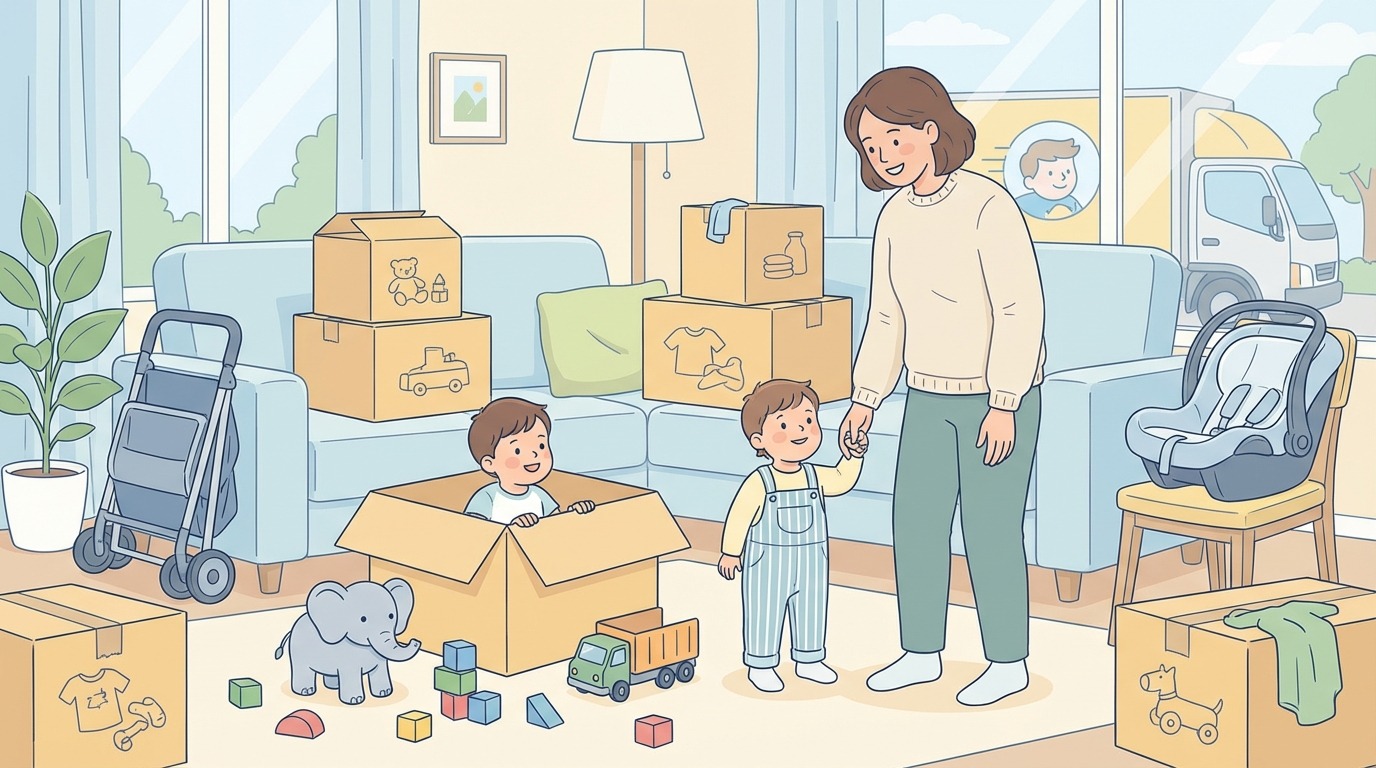
Moving Children: Managing a Move with Children Aged 1 to 3 Years.
- 🧸 Comforter + comforter backup (just in case)
- 🍼 2 bottles, nipples, sippy cups, soft snacks
- 🧼 Changing and mini pharmacy kit
- 📚 2 books and 1 quiet game
- 👕 2 full outfits and sleeping bag
The bag travels last in the truck and comes out first. A simple rule, zero panic.
Labeling, zones, and continuity of rituals
Each box receives a color code by room. “Priority” toys bear a VIP label. A “children’s area” is created in the old home and replicated in the new one. The routine follows: same bath music, same nightlight, same schedules. This symmetry speeds up adaptation.
To give meaning and create gentle landmarks, families benefit from anchoring simple rituals and traditions. A picnic snack on a sheet in the new room can become a sweet arrival custom.
Visualize to reassure: mission board
Visuals reassure 1–3 year olds. A magnetic board shows the day’s mission: draw their room, pack a “stuffed animals” box, visit the park. We tick together. The gesture materializes progress. The child sees that everything is moving forward and no one forgets them.
To go deeper, many creators share playful family routines. Targeted searches can inspire suitable formats.
A common thread emerges: preserve repetition and plan for the unexpected. It is the best possible alliance.
Moving safety and logistics: prevent risks with toddlers
On the big day, safety is paramount. A site is full of heavy objects, tools, and frequent traffic. A “safe” zone is marked off with empty boxes and a foam mat. A responsible adult stays there continuously. Keys, screws, and cutters never circulate on the floor. Prevention is worth a thousand reminders.
Karim set up a folding playpen in the living room. Lino played there with three chosen toys. A timer regulated cuddle breaks every 30 minutes. The need for attention doesn’t disappear. It’s scheduled.
Trips, carrying, stairs: anticipate hotspots
Stairs require free hands. A physiological baby carrier is planned. Strollers are used for outdoor breaks, away from traffic. In the car, the car seat remains installed until the last moment. The strap is never compromised “to go faster.” An accident cancels any time gain.
Upon arrival, doors are blocked with stoppers and electrical outlets covered. Cleaning products are stored high as soon as boxes are opened. Windows immediately receive blockers. These actions form a realistic firewall.
Active patience: occupy without overstimulating
Waiting long tires 1–3 year olds. The ideal: calm, sensory, and easy-to-put-away games. A “busy bag” contains stickers, finger puppets, wax crayons. For ideas, see these tips to make a child wait without extended screen time. A reading corner often proves magical. Attention calms, the team breathes.
Screens, if used, remain short and chosen. Better a familiar episode than an exciting novelty. Regulation protects evening sleep.
Hydration, meals, and mini-naps
Hunger and thirst amplify crying. Accessible water bottles and soft snacks prevent exhaustion. “Flash” naps are targeted in calm. A blanket on a closed mattress suffices. The body recharges. Good logistics very often start with these basic needs.
Many professionals illustrate “day J setups” in pictures. Searching real-life feedback helps visualize.
In the end, one rule oversees everything: when the child is protected and framed, the entire logistics chain runs smoother.
Adaptation to the new home: sleep, attachments, potty training and daycare
A successful arrival starts with the room. The bed, nightlight, and comforter are set up first. The bedding keeps the previous smell for two nights. This olfactory continuity supports adaptation. The bath follows closely. The water reactivates a strong sensory landmark. The implicit message is clear: “Your basics remain the same.”
Attachment objects form an emotional bridge. We avoid washing them immediately. A known smell balances the changing storm of visual landmarks. Romy, 3 years old, found her cushion and blanket identical. Her falling asleep time took 10 minutes, versus 40 the day before departure.
Evening rituals and night wakings
Bedtime follows the same script as before. Same story, same order of gestures, same keywords. If fears arise, a small light is turned on and the emotion is validated. A surge of images at night may occur. To distinguish fear from parasomnia, this guide on fear and night terrors offers landmarks. The response remains gentle and brief.
In the morning, a mini ritual of opening the curtain with a nursery rhyme launches the day. Repeated three times, it quickly anchors itself. Regularity matters more than duration.
Potty training and care transitions
A move can cause temporary regression. This is common. We avoid starting potty training right during the most intense period. If it was ongoing, we slow down without punishment. The guidance offered around potty training and daycare provides useful markers. We follow the child’s physical rhythm, not the adults’ schedule.
Regarding daycare or childminder, a visit before resuming calms nerves. Photos of the new route are shown. There is exchange with the team. Children sense the cooperation. They settle better.
Socialize quickly, but gently
Discover the neighborhood park, greet a neighbor, locate the library: three micro-missions suffice. They show life already exists here. The child meets other children at their own pace. One good landmark per day is better than ten over a weekend.
The guiding line persists: install the known, then open to the new. The immature brain loves this duo.
Support over time: games, social bonds, budget, and small victories
Adaptation is not played out in 48 hours. It stretches over several weeks. To stay on course, small victories are celebrated. “You noticed the doorbell,” “You tidied your book corner.” These phrases punctuate trust. They structure the child’s story and reduce child stress.
Free play nourishes this integration. A cardboard hut in the living room becomes a moving landmark. The child chooses when to enter. This symbolic control strengthens internal safety. Toddlers also like to carry, stack, sort. They “work” through the move on their scale.
Create connections in the new neighborhood
Encounters reduce apprehension. A storytelling stop, a story hour, a musical awakening workshop open doors. We go briefly but often. Repetition builds familiarity. We avoid nap times. We respect the 1 to 3 years biorhythm.
The thread of family traditions supports this dynamic. Preserving a pancake evening or a Sunday walk serves as the backbone. Children “read” these rites with their heart. The constancy of the bond protects curiosity.
Financial resources and helping hands
A move weighs on the budget, especially with childcare to organize. Financial aid for childcare exists depending on situations. Spotting them early facilitates choices. Sharing a close relative’s presence time can also ease pressure. Occasional relief at the park often equals a treasure of regained energy.
And if patience wears thin, remember the child is also progressing. Strategies to make a child wait remain valuable after moving in. They prevent escalation around meals, showers, or trips.
30-day check-in: adjust without judging
After a month, a check is done. Sleep, appetite, interactions, play. What needs stabilizing? What can still be lightened? The evaluation is done as a duo, with the child as partner. Two simple choices are offered. He votes for his lamp, his book spot, or the bedtime order. This co-construction nurtures trust.
At every stage, one compass remains: safety, routine, communication. This trio guides family organization and gives meaning to the new path.
When to announce the move to a child aged 1 to 3?
As soon as the decision is made. Simple sentences, images, and mini-rituals help make the information concrete without causing anxiety.
How to preserve the routine on the big day?
Keep a 48-hour bag accessible, set up the sleeping area first in the new home, and maintain the same key schedules.
What to do if sleep is disrupted after moving in?
Return to familiar landmarks: same story, same nightlight, bedding smell. Validate the fear and ensure brief and regular presence.
Should a child this young be involved in packing?
Yes, to their extent. Sticking a label, choosing two “travelling” toys, or carrying light objects strengthens mastery.
How to manage safety amid comings and goings?
Create a protected zone with a responsible adult, block doors and outlets upon arrival, and store tools and products out of reach.
“A successful move with a toddler is a course held by three sails: communication, routine, and safety.” ✨
| Short on time? Here’s the essentials ⚡ |
|---|
| Talk about the project early with simple words. Focus on communication and reassuring rituals 🗣️💞 |
| Maintain the sleep/meal routine. A stable setting reduces child stress ⏰🛌 |
| Anticipate safety on the big day. Dedicate a “safe zone” and a responsible adult 🛡️👶 |
| Involving children makes adaptation faster. Give them a role 👋🎨 |
| Take care of the family organization. Prepare a 48-hour survival bag and label everything 🧳🏷️ |
When a move involves children aged 1 to 3 years, the challenge goes beyond the boxes. At this age, landmarks support emotional balance and the relationship to the world. A change of home therefore affects routines, attachment objects, and trust. Yet, if well guided, this transition can become a valuable learning ground. It strengthens autonomy, curiosity, and the parent-child bond. The secret lies in methodical preparation, concrete communication, and constant emotional presence. Toddlers read attitudes. A calm and organized adult conveys serenity. Conversely, rushing increases child stress and withdrawal behaviors.
This guide offers a clear compass. It relies on proven practices in daycare and home settings. It details step by step what reassures a child aged 1 to 3 years before, during, and after the big day. On the agenda: accurate words, preserved routine, safety measures, symbolic games, sleep tips, hygiene, and socialization. A fictional family, Léa and Karim, here accompany Lino (2 years) and Romy (3 years). Their story illustrates useful choices and pitfalls to avoid. The goal remains simple: transform the unknown into a framed adventure, with a smooth and caring family organization.
Moving with children aged 1 to 3: reassuring communication and emotional preparation
Between 12 and 36 months, a child builds emotional landmarks. The move disrupts these milestones. To contain the shockwave, communication must be early, brief, and concrete. The project is announced as soon as the decision is made. Questions are answered with visible examples: “You will always have your comforter and your blue cup.” This detail makes the information tangible. It reduces uncertainty, the main source of child stress.
Lino’s family opened the dialogue three weeks before departure. Every evening, a simple sentence described the day’s step. For example, the new room was introduced by a photo. The toddler’s brain prepares better from familiar images. This storytelling already contributes to adaptation.
Announce without alarming: words, objects, gestures
At 1 to 3 years, thinking remains concrete. A sticker calendar helps understand “when.” A role play with figurines mimics departure and arrival. A truck is rolled. A miniature comforter is carried. This staging calms because the child acts on the scenario. It reduces the feeling of helplessness, often confused with anger.
Children also pick up adults’ internal states. A cheerful tone, short sentences, and steady gaze convey trust. Negative formulations are avoided. “Don’t worry” is replaced by “here is what will happen.” This rephrasing anchors active preparation.
Welcome emotions and prevent separation anxiety
Tears, restless sleep, frequent need for arms may arise. This is not a “tantrum” but an alarm signal. The emotion is named: “You are upset, that’s normal.” A hug and quiet time are offered. Short, structured separate times are also planned. They train the child to regain internal safety. For better understanding, this dossier on separation anxiety explains causes and appropriate responses.
Rituals contain. A song signaling “afterwards we tidy up” helps pass stages. Repetition is not a luxury: it is a neuro-affective need. At bedtime, a repeated story becomes a beacon. It links the old and new worlds, without long speeches.
Involve without overloading: give the child a role
Involvement supports mastery. The child chooses the wrapping paper for a “treasures” box. They stick a star-shaped sticker. They select two “travel buddy” toys. This participation acts as an emotional shield. The child feels important and able to act.
For inspiration, this article offers tips for a gentle transition. It reminds that symbolization and relational consistency outweigh material things. Labels stick better when presence is stable.
At the end of this phase, a key message stands out: the best anti-stress remains a available adult, guided by a simple and visible family organization.
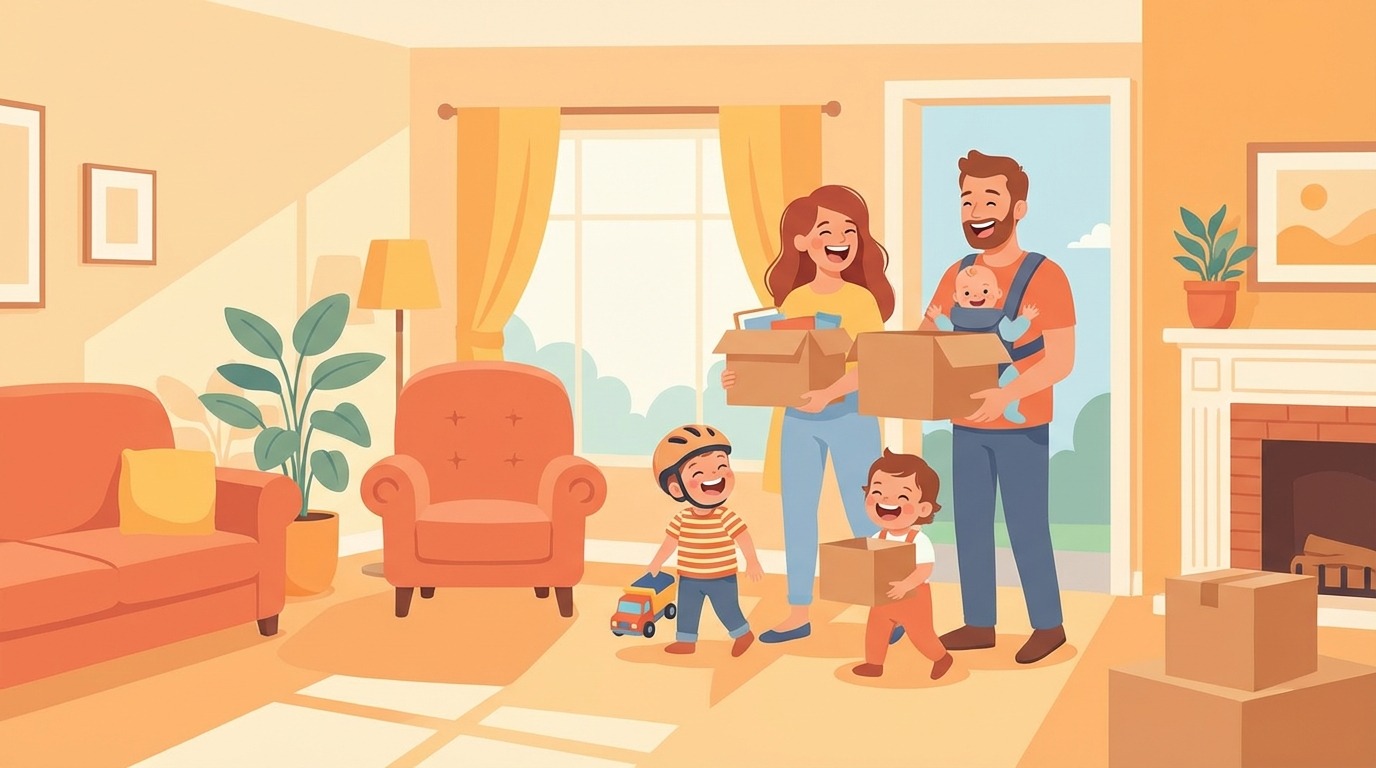
Family organization and routines: before, during, and after the big day
A good family organization turns a project into a marked path. From D-21, a weekly plan breaks tasks into small actions. We start with what is less visible to the child. Seasonal decorations leave before daily toys. This sequencing protects the routine and reduces emotional load.
With Romy, her parents kept the bookcase and play kitchen until D-2. In the evening, she found her landmarks. This consistency lowers cortisol, the stress hormone. The brain copes better with change when 70% of daily life remains stable.
The 48-hour survival bag: the kit that saves the day
An accessible bag gathers essentials for two days. It holds pajamas, diapers, wipes, water bottles, comforters #1 and #2, and some snacks. A first aid kit is added. Two favorite books slip in as well. This kit limits the unexpected, a major child stress factor.
- 🧸 Comforter + comforter backup (just in case)
- 🍼 2 bottles, nipples, sippy cups, soft snacks
- 🧼 Changing and mini pharmacy kit
- 📚 2 books and 1 quiet game
- 👕 2 full outfits and sleeping bag
The bag travels last in the truck and comes out first. A simple rule, zero panic.
Labeling, zones, and continuity of rituals
Each box receives a color code by room. “Priority” toys bear a VIP label. A “children’s area” is created in the old home and replicated in the new one. The routine follows: same bath music, same nightlight, same schedules. This symmetry speeds up adaptation.
To give meaning and create gentle landmarks, families benefit from anchoring simple rituals and traditions. A picnic snack on a sheet in the new room can become a sweet arrival custom.
Visualize to reassure: mission board
Visuals reassure 1–3 year olds. A magnetic board shows the day’s mission: draw their room, pack a “stuffed animals” box, visit the park. We tick together. The gesture materializes progress. The child sees that everything is moving forward and no one forgets them.
To go deeper, many creators share playful family routines. Targeted searches can inspire suitable formats.
A common thread emerges: preserve repetition and plan for the unexpected. It is the best possible alliance.
Moving safety and logistics: prevent risks with toddlers
On the big day, safety is paramount. A site is full of heavy objects, tools, and frequent traffic. A “safe” zone is marked off with empty boxes and a foam mat. A responsible adult stays there continuously. Keys, screws, and cutters never circulate on the floor. Prevention is worth a thousand reminders.
Karim set up a folding playpen in the living room. Lino played there with three chosen toys. A timer regulated cuddle breaks every 30 minutes. The need for attention doesn’t disappear. It’s scheduled.
Trips, carrying, stairs: anticipate hotspots
Stairs require free hands. A physiological baby carrier is planned. Strollers are used for outdoor breaks, away from traffic. In the car, the car seat remains installed until the last moment. The strap is never compromised “to go faster.” An accident cancels any time gain.
Upon arrival, doors are blocked with stoppers and electrical outlets covered. Cleaning products are stored high as soon as boxes are opened. Windows immediately receive blockers. These actions form a realistic firewall.
Active patience: occupy without overstimulating
Waiting long tires 1–3 year olds. The ideal: calm, sensory, and easy-to-put-away games. A “busy bag” contains stickers, finger puppets, wax crayons. For ideas, see these tips to make a child wait without extended screen time. A reading corner often proves magical. Attention calms, the team breathes.
Screens, if used, remain short and chosen. Better a familiar episode than an exciting novelty. Regulation protects evening sleep.
Hydration, meals, and mini-naps
Hunger and thirst amplify crying. Accessible water bottles and soft snacks prevent exhaustion. “Flash” naps are targeted in calm. A blanket on a closed mattress suffices. The body recharges. Good logistics very often start with these basic needs.
Many professionals illustrate “day J setups” in pictures. Searching real-life feedback helps visualize.
In the end, one rule oversees everything: when the child is protected and framed, the entire logistics chain runs smoother.
Adaptation to the new home: sleep, attachments, potty training and daycare
A successful arrival starts with the room. The bed, nightlight, and comforter are set up first. The bedding keeps the previous smell for two nights. This olfactory continuity supports adaptation. The bath follows closely. The water reactivates a strong sensory landmark. The implicit message is clear: “Your basics remain the same.”
Attachment objects form an emotional bridge. We avoid washing them immediately. A known smell balances the changing storm of visual landmarks. Romy, 3 years old, found her cushion and blanket identical. Her falling asleep time took 10 minutes, versus 40 the day before departure.
Evening rituals and night wakings
Bedtime follows the same script as before. Same story, same order of gestures, same keywords. If fears arise, a small light is turned on and the emotion is validated. A surge of images at night may occur. To distinguish fear from parasomnia, this guide on fear and night terrors offers landmarks. The response remains gentle and brief.
In the morning, a mini ritual of opening the curtain with a nursery rhyme launches the day. Repeated three times, it quickly anchors itself. Regularity matters more than duration.
Potty training and care transitions
A move can cause temporary regression. This is common. We avoid starting potty training right during the most intense period. If it was ongoing, we slow down without punishment. The guidance offered around potty training and daycare provides useful markers. We follow the child’s physical rhythm, not the adults’ schedule.
Regarding daycare or childminder, a visit before resuming calms nerves. Photos of the new route are shown. There is exchange with the team. Children sense the cooperation. They settle better.
Socialize quickly, but gently
Discover the neighborhood park, greet a neighbor, locate the library: three micro-missions suffice. They show life already exists here. The child meets other children at their own pace. One good landmark per day is better than ten over a weekend.
The guiding line persists: install the known, then open to the new. The immature brain loves this duo.
Support over time: games, social bonds, budget, and small victories
Adaptation is not played out in 48 hours. It stretches over several weeks. To stay on course, small victories are celebrated. “You noticed the doorbell,” “You tidied your book corner.” These phrases punctuate trust. They structure the child’s story and reduce child stress.
Free play nourishes this integration. A cardboard hut in the living room becomes a moving landmark. The child chooses when to enter. This symbolic control strengthens internal safety. Toddlers also like to carry, stack, sort. They “work” through the move on their scale.
Create connections in the new neighborhood
Encounters reduce apprehension. A storytelling stop, a story hour, a musical awakening workshop open doors. We go briefly but often. Repetition builds familiarity. We avoid nap times. We respect the 1 to 3 years biorhythm.
The thread of family traditions supports this dynamic. Preserving a pancake evening or a Sunday walk serves as the backbone. Children “read” these rites with their heart. The constancy of the bond protects curiosity.
Financial resources and helping hands
A move weighs on the budget, especially with childcare to organize. Financial aid for childcare exists depending on situations. Spotting them early facilitates choices. Sharing a close relative’s presence time can also ease pressure. Occasional relief at the park often equals a treasure of regained energy.
And if patience wears thin, remember the child is also progressing. Strategies to make a child wait remain valuable after moving in. They prevent escalation around meals, showers, or trips.
30-day check-in: adjust without judging
After a month, a check is done. Sleep, appetite, interactions, play. What needs stabilizing? What can still be lightened? The evaluation is done as a duo, with the child as partner. Two simple choices are offered. He votes for his lamp, his book spot, or the bedtime order. This co-construction nurtures trust.
At every stage, one compass remains: safety, routine, communication. This trio guides family organization and gives meaning to the new path.
When to announce the move to a child aged 1 to 3?
As soon as the decision is made. Simple sentences, images, and mini-rituals help make the information concrete without causing anxiety.
How to preserve the routine on the big day?
Keep a 48-hour bag accessible, set up the sleeping area first in the new home, and maintain the same key schedules.
What to do if sleep is disrupted after moving in?
Return to familiar landmarks: same story, same nightlight, bedding smell. Validate the fear and ensure brief and regular presence.
Should a child this young be involved in packing?
Yes, to their extent. Sticking a label, choosing two “travelling” toys, or carrying light objects strengthens mastery.
How to manage safety amid comings and goings?
Create a protected zone with a responsible adult, block doors and outlets upon arrival, and store tools and products out of reach.
“A successful move with a toddler is a course held by three sails: communication, routine, and safety.” ✨