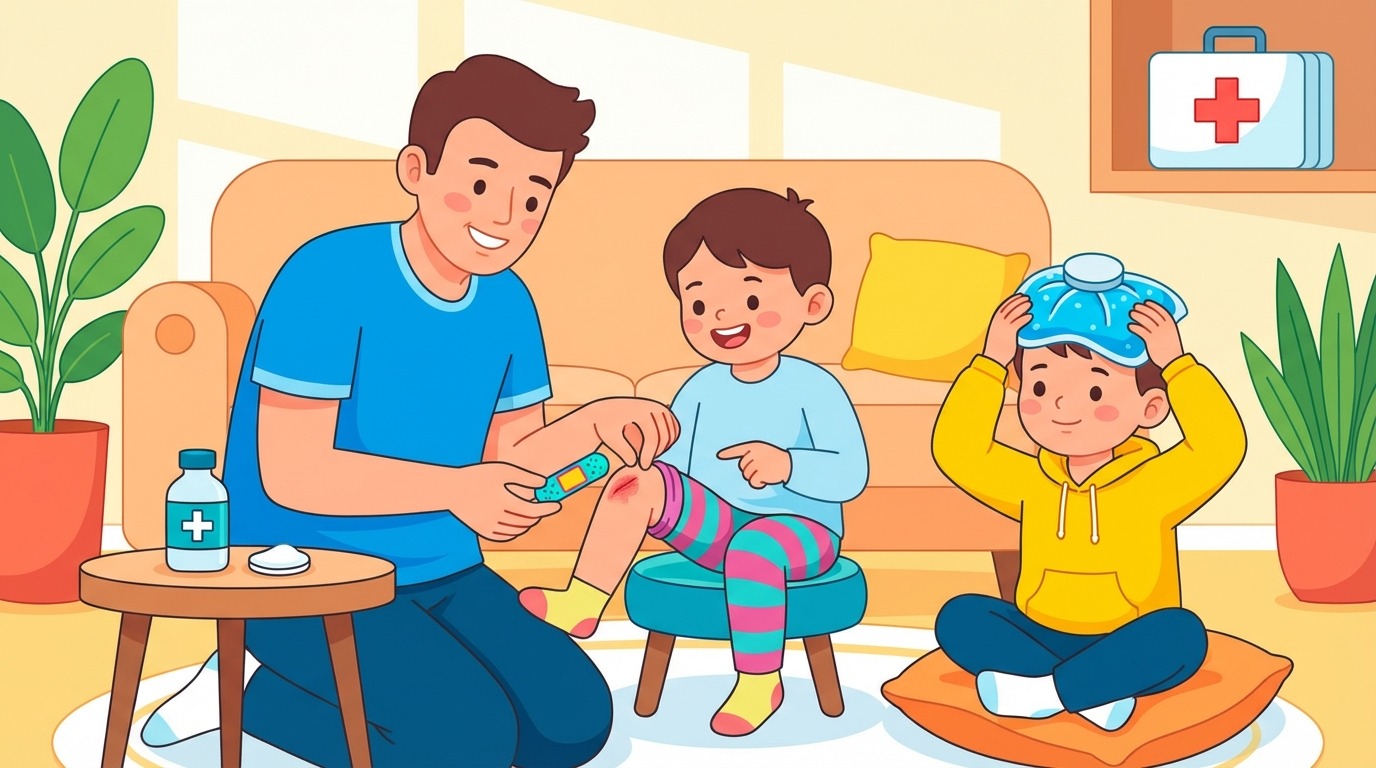
First Aid Injuries: First aid for common children’s injuries.
When a child gets injured, time seems to stand still, but every second counts. First aid gestures are simple, concrete, and reassuring, provided you know where to start. Disinfecting a small wound, cooling a burn, stopping bleeding, or deciding to go to the emergency room relies on a clear logic: observe, act, secure. This article offers a structured and practical approach, enriched with everyday examples, for the most common children’s injuries. The steps are described step by step, with easy-to-remember decision markers to increase confidence and reduce stress.
Families appreciate a method that combines efficiency and gentleness. Because every toddler reacts differently, injury assessment always takes precedence before action. Then, emergency care follows in a few steps. The prevention links provided complement the approach: securing the home, choosing appropriate activities, setting clear play rules. This guide aims to be resolutely operational, with checklists, precise time markers, and unambiguous medical referral criteria. The goal is simple: to transform “What to do now?” into “Here’s what we do immediately.”
| Short on time? Here’s the essentials ⏱️ |
|---|
| Stop the bleeding by pressing 5–10 min with a clean compress 🩹 |
| Rinse wounds with cold water, then cover to avoid impurities 🚿 |
| Cool a burn with lukewarm water 20 min, never ice ❄️🚫 |
| Choking: 5 back blows + 5 thrusts (depending on age) 🆘 |
| Traumas: wrapped ice, elevate, monitor pain 💪 |
| Consult if bleeding persists, deep wound, signs of infection 📞 |
| Ready kit: gloves, compresses, dressings, saline solution, bandage 🧰 |
Cuts and scrapes in children: stress-free first aid
Superficial wounds dominate everyday bumps: scraped knees, small cuts on fingers, scratches on elbows. Above all, staying calm helps the child regulate. Yet, one must act quickly and well. The injury assessment begins with three questions: Where is it bleeding? How deep? Is a foreign object visible?
As soon as bleeding appears, applying firm pressure with a clean compress or cloth makes a difference. Holding for 5 to 10 minutes without releasing avoids breaking the clot. During this time, observe the child: paleness, dizziness, sharp pain. These signs guide what comes next. A dressing does not replace a good initial hemostasis.
Once the bleeding is stopped, rinsing with cold water is often enough. Mild soap may help around the wound, never inside. Avoid alcohol, concentrated hydrogen peroxide, and drying powders, which irritate. The key gesture: dab from the center outward with a sterile compress. This routine limits infections.
Protection follows. A layer of mild antiseptic can be applied. Then, a dressing suited to the area’s movement protects against rubbing. Hydrocolloid dressings also help heal small scrapes. Changing the dressing daily maintains hygiene, especially if the child sweats.
What to watch for during healing? Spreading redness, local warmth, purulent discharge, or fever suggest infection. In such cases, consulting is a priority. A tetanus vaccination booster should be up to date if the wound is dirty or caused by a rusty object. This check avoids many worries.
When to seek medical help? Here are useful markers: bleeding that persists despite 10 minutes of pressure, very gaping wound edges, visibility of fat, muscle or bone, location on the face or genital organs. Lacerations by blade or bite also require medical evaluation. Precision is better than waiting.
In real life, an example speaks louder than a thousand theories. During recess, Hugo falls and scrapes his knee. We rinse, check for absence of gravel, dry by dabbing, apply a hydrocolloid dressing. In the evening, we check mobility and pain. With this protocol, he goes back to play confidently. The message is clear: simple and constant action protects.
To soothe along the way, verbalizing each step reassures. Explaining what is happening, showing the dressing, inviting the child to help strengthens engagement. Self-regulation returns faster when the child feels involved. In the end, first aid here rhymes with clarity, gentleness, and controlled hygiene.
- 🩹 Key steps: pressure → rinsing → protection → monitoring
- 🧠 Remember: avoid alcohol and drying powders on wounds
- 📞 Emergency if deep wound, gaping edges, or persistent bleeding

Burns in children: emergency care and mistakes to avoid
An overflowing pot, an overheated radiator, a spilled bowl of soup: burns happen in a flash. The vital reflex boils down to four words: lukewarm water, 20 minutes. Cooling reduces depth of injury, quickly relieves pain, and decreases risk of scars. Water should flow gently over the area, not directly on the lesion.
Why lukewarm water and not ice? Ice causes excessive vasoconstriction, worsens pain, and damages tissue. Lukewarm water maintains a skin temperature compatible with healing. This technical nuance changes the prognosis. It applies to everyday thermal burns, especially in toddlers.
Never tear off clothing stuck to the skin. First cool with the fabric, then try to remove it without pulling. Quickly removing soaked layers prevents ongoing cooking. If blisters appear, do not pierce them. They form a natural barrier. Then cover with a non-adhesive compress to prevent friction.
How to classify severity? An area larger than the child’s palm, involvement of the face, hands, feet, or perineum mandates a consultation. Increasing pain, multiple blisters, or a pale numb area also require medical advice. Better to over-triage than delay.
Chemical burns require prolonged rinsing, often beyond 20 minutes. Removing contaminated clothes with gloves protects the caregiver. Even small electrical burns justify evaluation as internal injuries may exist. Heightened vigilance is necessary after any contact with electricity.
Once the acute phase passes, pain management is key. An age-appropriate painkiller may be given as recommended by a doctor or pharmacist. Protecting from the sun during healing remains a golden rule. Children’s skin pigments are fragile and mark easily.
Daily prevention relies on simple decisions: pot handles turned inward, hot drinks out of reach, appliance cords tucked behind counters. Visual “hot” markers in the kitchen also help older children understand risks. Anticipation becomes a discreet ally.
Finally, verbalizing the event without dramatizing calms the child. Describing what happened, reassuring about the body’s natural repair, and showing care restores control. Emotional education reduces future avoidance behaviors. Once again, simplicity and consistency win the day.
Sprains, bruises and traumas: injury assessment without mistakes
Falls from scooters, awkward landings in sports, or slips at the playground often lead to bruises, sprains, or minor bumps. However, sorting properly from the start prevents underestimating fractures. Injury assessment relies on four markers: localized pain, deformity, functional impairment, very painful bone spot.
In case of a closed trauma, adopting the reassuring PEACE & LOVE sequence is relevant. First, Protection and Relative Rest. Then, Wrapped Ice for 10 to 15 minutes, several times a day. Next, gentle Compression with a bandage and Elevation of the limb if possible. Finally, encourage gentle movement when pain permits.
Why must ice be wrapped? Direct contact irritates the skin and risks a cold burn. A thin cloth suffices to secure the gesture. This precaution reduces swelling and quickly relieves. Resuming intense activities too soon intensifies inflammation; hence the argument for gradual resumption.
When to suspect a fracture? Visible deformity, an initial crack, sharp pain on a precise bone point, or inability to bear weight should alert. In such cases, immobilize in found position and consult. Do not force repositioning. Radiological diagnosis precision will adjust treatment.
Mild head traumas remain common. After a blow to the head, monitor for 24 hours: headaches, repeated vomiting, unusual drowsiness, balance problems. Gently wake the child every 3 hours the first night to check responsiveness. At the slightest abnormal neurological sign, urgent consultation is necessary.
Nosebleeds look alarming but are well managed. Have the child sit, tilt the head slightly forward, and pinch nostrils for 10 minutes at the wings of the nose. Do not insert cotton or tilt the head back. After bleeding stops, avoid blowing the nose for a few hours. This simple routine reassures the whole family.
For sports activities, choosing the right level greatly reduces injuries. A program aligned with age and motor development reduces joint stress. This marker is as important as a proper warm-up. Practical resources exist to better guide by age and activity.
Ultimately, consistency and good sense win. Pain that lessens within 48 hours reassures. Stable or increasing pain calls for advice. Following these concrete markers, emergency care stays controlled and effective, without excess or delay.
Choking and bleeding: life-saving gestures in under a minute
Choking requires immediate and precise action. For infants under one year, the protocol differs from older children. Recognizing severity signs is paramount: ineffective cough, silent breathing, bluish lips, inability to cry. Here, coordination of gestures is practiced calmly and quickly.
For a baby, place the body face down on the forearm, head lower than the trunk, supported by the hand. Give 5 firm back blows between the shoulder blades. Then turn the baby onto the back, still inclined, and perform 5 chest thrusts with two fingers in the middle of the sternum. Check the mouth; remove only what is visible along the cheek.
For a child over one year, stand behind them, lean them forward, then deliver 5 back blows. If ineffective, perform 5 abdominal thrusts in a “J” shape just below the sternum, fist clenched and grasped by the other hand. Alternate 5 and 5 until an effective cough returns or the object is expelled. If the child becomes unconscious, call for help and start resuscitation as trained.
Common mistakes to avoid are known: never blindly try to grab deep in the throat, do not shake the child, do not give fluids during obstruction. The logic remains the same: mechanically free the airway and monitor breathing resumption.
Another emergency, severe bleeding tolerates no delay. Apply firm direct pressure with a clean compress or cloth, maintain without easing. Add compresses if blood seeps through, without removing the first. Elevate the limb if comfortable, but do not waste time if difficult.
If pressure alone is not enough, continue manual compression and call emergency services. A tourniquet may be considered by a trained person in case of major limb bleeding. In all cases, priority remains continuous pressure and protecting the victim against cold and stress.
After bleeding stops, cover the wound and monitor general condition: skin color, consciousness level, marked thirst. These signs reflect tolerance to blood loss. Documenting time and actions helps rescuers upon arrival. This rigor saves time and complications.
For every household, an annual review of domestic emergencies makes sense. Repeating back blows on a mannequin, reviewing compression steps, checking the first aid kit location. This ritual installs automatic responses. When the day comes, hands know what to do.
Active prevention, family kit, and first aid training
The best response to injury is often prevention. Organizing the home, choosing suitable equipment, and teaching play rules significantly reduce risks. The goal is not to prevent exploration but to frame it intelligently. Concrete markers change everything daily.
Inside the home, securing hot spots and fall zones is a priority. Lock knife drawers, store cleaning products out of reach, install stair gates—this already helps a lot. Practical resources gather simple and efficient advice to structure a safe and evolving environment.
Outside, setting clear playground rules reduces collisions and falls. Choosing shock-absorbing surfaces, checking structure solidity, and teaching children to wait their turn also help. Small habits create a reassuring framework. They allow freedom without sacrificing safety.
On the road, a properly chosen and installed car seat is non-negotiable. Adjusting the harness, checking the angle, upgrading according to size changes the prognosis in case of impact. Parents benefit from reviewing these points before every long trip. A checklist stuck in the car is helpful.
Sports activities must respect age, bone growth, and coordination. Too demanding a sport too early increases risk of sprains and tendon fatigue. Conversely, a progressive program builds solid supports and protective muscles. The joy of movement follows safety.
The family first aid kit must be visible, complete, and checked twice a year. The idea is not to have everything but to have the essentials well thought out. A compact “outdoor” version accompanies outings. Themed pocket organization facilitates handling under stress.
Training adults and teens in life-saving gestures embeds reliable reflexes. Short sessions, in person or online, increasingly accessible in 2026, teach pediatric resuscitation, choking management, and bleeding control. Families gain valuable team coherence.
To illustrate, think of Lina and Adam. After a weekend workshop, they reorganized the kitchen, checked the car seat, and assembled a modular kit. The following month, a scrape at the park was managed calmly in 3 steps. This scene tells it all: preparation turns panic into useful actions.
- 🧰 Home kit: gloves, sterile compresses, dressings, bandages, saline solution
- 🧴 Mild antiseptic, round-tip scissors, splinter tweezers, survival blanket
- ❄️ Instant cold pack, triangular sling, comforting sweet solution
- 📱 Emergency numbers displayed, allergy/medication info, headlamp
To go further and equip the family daily, explore useful resources like these children safety tips and these clear and actionable playground rules. For trips, learning to properly choose a car seat protects at all distances. Finally, aligning activities by age benefits from concrete markers: consult these activity ideas by age to enhance safe movement. To embed good routines, some daily gestures smooth family life.
“The right reflex, at the right time, with the right words: this is how small bumps stay small.”
How to recognize if a wound requires stitches?
If the edges are gaping, if fat or muscle are visible, if the wound exceeds 2 cm, or if bleeding resumes as soon as pressure is released after 10 minutes, medical evaluation is necessary. Location on the face or near an eye also warrants prompt advice.
How long should a dressing be kept on a scrape?
Cover the first day, then change every 24 hours or as soon as it is wet/dirty. Keep the protection as long as the scab is not solid and the environment risks dirtying the wound. Regular hygiene accelerates healing.
What to do if my child starts vomiting after a head injury?
Watch closely. Repeated vomiting, unusual drowsiness, severe headaches or confusion justify emergency consultation. Gently wake the child every 3 hours the first night to check responsiveness.
Can a tourniquet be used on a child?
Only in case of severe bleeding of a limb and if you are trained. The priority remains firm direct pressure with compresses. If in doubt, maintain pressure and call emergency services.