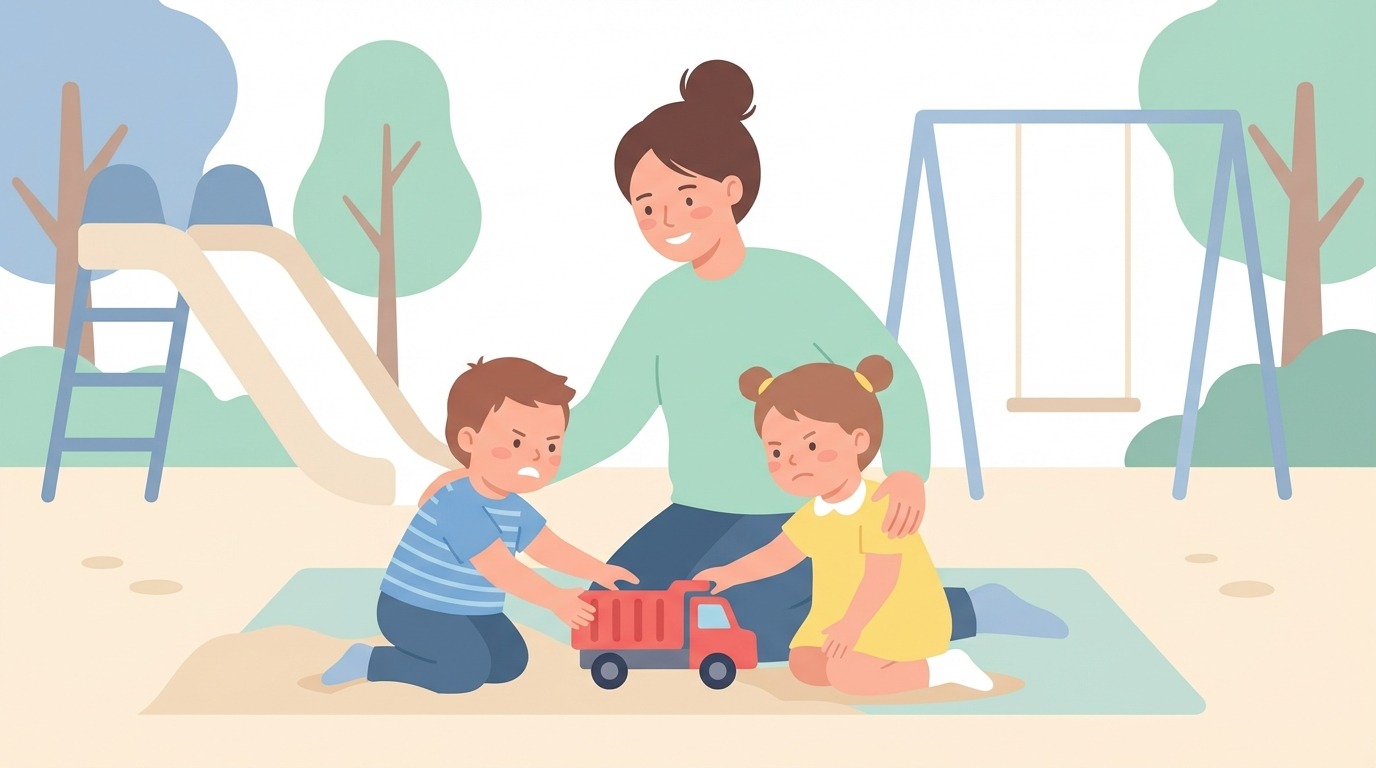
Intervene Children Others: How to intervene with other people’s children (1-3 years).
| Short on time? Here’s the essentials ✨ |
|---|
| ✅ Prioritize safety and dignity of everyone above all. |
| ⏳ Let parents act first, then intervene with kindness. |
| 🧎♀️ Get down to the child’s level, speak with clear communication and active listening. |
| 📜 Name the rule, offer an alternative, then invite to make amends. |
| 🤝 Protect the relationship with the parents through factual and respectful feedback. |
| 🎯 Adapt the intervention according to age: from 1 year to 3 years, needs differ. |
| 🧰 Anticipate: duplicate objects, sharing scenarios, soothing rituals. |
Between 1 and 3 years, children explore without filter, test boundaries, and learn group living. Third-party adults — relatives, friends, neighbors, professionals — are often witnesses to strong impulses: a shove, a toy snatched, a bite, a scream. Should one intervene, how, and how far? The question seems simple. Yet it calls upon precise principles of safety, communication, and support tailored to early childhood. Here, every gesture counts: tone, posture, order of actions.
Because trust among adults is as precious as the regained calm of toddlers, a successful intervention preserves the relationship. It reassures the child and comforts the parents. From a neighborhood park to a family gathering, the same reference points apply. Lina’s story, 2 and a half years old, and Noé, at 3 years, serves as a guiding thread: thanks to short sentences, attentive listening, and clear limits, their conflicts turn into learning opportunities. The following sections detail, step by step, what works and why. Concrete tools, realistic examples, and a clear framework, without judging anyone, but with an energy decidedly focused on solutions.
When and why to intervene with a child who is not yours (1-3 years)
Before acting, it is important to observe. Three questions guide the decision: is there a risk to immediate safety, persistent disrespect, or obvious distress? Depending on the answer, the intervention varies, from simple mediation to an immediate stop of the action. At this age, quick reactions are frequent. They often express an overwhelming emotion rather than an intention to harm.
Let the parents take the lead first. When present, a few seconds are enough for them to take over. However, if no one acts and a child’s integrity is threatened, intervention becomes necessary. Doing so without judgment protects the adult-to-adult relationship and avoids misunderstandings that tire everyone.
Assess in three steps: safety, respect, repair
First step: secure. Block the hitting hand, separate bodies, and create distance from the dangerous object. Second step: briefly recall the rule in a communication that is short. For example: “Here, we do not hit. I see you’re angry.” Third step: offer a repair. Return the toy, offer a symbolic caress, or help tidy up. This triptych establishes a framework that is both firm and gentle.
At the park, Lina snatches Noé’s shovel. Rather than scolding, the adult gets down to their level, calmly places a hand on the object, and says: “I hear you want it. We wait our turn. I’ll lend you this bucket.” The conflict often eases thanks to this simple and concrete redirection.
Consider developmental needs
From 18 months to 3 years, sharing remains a learning process. The child protects access to resources. Faced with typical crises, detours through understanding help a lot. These moments, often called “the terrible twos”, are not tantrums. They reflect neurological immaturity. To go further, the article dedicated to the terrible twos details useful reference points.
It is possible to anticipate by offering duplicates, timed turns, and games that tolerate emotional intensity. The goal remains progressive support toward self-regulation, without crushing the impulse to explore.
Remain a supporting third party, without judging
A remark that humiliates breaks trust. The third-party adult benefits from naming the behavior, never the child. “That action hurts” is better than “You are mean.” This word choice builds relational safety and meets the needs of early childhood.
Parents often feel observed. Factual reformulation, without “always” or “never,” lowers tension. Thus, the adult-child pair leaves with a strategy, not blame. This is the heart of a fair intervention.
In short, acting early to prevent injury, then speaking little but well, lays the groundwork for lasting support. It’s a solid compass for daily situations.
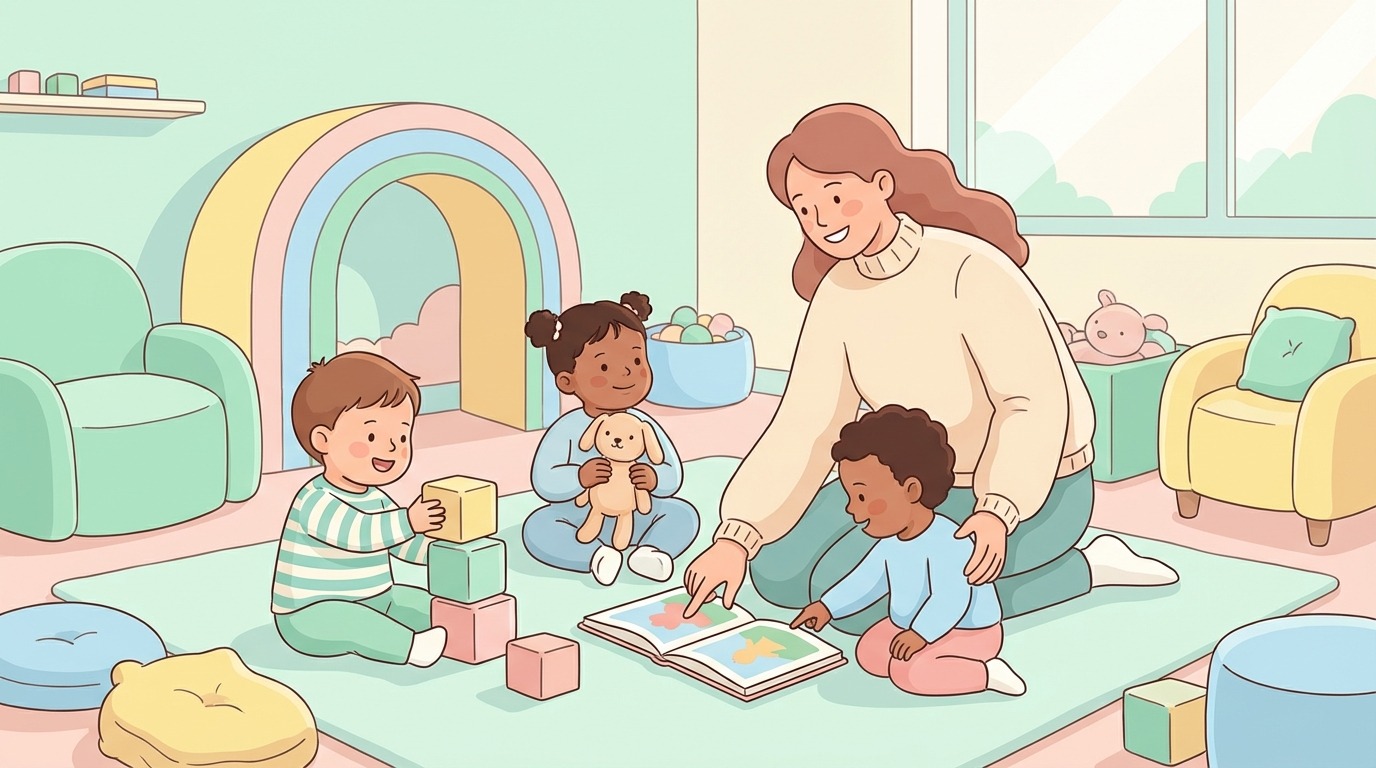
Kind and effective interventions: posture, words, and rituals that soothe
A successful intervention begins with the body. Squat down, turn your torso toward the child, keep hands visible and calm. The face must remain expressive, never threatening. This nonverbal consistency reassures and opens the way to communication.
Words come next. Short, concrete, firm. They describe the scene, set a rule, propose an alternative. Listening follows, to capture the emotion behind the action. Thus, the adult guides without crushing, and the child feels seen and contained.
Three phrases that structure the moment
- 🧭 “Stop, I’m stopping the hand. Safety first.”
- 🗣️ “Here, we don’t push. You can say ‘it’s my turn after.’”
- 🔄 “We repair: you give back, then we find a toy for you.”
These statements anchor a simple logic: containment, rule, repair. They become landmarks, even in noisy contexts. The child gains clarity and the ability to wait.
List of concrete everyday tools
- 🧸 Duplicate strategic toys to limit friction.
- ⏱️ Visual sand timer for “my turn/your turn”.
- 🎯 Non-punitive “calm corner,” with cushion and book.
- 👐 Soothing gestures: “candle” and “flower” breathing.
- 🎵 End-of-play ritual song to ease transitions.
Some children need motor outlets. Supervised rough-and-tumble play can channel energy and support the connection. For inspiration, this article on adapted rough-and-tumble games offers safe and fun ideas.
Correspondence table: from behavior to alternative
| Behavior 🚩 | Proposed Alternative 🌱 | Repair 🤝 |
|---|---|---|
| Nibbles a friend | Teething ring to bite | Say “ouch”, blow on hand, apologize |
| Snatches a toy | “My turn/your turn” with timer | Return the object, offer another toy |
| Pushes to pass | Ask “may I pass?” + wait for “yes” | Help the other get up, check if okay |
Rituals, simple words, and concrete alternatives: this trio builds trust. And trust is the fuel for social learning.
Common conflicts at 3 years: shoving, biting, and sharing first and foremost
Why so much intensity? Because the social and emotional brain is developing. At 2 years, impulse speaks fast. At 3 years, language progresses and already supports regulation. Between the two, the grey area requires a clear, quick, and gentle adult.
Biting causes much concern. Yet, it often stems from teething pain, sensory curiosity, or sudden anger. We stop immediately, offer something “approved” to bite, then repair. The message remains the same: “I help you do it differently.”
3-step protocol for conflicts
- 🛟 Secure: separate, breathe, put the object at a distance.
- 📣 Name the rule: “We do not hurt,” then translate the emotion.
- 🔧 Repair: give back, check on the other, then redirect play.
This protocol takes thirty seconds. It frames the moment without a long speech. The attention of early childhood is short, so use it well.
Explosive “no’s” are part of a normative phase. Some spectacular tantrums resemble episodes described in the terrible twos references. In these moments, speaking less and breathing with the child works well. The adult becomes a beacon.
Transforming conflict into learning
A child can learn to ask for a turn, set a limit, refuse without hitting. The adult models these social skills. Formulate on their behalf, then invite repetition, anchoring the new script. It is a guided communication that increases autonomy.
When energy overflows, supervised motor games channel and repair the relationship. Ritualized pillow fights, floor courses, or “stop/go” races turn tension into laughter. Overflow becomes learning.
Conflicts are not failures. They are training grounds. With consistency, they become rare, and children gain social flexibility.
Cooperating with parents without offending: tact, common framework, and useful feedback
Intervening with other people’s children always involves two fields: the child and the accompanying adult. Preserving the relationship between adults is strategic. Without it, the framework breaks and the child loses their bearings.
Before a meeting, it is relevant to align basic rules: “Do not hurt,” “Wait your turn,” “Tidy up together.” Saying them aloud establishes a clear contract. Listening to the other family’s habits avoids unnecessary friction.
During the incident: fact, rule, openness
During the action, the third-party adult stays factual. “I saw the shovel being snatched.” Then the rule, short. Finally, an opening: “I’ll let you take back if you want.” This format respects everyone. It protects cooperation, without implicit hierarchy.
Afterwards, 20 seconds of feedback suffice. “I separated them, they returned the toy, everything is calm.” Lack of judgment restores trust and focuses the exchange on the solution.
Protocols and intervention plans in groups
In nursery, daycare, or with a childminder, intervention plans standardize responses. They include redirection strategies, visual tools, and aggression management scenarios. This framework, designed for safety and coherence, supports adults and reassures families.
Sometimes, a transversal issue arises: delayed speech or difficult sounds. Practical resources on articulation and clarity of exchanges can support daily communication. On this subject, a spotlight on when a child mispronounces words can help adapt expectations and instructions.
Message framework to maintain connection
- 🧩 “Here’s what I saw…” (a precise fact)
- 🪧 “Here’s the rule…” (a simple principle)
- 🛠️ “Here’s what I did…” (separate, redirect, repair)
- 🌿 “Here’s what helped…” (timer, duplicate, keyword)
- 🔁 “What do we say for next time?” (co-construction)
When everyone knows what to do, the child feels the solidity of the framework. And a solid framework frees play.
Supporting socialization at 3 years: games, rhythms, and supportive environments
Socialization is not a checkbox. It’s a journey. We start with parallel play, then move towards cooperation. Adults pave the way with predictable routines and subtle invitations.
Invite just one friend at home, plan a two-player game, and limit the duration. This gradual approach helps shy children, as well as those overwhelmed by noise. To explore more, an overview of children’s social development highlights key milestones.
Case studies: Lina and Noé
Lina, 2 and a half, refuses to share. In two weeks with timer, duplicates, and the phrase “after me, you,” conflicts drop. Noé, at 3, speaks up but interrupts others. A ritual “hand on heart, I listen” + a visual talking stick smooths turns. Simple, well-placed tools change the dynamic.
Sometimes, fatigue or health play a role. A dehydrated child cries more, gets frustrated faster. In heat or during a stomach bug, these hydration prevention tips help stabilize mood and attention.
Ambiences that help: materials, light, transitions
Few visible objects, defined corners, and a rug on the floor to delimit the action. Soft light and a transition song prepare the social brain to change state. Moving from one game to another becomes clear, and bumps decrease.
Finally, celebrating micro-successes consolidates momentum. A wink, a “you waited your turn!” is worth a thousand theoretical lessons. Shared joy is a powerful accelerator of social learning.
Socialization is the art of daring to approach without losing oneself. With clear landmarks, this path becomes an exciting adventure.
“In early childhood, every successful intervention combines listening, communication, kindness, and safety — the rest is the magic of a relationship that grows.” ✨
What to do if parents get angry after my intervention?
Stay calm, describe the facts without judgment, recall the common rule, and suggest validating a response together for next time. A short “fact-rule-solution” message protects the relationship and prevents escalation.
Can you punish another’s child?
No. Setting the limit and proposing a repair is enough. Sanctions belong to the parents. Your role: secure, remind the rule, redirect the play, and preserve the adult-to-adult relationship.
How to react to a bite with a visible mark?
Separate, clean if necessary, comfort, and immediately inform the parent. Tell the biting child: “We do not hurt. You can bite the ring.” Then offer an appropriate repair and a calm time.
What if the child does not speak yet?
Use gestures, images, and very simple words. Model the sentence to say, then invite imitation. Visual aids and routine help comprehension and calming.
When to worry about persistent social isolation?
If the child consistently avoids contact, is very anxious in groups, or regresses over several weeks, discuss with the parents then a professional to adapt the support.