rules from the four corners of the world for a fulfilling and serene postpartum
In Brief
- The postpartum period can be thought of as a time framed by traditional rules: rest, warmth, simple food, and organized maternal support.
- In an interview given to Newsweek and published on March 30, 2023, Chantal Wijbrandi, a mother living in the Netherlands, describes 11 rules inspired by rituals from around the world for her post-birth recovery.
- Known cultural practices, such as the Chinese “month of rest” or the cuarentena in Latin America, often structure 30 to 40 days of postnatal care centered on the mother.
- Three themes recur in many frameworks: limiting outings, favoring warm meals, and providing postpartum body care (massage, warmth, rest).
- The point that changes daily life: turning help into concrete instructions (meals, presence, light housekeeping) instead of “tell me if you need.”
Forty days without running everywhere, two weeks mostly in bed, warm meals arriving like magic, and relatives who are helpful rather than noisy: the idea raises some eyebrows… and lowers some shoulders. Postpartum, in many societies, is not a period where the mother “bounces back quickly”; it is a time framed by specific postnatal care, often passed down as traditional rules. The goal is not mysterious: to reduce fatigue, support breastfeeding when it exists, limit mental load, and give the body a true recovery window after birth.
In Western countries, the implicit norm sometimes remains immediate autonomy: baby settled, suitcase packed away, and return to “productive” mode with a polite smile. Except that between healing, hormonal drop, fragmented sleep, and visits that “last five minutes” over three hours, serene motherhood often depends on very concrete details. Looking at what is done elsewhere is not for copy-pasting a culture, but to pick rituals from around the world that put the mother back at the center, without guilt and without forced folklore.
Traditional Rest Rules: slow down to support postpartum recovery
Rest is the most widespread basis in postpartum cultural practices, even when forms vary. The idea is not to lock a mother in a decorative bubble, but to reduce physical constraints while the body manages healing, uterine involution, and overall adaptation. In the story reported by Newsweek, Chantal Wijbrandi explains having chosen to stay mainly in bed for two weeks, then avoid leaving her home for 40 days. These highly framed choices recall logics present in several regions: withdrawal period, limiting long visits, and priority given to sleep as soon as possible.
Concretely, “staying in bed” does not mean total immobility. It can translate into an organization in circles: a “bed-sofa” perimeter for the first days, then a progressive extension to the entire home. The goal is to reduce stairs, lifting loads, and repetitive tasks. In many households, the difficulty is not theory but logistics: who manages the older child, who handles meals, who answers the delivery person, who runs the washing machine. Without a plan, rest becomes a decorative injunction imposed on a reality that is running fast.
The 14-day model: a recovery gateway, not a nap contest
Two weeks focused on rest form a useful gateway, especially after a birth with stitches, tearing, or cesarean. Pain, milk coming in, postpartum constipation, and fatigue easily accumulate. Rest also helps limit wandering: getting up twenty times to “do as before” often ends in a feeling of failure, while the body simply asks for a different tempo. A simple guideline is to plan, over this period, activities “seated or lying down”: feeding, skin-to-skin, hydration, quick shower, gentle stretching validated by a professional if necessary.
To make this model realistic, a pragmatic rule is to prepare stations. A “care” station near the bed (water, snacks, diapers, wipes, charger) avoids back-and-forths. A “calm” station in the living room (cushion, blanket, soft light) allows fresh air without turning the day into a hike. Rest then becomes a strategy, not a wishful thinking.
The 40 days: limit outings to reduce social pressure
Avoiding leaving the home for 40 days, as in the cuarentena, does not mean cutting all ties. The principle is rather to reduce daily friction: trips, schedules, weather, multiple contacts. In the first weeks, the slightest outing can trigger a cascade: baby to change, unexpected feeding, crying, checkout line, and return with the feeling of running a marathon. This framework can be adapted: a short walk outside, a medical appointment, a visit to the garden. The rule then becomes “no social obligations” rather than “no sun.”
An often underestimated point is emotional recovery. Quick outings also expose to constant comments: “does he sleep at night?”, “you look well” (which means the opposite), “enjoy.” Limiting social exposure, at first, reduces these micro-stresses that chip away energy. Rest here acts as a noise-barrier.
Ultimately, these traditional slowing-down rules offer a concrete framework: fewer decisions to make, less justification to give, and more availability to recover and create sustainable routines.
Postnatal care through nutrition: warm, simple, and regular meals for well-being after birth
In many rituals around the world, postpartum nutrition has a functional role: warming, hydrating, providing quickly available energy, supporting digestion, and limiting fatigue peaks. In the testimony relayed by Newsweek, one of Chantal Wijbrandi’s choices is to favor warm and cooked meals. This may seem trivial, but it is a major difference with the combo “standing toast + lukewarm coffee forgotten on a shelf” which circulates in some households as an unofficial tradition.
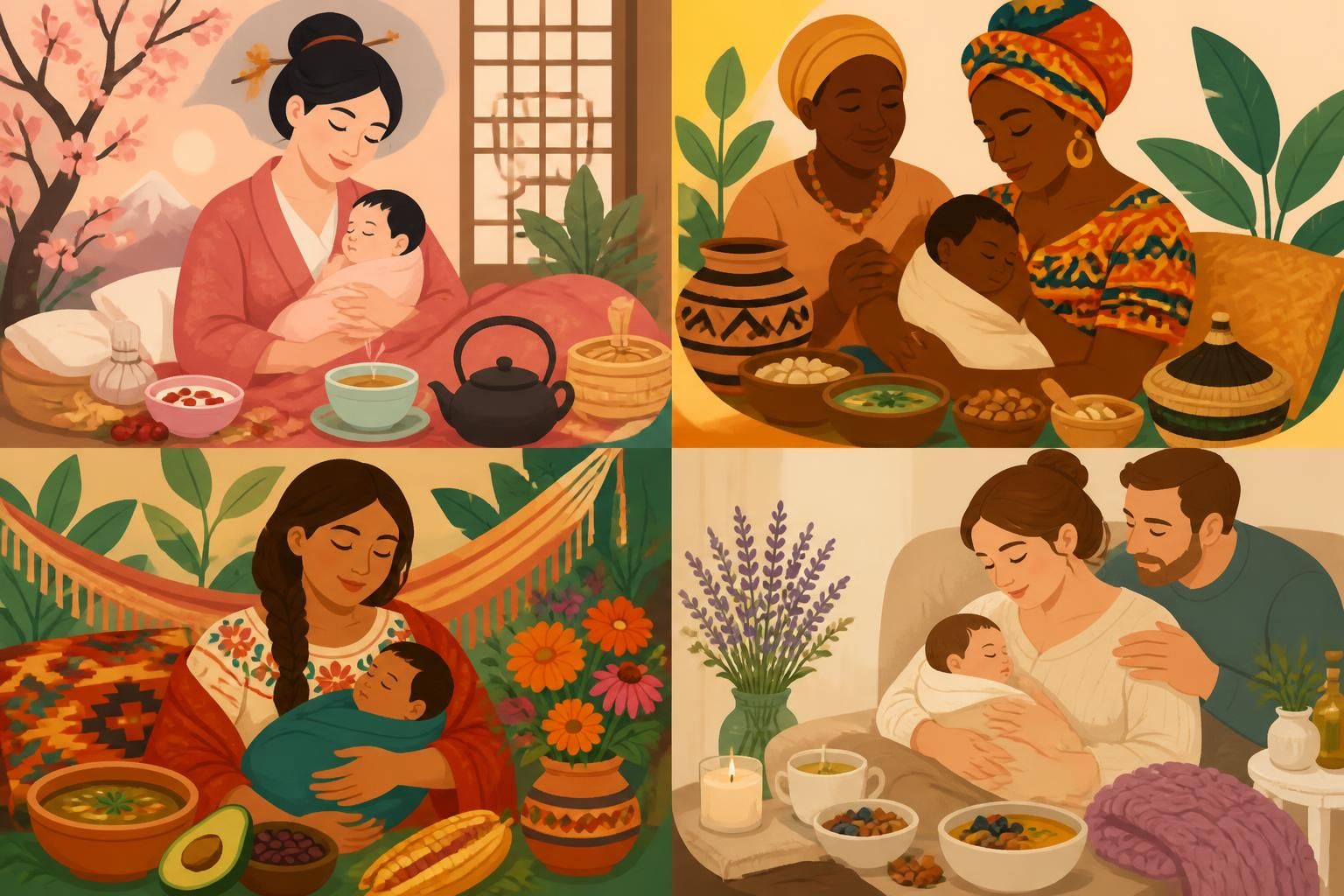
Traditional rules around food vary by region: broths, porridges, stewed dishes, “warming” spices or on the contrary very mild cuisines. The interest, for a reader in France or Belgium, is to extract the logic: keep it simple, warm, frequent, and low in preparation demands. The challenge is not to achieve culinary performance, but to avoid the trap of sugary snacking for lack of better, which gives a boost then a crash, just when the baby decides to be a living alarm clock.
Why “warm” recurs so much in cultural practices
Warmth is first a comfort tool. After birth, chills, night sweats, and feelings of vulnerability are frequent. Soup, a stewed dish, or a hot drink can help feel better effortlessly. There is also a practical dimension: a large pot feeds several times, reheats quickly, and can be shared with the rest of the household. In postpartum, food “that reheats” is often worth more than a dish “that impresses.”
Digestion is another key point. Some people describe disturbed transit after birth, sometimes worsened by fear of pain in case of stitches. Meals rich in easy fibers, hydrating, with quality fats, can help. In practice, these are often basic gestures: cooked vegetables, well-tolerated legumes, rice, potatoes, eggs, fish, yogurts, stewed fruits. Nothing exotic, just a cuisine that does not require negotiation with the stomach.
Set up a “meal” logistics: clear instructions to relatives
Chantal’s testimony emphasizes a social point: learning to ask for help concretely. She explains having told her relatives: no toys, but food, company, or a contribution to a postpartum fund. In real life, a motivated relative especially needs a clear mission. “Bring a dish that reheats in 5 minutes” produces a result. “We’ll see” often produces a bouquet of flowers and a two-hour conversation, which is lovely but not always restful.
A simple list to share can avoid misunderstandings. It also helps not to repeat the same thing twenty times when fatigue rises. Here is a realistic list, compatible with varied tastes and a classic family organization:
- Two large family-sized dishes (gratin, mild dhal, lasagna) portionable into 6 to 8 servings.
- A broth or thick soup for 4 meals, easy to swallow even with one hand.
- Ready breakfasts: milk porridge, compotes, yogurts, sliced wholemeal bread.
- Nourishing snacks: fruit, nuts, cheese, hummus, hard-boiled eggs.
- A round of drinks: water, herbal teas, broths, to limit dehydration.
This food framework directly supports well-being after birth: less mental load, more stable energy, and a feeling of security. And yes, eating warm can become a very concrete luxury when time is measured in sleep cycles.
Postpartum cooking demonstrations mainly help to see formats of dishes that reheat well, freeze well, and require little dishwashing. The value is in the organization, not in gastronomy.
Maternal support and family organization: turn help into a system (and not a visit)
Maternal support is the most universal element… and the most misunderstood. In many cultural practices, relatives do not come to “meet the baby”; they come to keep the household running. Chantal Wijbrandi’s account highlights this shift: asking for help, but asking operationally. In a Western postpartum, visits can become endurance sports: tidy up beforehand, offer drinks, answer questions, and end wondering where the day went. The idea is not to ban relatives, but to set boundaries.
A simple system is to distinguish three circles: people who really help (meals, light cleaning, managing older children), those who bring connection without exhausting (calm presence, listening, short visit), and those who are sincerely well-intentioned but energy-draining. Postpartum is not the time to do emotional pedagogy with everyone.
The “five-minute visit” scenario: set rules that protect
Setting limits avoids unnecessary tensions. A concrete rule can be: visits by appointment, maximum duration of one hour, no expectation of service. A relative who wants to “just see the baby” can leave with a task like taking out the trash or folding laundry. It’s not a punishment, it’s a way to make the meeting compatible with postpartum recovery.
The question of gifts is a comical ground because it is often absurd. Many families end up with a mountain of cute objects and an empty fridge. The instruction “no toys, bring food” is blunt but effective. A socially softer alternative is a shared list: dishes, delivery gift cards, babysitting hours for the older child, contribution to occasional cleaning service. The result is measurable: time gained.
The role of partners and co-parents: prioritize protecting the mother
In rituals from around the world, the mother is often considered the person to protect physically and mentally. In a contemporary household, this translates into a clear distribution of tasks. Nights can be shared differently depending on breastfeeding, but the day must avoid the trap of “everything on the mother.” Preparing time slots where the co-parent fully manages the baby (walk, skin-to-skin, changing, carrying) allows the mother to sleep without staying on alert.
There is also a logistical issue: managing paperwork, answering messages, filtering solicitations. The postpartum mother can quickly become a receptionist of her own convalescence. Outsourcing this load to the co-parent or a trusted person reduces cognitive fatigue, often invisible but very costly.
Comparison table: concrete rules and expected effects
To get out of vague notions, a table helps link a traditional rule to a practical impact. The durations indicated are common benchmarks in postpartum rituals and in the cited testimony, to be adapted to the medical context of each family.
| Practical rule | Typical duration | Measurable daily indicator | Effect aimed at recovery |
|---|---|---|---|
| Mostly bed rest | 14 days | Number of stairs and heavy loads close to 0 | Less pain, reduced fatigue |
| Limit non-medical outings | 40 days | Social appointments reduced to 0 or 1 per week | Less stress, preserved energy |
| Ready warm meals | 30 to 40 days | 2 warm meals per day | More stable energy, digestive comfort |
| Presence of a helper (relative, co-parent) | 2 to 6 weeks | 1 daily slot of 60 to 120 minutes of full relief | Restorative sleep, decreased mental load |
This type of organization brings maternal support to the level of a schedule, not an intention. Postpartum becomes more predictable, therefore more breathable.
Feedback and organizational methods (visit schedules, relief, meal management) allow visualizing how to turn help into concrete actions without ending up hosting a permanent social event.
Postpartum body care and world rituals: framed massage, warmth and touch
In many countries, postpartum body care is part of postnatal care just like nutrition and rest. Massages, heat applications, baths, wraps: modalities differ, but the logic is coherent. The body has just gone through an intense event, and framed touch can help release tension, improve comfort, and offer mental recovery time. In the rules followed by Chantal Wijbrandi, receiving regular massages is part of the chosen practices, with the idea of supporting relaxation and postpartum recovery.
Postpartum massage is not a “spa” service posted on Instagram. It is a care that must remain compatible with health status: scars, pain, engorgement, possible diastasis. It can be carried out by a trained professional or a relative, provided it remains gentle and avoids sensitive zones. The most immediate benefit is often shoulder and back relaxation, strained by breastfeeding, carrying, and prolonged static positions.
Warmth and comfort: what these practices aim to obtain
In rituals from around the world, warmth is frequently associated with postpartum: hot drinks, heated rooms, blankets, hot water bottles. Practically, warmth can help relax muscles and make certain pains more bearable. It can be as simple as a hot water bottle on the lower back, an accessible blanket, or a five-minute hot shower while someone watches the baby. The central point is regularity: repeated micro-care often has more impact than a rare big moment that requires heavy organization.
Another aspect is the feeling of security. In the first days, the body may feel “strange”: still present belly, pelvic sensations, possible leaks, extreme fatigue. Light and regular body care provide an anchor. Postpartum is not a period when the body must be judged; it must be supported and observed without violence.
Rituals compatible with modern life: short and realistic formats
To integrate these cares without turning the home into a retirement center, short formats are the most useful: hand or foot massage for 10 minutes, self-massage of shoulders, heat application on the back, guided breathing. Some households adopt a simple rule: one body care per day, even minimal. This avoids the “all or nothing” effect that often ends in “nothing.”
Touch, in this context, also has a relational dimension. A calm presence, a shoulder massage, help with the shower, these are gestures that support serene motherhood because they reduce the feeling of bearing the body’s load alone. In cultural practices, this help is often planned, not negotiated at the last minute.
This “body care” aspect anchors postpartum in the concrete: a body that recovers better when treated methodically and consistently.
Put the mother back at the center: traditional rules, social expectations, and serene motherhood
Beyond practical gestures, the interest of traditional rules is to rebalance attention: many societies celebrate pregnancy and the baby, then leave the mother to manage the rest with little structured support. Chantal Wijbrandi formulates this gap in her interview: intensive room preparation, parties and purchases, then quick return of everyone to their life once the child is born. This observation does not accuse relatives; it describes a social mechanism that easily repeats, especially when families live far and work resumes quickly.
Putting the mother back at the center does not mean eclipsing the baby. It means recognizing that the quality of postnatal care given to the mother directly influences the household atmosphere: fatigue, irritability, physical recovery, ability to ask for help. Serene motherhood is built on material and social conditions, not on willpower.
Communication rules: reduce mental load
Postpartum mental load feeds on micro-decisions: responding to messages, managing appointments, explaining choices (breastfeeding, bottle, carrying), justifying limits. A simple rule is to centralize communication on one person of the couple or a close reference. A group message can set the framework: visits by appointment, short duration, rest priority, and a list of useful helps. This avoids case-by-case negotiation.
Another rule is to replace open questions with options. Instead of “do you want us to come by?”, propose “Tuesday 5 p.m. to drop off a dish, does that work?” The postpartum brain manages limited choices better. The gain is immediate: fewer discussions, more energy for postpartum recovery.
Adapt rituals from around the world to a Western context without rigidity
Cultural practices are not always transposed as is. Some mothers need to go out quickly for their mental health, others live in apartments without entourage, others still must manage an older child. Adaptation can pass through substitutes: prepared meal delivery, occasional paid relief, brief visits, professional support when available. The important thing is to keep the basic intention: protect rest, secure food, frame solicitations.
An often underestimated point is the role of internal expectations. During her first postpartum, Chantal describes having believed that a “good mother” had to manage everything alone, before feeling isolated and overwhelmed. Changing rules is not only about the schedule; it concerns self-image. Giving oneself permission to be helped is a cultural change at the household scale.
This rereading of social norms allows creating “home” rules inspired by world rituals while remaining compatible with everyday reality.
What do people say?
Traditional rules from elsewhere are useful when they become concrete tools: framed rest, ready warm meals, and organized maternal support. The model of 14 days of slowing down and 40 days without social obligations provides a simple framework that protects postpartum recovery. Postpartum body care such as massage and warmth bring an immediate comfort benefit, provided they remain gentle and adapted. The most effective recommendation remains turning help into precise missions, because that really lowers daily mental load.
How long does postpartum last according to traditions like the cuarentena?
In several rituals around the world, a period of 30 to 40 days is often cited as a window of enhanced postnatal care, with rest and limited outings. In everyday life, these benchmarks mainly serve to structure the organization: reduce social obligations, secure meals, and plan support. Adaptation then depends on health status and family context.
What simple rules to apply if relatives are far away or unavailable?
Without relatives nearby, the idea is to replace informal support with logistical solutions: prepared frozen meals, deliveries, occasional paid relief if possible, and filtering solicitations. A minimal schedule can suffice: 1 daily slot to sleep, 2 warm meals, and a very short visit rule. The goal remains postpartum recovery, not perfection.
Are massages and postpartum body care essential?
They are not essential, but they can improve comfort, especially in the back, shoulders, and general relaxation. Postpartum body care can be very simple: local heat, self-massage, gentle shoulder massage. In case of significant pain, fever, or medical doubt, it is preferable to seek professional advice before intensifying care.
How to ask for help without feeling overwhelmed by visits?
The most effective is to make concrete requests and set a framework: appointments, limited duration, and useful mission (bringing a dish, running a washing machine, taking out the trash). A shared list avoids repeating instructions and reduces mental load. This framework allows maintaining social connection while protecting rest and serene motherhood.