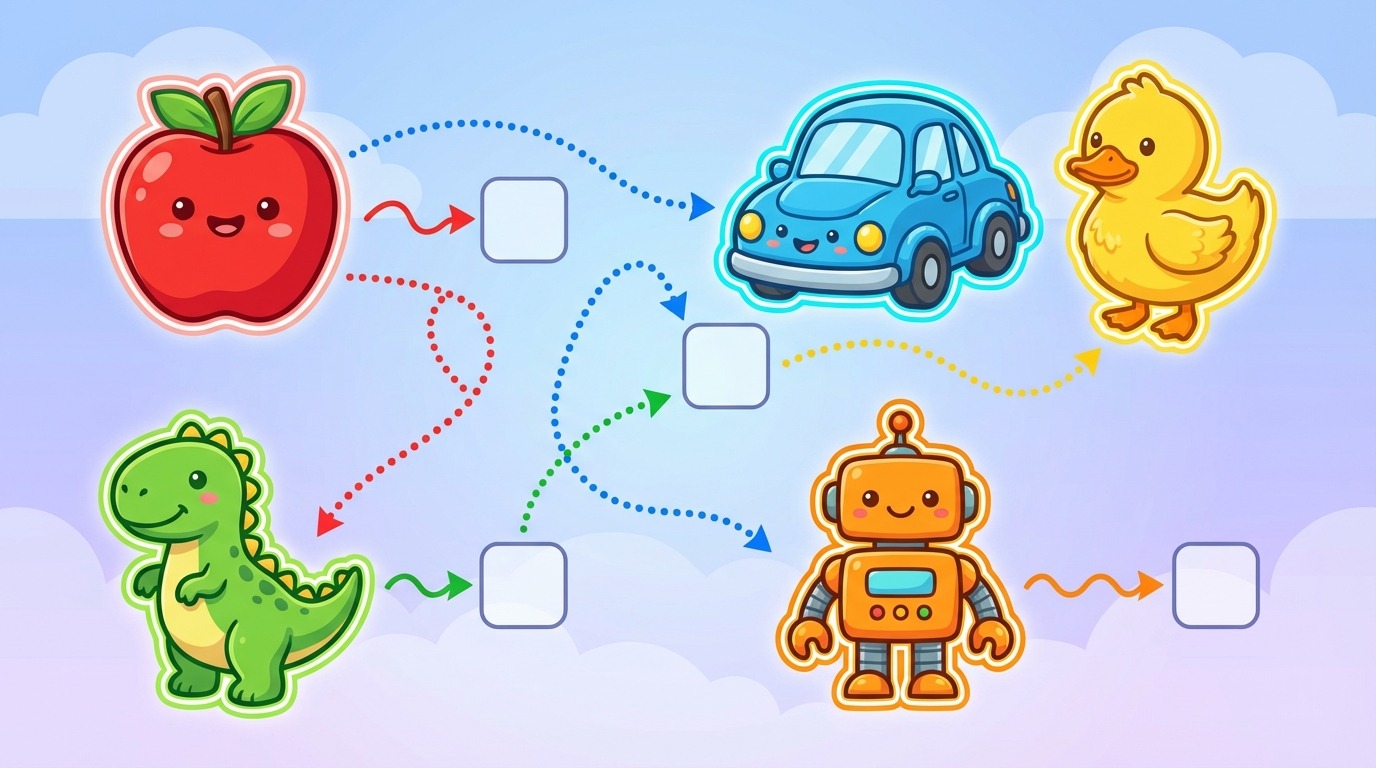
Match Word Image : Game : match the word to the image for ages 5-8.
| Short on time? Here’s the essentials ⏱️ |
|---|
| The word-picture matching game transforms early reading into playful learning 🌈 |
| For children aged 5-8, word-image association strengthens comprehension, memory, and enjoyment 📚 |
| A good educational game is progressive, short, varied, and offers immediate feedback ✅ |
| Alternate paper, tactile, and digital supports for a motivating recognition game 💻🖍️ |
| Measure progress with thematic “belts” and celebrate every milestone 🏅 |
Linking a word to its image offers a clear shortcut between the world of language and reality. This educational game, highly appreciated in cycle 2, relies on the natural curiosity of children aged 5-8. It captures attention, activates meaning, and establishes useful automatisms for early reading. The strength of the system comes from an obvious fact: a well-chosen visual link makes the word alive, hence memorable.
In classrooms as well as at home, a well-designed interactive activity opens the way to steady progress. It starts with frequent words, then enriches the vocabulary with seasonal themes, sound families, and short sentences. The goal is twofold: to develop decoding accuracy and to nurture vocabulary growth. Along the way, regular successes maintain motivation. The result is quickly visible: bright eyes, unfolding words, and settling sentences.
Word-picture matching: why the brain loves this bridge between meaning and sound
Between 5 and 8 years old, the brain builds roads that link perception, language, and memory. A thoughtfully designed recognition game exploits these roads. The image focuses attention, the word guides analysis, and the final match validates the intuition. This short loop strengthens the memory trace. In practice, rapid progress is observed across varied fields: basic vocabulary, reading complex sounds, and global understanding of small scenes.
From visual recognition to fluent early reading
Initially, the child identifies a familiar drawing, then scans the letters to check. With habit, they anticipate the word even before reading all letters. This shift from word-image to image-word marks a key step. Decoding becomes more flexible, prosody settles. Thus, the word-image association acts like a booster: less effort on identification, more energy to understand the whole sentence.
A foundation that nourishes vocabulary development
Appropriate iconography amplifies playful learning. Clear images, without distracting details, guide toward the relevant semantic trait. For “glove,” for example, a close-up on the shape avoids confusion with “mitten.” Each victory reinforces intrinsic motivation. Over three weeks, teachers often report a leap of 10 to 20 reliably recognized words, especially when the educational game is part of a short ritual.
Progressivity and frequent small victories
Progress in thematic batches stabilizes effort: animals, classroom objects, cooking, then targeted sounds (bl, cl, fl, gl, pl). Graduated levels, inspired by tested practices in CP (first grade), facilitate the next step without discouragement. Short sessions (6 to 10 minutes) with immediate feedback are aimed for. A green dot, a correct stroke lighting up, or a discreet pictogram suffice. This quick feedback frees mental load and encourages risk-taking.
A guiding thread to engage everyone
In the Owls’ Workshop, a fictional class, pupils guide a mascot who loses their labels. Each found card advances the story. This gentle narrative makes the task meaningful. The shyest dare to propose, the fastest explain. Cooperation mixes with friendly competition. Ultimately, the desire to “fix” the mistake motivates more than fear of failure.
At the end of the day, this bridge between word and image reduces obstacles, speeds recognition, and supports comprehension. Here is an effective springboard toward more confident reading.
Designing an irresistible educational game: clear rules, levels, immediate feedback
A good system stems from a winning trio: clarity, progressivity, and self-correction. The rules fit in one sentence: read, point, check. The child must instantly understand what is expected. A limited time and a visible goal frame the session. The brain likes short, repeatable, predictable challenges. This stability allows focusing on the essential: linking words and images with precision and pleasure.
Levels thought of as steps
The ideal progression resembles a ladder: transparent words (dad, moto), everyday words (pencil case, eraser), then complex sounds (ch, ou, oi, bl, cl, fl, gl, pl), and finally short sentences. Several teachers have adopted graduated series close to “levels 1 to 5” for words, then “1 to 4” for sentences. This architecture supports all reading methods, including recent approaches, without depending on a single manual.
Self-correction and discreet signs
To gain autonomy, correction must be visible yet discreet. A pictogram on the back of a card, a light color code, or a stroke that turns white upon success on an interface suffice. Thus, guidance remains benevolent. The adult can attend to a small group while two children check their matches alone. This setup reduces waiting and multiplies successful attempts.
Clear materials, clean visuals
Simple images are better than crowded scenes. One word per image, no unnecessary decorative elements. Sans-serif fonts serve early reading. On digital supports, large, high-contrast buttons and low latency smooth the interactive activity. Paper sheets remain useful, especially for handling, sorting, spreading out, and organizing by themes. A mix of both worlds supports all learning preferences.
A time marker and a short ritual
A 3-minute hourglass adds a gentle constraint that energizes without stressing. At the end, a mini-debrief fixes learning: “Which word surprised you?”, “What did you remember?”. These open questions invite the child to verbalize. Speech crowns the action. Oral traces help memory and reinforce pride in progress.
To complement, cultural and parental resources can enrich the approach, like this file on the benefits of reading for children, useful for aligning family and school. The educational game then finds a favorable, coherent, and sustainable ecosystem.
A simple framework, clear levels, and immediate verification: this combination turns the exercise into a joyful and effective challenge.
Implementing at home and in class: rituals, differentiation, and cooperation
The winning deployment starts with a fixed ritual. In class, two 8-minute rotations are proposed: one group links words and images on cards, the other uses self-correcting cards. At home, a short nightly version keeps attention steady. The secret sums up as: little but often. This light discipline installs reassuring markers and visible progress.
Concrete scenarios for all setups
“Gentle speed” scenario: 10 cards, hourglass, one attempt per card, then validation. “Expert search” scenario: cards mixed by themes, the child explains their choice before linking. “Cooperation” scenario: in pairs, debate, decide, check. Everyone finds their place. The advanced support the hesitant without losing interest, as the variety of batches maintains curiosity.
Differentiating without compartmentalizing
Levels intermingle to avoid the label “easy/hard.” Two slightly harder cards can be slipped into a simple batch. The child feels challenged, not overwhelmed. An individual dashboard tracks successes by themes: school, cooking, animals, seasons. Over weeks, progress visualizes. Families appreciate these concrete clues, as they tell a story of perseverance.
A creative corner to make materials
Making one’s own cards strengthens ownership. Cut, glue, draw or print ready-made series. For suitable craft ideas, parents will find inspiration in these craft activities for 5-8 years, and even a cardboard house project that will become game scenery. When the child creates, they get involved, and their memory activates differently.
Quick checklist for a smooth session
- 🎯 Clear goal of the day (e.g. “8/10 on ch/oi sounds”) and short time
- 🖼️ Clean images, frequent words, and 2 bonus challenges
- 🔁 Alternation paper/digital to vary the educational game
- 🗣️ Final oral minute: “What did I learn?”
- 🏅 Visible pleasure: sticker, green dot, or “champion” card
Families aligned with school quickly notice a calmer reading atmosphere. Everyone knows what to do, when, and why. The ritual makes the difference.
This short video resource helps visualize workshop organization, then transpose the idea at home. Concrete gestures reassure and inspire.
Varying supports and themes: seasons, sounds, music, and digital
Variety maintains the appetite to learn. A winter theme introduces words like “hat,” “snowflake,” “sled.” In spring, “bulb,” “bud,” and “nest” open other lexical doors. This rotation avoids boredom and contextualizes vocabulary. Words don’t remain abstract; they breathe with the calendar. The child fixes information better when encountering it in real life.
Reinforcing target sounds and syllables
A recognition game can target combinations: ch, ou, oi, or the series bl, cl, fl, gl, pl. Dedicated packages are created for each group. First, the sound is identified orally, then pinpointed in writing, finally linked to the image. The sound-letter-image triad solidifies reading. It also prepares writing, as the child learns to segment finely.
Adding music and gestures
Memory loves multisensoriality. A short tune, a marked rhythm, and a gesture associated with a sound reinforce encoding. To nurture this dimension, simple ideas are proposed here: small musical rituals. When the body moves and the voice sings, the word sticks. We read, link, then mime. This loop supports playful learning without weighing it down.
Minimalist digital, maximum efficiency
Online interfaces facilitate autonomy: click on the image, then on the word; if the stroke turns white, you’ve won; if it turns red, you correct. A simple visual code warns without judgment. The child progresses at their own pace. In class, two tablets suffice for a rotating workshop. At home, a smartphone can help, provided the session stays short and focused.
Mini table of variants to explore
| Variants to try 🎲 |
|---|
| Sentence cards (scene image + short caption) ➜ comprehension 📖 |
| Sound hunt (find “ch” in 5 words) ➜ discrimination 👂 |
| Seasonal course (winter/spring) ➜ contextual vocabulary ❄️🌱 |
| Smiling chrono (2-min challenge) ➜ stress-free speed ⏳ |
| Silent dictation (match then write) ➜ transfer to writing ✍️ |
By renewing supports, the curiosity engine stays lit. Each variant adds a new shade to the same core skill.
Measuring progress and keeping pleasure: belts, feedback, and learning hygiene
We remember what we celebrate. Thematic “belts” (school, home, animals, seasons, targeted sounds) make progress tangible. A wall chart or personal notebook holds colorful stamps. At each milestone, a small mission appears: “Discover 4 ch words,” “Read 3 sentence images.” This reasonable gamification maintains enthusiasm without excessive pressure.
Feedback that fosters growth
Winning feedback describes effort and strategy: “You spotted the fl in flower,” “You checked the end of the word.” This language nurtures metacognition. The child understands what works and reuses it. Errors then serve as a springboard. We rephrase, retry, confirm. Confidence builds brick by brick.
Role of families and gentle routines
School-family alignment stabilizes acquisition. Ten minutes suffice at night, before the story. Light, calm, and a regular schedule optimize attention. To anchor the taste for reading, this guide on the benefits of reading for children offers excellent markers. When reading becomes an awaited moment, progress accelerates.
Energy, sleep, and cognitive availability
A rested child learns better. Consistent rhythms and screen breaks before bedtime help. Families questioning sleep hygiene will find markers here: sleep and melatonin in children. The goal isn’t to medicalize the ordinary, but to remind that attention and memory grow on a calm terrain.
Motivating case study
Paul, 6, struggled to distinguish “ch” and “j.” For three weeks, a daily 8-minute ritual mixed sound cards, some sentence images, and a gentle chrono challenge. Result: 90% correct matches on the “ch/oi” batch, and increased fluency in evening reading. Adults especially noted a precious detail: more desire to try, hence more chances to succeed. The virtuous spiral engaged.
Measure, adjust, celebrate: this triple action keeps the course. Pleasure remains the best fuel for lasting effort.
Watching a real workshop helps capture details that make the difference: children’s posture, instruction pace, and micro-adjustments that smooth the session.
Resources, bridges, and extensions: from word to sentence, then to the world
The educational game does not live in isolation. Bridges are woven with writing, music, visual arts, and world discovery. A “silent dictation” extends the image-word link toward written production. A “sentence card” prepares understanding of short texts. Then, the image is told, debated, enriched. These expansions multiply opportunities to handle language.
Reliable supports to accompany
Parents like clear markers. Educational videos provide a reassuring framework and ready-to-use ideas, such as these contents inspired by early childhood to watch via reference videos. When adults share the same compass, the child progresses smoothly. Transitions between home and school gain in ease.
Linking, storytelling, reasoning
After matching, one can ask: “What changes if we place the card ‘ice cream’ near ‘sun’?” Thus, the child explains, argues, justifies. They move from quick gesture to constructed language. This rise in complexity establishes transversal skills: shared attention, cognitive flexibility, and speaking turns. The educational game becomes a thinking laboratory.
Acting to better memorize
Mini-scenes with seasonal accessories animate the cards. A hat, a scarf, a cardboard sled, and the story takes shape. Concrete handling gives body to words. Semantic links thicken. We move from isolated object to network of meaning. Once these nets are set up, reading gains depth, as each word naturally finds its family.
From the right word to social ease
Language supports confidence. When a child names with precision, they assert themselves and cooperate better. Simple language games then become tools of relational well-being. A class that reads, links, and tells regularly cultivates a climate of listening and respect. Language builds bridges between people as much as between ideas.
Well-thought cards, lively rituals, and smart extensions: here is the path to move from the isolated word to the world of texts, then to the real world.
How long does an effective session last?
Aim for 6 to 10 minutes. This short format maintains sharp attention, allows repetition, and leaves time for final verbalization. Two to three sessions per week suffice to observe clear progress.
Should we favor paper or digital?
Alternate. Paper cards encourage handling and cooperation. Digital offers quick and motivating self-correction. The essential remains the quality of images and clarity of instructions.
How to differentiate without stigmatizing?
Mix 2 more demanding cards among simple cards, adjust time, and keep the same ritual for all. Everyone experiences success at their level without visible labels.
When to move from words to sentences?
As soon as 80% of word-image matches are reliable on a theme. Then introduce very short sentence cards, with a clear scene image and familiar lexicon.
How to maintain motivation over time?
Display visible goals, celebrate each milestone with a thematic ‘belt,’ renew themes (seasons, sounds, places), and involve the child in making the material.
“A word that sticks to an image immediately sticks to the child’s heart.” ✨