Forward Music: File: forward the music!
| Short on time? Here’s the essentials 🎯 |
|---|
| 🎵 Music shapes culture, stimulates language and strengthens social bonds from early childhood. |
| 🗂️ A lively dossier mixes singing, rhythm, sound games and active listening to guide families and educators. |
| 🥁 A simple homemade instrument (kazoo, maracas) opens the door to music education and collective orchestration. |
| 🎫 From the living room to the stage, a small concert motivates effort, values the child, and anchors learning. |
| 🖍️ Visual art and sound reinforce each other: drawing what we hear sharpens listening and memory. |
Music crosses generations, but it is not just about notes. It is caught by the body, invited in the voice, and above all learned by playing. This dossier shows how rhythm regulates emotions, how singing structures language, and why a simple handcrafted instrument restores confidence both to the child and the parent. A collective story emerges throughout: families who turn a living room into a stage, a school that weaves its shared culture, and educators conducting simple, effective, and joyful gestures.
Because every household can become a studio for music education, the proposed path relies on concrete examples and easy rituals. Thus, daily life becomes colored with art and discoveries: a tapping step, a clinking spoon, a voice daring to speak. And very quickly, the desire for a first concert sprouts. What does this journey look like? Here are solid landmarks to move forward without stress, with enthusiasm, and above all with the certainty that every ear deserves its stage.
Music and living culture: why this dossier makes a difference
Everywhere, adults want to anchor music in daily life without falling into early performance. This dossier takes a stand: musical culture is born from play, laughter, and small rituals. As a result, the child learns better, retains longer, and dares more.
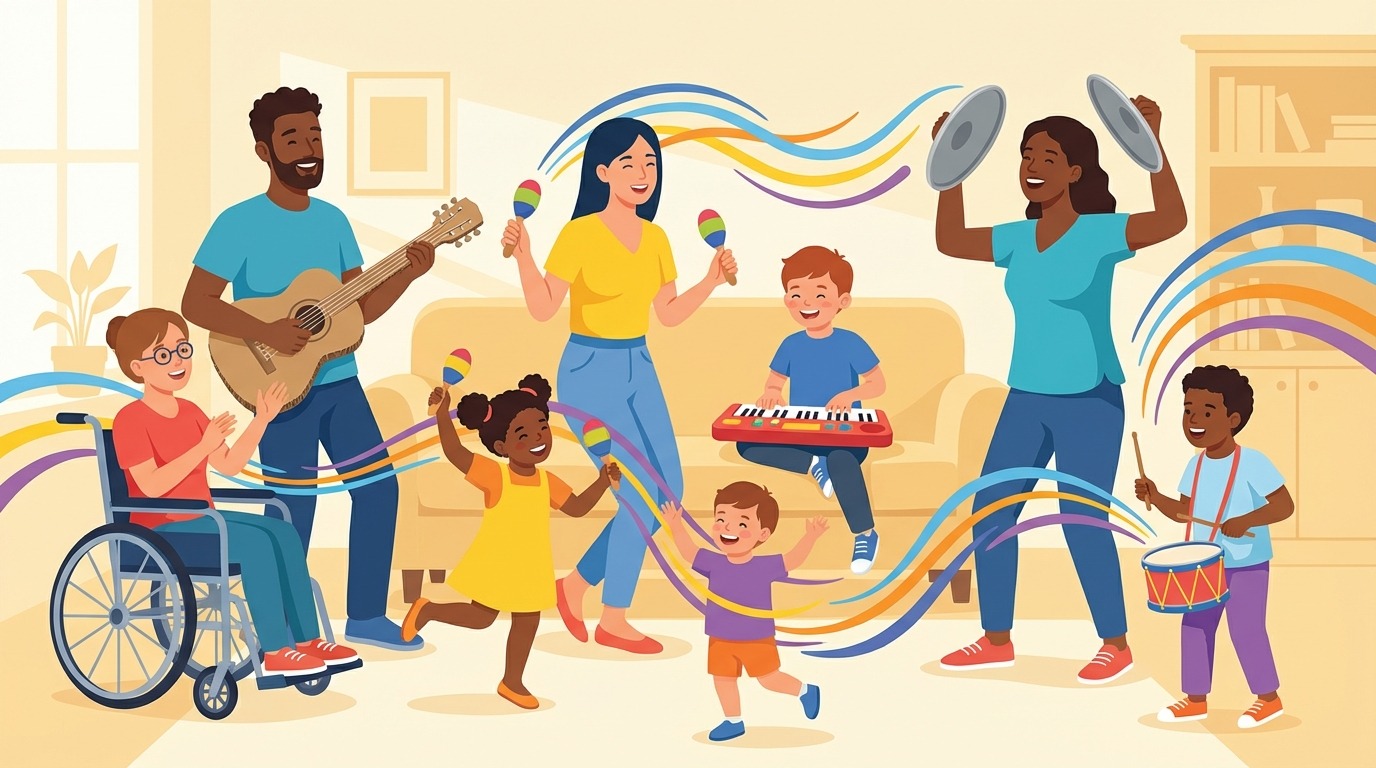
The example of the collective “Les Petits Tambours” illustrates this dynamic. Every Wednesday, five families gather in a municipal hall. They start with a vocal round, continue with body percussion, and finish with a mini-improvisation. Gradually, cohesion grows and the sound vocabulary expands.
From singing to gesture: first steps in music education
Singing is not just about interpreting a melody. It offers a space for breathing, articulation, and reciprocal listening. For example, a simple nursery rhyme alternates short and long sounds, sharpens the ear, and trains memory. With repeated rehearsals, children naturally synchronize their breath and attention.
To nurture this start, adapted nursery rhymes and songs open a solid repertoire. Then, one can play with onomatopoeia, vary the tempo, and introduce coded gestures (palm, clap, rub). Each gesture becomes a living note, and music education takes shape.
Social rhythm and bonds: music as cement
Rhythm generates cooperation. When a group keeps the beat, glances align and trust builds. Field studies show that a simple ostinato (TA–ta–ta) facilitates entry for the shyest. Then, a call-and-response strengthens team spirit.
Over the sessions, a domino effect is observed. Children better self-regulate because the pulse frames their energy. To extend this effect, a guide on self-control in 1–3-year-olds provides complementary pistes. Ultimately, group culture settles and the joy of learning multiplies.
Local conclusion: the magic is not abstract. It rests on concrete gestures, repeated with kindness, that transform the ordinary into a shared stage.
Learning by ear: music education from 0 to 8 years, key milestones
The first years lay the foundations. A baby reacts to timbre, volume, and tempo. Around 2 years old, they willingly imitate sounds, then around 4 years old, they confidently mark the beat. Finally, between 6 and 8 years, rhythmic structuring and polyphonic listening emerge. This progression is not a race. It reflects fine maturation.
Daily rituals and micro-learnings
An effective ritual relies on three levers: regularity, short duration, and variety. Every morning, a “daily pulse” with the hands gets the body moving. At noon, a one-minute mini-listening teaches how to settle. In the evening, a soft song closes the day. These micro-learnings sculpt the ear.
To inspire these moments, a guide like baby’s favorite tracks directs soothing or stimulating choices. Furthermore, milestones for 3–4 year-old development help calibrate expectations and avoid overstimulation.
Body games and fine coordination
Body percussion teaches coordination of brain, hands, and voice. A weekly cycle can follow progression: hit the thigh, clap hands, tap the chest, then make a sequence. Quickly, the child feels the pulse and distinguishes between binary and ternary. It is concrete, joyful, and very structuring.
To extend the experience, the adult can propose a “rhythmic card” drawn: a square for tapping, a circle for rubbing, a triangle for clapping. Thus, reading images is combined with sound, and visual art strengthens listening.
- 🎯 Short-term goal: anchor the bodily pulse.
- 🎶 Medium-term goal: name and imitate rhythmic patterns.
- 🌱 Long-term goal: improvise and listen in group.
When a difficulty arises (fatigue, frustration), an active break helps: walk in rhythm, blow hard, resume at a slower tempo. This strategy defuses tension and protects the joy of learning.
The payoff is a more present child who expresses themselves better and feels capable of daring their voice. This is a healthy foundation for all musical adventures to come.
Instruments and orchestration at child’s level: from workshop to mini-ensemble
A handcrafted instrument sparks immediate pride. It values the gesture and creativity. First, make it simple: shaker in a box, tambourine with lid, or make a kazoo to explore timbre. Then, refine listening by comparing sounds: low/high, short/long, soft/loud.
Build, explore, compare
The “Sound Hands” workshop follows a clear path: build, explore, compare, play. During the exploration phase, each child looks for two ways to make their object sound. Then, everyone compares in a circle, naming sensations. This verbalization enriches language while providing sensory landmarks.
Gradually, a mini-orchestration emerges. Roles are distributed: pulse, motif, punctuation. A conductor leads with simple gestures (up/down/stop). Thus, mutual listening becomes the group’s engine.
Ages, expectations and flexibility
Rather than fixed ages, autonomy milestones guide the adult. At home, the goal remains pleasure and shared attention. In groups, clear signals are set to start and stop. The quality of silence matters as much as sound richness.
And if a child refuses to participate? They are entrusted with the “color of the sound”: choosing which family will play (wood, metal, skin). Very often, responsibility awakens the desire to join the game.
Checkpoint: the making of sound objects, coupled with playful orchestration, establishes valued roles and supports cooperation.
From living room to stage: succeeding in a first educational concert
Putting on a small concert changes everything: the child understands the meaning of effort, group listening sharpens, and motivation soars. It’s not about impressing, but sharing a moment that is clear, short, and joyful. Five minutes are enough to live a memorable experience.
Three-step action plan
A simple plan is required: prepare, rehearse, share. During preparation, choose three pieces: a round, a rhythmic game, a final song. During rehearsal, work on beginnings and endings, because they reassure. On the day, welcome the audience, introduce the pieces, smile.
To limit stress, organize a run-through the day before. Children test the space, entrances, and exits. Thus, the body memorizes the route and each anticipates their role.
Validate effort, nurture confidence
After the concert, a “circle of applause” allows saying a strong point about one’s neighbor. This positive speech anchors learning. If a hiccup occurs, turn it into a game: replay the passage at half tempo. Leaving, families take away a feeling of shared success.
At this stage, the dossier becomes practical: it shows how music, visible and audible, creates a shared memory that will fuel future learning desires.
Building bridges between art, drawing, and music daily
To broaden horizons, linking visual art and music proves decisive. Drawing what is heard, miming a melody, associating a color with a timbre: all sharpen attention. Moreover, the child gains emotional vocabulary. They can say “it’s soft,” “it’s sharp,” “it’s misty.”
Listening with the eyes
An effective setup relies on three tools: crayons, texture cards, short playlist. A listening is launched, everyone draws lines following the pulse. Then, drawings are compared: what looks alike? what differs? This putting into words strengthens sensory analysis.
Need ideas? Here is a useful bridge to link music, drawing, and comfort object without getting lost in theory. This type of activity soothes, occupies the hands, and stabilizes attention.
Little routine of inner stage
Daily, an “inner stage” ritualizes expression. Choose a short piece of music, draw for 60 seconds, then each shares one word. In under three minutes, the group lives a complete sensitive experience. By repetition, confidence grows.
When morale falters, this routine acts as a compass. Sound refocuses, the stroke channels, and the exchange connects. The child leaves with a simple tool they can reuse alone.
Last landmark: the alliance of visual and sound installs deep learning, because it mobilizes body, emotion, and thought. This alchemy makes every day more creative.
Quick idea box for home and school
To finish with action, here are quick proposals to pick depending on the mood of the day. They require little equipment but produce maximum engagement.
- 🎵 “Pulse-walk”: walk, stop, restart on signal. Goal: precision and listening.
- 🪘 “Echo-rhythm”: adult does, child responds. Goal: auditory memory.
- 🎨 “Pulse-crayon”: draw a pattern during one minute of listening. Goal: focused attention.
- 🎤 “Singing-motif”: invent a two-word chorus. Goal: voice work.
- 🥁 “Hidden timbres”: guess the object sounding behind a screen. Goal: auditory discrimination.
To enrich the repertoire, a detour via reliable resources reassures and inspires. Ideas can also be explored when school becomes a challenge, relying on sensitive approaches such as those proposed around school refusal in 5–8 year-olds. The artistic path, when ritualized, often helps return to calm and engagement.
“Music awakens, connects and reveals — it brings the world to child’s height.” ✨
How to start music with a toddler without expensive equipment ?
Start with the voice and body : nursery rhymes, body percussion, echo games. Then add a homemade instrument (kazoo, shaker). The essentials : regularity, brevity, and shared pleasure.
How long to practice each day to progress ?
Five to ten minutes is enough. Short and frequent sessions are better than one long weekly block. Varying singing, active listening, and rhythmic play maintains attention.
Is it necessary to read music to organize a small concert ?
No. Three very simple pieces, clear beginnings and endings, a conductor with gestures, and a smile : that’s the key. The goal : share, not perform.
How to integrate visual art to reinforce listening ?
Draw while listening : lines for the pulse, colors for timbres, shapes for intensities. Sharing strengthens vocabulary and memory.
What resources to enrich the family repertoire ?
Explore reliable and short nursery rhymes, such as selections of children’s songs, and choose ideas for making simple instruments to vary timbres.