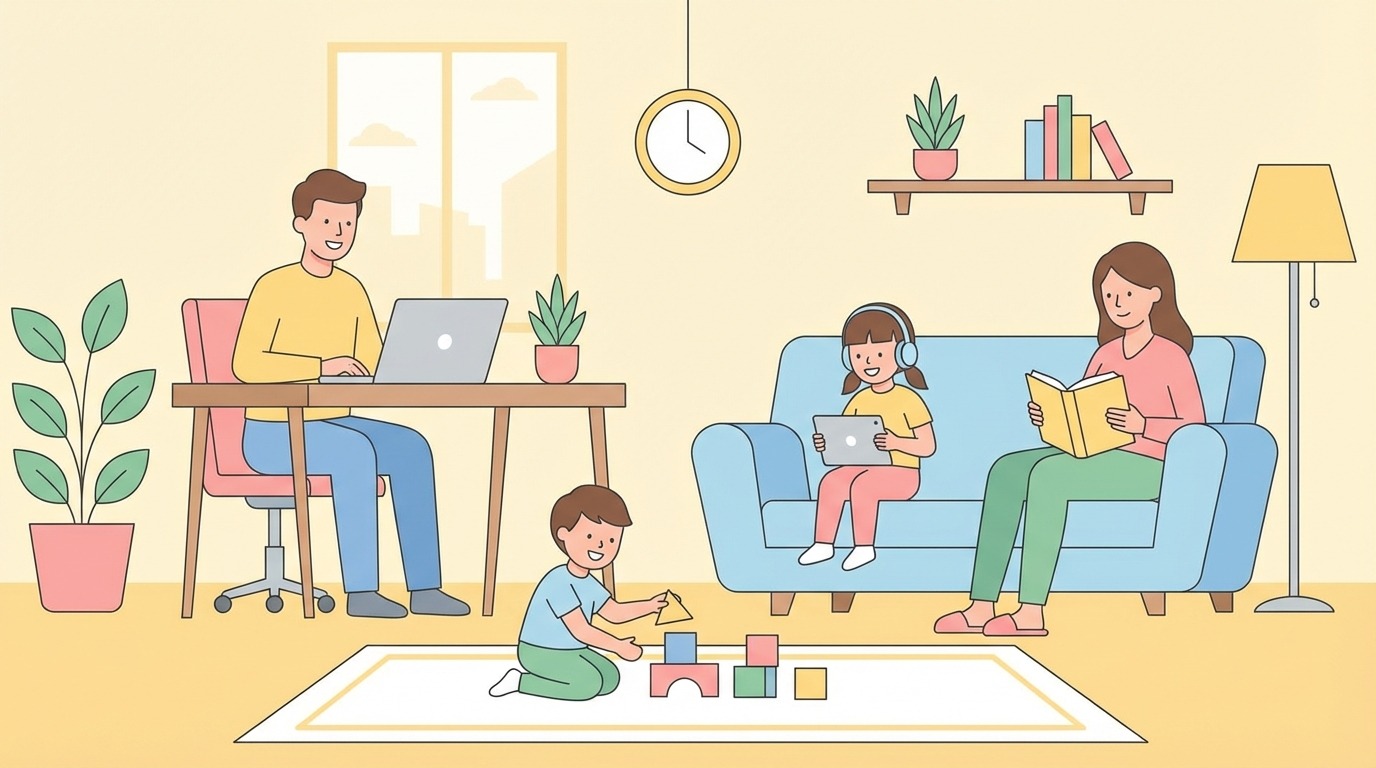
Parenting Video: The challenges of parenting daily.
| Short on time? Here’s the essentials ⏱️ |
|---|
| Parenting changes quickly: rising social expectations, diverse families, fragmented support, but new digital relays are emerging 💡 |
| Time with children has doubled since the 1970s: mental load is also increasing, hence the importance of concrete tools 🧠 |
| Screens and emotions: setting a clear framework, co-viewing, keeping the dialogue and adapting rules according to age 📱 |
| Work-family balance: micro-rituals, visual routines, and managing time weekly rather than daily 📅 |
| Communicating to soothe: naming emotions, co-constructing rules, playing to strengthen the parent-child relationship 🎲 |
| Don’t stay alone: Caf, Unaf-Udaf, local initiatives, support groups, and useful apps 🤝 |
Never has the word parenting held so much meaning. Families move forward balancing professional demands, demanding education, and social expectations, while navigating the omnipresence of digital technology and more fragmented supports than before. Videos and short formats, coming from public or associative initiatives, now provide concrete landmarks: attachment, emotions, discipline, play, language, nothing is left to chance. Yet each household retains its uniqueness, and winning solutions are built step by step, as close as possible to daily life.
Since the 1970s, time spent with children has doubled. Meanwhile, the pressure to “succeed” in education has never been stronger, in 2025 just as in the past. Thus, parents alternate between logistical challenges, mental load, and the search for reliable tools. In this changing landscape, one thing is clear: quality information and peaceful family communication remain powerful levers to navigate uncertainty, strengthen the parent-child relationship, and breathe easier.
Parenting Video: daily challenges and the art of adapting
Parenting no longer follows a single model. Between single-parent, blended, or same-sex parent families, experiences diversify and reference points evolve. This pluralism calls for revisiting old frameworks without giving up the fundamentals: emotional security, clear boundaries, and reassuring routines. Indeed, video formats help integrate these concepts with concrete examples, step-by-step guides, and real-life scenarios.
Faced with challenges, the appeal of short, concrete content is growing. Series dedicated to child development, gentle discipline, and attachment prove invaluable. They provide a common language for adults while reminding that video tools do not replace listening to the child. Thus, videos are a springboard, never a magic wand.
Social pressure, mental load, and navigating shifting ground
The parental mental load increases as expectations pile up. School, health, sleep, screens, sporting or artistic success: everything seems counted, evaluated, and shared. This pressure creates stress, especially when traditional supports diminish. To take stock and gain perspective, a solid dossier on parental stress provides a useful summary: understanding the mechanics of stress already helps to reduce it.
In this tension, well-made videos offer reference points without moralizing. They show behind-the-scenes, validate adults’ emotions, and remind that mistakes are part of learning. Ultimately, accepting imperfection frees up space to adjust educational gestures.
Case study: a week with Léna and Malik
A parental duo, Léna and Malik, with two children of different ages, illustrate these challenges well. On Monday, the race against time starts with managing the backpack, comfort object, and an appointment at the pediatrician. Videos watched the previous weekend offered a simple tip: a “morning tray” with task picture cards. Result: fewer verbal commands, more autonomy.
On Wednesday, the eldest resists homework. Rather than clenching, the adults try the “little steps” technique seen online: 10 minutes of concentration, then 5 minutes of active break. Opposition decreases, and the parent-child relationship is no longer just about conflict. On Friday, a video about emotions offers a colorful wheel to verbalize each person’s feelings before bedtime. The atmosphere calms, and the night improves.
This type of resource proves effective when accompanied by a precise and realistic plan. Without this adaptation effort, even the best video remains theoretical. The challenge lies in daily transposition, relying on each family’s uniqueness.
Screens, emotions, and gentle education: setting a clear framework without antagonizing
The issue of screens crystallizes many debates. In practice, it mainly requires an explicit, evolving framework connected to the child’s development. International recommendations provide direction, but home application demands tact. The goal is to learn self-regulation while preserving the relationship.
Specifically, it becomes relevant to distinguish co-viewing from free screen time. The former allows mediation and discussion, the latter calls for clear limits. For informed guidelines, this detailed resource offers practical keys on young children and digital use: supporting screen use.
Family framework, safety, and useful tools
Beyond rules, material safety matters. Baby monitors and surveillance apps should remain allies, not sources of anxiety. A clear comparison helps decide between technical options: babyphones and listening smartphones. Then, usage hygiene is essential: no screens in bed, no exposure during meals, and predictable shutdown rituals.
Emotionally, the child needs an adult who names, explains, and offers engaging alternatives. During emotional storms, the screen must not become a systematic bandage. Conversely, motor play, outdoor time, or creative activities channel energy and support self-regulation.
Micro-strategies for ages 6-10
At primary school, social stakes come into play, and comparisons multiply. It is then strategic to establish co-constructed and displayed rules. For example, two weekly slots of 30 minutes of video games, chosen Sunday evening, with co-viewing of every other session. Then, a transition activity is proposed to help calm down: shared reading or family puzzle.
To lighten mental load, a visual reminder of the “screen on / screen off” routines facilitates application. Moreover, linking screens to specific goals boosts motivation: documentaries to support a presentation, tutorials for a creative project, video call to a grandparent to maintain connection. Thus, digital can gently nourish intergenerational communication.
- 🎯 Set slots and announce them in advance
- 🗣️ Co-view and discuss content
- 📵 Protect meals and bedtime
- 🌳 Offer an active alternative after screen time
- 📚 Link screen to a concrete project
Finally, when the temptation of total control arises, a useful reminder applies: trust is built. A understood, explained, and fair rule lasts longer than a harsh prohibition. A clear framework means a calm heart.

Work, school, and time management: orchestrating balance daily
Balancing work and family often feels like a puzzle. Yet some concrete levers can change the game. The first idea is to think weekly rather than daily. This way, workload and recovery times are distributed, “light” evenings are preserved, and professional activity peaks anticipated.
Then, 10-minute micro-rituals suffice to nourish the parent-child relationship. Lamp reading on Tuesday, pillow fight on Thursday, playful cooking on Saturday: these fixed bricks make the week predictable and emotionally nourishing. By domino effect, they reduce conflicts around homework or bedtime.
Tools and apps that really relieve
When the agenda bursts, simple apps centralize health, sleep, and meal info. A targeted overview avoids testing ten useless services: baby tracking app ideas. For older children, a shared calendar with color codes clarifies who does what and when.
Organization goes beyond tools. It requires alliances. Setting up a “Wednesday task force” with another household to share activity support relieves greatly. Over a quarter, the energy gained is tangible.
Companies, rights, and life stages
Announcing a pregnancy at the office remains a sensitive step. Practical advice helps combine rights, timing, and attitude: preparing the announcement at work. On the other parent’s side, their role at birth plays a decisive part for the dyad and family balance. This guide clarifies expectations, emotions, and coordination with the medical team: the role of fathers during childbirth.
In single-parent families, time management demands even finer coordination. Resorting to grandparents, neighbors, and local resources must be facilitated and valued. Again, video can defuse feelings of isolation by offering an accessible roadmap.
In the end, balance does not aim for perfection. It seeks a global stability where everyone finds their place, week after week. Coherence, predictability, and a good dose of flexibility: here is the recipe that lasts.
Family communication and the parent-child relationship: words, gestures, games
To ease tensions, communication stands as the primary lever. Naming emotions, rephrasing, and proposing realistic options allow moving beyond standoffs. The child feels heard and acknowledged, naturally reducing opposition. Cooperation replaces escalation.
A simple method consists of describing what is observable and linking the emotion to a need. “Your voice rises and your fists clench. You are frustrated; you need help with your homework.” This structure, used regularly, provides a secure verbal framework. Gradually, the child learns to do the same.
Playing to communicate better
Play supports attachment and smoothes communication. Battle games, well framed and with rules revised to preserve fairness, offer an outlet for energy and rivalry. This resource proposes clever variants for home: battle game ideas. Meanwhile, maintaining connection with distant relatives strengthens children’s emotional stability. These tactile and video paths nourish family bridges: playing remotely with loved ones.
Among siblings, conflicts reveal competing needs more than “bad characters.” Building an express mediation ritual, with turns to speak and choosing one solution among two, prevents wear. Over time, self-mediation develops.
Practical scenario: an evening going off track
Let’s return to Léna and Malik. On Thursday, fatigue derails the evening. Instead of punishing immediately, they pull out the “framework + limited choices” card learned in video: “We read two stories if we’re in pajamas in 5 minutes, otherwise just one.” This framing gives power to act to the children without triggering endless negotiation.
Then, a 3-minute “emotion debrief” before lights out lets everyone share their day. Children love drawing a “I feel… because…” card. Adults gain coherence. In the long run, these micro-gestures are worth long family therapies.
In the end, one truth is confirmed: language structures soothing, but play seals complicity. This duo sustainably lowers tension.
Support networks, local initiatives, and innovations that lighten the load
You don’t raise a child alone. Associative networks, public services, and citizen initiatives weave concrete solutions. Caf offer workshops and meetings between parents. Unaf-Udaf guide towards family mediation, legal advice, and support groups. Closer to the ground, local collectives organize parent cafés, conferences, and festive times to breathe.
Certain events give a strong boost. The Becoming a Parent Festival in Chabeuil, driven by committed professionals, combines practical workshops and soothing meetings. You’ll find parent-child yoga, massage, and spaces dedicated to psychomotor development. Families leave with simple gestures, tested and reusable from that very evening.
Products and services: useful when they serve the relationship
Innovations abound, but the usage angle makes the difference. A connected stroller helps in transport, if it doesn’t add useless alerts. A smart thermometer helps objectify fever if it remains a tool, not a generator of anxiety. Interactive toys are best chosen for their exchange potential rather than their “wow effect.” Ultimately, the key question remains: does it facilitate the parent-child relationship, here and now?
Parent-dedicated platforms complement the network. Whether guides, practical sheets, or experience feedback, information quality matters. In times of emotional storm, a few reliable landmarks are worth more than an avalanche of contradictory content.
Practical reference points to rely on without losing your way
To move forward with clarity, a small action plan works well. First, map accessible supports within 30 minutes around home. Then, choose one video resource per week and apply it to one theme only. Then, join a support group for a quarter to test concrete gestures.
Finally, keep in mind a golden rule: tools serve the bond, not the opposite. With this direction, each family charts its own course, without comparing to unreachable standards.
Quick reference for busy parents
| 🧭 Express parental checklist |
|---|
| 1. Write 3 key routines (morning, homework, bedtime) ✍️ |
| 2. Set 2 weekly co-viewed screen slots 🎬 |
| 3. Block 10 minutes per child, 3 evenings/week ❤️ |
| 4. Call a local relay (Caf, Unaf-Udaf) ☎️ |
| 5. Prepare a “difficult evening” plan together 🧩 |
A network, a clear rule, a ritual that holds: balance becomes possible again.
{“@context”:”https://schema.org”,”@type”:”FAQPage”,”mainEntity”:[{“@type”:”Question”,”name”:”Comment cadrer les u00e9crans sans conflit ?”,”acceptedAnswer”:{“@type”:”Answer”,”text”:”Annoncer les cru00e9neaux u00e0 lu2019avance, co-visionner, protu00e9ger repas et coucher, puis proposer une activitu00e9 de transition. Adapter la duru00e9e u00e0 lu2019u00e2ge et expliquer les raisons des ru00e8gles renforce lu2019adhu00e9sion.”}},{“@type”:”Question”,”name”:”Quels outils aident u00e0 la gestion du temps ?”,”acceptedAnswer”:{“@type”:”Answer”,”text”:”Un calendrier partagu00e9, des pictogrammes de routines, et une application de suivi pour les plus petits. Une su00e9lection ciblu00e9e u00e9vite la surcharge et soutient des habitudes ru00e9guliu00e8res.”}},{“@type”:”Question”,”name”:”Comment amu00e9liorer la communication en famille ?”,”acceptedAnswer”:{“@type”:”Answer”,”text”:”Du00e9crire lu2019observable, nommer lu2019u00e9motion, proposer un choix limitu00e9. Les jeux et rituels du2019u00e9coute, mu00eame tru00e8s courts, relancent la coopu00e9ration et la confiance.”}},{“@type”:”Question”,”name”:”Que faire quand la charge mentale explose ?”,”acceptedAnswer”:{“@type”:”Answer”,”text”:”Ru00e9duire le nombre du2019objectifs, du00e9lu00e9guer une tu00e2che concru00e8te, et solliciter un relais local. Un dossier de ru00e9fu00e9rence sur le stress parental permet de trier les prioritu00e9s.”}},{“@type”:”Question”,”name”:”Ou00f9 trouver des idu00e9es du2019activitu00e9s simples et utiles ?”,”acceptedAnswer”:{“@type”:”Answer”,”text”:”Privilu00e9gier les jeux moteurs ou symboliques, les activitu00e9s courtes et les variantes de batailles cadru00e9es. Des ressources en ligne proposent des idu00e9es rapides u00e0 mettre en u0153uvre.”}}]}Comment cadrer les écrans sans conflit ?
Annoncer les créneaux à l’avance, co-visionner, protéger repas et coucher, puis proposer une activité de transition. Adapter la durée à l’âge et expliquer les raisons des règles renforce l’adhésion.
Quels outils aident à la gestion du temps ?
Un calendrier partagé, des pictogrammes de routines, et une application de suivi pour les plus petits. Une sélection ciblée évite la surcharge et soutient des habitudes régulières.
Comment améliorer la communication en famille ?
Décrire l’observable, nommer l’émotion, proposer un choix limité. Les jeux et rituels d’écoute, même très courts, relancent la coopération et la confiance.
Que faire quand la charge mentale explose ?
Réduire le nombre d’objectifs, déléguer une tâche concrète, et solliciter un relais local. Un dossier de référence sur le stress parental permet de trier les priorités.
Où trouver des idées d’activités simples et utiles ?
Privilégier les jeux moteurs ou symboliques, les activités courtes et les variantes de batailles cadrées. Des ressources en ligne proposent des idées rapides à mettre en œuvre.
“Raising a child is balancing chaos with trust and turning every challenge into connection.” ✨