Raclette and Fondue Pregnant: Which Cheeses Are Allowed or Forbidden?
| Short on time? Here’s the essential ✅ Allowed cheeses during pregnancy: most pasteurized milk cheeses, processed cheeses, and hard cheeses (sometimes even raw milk) without rind. ⚠️ Forbidden cheeses: soft cheeses made with raw milk, blue/veined cheeses, and cut-to-order cheeses (risk of contamination). 🔥 For raclette and fondue: cheese becomes safer when it is properly heated (target > 70°C). 🥓 Beware of charcuterie: prefer vacuum-cooked ham or plant-based options. 🩺 In case of mistake: monitor fever and headaches and consult promptly. |
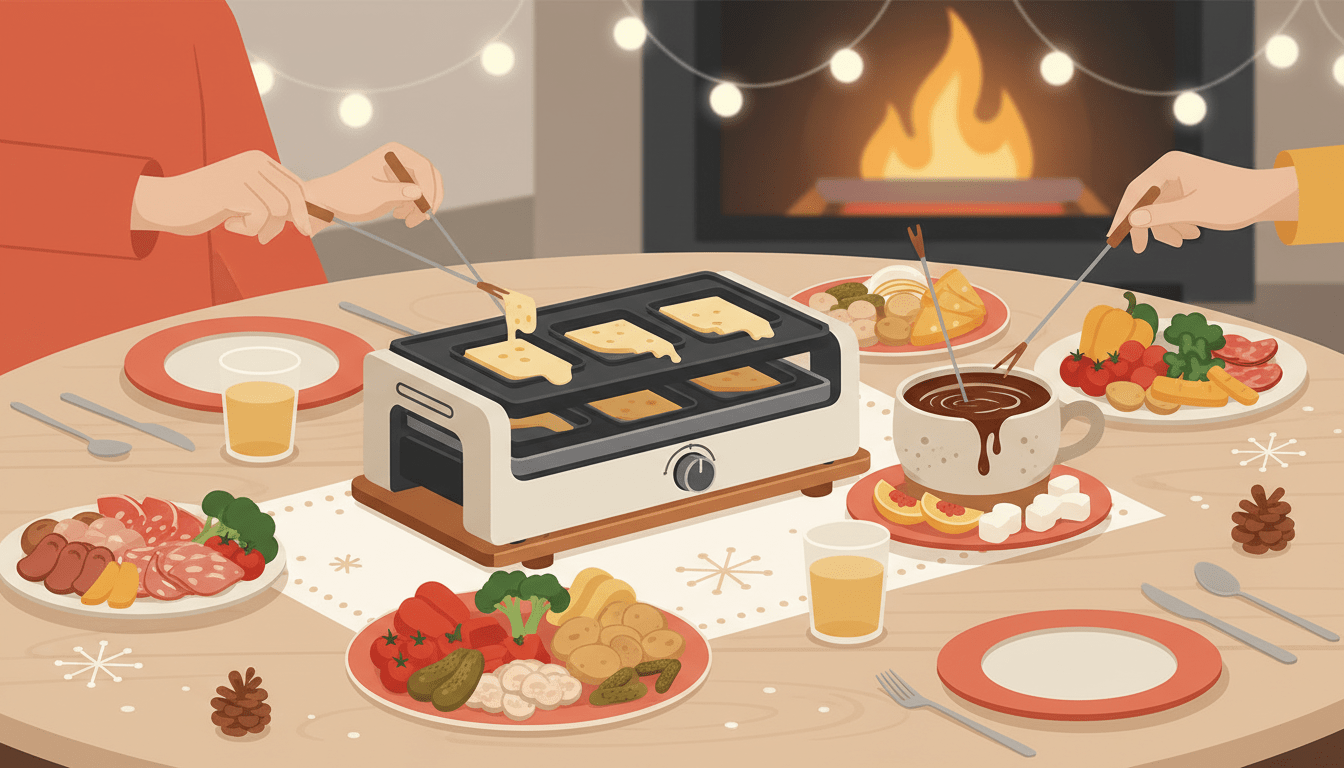
When winter settles in, raclette and fondue come back like a promise of warmth, laughter, and long-lasting meals. Yet, during pregnancy, this simple joy often mixes with very real worry: are cheeses safe when pregnant, and which ones fall into the “to avoid” category? Doubt sometimes sneaks in as soon as the dairy aisle, then grows in front of the raclette grill heating up, or the pot simmering for fondue.
The good news is that togetherness doesn’t have to disappear. However, food safety becomes a guiding thread, because listeria cannot be seen, smelled, and doesn’t change the taste. Thus, a few reliable references are enough to turn a “risky” meal into a calm moment: understand the difference between allowed cheeses and forbidden cheeses, know how to read a label, and master the cooking. Then, it remains to compose a raclette or fondue that reassures without punishing the taste buds.
Can you safely eat raclette when pregnant? Clear food safety guidelines
Yes, raclette can stay on the menu when pregnant, provided some simple rules are followed. First, it’s important to understand why this topic causes concern: some cheeses can host listeria, the cause of listeriosis, a rare but feared infection during pregnancy. Then, remember a reassuring principle: heat is an ally because above roughly 70°C, the bacteria can’t survive.
However, it’s not just about cooking. Contamination can also come from handling, a shared knife, or a “cut-to-order” exposed product. Thus, food safety relies on a trio: choosing the right products, cooking properly, and avoiding cross-contamination.
Why listeria is especially concerning during pregnancy
Listeria can cause fever and headaches, sometimes mild. Yet, in pregnant women, the stakes are higher because the infection can reach the fetus. Therefore, the focus is mainly on prevention, without falling into panic.
In practice, this risk is concentrated on certain types of cheeses: high moisture, long ripening, bloomy rind, or raw milk production. That’s why soft cheeses are often more problematic than hard cheeses.
“Melted well” isn’t enough: aim for actual heating
A cheese that just barely “weeps” under resistance hasn’t necessarily reached a protective temperature. Conversely, a well-melted, even slightly browned slice inspires more confidence. So, better to extend the time under the pan slightly than to serve too early.
To keep peace of mind, one trick works well: prepare very hot potatoes first, then let the cheese cook until it bubbles. Only then can it be poured onto the plate. This rigor provides immediate calm, and the meal becomes a celebration again.
Real case: a “zero stress” raclette at a dinner with friends
A future mom invited to raclette doesn’t have to isolate herself with a salad. However, she can gently request an industrial cheese made with pasteurized milk and cooked side dishes. Also, a platter of roasted vegetables and vacuum-sealed ham easily replace risky charcuteries.
To go further on common questions around food choices, this file provides useful guidelines: common questions about eating during pregnancy. That way, decisions become simpler day to day. And above all, the evening keeps its taste of “normality”.
Fondue when pregnant: which cheeses are allowed, and how to avoid forbidden ones
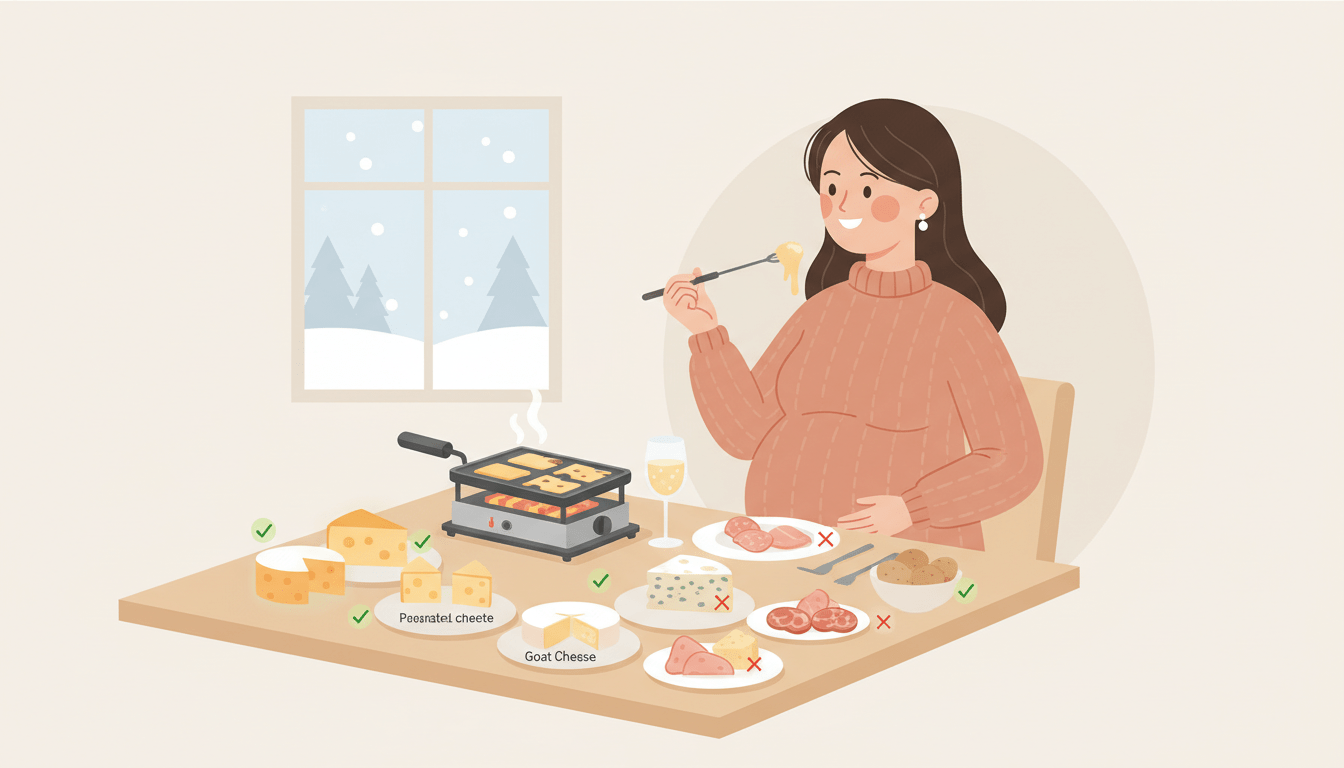
Fondue has a strong emotional advantage: it brings people together, slows things down, and creates a little ritual. However, the cheese choice remains central during pregnancy. The general rule is simple: favor allowed cheeses made with pasteurized milk, and be wary of wetter or veined types, even if the label seems reassuring.
In fondue, the temperature often rises sufficiently, especially if the device is properly set. Yet, the real weak point can sometimes be before heating: buying cut-to-order cheese, too long transport, or mixing unidentified cheeses. So, safety starts at the shopping basket.
Allowed cheeses that work very well in fondue
For a mild and reliable fondue, pasteurized milk cheeses work very well, especially industrial versions. Moreover, processed cheeses can help with the texture. Finally, some hard cheeses remain compatible, as their low moisture limits bacterial growth.
A useful reference when doubt arises is here: gynecologists’ advice on cheeses during pregnancy. Thus, the choice is not based on rumors but on coherent advice.
Forbidden cheeses: watch out for blues and soft cheeses
Soft cheeses made from raw milk, especially with bloomy rind, should be avoided. Then, veined cheeses are problematic because their moisture promotes microbial growth. Even when made with pasteurized milk, they are often discouraged.
In reality, it is often habits that trap people: “a small piece of brie,” “just a lick of roquefort.” But during pregnancy, these “small” slips can create great anxiety. So, better to choose a safe pleasure rather than a worrying one.
Temperature, mixing, and serving: fondue becomes safe like a recipe
The thermostat matters. If there is one, it should be set above 70°C, otherwise the mixture cools down quickly. Then, stirring is necessary to even out the heat, as a fondue hot on the edges can be cooler in the center. Finally, it’s better to serve immediately rather than let it “wait” on the table.
This technical frame may seem strict, yet it frees the mind. And when the mind breathes, fondue regains its magic.
To visualize fondue ideas and understand usual settings, this video search can help:
Practical list 2025: allowed vs forbidden cheeses for raclette, fondue, and tartiflette
Facing the cheese section, information overload quickly tires. However, a simple sorting allows moving forward with confidence. On one side, allowed cheeses rely on pasteurization, hard cheeses, and processed products. On the other, forbidden cheeses mostly concern raw milk soft cheeses, veined, and cut-to-order purchases.
In daily life, one detail changes everything: reading the label becomes a protective gesture, not a punishment. In 2025, most packages clearly state “pasteurized milk” or “raw milk.” So, a two-second glance can prevent an entire evening of worry.
Quick reference: what’s okay, what’s not
- ✅ Allowed cheeses: feta with pasteurized milk, pasteurized mozzarella, ricotta, mascarpone, cancoillotte, industrial spreadable cheese 🧀
- ✅ Hard cheeses: comté, parmesan, pecorino, gouda, gruyère, cheddar (without rind) 🟡
- ⚠️ Avoid: cut-to-order products, even if pasteurized, because of possible cross-contamination 🧤
- ⛔ Forbidden cheeses: soft cheeses made from raw milk (brie, camembert, reblochon), bloomy rinds, washed rinds 🧨
- ⛔ Blue/veined: roquefort, gorgonzola, bleu d’Auvergne, fourme (risk linked to moisture) 🔵
Raclette and cheeses: the trap of “local specialties”
Some artisanal raclettes may be raw milk. They have a strong terroir aroma, and it’s tempting. Yet, during pregnancy, caution recommends a pasteurized version, ideally packaged. Thus, buying becomes an act of care.
To save time, online shopping also allows filtering more calmly, without queue pressure. For example, shopping online at Monoprix can help compare labels and choose more serenely.
Mini case study: the “comfort” tartiflette revisited
The classic tartiflette often calls for a raw milk reblochon. However, a pasteurized version sometimes exists in supermarkets. Otherwise, an alternative is to use a pasteurized cheese suitable for cooking, then cook the dish thoroughly.
The result surprises: the gratin remains tasty, and the future mother eats without that little knot in her stomach. And that’s where pleasure changes texture: it becomes gentle, not anxious.
For recipe ideas and family balance around dairy products, this resource nicely complements the guidelines: balanced menu for the whole family.
Pregnant raclette: also secure charcuterie, sides, and everyday cooking
Raclette is not just about cheese. In fact, many risks hide in the “extras,” especially when the charcuterie platter stays too long at room temperature. So, for consistent food safety, it’s important to secure the entire meal, not just the melting slice.
The sensitive point is raw or smoked charcuterie, sometimes riskier than heated cheese. Thus, the simplest strategy is to substitute without frustration: vacuum-cooked ham, cooked chicken breast, or well-cooked fish. Then, roasted vegetables can add color and crunch.
Delicious alternatives to “classic” charcuterie
A reassuring platter can include vacuum-cooked ham, hard-boiled eggs, and sautéed mushrooms. Also, steamed broccoli florets and roasted carrots pair very well with cheese. Moreover, pickles and onions remain possible as long as properly conserved.
This approach also soothes the surroundings. When everyone eats the same, the future mom doesn’t feel “separate.” And that detail matters tremendously emotionally.
Organization: avoid cross-contamination without rigidity
One knife for everything is a raclette evening classic. Yet it is also a classic source of contamination. So, two knives are better: one for packaged safe products, and another for the rest. Then, a quick hand wash before touching the cheese makes a real difference.
Another reassuring detail: serve cheese directly from the package, rather than from a “common” plate where everyone picks. Thus, the evening keeps its spontaneity while reducing unnecessary contacts.
When the meal lasts: managing leftovers
After raclette, leftovers often linger on the table because “we’ll put them away later.” Yet during pregnancy, it’s better to refrigerate quickly. Then, leftovers must be reheated thoroughly before eating, especially if the plate waited a long time.
To complement this balanced logic over time, especially when baby arrives and rhythms change, practical ideas exist here: practical recipes for parents. Thus, prevention becomes a lifestyle, not a one-time constraint.
For examples of convivial table organization and cooking options, this video search may inspire:
If raw milk cheese was eaten during pregnancy: what to do, and how to reassure without minimizing
A “whoops” happens fast: a piece of brie at aperitif, a fondue at a restaurant without certainty about origin, or raclette where the cheese wasn’t hot enough. In these moments, fear can surge suddenly. However, there is a simple, especially human, way forward: observe, note, and consult if needed.
Listeriosis remains rare, and antibiotic treatment exists. So, the goal is not to panic but to act with clarity. In practice, the main sign to watch for is the appearance of symptoms such as fever, headaches, or flu-like state. Then, a doctor can decide on tests or treatment.
The right reaction: active monitoring, no panic
Noting what was consumed helps a lot. First, it allows precise answers to the health professional’s questions. Then, it prevents dwelling on vague scenarios. Also, drinking enough and resting support the body, even if this doesn’t substitute medical advice.
Another useful reflex is to keep packaging when possible. That way, brand, milk type, and date are known. And when the information is clear, anxiety often decreases.
How to read a label and ask the right question at the right time
On packaging, the mention “pasteurized milk” is a frequent green light. Conversely, “raw milk” should trigger immediate caution, especially for rind cheeses. At a restaurant, a simple question suffices: “Is the cheese made from pasteurized milk?” Then, if the answer is unclear, it’s better to choose another option.
This habit also protects after pregnancy because it establishes a family culture of food safety. Moreover, hygiene rules continue in many daily areas, such as toddlers’ table autonomy: forbidden and autonomy by age.
Phrase to help keep on track
Each safe choice doesn’t take away pleasure, it adds to it. And when the mind is calm, the body relaxes too. That is the quiet victory of these nine months: learning to protect oneself without shutting down.
“True indulgence is that which leaves the heart light and the table joyful.”
{“@context”:”https://schema.org”,”@type”:”FAQPage”,”mainEntity”:[{“@type”:”Question”,”name”:”Peut-on manger une fondue au restaurant quand on est enceinte ?”,”acceptedAnswer”:{“@type”:”Answer”,”text”:”Oui, u00e0 condition de privilu00e9gier une fondue dont les fromages sont au lait pasteurisu00e9 ou dont la cuisson est ru00e9ellement bien chaude. Cependant, si lu2019origine des fromages est incertaine, il vaut mieux choisir un plat bien cuit u00e0 la place, pour limiter le risque liu00e9 u00e0 la listeria et renforcer la su00e9curitu00e9 alimentaire.”}},{“@type”:”Question”,”name”:”Les fromages u00e0 pu00e2te dure sont-ils toujours autorisu00e9s pendant la grossesse ?”,”acceptedAnswer”:{“@type”:”Answer”,”text”:”Les fromages u00e0 pu00e2te dure sont gu00e9nu00e9ralement mieux tolu00e9ru00e9s sur le plan sanitaire, car ils sont moins humides et la listeria su2019y du00e9veloppe moins. De plus, certains sont cuits lors de la fabrication. En revanche, il reste conseillu00e9 du2019u00e9viter la crou00fbte et de privilu00e9gier des produits emballu00e9s plutu00f4t quu2019u00e0 la coupe.”}},{“@type”:”Question”,”name”:”Une raclette avec fromage au lait cru est-elle su00fbre si le fromage est tru00e8s chaud ?”,”acceptedAnswer”:{“@type”:”Answer”,”text”:”La chaleur forte du00e9truit la listeria au-delu00e0 du2019environ 70u00b0C, donc une cuisson ru00e9elle aide beaucoup. Toutefois, le risque peut aussi venir de la manipulation et de la contamination croisu00e9e. Ainsi, il est plus simple de choisir un fromage u00e0 raclette au lait pasteurisu00e9 et de le faire bien fondre, voire lu00e9gu00e8rement dorer.”}},{“@type”:”Question”,”name”:”Quels signes doivent faire consulter apru00e8s avoir mangu00e9 un fromage interdit enceinte ?”,”acceptedAnswer”:{“@type”:”Answer”,”text”:”En cas de fiu00e8vre, de maux de tu00eate, de douleurs inhabituelles ou de sensation grippale dans les jours qui suivent, une consultation mu00e9dicale est recommandu00e9e. Il est utile de noter le fromage consommu00e9 (type, marque, date) afin du2019aider le professionnel u00e0 u00e9valuer le risque et u00e0 du00e9cider du2019un traitement si besoin.”}}]}Can you eat fondue at a restaurant when pregnant?
Yes, provided you favor a fondue whose cheeses are made with pasteurized milk or whose cooking is really hot. However, if the origin of the cheeses is uncertain, it’s better to choose a well-cooked dish instead, to limit the risk linked to listeria and strengthen food safety.
Are hard cheeses always allowed during pregnancy?
Hard cheeses are generally better tolerated health-wise because they are less moist and listeria develops less there. Also, some are cooked during production. However, it’s still advised to avoid the rind and favor packaged products rather than cut-to-order.
Is raclette with raw milk cheese safe if the cheese is very hot?
High heat destroys listeria beyond about 70°C, so actual cooking helps a lot. However, the risk can also come from handling and cross-contamination. Therefore, it’s simpler to choose a raclette cheese made with pasteurized milk and melt it well, even lightly brown it.
Which signs should lead to consulting a doctor after eating a forbidden cheese while pregnant?
In case of fever, headaches, unusual pains, or flu-like symptoms in the following days, medical consultation is recommended. It’s useful to note the consumed cheese (type, brand, date) to help the professional assess the risk and decide on treatment if needed.