Respiratory Health: How to improve air quality for respiratory health.
| Short on time? Here’s the essential ⏱️ |
|---|
| Reducing fine particles and NO2 protects the respiratory health of the youngest 👶 |
| Effective ventilation and allergen removal help limit asthma prevention and respiratory allergies 🌿 |
| A HEPA air purifier helps as a supplement but never replaces airing 🌀 |
| Acting on air quality at the source (heating, mobility, products) remains the winning strategy 🛠️ |
| Public policies (PPA, PRSE, low emission zones) reduce air pollution and its costs 💶 |
The air we breathe shapes our energy, sleep, and above all the lung health of children. Each adult inhales between 10,000 and 20,000 liters of air per day, yet this air carries fine particles, volatile organic compounds, and invisible allergens. International figures recall a harsh reality: a majority of the world population lives in areas where air quality does not meet health recommendations. In the face of this observation, action is not a luxury, but a collective and daily priority.
In daycare centers, schools and homes, specific actions change the game: controlled ventilation, allergen removal, choice of safe materials and cleaning products, and management of exposure to fine particles. Meanwhile, public policies align powerful levers: low emission zones, Euro standards, climate plans and health-environment strategies. The challenge is clear: connect field decisions to a long-term vision, in order to establish a healthy environment that protects the respiratory health of the most vulnerable and sustainably relieves our cities.
Air quality and respiratory health of children: understand to act
Common pollutants, damage mechanisms and vulnerability windows
Air pollution affects each life stage differently. In children, the immune system is developing, airways are narrower, and respiratory rate is higher. Thus, the same concentration of fine particles leads to a higher internal dose. This reality increases the risk of incomplete asthma prevention, respiratory allergies, and infections.
The pollutants involved vary: PM2.5 and PM10 particles from heating and traffic, nitrogen dioxide related to engines, summer ozone, and VOCs coming from paints, candles and solvents. Each has a distinct mode of action: epithelium irritation, chronic inflammation, oxidative stress, and allergen potentiation. In a damp dwelling, molds release spores and mycotoxins, worsening asthma.
An urban daycare center witnessed these mechanisms. The team observed nocturnal coughing and frequent wheezing episodes in winter. After diagnosis, combined sources were identified: low-efficiency boiler, blocked air inlets, and scented cleaning products. Corrective measures reduced symptoms in three months.
Health benchmarks and key messages
Simple benchmarks guide action. First, limiting chronic exposure yields the best results. Acting only during pollution peaks offers little benefit over the year. Then, combining regular airing, wet cleaning, and a properly sized HEPA air purifier effectively protects a sensitive room.
Next, humidity control remains essential. A hygrometry between 40 and 60 % slows down dust mites and reduces the viability of many viruses. Furthermore, CO2 sensors help time ventilation in classrooms: beyond 1000 ppm, the air must be refreshed.
Finally, reducing air pollution at the source changes the trajectory long-term: efficient heating, active mobility, and choice of low-emission materials. This simple tripod strengthens a healthy environment for families. In short, understanding the risk enables prioritizing actions without distraction.
Improving indoor air daily: proven methods and concrete examples
Airing, ventilation and humidity control
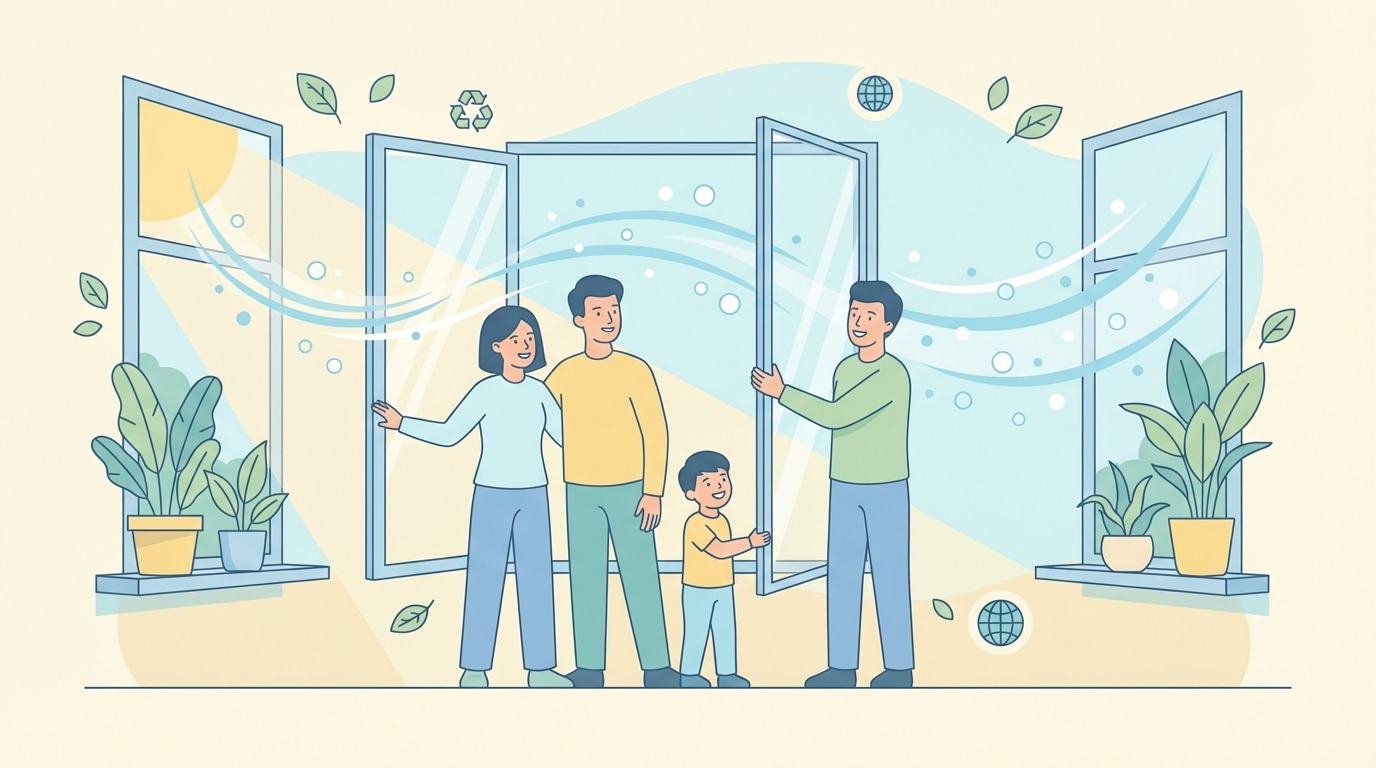
Air renewal remains the first barrier. Opening wide twice a day for 10 minutes, even in winter, expels indoor pollutants without cooling the structure. When the dwelling has a mechanical ventilation system (VMC), biannual maintenance of vents prevents airflow loss. In the kitchen, an externally vented hood limits ultrafine particles from cooking.
Humidity control complements ventilation. A well-adjusted dehumidifier in a condensation-prone room breaks the mold-allergy cycle. Conversely, too dry air irritates mucous membranes; the 40–60 % balance remains the target. Air-purifying plants decorate, but their effect on air quality is less than ventilation; better consider them as an aesthetic plus.
Allergen removal and smart cleaning
Allergen removal relies on capture, not dispersion. A vacuum cleaner with a HEPA filter traps fine particles and dust mite allergens. A damp cloth traps dust where a duster would resuspend it. For bedding, weekly washing at 60 °C significantly reduces allergens.
Regarding products, favoring black soap, baking soda, and white vinegar reduces VOCs. Indoor fragrances accumulate irritating compounds that fuel respiratory allergies. In renovations, choosing paints with very low emissions (serious labels) reduces odor and prolonged effects.
Air purifier: when, which, how
A HEPA air purifier is useful as a supplement when airing is limited or during heavy pollen seasons. HEPA H13 or H14 filters capture fine particles, while activated carbon adsorbs certain gases. The clean air delivery rate (CADR) must correspond to the room volume; aiming for 5 to 6 air changes per hour ensures notable particle load reduction.
However, no device replaces proper ventilation. Without airing, CO2, VOCs, and humidity build up. Install the purifier at breathing height, away from obstacles, and change filters as needed to guarantee reproducible results. In a nap room, this airing + HEPA duo reduces wake-ups with coughing.
- 🪟 Air out 2×10 min/day, summer and winter
- 🧼 Clean with damp methods, HEPA filter mandatory for vacuum cleaner
- 🌡️ Monitor 40–60 % humidity
- 🌀 Choose a HEPA purifier with suitable CADR
- 🧴 Prefer simple and fragrance-free cleaning products
These combined actions reduce asthma risk and make the home more comfortable. In the long term, regularity matters more than occasional deep cleans.
Public policies and breathable urban planning: levers that change lives
Regulatory framework and monitoring in France and Europe
Emission reduction does not rely solely on households. It also depends on a solid framework. European air quality directives set health standards, while the European emission ceilings directive regulates pollutant reductions by country. In France, the air law recognizes the right to breathe air that is not harmful to health, and the environmental code organizes monitoring by AASQA, gathered within Atmo-France, under the technical coordination of LCSQA.
Plans structure action: PRÉPA to reduce emissions, PNSE to guide health-environment strategy, and locally, PPA in major cities. PRSE and air-energy-climate plans (PCAET) complete the system. During peaks, prefects trigger emergency measures to inform and reduce exposure.
Mobility, heating and co-climate benefits
Transport remains a major improvement source. Euro standards reduce emissions at the exhaust, while low emission zones lower exposure in city centers. Active mobility — walking, cycling — acts doubly: improving health and decreasing air pollution. Regarding heating, replacing old inefficient wood appliances reduces winter particles.
Co-benefits are notable. Reducing atmospheric pollutant emissions also limits some short-lived greenhouse gases. Conversely, focusing solely on aerosol reduction without a coherent climate trajectory can disturb balance. The key lies in aligned policies, recognized since the Paris Agreement.
Health and economic impact: evidence and feedback
European cities have observed a decline in morbidity and mortality after strong measures: fuel desulfurization, low emission zones, and modernization of power plants. In France, health evaluation of LEZs shows measurable gains on respiratory health. Above all, tackling average annual levels maximizes benefits more than responses to peaks alone.
Economically, public reports estimate the external air pollution cost at tens of billions of euros per year, plus indoor air costs. The net benefit of an ambitious fight amounts to over 11 billion euros annually for France. Thus, it is not an expense, it is a social investment.
This articulation of policies and daily use creates a virtuous circle: urban planning, transport and housing converge toward a healthy environment. The next chapter shows how these principles apply to children’s care places.
Daycares and schools: clean air protocols to prevent asthma and allergies
Organization, equipment and winning routines
In care places, every detail counts. A simple protocol relies on three pillars: controlled ventilation, wet cleaning, and textile allergen removal. CO2 sensors signal airing to trigger, especially during naps and meals. Washable mats and anti-dust mite covers reduce allergenic load.
Toy management deserves a strategy. Stuffed toys go in the freezer then washing machine to break the dust mite cycle. Hard plastic toys clean with water and soap. Choosing low-emission glues and paints limits VOCs during creative workshops. Ambient fragrances are avoided.
Case study: the daycare Les P’tits Explorateurs
In a 40-child structure, the team noted more cough episodes in winter. After audit, two weaknesses emerged: clogged VMC and scented cleaning products. The action plan included VMC maintenance, cross ventilation, purchase of a HEPA air purifier for the nap room, and a new product charter.
Within six weeks, nocturnal wakes with cough dropped. Monitoring showed a decrease in PM2.5 and improved attention times after lunch. Parents received a sheet with simple gestures to replicate at home, ensuring school-home coherence for asthma prevention.
Menus, activities and healthy air
Outdoor physical activities are scheduled according to air quality indices. On days with poor index, quiet games move indoors to well-ventilated spaces. Menus reduce fried foods, which emit particles. In the kitchen, the hood works during and 10 minutes after cooking.
A bulletin board shares CO2, PM data, and airing routines. This positive communication engages families and strengthens adherence. In practice, involving children in window opening raises awareness of the air-wellbeing link.
What works in daycare adapts to primary schools or pediatric offices. The recipe remains stable: simple routines, regular measuring, and continuous team training.
Measure, equip, decide: sensors, filters and informed choices
Local measurement and monitoring networks
A plan without measurement navigates blindly. CO2, humidity and particle sensors help guide actions. For outdoor air, Atmo-France’s AASQA members disseminate real-time maps, technically coordinated by LCSQA. This dual reading — local and territorial — guides sensitive activities: children’s sports, room ventilation, and travel.
Interpretation remains crucial. High CO2 indicates a ventilation need, not a direct toxic risk. High PM2.5 after cooking requires using the hood and opening the window. The goal is not absolute purity but regular exposure reduction.
Choosing an air purifier without error
The market is booming. To select a relevant HEPA air purifier, check for an H13/H14 HEPA filter, useful activated carbon for odors, CADR suited to room volume, acceptable noise level for nap time, and available replacement filters. Promises of “miracle ionization” or “total sterilization” deserve caution; well-sized mechanical filtration often suffices.
Maintenance makes the difference. A saturated filter becomes a pollution source again. Schedule seasonal reminders and keep a maintenance log in daycares or schools to maintain efficiency. Coupling the purifier with allergen removal routines stabilizes results.
Prioritize: from most to least useful
Prioritizing avoids unnecessary expenses. First act at the source (clean heating, soft mobility) to reduce fine particles. Then optimize airing and ventilation. Then improve cleaning practices. Finally, complement with HEPA devices if needed. This path reduces costs and maximizes measured benefits.
To decide, simple matrices help: health impact, feasibility, cost, and climate co-benefits. Laying out these criteria on paper makes each choice clear and justified. Thus, air becomes a shared project, not a vague constraint.
Ultimately, breathing better depends neither on chance nor gadgets. It relies on a readable strategy, followed over time, and carried by all stakeholders.
Practical checklist for a healthy environment at home
- 🧹 Wet cleaning 3×/week, HEPA vacuum cleaner
- 🪟 Cross ventilation 2×/day, plus after cooking or showering
- 🛏️ Bedding at 60 °C, anti-dust mite covers if needed
- 🧪 Simple cleaning products, no synthetic perfumes
- 🌀 Appropriately sized HEPA purifier, filter tracking
- 🧭 CO2 sensors and hygrometer to guide actions
Applied regularly, this list reduces respiratory allergies and improves respiratory health of both the youngest and adults.
“Healthy air is not a luxury: it is childhood’s first nourishment.”
{“@context”:”https://schema.org”,”@type”:”FAQPage”,”mainEntity”:[{“@type”:”Question”,”name”:”Is an air purifier enough to improve indoor air quality?”,”acceptedAnswer”:{“@type”:”Answer”,”text”:”No. A HEPA air purifier reduces fine particles but does not replace airing or ventilation. For lasting protection, combine source reduction, wet cleaning, humidity control, and air renewal.”}},{“@type”:”Question”,”name”:”What immediate actions for asthma prevention in children?”,”acceptedAnswer”:{“@type”:”Answer”,”text”:”Air out morning and evening, wash sheets at 60 °C, vacuum with HEPA filter, avoid indoor fragrances, monitor humidity (40–60 %), and limit exposure to smoke and candles.”}},{“@type”:”Question”,”name”:”Does outdoor air quality influence indoor air?”,”acceptedAnswer”:{“@type”:”Answer”,”text”:”Yes. Outdoor air feeds indoors. Choose airing times based on air quality index and traffic, use extraction hood in the kitchen, and favor windows overlooking courtyards when possible.”}},{“@type”:”Question”,”name”:”Are connected sensors necessary to act effectively?”,”acceptedAnswer”:{“@type”:”Answer”,”text”:”They help but are not essential. A CO2 sensor and a hygrometer suffice to time airing and prevent mold. Regularity of actions remains key.”}},{“@type”:”Question”,”name”:”Which materials to choose during family renovation?”,”acceptedAnswer”:{“@type”:”Answer”,”text”:”Favor paints and glues with very low VOC emissions, washable coverings, and maintained mechanical ventilation (VMC). Plan reinforced ventilation during and after work to avoid irritations.”}}]}Is an air purifier enough to improve indoor air quality ?
No. A HEPA air purifier reduces fine particles but does not replace airing or ventilation. For lasting protection, combine source reduction, wet cleaning, humidity control, and air renewal.
What immediate actions for asthma prevention in children ?
Air out morning and evening, wash sheets at 60 °C, vacuum with HEPA filter, avoid indoor fragrances, monitor humidity (40–60 %), and limit exposure to smoke and candles.
Does outdoor air quality influence indoor air ?
Yes. Outdoor air feeds indoors. Choose airing times based on air quality index and traffic, use extraction hood in the kitchen, and favor windows overlooking courtyards when possible.
Are connected sensors necessary to act effectively ?
They help but are not essential. A CO2 sensor and a hygrometer suffice to time airing and prevent mold. Regularity of actions remains key.
Which materials to choose during family renovation ?
Favor paints and glues with very low VOC emissions, washable coverings, and maintained mechanical ventilation (VMC). Plan reinforced ventilation during and after work to avoid irritations.