Raising Awareness Children Environment: File: raising children’s awareness of the environment.
| Short on time? Here’s the essential ⏱️ |
|---|
| 🌱 Start early: from kindergarten, connect ecology to daily life with simple rituals. |
| 🧭 Give meaning: tell stories, name emotions, turn worry into concrete actions. |
| 🧪 Learn by playing: easy experiments, mini investigations, playful kits, recycling challenges ♻️. |
| 🌊🌳🔥 Climate, oceans, forests: explain without alarming, always with age-appropriate solutions. |
| 📈 Sustainable routines: progress charts, tracked eco-gestures, school-family cooperation for the protection of nature. |
Facing climate challenges and the erosion of biodiversity, the best response remains environmental education rooted in everyday life. Children learn by example, play, and emotional connection. So, to raise awareness without scaring, the challenge is to link each concept to a concrete experience, a doable gesture, and an inspiring story. This file offers operational leads, tested in the field, to make ecology a lively, positive, and structuring adventure.
Throughout the pages, the reader will find ready-to-use activities, age-group benchmarks, engaging videos, and easy rituals to establish at home or school. Thus, climate, forests, oceans, and sustainable development become familiar topics. By laying clear milestones and achievable goals, every child can feel useful in the protection of the environment, while developing autonomy, cooperation, and a sense of responsibility.
Educate without anxiety: kind methods to raise children’s environmental awareness
Approaching the environment with children requires tact and kindness. Everything starts from a simple principle: start from reality, then gradually expand. Rather than listing threats, rely on familiar situations, like running water, turning off the light, or the cookie box that is recycled. This entry through daily life avoids feelings of helplessness. Above all, it instills the idea that everyone can act here and now.
To frame these exchanges, the most effective method rests on three benchmarks: name, connect, act. First, name what is happening in nature with simple words. Then, connect this observation to an emotion, then to a need. Finally, act with a micro-gesture suitable for the age. This triptych makes environmental education clear, structured, and above all reassuring.
Transform eco-anxiety into empowering action
Children hear about fires, droughts, or pollution. Rather than avoiding, it is useful to welcome these concerns. A trick is to create a “good news corner” where each week a success is posted: a tree planted, a nest protected, a pond cleaned. This ritual values action and shows progress exists.
To channel energy, a weekly “eco-contract” works very well. Two gestures to choose, measurable, and approved by family or class. It could be a water waste hunt, waste weighing, or a zero-plastic lunch challenge. This format strengthens trust and cooperation.
Telling stories that open doors
Stories facilitate learning. A plant that “drinks” light, a turtle that “reads” ocean currents, a forest that “breathes”: these images help memorize complex phenomena. For waiting times, ideas for games to wait transform a queue into a mini discovery workshop, like a leaf color bingo or a seasons quiz.
During daily transitions, learning to make a child wait through observation challenges supports attention and curiosity. This playful detour shows that ecology is not just another school subject, but a joyful way to look at the world.
Mobilize the five senses to anchor knowledge
For the youngest, sensory comes first. Feeling damp earth, listening to a blackbird, touching bark: these experiences engrave lasting markers. They also support language and fine motor skills. To understand this logic, exploring the development of touch in babies helps adapt workshops and secure handling.
In practice, a “sensory box” can contain natural elements collected during a walk. Each object triggers a micro-story, a drawing, or a riddle. This approach respects the child’s rhythm and establishes a sensitive relationship with nature.
At the end of these first practices, a thread is woven: knowledge comes through experience, experience through play, and play through wonder. It is this trio that puts children in motion, without fear and with enthusiasm.
Ecological activities at home and outside: experiments, games, and challenges to protect nature
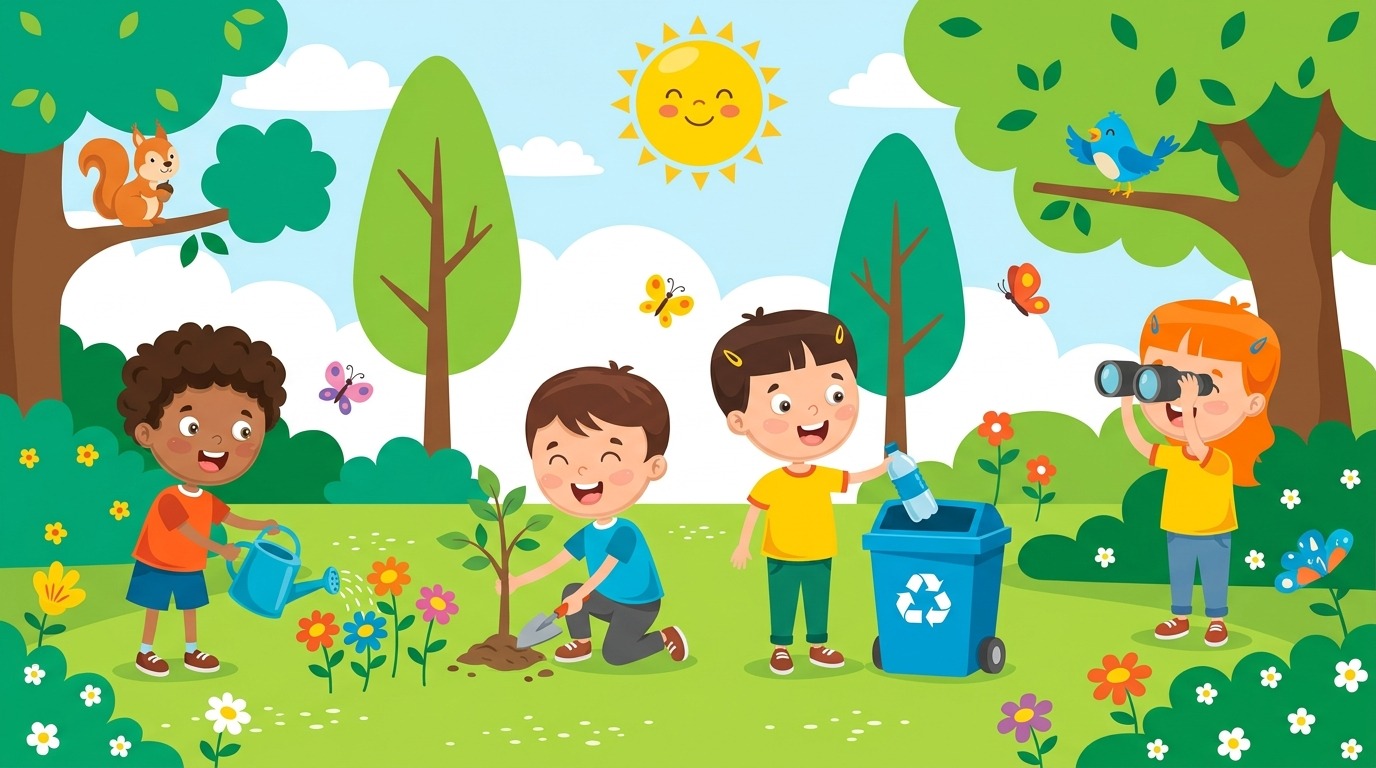
Concrete activities allow sustainable awareness. At home, in the schoolyard, or in the park, it is important to ritualize. Thus, each week can host a “green challenge” and a “minute experiment”. This short format anchors regularity and feeds motivation.
Easy and safe experiments
A yogurt pot, some soil, and seeds are enough to observe germination. Children note growth, compare light and shade, then build a mini-greenhouse with reused packaging. This simple protocol connects science and recycling. Another quick idea: measure water consumption while washing hands with and without turning off the tap. The difference surprises and triggers a lasting gesture.
To discuss urban heat, place two thermometers on a dark slab and in the grass. After ten minutes, temperature differences open discussion about trees, shade, and urban biodiversity. These micro-experiences make often abstract issues visible.
Cooperative games and family challenges
Cooperation strengthens engagement. Here is a list of short activities to insert in the week:
- 🧺 Minute sorting ♻️: time sorting a small bin, then check mistakes together.
- 🥪 Zero-waste snack: reusable box, water bottle, cloth napkin, peel composting.
- 🔎 Insect safari: observe, draw, then release without capturing long-term.
- 🚲 Soft mobility outing: count trips without car and celebrate milestones.
- 🎲 Market eco-bingo: find a seasonal vegetable, a local producer, a reused basket.
These games adapt to all ages. They also create shared memories, drivers of learning.
Thematic kits and playful investigations
Educational kits offer ready-to-use paths. They gather sheets, experiments, and scripted games like treasure hunts or escape games. Several themes are available for ages 3-6 and 6-10: global warming, biodiversity, pollution, oceans, energy, or sustainable development. Each adventure proposes simple handling and a final quiz to anchor concepts. From about €14.99, these resources ease organization and free up quality time.
A striking example comes from a family who tested the climate module. The children modeled ice melting in saltwater and freshwater. They then imagined a letter to future inhabitants. This storytelling triggered true pride in acting, without moral heaviness.
To nourish these workshops, targeted video research helps to launch discussion and capture collective attention.
Finally, a mini family “nature commission”, with very short agendas, formalizes decisions: which seasonal fruits this week? What soft transport challenge for the weekend? This light governance establishes overall coherence.
Climate, forests, oceans: explain major issues without fear
Talking about “big topics” becomes possible as soon as two rules are respected: use simple images and propose immediate solutions. Animated videos are precious because they embody issues with characters and everyday situations. They serve as introductions to active workshops.
Climate, a story of connections
Climate differs from weather by its duration. In class, a temperature and rain journal over a month illustrates this idea. Then, a “climate links” game shows how oceans and forests absorb CO2, regulate humidity, and protect life. Children build a chain with “soil”, “trees”, “clouds”, “animals” cards. Then scenarios are tested: what happens if the forest recedes? This approach questions without alarming and opens to concrete actions.
To anchor understanding, a “turn off, unplug, share” workshop fixes three reflexes. Turn off lights, unplug standbys, carpool. These actions reduce the energy footprint and provide daily markers.
Forests, allies to protect
Short films show the flip side of deforestation, notably linked to certain crops and overconsumption. For the youngest, the goal is not to guilt but to understand animal habitats, soil role, and the magic of photosynthesis. A simple workshop consists of measuring the shadow of a tree at noon, then drawing the cool zone. You physically feel the service rendered.
At home, a “day without spread with controversial oil” can open debate on more responsible alternatives. Far from a ban, it is a test. Homemade recipes are tasted and labels read. This learning stimulates sense, autonomy, and critical thinking.
Oceans, a fragile and vital world
Oceans regulate climate, feed billions of humans, and house countless species. Yet, six out of seven species of sea turtles are classified as threatened. To grasp this fragility, building a food chain with everyday objects works well: green ribbon seaweed, small blue fish, red predator. The domino effect is observed when a link is removed. Then comes the “ghost net” workshop with a rope and corks, to talk about debris trapping wildlife.
After viewing, children suggest gestures to protect the sea: reusable bottles instead of plastic ones, rigorous selective sorting, litter collection during a walk. This links emotion to action, an essential condition to cultivate lasting motivation.
These three thematic paths always conclude with a positive creation: a classroom shield “climate ally”, a mural of the living forest, a map of happy turtle currents. The final image remains in mind and fuels momentum.
Progress by age: from kindergarten to high school, tailored environmental education
Environmental education becomes more effective when it respects developmental stages. Each age group requires adapted formats, without lowering scientific rigor. The central idea: offer accurate but digestible content, which the child can reuse independently.
3-6 years: explore through senses and routine
At this age, very short rituals are favored. Water the classroom plant, turn off the light when leaving, sort two visible streams. A “mystery” bin offers leaves, stones, pine cones. The child touches, describes, compares. The adult’s stance values curiosity and autonomy. It is about laying foundations: respect for life, observation, patience.
Stories and action rhymes are ideal. They combine movement, speech, and emotion. At the end of the week, a “wow moment” invites everyone to share a discovery. This feedback nourishes memory and confidence.
6-9 years: understand by playing, act as a team
Reading progresses, reasoning enriches. Cooperative challenges, guided experiments and “sorting guardians” missions are introduced. Short videos launch debate, then action follows. An investigator’s notebook accompanies water, energy, or waste recordings. At home, roles rotate: tap master, light captain, compost chief. This framework builds responsibility without rigidity.
Family programs with stories, games, and activities strengthen the parent-child bond. They suggest quarterly content and supports to start discussion. These varied themes keep learning fresh and open to global issues.
10-15 years: investigate, compare, debate
From age 10, the child can use thematic sheets autonomously. They include climate, oceans, forests, plastic, or emotion management facing issues. Each sheet offers activities, resources, and an “action box” to raise awareness around oneself. At this age, debate becomes central. Sources are compared, weather and climate distinguished, and the footprint of an everyday object like a plastic spoon measured from production to end of life.
In middle and high school, educational videos on threats and solutions guide concrete projects: gardens, local fauna inventories, youth council advocacy. This approach anchors citizenship and critical thinking, two essential levers for genuine sustainable development.
To connect learning, meetings with associative actors, local groups, or green professions illuminate perspectives. Adolescents envision themselves, see engagement paths, and consider coherent training choices.
Establish sustainable routines: tools, cooperation, and positive evaluation
Routines turn good intention into habit. The key lies in simplicity and consistency. Starting with two measurable eco-gestures is enough. For example, tracking “bottle vs. reusable bottle” and a chart of lights turned off. Progress is celebrated every week, even if small. This recognition feeds perseverance.
Visual tools and gamification
A wall dashboard visible to all, with stickers and small missions, makes the process motivating. Add a step counter by bike or foot, a seasonal fruit and vegetable calendar, and a graph of waste avoided. Gamification should not crush meaning. It is support, not an end. Goals remain realistic and regularly revised.
A digital or paper logbook facilitates traceability. Children paste photos, tickets from soft transport, eco-designed product labels. Trends are visualized, choices adjusted. This “home data” becomes a support for concrete math and language.
School-family-association cooperation
The collective strength multiplies impact. A school opening to a naturalist association to inventory the yard learns differently. A class contacting a local group engaged in nature protection discovers professions and projects. At home, a symbolic “green project” fund finances a tree to plant or birdhouses. This network creates shared culture.
To support momentum, weekly video capsules with practical advice can be shared in family. They inspire and avoid starting from scratch. Children become enthusiastic messengers to relatives, a powerful change driver.
Evaluate without stress, adjust without punishing
Positive evaluation focuses on progress made. Effort, cooperation, inventiveness are measured. Mistakes serve as springboards. A very short monthly report, with three columns “keep, improve, try” favors adjustment without blame. The goal remains clear: learn to learn, and live ecology as a social and emotional skill.
At period end, organizing an exhibition open to families values explorations: naturalist drawings, experiment protocols, before/after photos of the nature corner. This celebration seals commitment and invites imagining the future.
In short, a successful routine combines simplicity, measure, and joy. It transforms environmental education into shared culture and pride in acting.
How to present sorting without unnecessary complexity?
Limit categories at the start (paper, packaging, glass, household waste) and use colorful pictograms. Add a daily verification ritual, then later expand to composting or recycling centers.
What quick activities for a 20-minute class?
An eco-bingo of reusable objects, a minute experiment on water (tap closed vs open), or a sound safari to identify three bird songs. Each activity ends with a concrete gesture to reproduce at home.
How to address strong images of deforestation with the youngest?
Prefer metaphors and stories about animals to protect, then propose an immediate positive action (plant, mulch, save paper). Avoid shocking details and refocus on solutions.
What levers to maintain motivation over several months?
Install a visible dashboard, set realistic challenges, vary formats (game, investigation, outing), celebrate milestones and renew responsibilities within the group.
How to connect home and school around the same approach?
Share a common logbook, launch a monthly family-class challenge, organize a quarterly mini-exhibition, and invite a local association for joint intervention.
“Awakening an ecological conscience is to offer children the joy of inhabiting the world as inspired protectors.” ✨