Distance Games with Loved Ones: Game ideas to play remotely with your loved ones.
| Short on time? Here’s the essence ⏱️ |
|---|
| Mix the formats: quiz, drawing, strategy, blind test, for a remote entertainment suited to all 🎯 |
| Keep clear and visible rules on screen to limit bias and avoid tensions in social play ✅ |
| Vary the durations: 10 minutes for a mystery word, 30 minutes for Werewolf, 60 minutes for a tournament ⏳ |
| Favor collaborative play with children, then slip in a competitive challenge to reignite the energy 🤝 |
| Equip yourself: Board Game Arena, JKLM.fun, Wolfy, Kgames, TriviaMaker… reliable and accessible online games 🧰 |
Distant families, scattered friends, and blended tribes are looking for easy-to-launch remote games rich in connection. Today, platforms transform a simple video call into an interactive game where everyone participates, laughs, and pushes themselves. From modernized classics to clever new arrivals, the offer explodes, covering all ages, temperaments, and skill levels, without complicated equipment.
When schedules tighten, multiplayer games create a flexible meeting point, often more inclusive than an outing. The little ones feel included, teens regain the desire to play with adults, and grown-ups reconnect with lightheartedness. Combining video games, online board games, and mini creative challenges, everyone finds their place. Above all, bonds strengthen, even when miles join the table.
The perfect online games for remote family entertainment
The heart of a successful evening lies in a measured mix of cooperation and competition. Online games that promote mutual aid reassure the youngest and warm the atmosphere, before a final sprint awakens the competitive spirit. This simple balance keeps attention and avoids frustration, a crucial point in remote family play.
On the video game side, Animal Crossing’s return has brought island visits, small favors, and item exchanges back into vogue. This gentle world stimulates creativity and values attentions, perfect for bringing grandparents and children together. In the same spirit, Overcooked 2 heats up the kitchen, but pushes players to communicate to fulfill orders.
On smartphones, Mario Kart Tour offers quick races with eight players. Short sessions fit well between activities and reinforce the desire to play again. The UNO app, very faithful to the physical game, even allows rule adjustments via the “Fun Room”, useful when families have different habits.
To animate video calls, Houseparty popularized the idea of a video lounge including mini-games like Time’s Up, Pictionary, or Trivial. Up to eight guests can easily meet. This hybrid approach strengthens social play by focusing on looks, facial expressions, and side conversations—ingredients missing from plain chats.
With children, a clear framework helps a lot. Before the game, announce durations, speaking turns, and victory criteria as you would on a playground. Tips for providing a reassuring framework remain valid, and one can be inspired by cues proposed for public play areas in this article on setting simple and understood rules for all. This reflex prevents overflows and strengthens trust.
Screen time also deserves flexible and coherent attention. When very young children participate, suggest short formats, observation games, and regular breaks. Useful references appear here to support young children’s screen time. Thus, remote entertainment remains a shared pleasure, without overload.
In case of suspected cheating, emphasize the hand-table camera for card games or use platforms’ built-in logs. Don’t accuse; set up visible “fair-play” rules on a small board. Tensions quickly drop when arbitration is known in advance and applied with kindness.
Ultimately, choosing accessible, cooperative, and short titles secures beginnings. You can then switch to more competitive challenges, driven by the strengthened relationship.
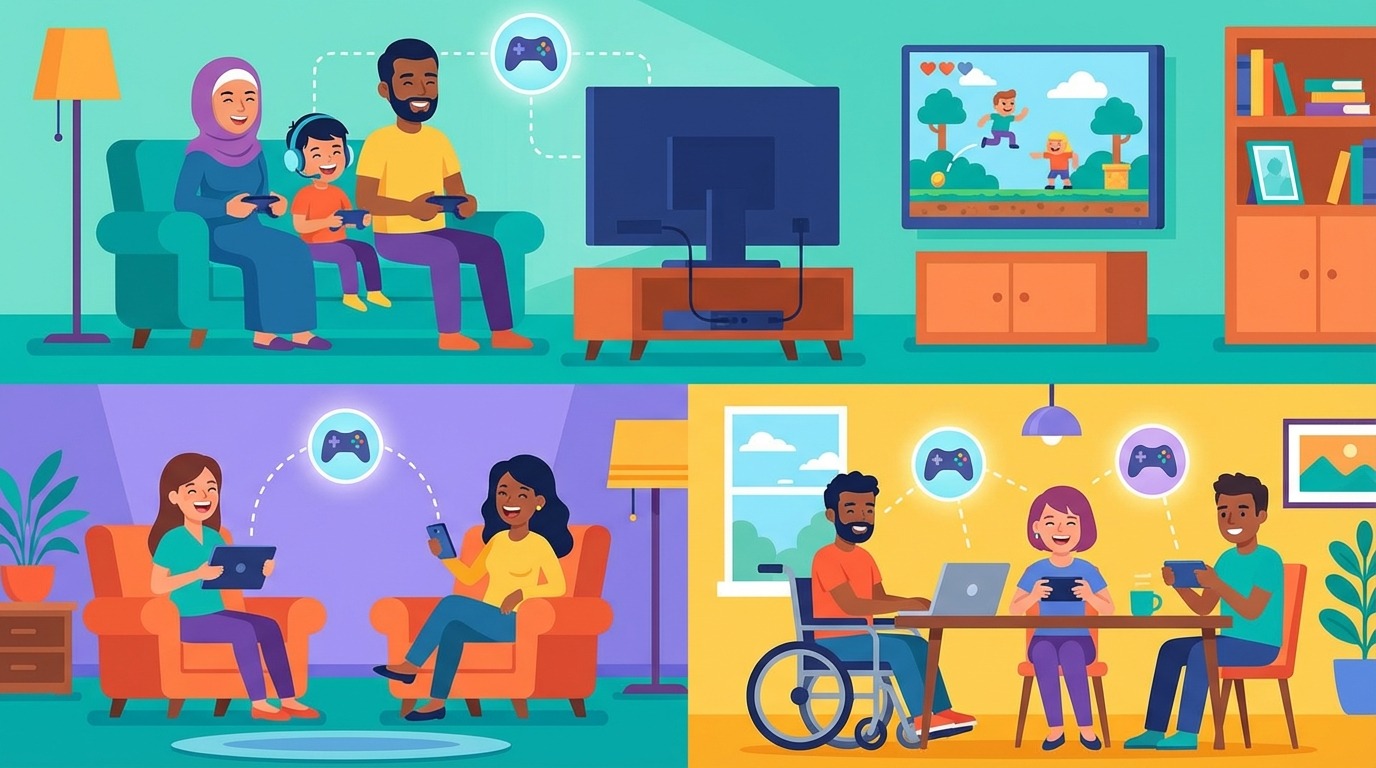
20 best games for friends and family at long distance
To structure a solid game library, group titles by “desires”. Drawing lovers adore Skribbl.io and Gartic Phone, which twist reality and spark laughter. Quiz fans rush to Mukiz for precise music blind tests, or to TriviaMaker and Trivia Creator for customizable formats.
Strategic players feast on Wolfy (a version inspired by Werewolves), while Board Game Arena hosts belote, tarot, chess, and a Werewolf game for up to 50 players. General knowledge curious test Wikirace, and visual explorers dive into Lostgamer.io, inspired by GeoGuessr but rooted in video game universes.
For completion, JKLM.fun offers BombParty, where you must find words before the explosion, and PopSauce, a quiz with adjustable categories. Kgames offers a collection of mini-games, from bluff to culture. We don’t forget UNO on mobile, Rummikub online, nor gems like Limite Limite for sharp adult humor.
Need “ready-to-play” ideas with the little ones? The online Petit Bac works wonderfully, as does this grocery store guessing game that trains children to categorize and name. These fast formats avoid boredom and spark rich discussions.
In sibling groups, age gaps often create imbalances in pure competition. Opt for mixed teams and fairness bonuses. Some relational cues from family situations are detailed here on age gap between siblings. Games for loved ones gain quality when everyone feels useful in their own way.
Choose by age and mood
When energy is low, favor quizzes or a short collaborative game. More lively evenings suit Mario Kart Tour or point-based challenges. You can also build a mini-tournament mixing a blind test, drawing, and a word duel to balance talents.
- 🎨 Hilarious drawing: Gartic Phone, Skribbl.io
- 🧠 Quiz and blind test: Mukiz, TriviaMaker, PopSauce
- 🐺 Social deduction: Wolfy, Werewolf BGA
- 🗺️ Culture and observation: Wikirace, Lostgamer.io
- 🃏 Timeless classics: UNO, Rummikub, Petit Bac
Diversity feeds motivation, and motivation maintains the pleasure of replaying. It’s the best recipe for lasting meet-ups.
Vary rhythms, combine short challenges, and build mixed teams to create smooth evenings where no one drops out.
Online games to have fun remotely with family: caring framework and suitable ideas
Successful intergenerational sessions rely on three levers: simple rules, controlled time, and a choice of interactive games that value each participant. When a toddler joins the screen, favor observation, repetition, and gentle transitions. References about baby motor development help calibrate expectations and choose simple actions.
The camera can be intimidating. Some children need a safe space, especially at the age when stranger anxiety appears. This synthetic resource sheds light on this delicate moment about fear in young children. Start with “peekaboo” on screen or visual riddles, then gradually extend.
The time frame must remain clear. Announce total timing, a water break in the middle, and a photo moment at the end. This cue ritualizes the experience and helps the most sensitive anticipate the end of remote entertainment.
Game choices must reflect the goal. To build trust, first choose cooperative games for loved ones. Competitive challenges will return once dynamics are secure. The switch is then experienced as a celebration, not a test.
Toolbox for a smooth session
- 🧭 Define a “game plan” displayed on screen (order of games, durations, key points).
- 📷 Activate hand camera for cards and dice if necessary.
- 🔔 Provide transition signals (soft sound, visual timer).
- 🧩 Alternate cooperation and duels to maintain attention.
- 🌟 Value every contribution, even a rough drawing or partial word.
Shyness may hold back a preschooler. Introduce them first as “color referee” on Skribbl or “time keeper”. This role values without exposure. Additional tips appear here to help a shy preschooler. With this kind of support, remote family play becomes a social training space.
Screen time should remain measured. Balance the week and favor days when alertness is good. Concrete and nuanced references are recalled in this guide on screens and young children, useful to stay on course without rigidity.
In sum, kindness, predictability, and accessible games build lasting trust. It is the foundation of a flourishing relationship, screen on or off.
Top platforms for playing online with friends and having fun remotely
Knowing platforms’ DNA simplifies planning. Board Game Arena suits families who love refined classics and fine rule management. There you find Werewolf with many roles, plus tarot, belote, chess, and hundreds of digital board games with smooth graphics.
For fast and brainy challenges, JKLM.fun shines with BombParty and PopSauce. Matches take a few minutes, ideal to start the evening or revive the group. Categories, turn duration, and number of lives can be set, structuring difficulty without exclusion.
Wolfy modernizes social deduction and offers intuitive interfaces. Since January, the former competing reference being unavailable, many groups meet here by reflex. Role clarity and chat fluidity improve accessibility, even for newcomers.
Kgames aggregates various mini-games. You find bluff experiences like Spyfall, culture quizzes, and fun geo challenges. This diversity suits heterogeneous groups and siblings of different ages.
For learning while having fun, Wikirace stimulates curiosity. You start from one article and reach another in minimal clicks. Teens love the “flash journey” side, while adults discover unlikely topics to tell later.
Lostgamer.io offers a rare immersion. Explore famous game maps, observe details, then guess your position. Open world fans spend hypnotic moments here, while strengthening their observation skills.
Animation tools and practical integrations
To create your own shows, TriviaMaker and Trivia Creator transform Zoom or Discord into a TV set. You build custom themes, add a jingle, and award bonus points. The host announces scores, then opens a “fan favorite” vote to boost team spirit.
If the family grows, organization tightens. Plan shorter, more frequent sessions, and adjust times according to rhythms. Modern challenges around parenting and family calendars are addressed in this summary on late pregnancies and their challenges in 2025. This reality impacts logistics and game selection.
A good platform respects time, clarity, and inclusion. When these criteria are met, social play gains quality and consistency.
Technology then becomes invisible, and the relationship regains first place. It’s a sign your tools are well chosen.
Playing together: concrete scenarios, rituals that bring closer, and playful pedagogy
Imagine the “Martin tribe,” split between Lyon, Liège, and Montreal. On Wednesdays, they follow a simple routine: 10 minutes warming up, 20 minutes of crazy drawing, 15 minutes of music quiz, then a mini final duel. This agile format brings together three generations without exhausting anyone.
The youngest, four years old, starts as “color chief” on Skribbl. Over weeks, he dares to suggest a word and gets applauded. The big sister, more competitive, shines on Mario Kart Tour and practices coaching the little ones. The eldest, a geek culture fan, hosts a surprise Wikirace.
A difficulty arises: the little cousin freezes on camera. The family reassures her and gives her a discreet role. Practical advice to support shyness in preschoolers guides adults. Two sessions later, she herself asks to keep the timer.
Among cousins, the age gap created tension. They formed mixed teams, “junior bonuses,” and a joker for the little ones. The dynamics calm down, and everyone finds their place. To reflect on these balances, this reference on sibling age gap offers useful paths.
Sometimes, a toddler shows anxiety facing new faces on screen. A welcome time with a comfort object, a ritual song, and eye-contact games often suffice. Some benchmarks are recalled in this guide on fear in children aged 1 to 3, precious to avoid misunderstandings.
The tribe also created a “kit for animation”. A cardboard sheet displays the order of games and durations. A digital hourglass runs on a tablet. Scores are noted on a slate held by a child-judge. This ritual secures and motivates, session after session.
Ready-to-use checklist for a successful evening
- 🗓️ Set a short but regular appointment.
- 🎮 Mix collaborative and competitive games.
- 📚 Plan a homemade quiz about family history.
- 🎵 Include a Mukiz blind test “holiday memories”.
- ✏️ Use free drawing to ease tension.
- 📌 Close with a group “funny faces” photo to archive the moment.
When family evolves (arrival of a baby, shifted schedules), flexibility takes priority. Shorten duration, keep essentials, and bet on very simple formats. New realities, described here on the stakes of later parenthood, remind that a good remote family game adapts instead of demanding.
In the end, a clear routine, some reliable tools, and listening to needs are enough. Remote games then become anticipated appointments, nurturing ties week after week.
{“@context”:”https://schema.org”,”@type”:”FAQPage”,”mainEntity”:[{“@type”:”Question”,”name”:”How to prevent children from quickly getting bored during a video game session?”,”acceptedAnswer”:{“@type”:”Answer”,”text”:”Alternate very short games (5-7 minutes) and a slightly longer challenge. Provide rewarding roles for the youngest (color master, time keeper). Always end with a positive ritual (photo, dance, applause) to encourage them to come back.”}},{“@type”:”Question”,”name”:”Which platforms are simple to start a family evening?”,”acceptedAnswer”:{“@type”:”Answer”,”text”:”Board Game Arena for classics, JKLM.fun for fast challenges, Wolfy for social deduction, Skribbl.io and Gartic Phone for drawing, and Mukiz for instant blind tests. Combine two formats to keep the pace.”}},{“@type”:”Question”,”name”:”Is a fair-play charter necessary?”,”acceptedAnswer”:{“@type”:”Answer”,”text”:”Yes, display visible rules: speaking turns, hand camera for cards, time per turn, and kind arbitration. An anticipated framework defuses 90% of tensions and protects good mood.”}},{“@type”:”Question”,”name”:”How to manage the place of toddlers in games?”,”acceptedAnswer”:{“@type”:”Answer”,”text”:”Introduce them through observation, give them a simple role, and offer very short sensory or association games. Adjust duration according to their alert state and favor quality of connection over performance.”}},{“@type”:”Question”,”name”:”Which games to choose for very different ages?”,”acceptedAnswer”:{“@type”:”Answer”,”text”:”Form mixed teams, apply fairness bonuses, and chain several complementary mini-games (drawing, quiz, observation). Each shines in turn, motivation remains high, and fairness builds naturally.”}}]}How to prevent children from quickly getting bored during a video game session?
Alternate very short games (5-7 minutes) and a slightly longer challenge. Provide rewarding roles for the youngest (color master, time keeper). Always end with a positive ritual (photo, dance, applause) to encourage them to come back.
Which platforms are simple to start a family evening?
Board Game Arena for classics, JKLM.fun for fast challenges, Wolfy for social deduction, Skribbl.io and Gartic Phone for drawing, and Mukiz for instant blind tests. Combine two formats to keep the pace.
Is a fair-play charter necessary?
Yes, display visible rules: speaking turns, hand camera for cards, time per turn, and kind arbitration. An anticipated framework defuses 90% of tensions and protects good mood.
How to manage the place of toddlers in games?
Introduce them through observation, give them a simple role, and offer very short sensory or association games. Adjust duration according to their alert state and favor quality of connection over performance.
Which games to choose for very different ages?
Form mixed teams, apply fairness bonuses, and chain several complementary mini-games (drawing, quiz, observation). Each shines in turn, motivation remains high, and fairness builds naturally.
“Remotely, we don’t play to fill a screen, we play to bring hearts closer.”