Gross Motor Skills Baby: The development of the baby’s gross motor skills at 4 months.
| Short on time? Here’s the essentials ⏱️ |
|---|
| At 4 months, head control strengthens and paves the way for rolling over and forearm supports 🤸 |
| Daily tummy time is the key to muscle strengthening of the neck, back, and shoulders 💪 |
| Primitive reflexes gradually fade in favor of hand-eye movement coordination 👀✋ |
| An open and safe floor space encourages free motor exploration and confidence 🌟 |
| Each baby has their own pace: milestones serve as flexible guides, not verdicts 📈 |
At 4 months, the baby goes through a pivotal period where their motor development shifts speed. Movements organize, supports get more precise, and curiosity about the world triggers genuine motor exploration. This age range marks a gradual transition from primitive reflexes to more voluntary actions, supported by improved muscle tone. In practice, we see stronger support on forearms, a more stable head control, and the beginnings of rolling over. These are essential foundations for what follows.
However, it is never about going faster than nature. Milestones remain markers, not deadlines. Thus, everyday arrangements, simple floor games, and a regularly offered tummy time position are powerful levers. With some concrete adjustments and a lot of observation, each family can nurture gross motor skills without overstimulation. And because safety always accompanies the freedom to move, a prepared environment prevents falls while supporting the drive towards autonomy.
Gross motor skills at 4 months: neuro-motor bases and links with fine motor skills
Gross motor skills refer to large movements that mobilize entire muscle chains. They prepare walking, running, the ability to climb or sit. Conversely, fine motor skills concern precise gestures like picking up a small bead or turning a page. At 4 months, the baby strengthens trunk, shoulder, and neck muscles, consolidating head control. This progression also supports hand adjustments towards objects, a prerequisite step.
There is a strong interdependence between these two domains. By consolidating the body’s center, the shoulders become more stable and the hand gains precision. That’s why before requesting a precise movement, it’s better first to ensure solid supports. To deepen this continuum, a structured overview of milestones helps orient daily life. A detailed resource, like this guide on baby motor development, allows anticipating stages without pressure.
Primitive reflexes and emergence of voluntary gestures
During the first weeks, primitive reflexes dominate. The grasp reflex progressively becomes intentional around 3-4 months. This integration frees bandwidth for movement coordination. Gazes focus better, hands meet at the midline, and the child explores their knees with new curiosity. This phase marks a real turning point for gross motor skills, as the child starts organizing in space.
In a family’s daily life, a guiding thread is essential: regularity, simplicity, observation. A firm mat, some contrasting objects, and short, frequent tummy time sessions are often enough. Progress appears quickly: symmetrical supports, held head longer, and small weight shifts that herald future rolls.
Frequently asked question: should “technical” exercises be offered? Routines based on play and relationship work better. The baby follows the parent’s face, laughs, and engages longer. Thus, pleasure becomes the best driver of progress.

4-month-old baby: head control, tummy position, and first rollovers
At this stage, axial muscle tone improves. In tummy position, the baby can lift their head and chest, lean on their forearms, and turn their head from side to side. This triptych prepares rolling over and future sitting. More coordinated leg movements are also observed, initiating weight transfers. This supports trunk stability and posture changes preparation.
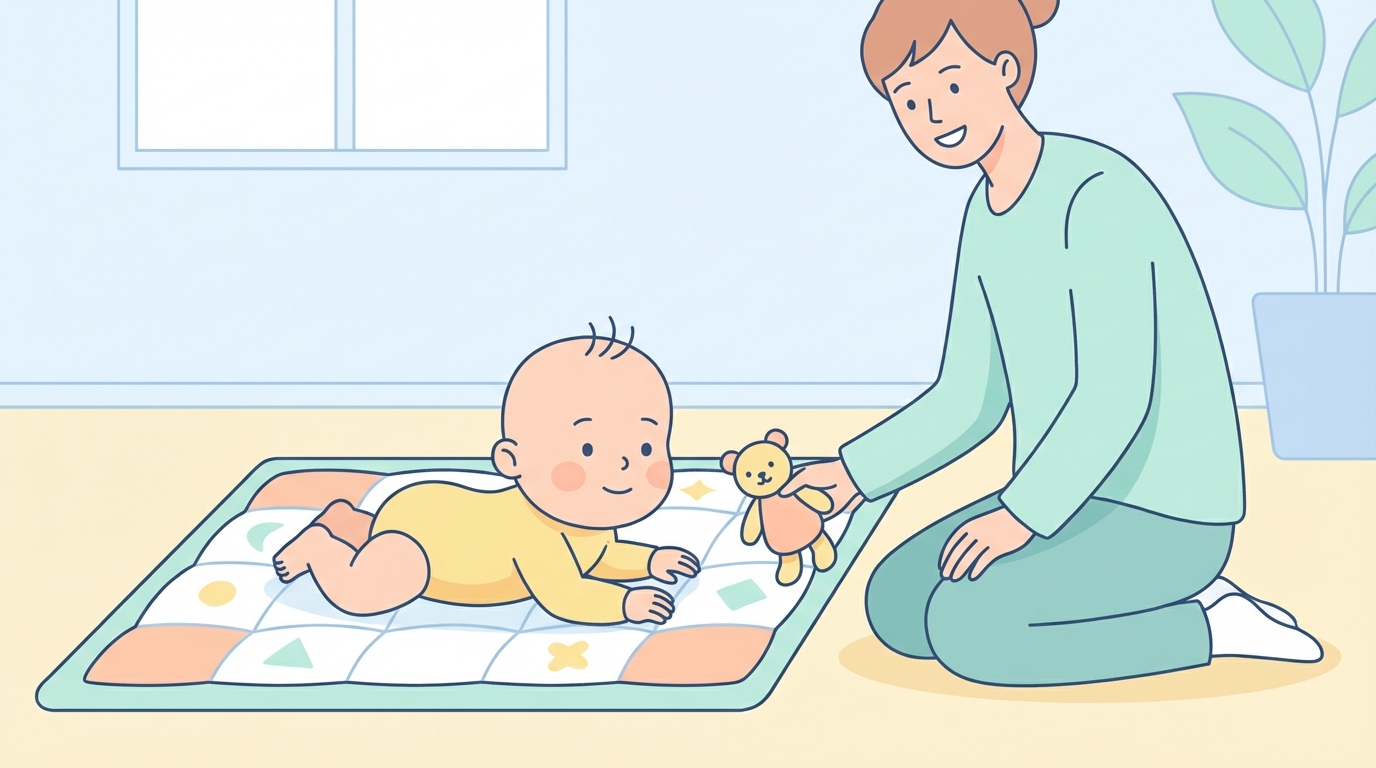
“Tummy time” remains the key activity. Ideally, this is broken into several short sessions spread throughout the day. A firm surface, a flat cushion under the chest if needed, and a familiar face at eye level create a reassuring setting. These conditions encourage free motor exploration, without overexertion. To limit prolonged pressure at the back of the skull, these tummy sessions also contribute to flat head prevention.
Movement coordination and concrete adjustments
When hands reach the midline, the baby looks, touches, and grabs better. Head nodding decreases as head control gains stability. To support these acquisitions, soft clothes that don’t hinder shoulder and hip supports facilitate movements. Everyday brands offer comfortable and practical outfits; exploring items at Vertbaudet can help equip without restricting freedom to move.
Field case study: Lina, 4 months old, quickly gets frustrated on her tummy. Her parents place an unbreakable mirror near the mat and position themselves facing her. Singing, they invite her to lift her head more. Quickly, she tolerates longer sessions and begins swiveling her trunk to look at a sound rattle. This progression illustrates the combined power of motivation and repetition.
Finally, as autonomy increases, vigilance is necessary. Changing tables or sofas may deceive by their height. To reduce domestic risks, this practical guide on baby fall prevention presents simple and effective strategies. It’s better to plan a prepared floor space than multiply elevated equipment.
Playful activities and safe muscle strengthening at 4 months
Play initiates muscle strengthening organically. The goal remains to increase tummy support time, stimulate scapular mobility, and support symmetrical supports. The suggestions below easily fit into a typical day. We stay attentive to fatigue signals and favor short but frequent sessions.
Simple ideas to implement daily
- 🐣 Tummy time in pairs: lie face to face on the floor. Tummy position for baby, on the side for the adult, to encourage gazes and supports.
- 🎵 Nursery rhymes and gaze: singing at eye level strengthens alignment and head control.
- 🪞 Unbreakable mirror: place a small mirror to trigger head rotation and eye-hand movement coordination.
- 🧦 Soft clothing: avoid outfits too stiff that hinder shoulder and hip supports.
- 🧸 Light toys: soft rattles, easy-to-grasp rings, inspired by ideas seen at Fisher-Price and baby development.
- 🛝 Assisted mini-rolls: guide the pelvis to initiate a half roll, always on a firm mat.
To nurture imagination without forcing pace, seasonal inspirations stimulate curiosity. For example, sensory objects with soft textures can vary supports and enrich the experience. In another vein, families like to collect activity ideas for later. Browsing resources like activities for a 17-month-old baby helps visualize the overall journey, reassuring about progress.
Throughout the year, playful proposals help celebrate small milestones. Some themed selections, like Advent calendars for babies, can become cheerful pretexts to explore, touch, look, and turn the head. Not essential, but novelty often motivates engagement from the little one.
Last ergonomic tip: place toys slightly to the side to encourage head rotation, then alternate sides. This simple trick strengthens muscle symmetry and reduces postural preferences. After a few days, longer support times and smoother movements are often observed.
Setting up a free motor environment and preventing risks
Freedom to move does not mean lack of structure. A well-defined floor space promotes gross motor skills while maintaining a high safety level. A firm, non-slip mat, light toys, and a calm corner without visual overload create a scene conducive to motor exploration. Minimalist tidying limits distractions and facilitates the baby’s focus on their supports.
Regarding equipment, prioritize the floor over elevated surfaces. Bouncers and molded seats should remain very occasional at 4 months, as they limit self-adjustments. The child needs to experience their supports to organize their body. On elevated surfaces, vigilance must be maximal. This reminder on fall prevention helps consider key daily details.
Reducing cranial pressure and supporting comfort
Back time is useful but if prolonged, can encourage flattening at the back of the skull. To counterbalance, multiply tummy sessions and vary carried positions. This combination contributes to flat head prevention. It’s also beneficial to alternate bed orientation and light sources to encourage balanced head rotations.
Clothing ergonomics play a discreet but real role. Soft bodysuits, stretchy leggings, and non-slip socks support freedom of movement. To find suitable pieces, the range of comfortable baby clothes has expanded with cuts designed for floor activities. Good clothes should neither squeeze the waist, hinder hips, nor mark the shoulders.
In this setup, parents remain the best “coaches.” By positioning at eye level, speaking softly, and offering attractive objects, they invite movement without forcing. One simple rule applies: if the child gets upset, pause, comfort, then resume later. The goal is not performance but quality exploration.
Key milestones at 4 months, warning signs, and calm support
Gross motor milestones provide guideposts, not verdicts. Around 4 months, many babies hold their head better, support themselves briefly on forearms, and initiate rolling movements. Others will go faster or slower. This dance between maturation and practice is seen in trajectory variety. Progress is never linear, and that’s normal.
When to seek advice? If head control remains very unstable, if one side is systematically avoided, or if the child shows persistent stiffness or floppiness, a check-up is needed. Dialogue with the pediatrician often soothes concerns and directs, if necessary, towards physiotherapy or psychomotor follow-up. For a panoramic view of progress, this dossier on motor development offers useful benchmarks.
Practical roadmap and immediate actions
While waiting for advice, regular floor play and tummy time remain allies. Observe the child in action, take quick notes, and adjust proposals. To project longer term, testimonials on progress towards 16 months help imagine the future without rushing stages. The goal is not to accelerate but to support a harmonious pace.
| Marker/Observation 📌 | Interpretation 🧭 | Concrete Action ✅ |
|---|---|---|
| Better head holding on tummy | Good developing axial muscle tone | Increase short tummy time sessions 🤸 |
| Head preference on one side | Postural asymmetry to rebalance | Alternate sides, vary lighting, seek advice if persistent 🩺 |
| Quick frustration on tummy | Demanding but necessary effort | Break up sessions, lie face to face, sing, use mirror 🪞 |
| Weak forearm support | Need to strengthen scapular girdle | Toys slightly shifted, flat cushion under chest for a few minutes ⏳ |
One last attitude word can change everything: value every micro-progress. Holding a bit longer, shoulder roll, or smoother head rotation deserve celebration. This recognition strengthens the baby’s motivation and parents’ confidence, day after day.
“To grow strong, a baby doesn’t need to go fast, they need to go free.”
{“@context”:”https://schema.org”,”@type”:”FAQPage”,”mainEntity”:[{“@type”:”Question”,”name”:”Combien de temps de position sur le ventre proposer u00e0 4 mois ?”,”acceptedAnswer”:{“@type”:”Answer”,”text”:”Viser plusieurs su00e9ances courtes chaque jour, par exemple 3 u00e0 5 minutes ru00e9pu00e9tu00e9es souvent. Ajustez selon lu2019humeur et les signaux de fatigue. La ru00e9gularitu00e9 compte plus que la duru00e9e du2019une seule su00e9ance.”}},{“@type”:”Question”,”name”:”Mon bu00e9bu00e9 nu2019aime pas le tummy time, que faire ?”,”acceptedAnswer”:{“@type”:”Answer”,”text”:”Commencez sur votre poitrine, inclinez-vous lu00e9gu00e8rement, parlez-lui, chantez, et utilisez un miroir ou un jouet sonore. Fractionnez en micro-su00e9quences et augmentez progressivement.”}},{“@type”:”Question”,”name”:”Quels jouets privilu00e9gier pour la motricitu00e9 globale u00e0 4 mois ?”,”acceptedAnswer”:{“@type”:”Answer”,”text”:”Choisissez des objets lu00e9gers, faciles u00e0 saisir, texturu00e9s, et placez-les lu00e9gu00e8rement de cu00f4tu00e9 pour encourager la rotation de la tu00eate et les appuis des avant-bras.”}},{“@type”:”Question”,”name”:”Quand su2019inquiu00e9ter pour le contru00f4le de la tu00eate ?”,”acceptedAnswer”:{“@type”:”Answer”,”text”:”Si la tu00eate bascule nettement en arriu00e8re la plupart du temps ou si lu2019enfant u00e9vite systu00e9matiquement un cu00f4tu00e9, u00e9changez avec le pu00e9diatre. Un avis pru00e9coce oriente les ajustements nu00e9cessaires.”}},{“@type”:”Question”,”name”:”Faut-il des u00e9quipements spu00e9cifiques pour stimuler le du00e9veloppement moteur ?”,”acceptedAnswer”:{“@type”:”Answer”,”text”:”Pas nu00e9cessaire. Un tapis ferme, du temps au sol, des vu00eatements souples et une pru00e9sence attentive suffisent u00e0 soutenir la motricitu00e9 globale du bu00e9bu00e9 de 4 mois.”}}]}How long should tummy time be offered at 4 months?
Aim for several short sessions daily, for example 3 to 5 minutes repeated often. Adjust according to mood and fatigue signals. Regularity counts more than the length of a single session.
My baby doesn’t like tummy time, what to do?
Start on your chest, lean slightly, talk to them, sing, and use a mirror or sound toy. Break into micro-sessions and gradually increase.
Which toys to favor for gross motor skills at 4 months?
Choose light objects, easy to grasp, textured, and place them slightly to the side to encourage head rotation and forearm support.
When to worry about head control?
If the head tilts sharply backward most of the time or the child systematically avoids one side, consult the pediatrician. Early advice guides necessary adjustments.
Are specific equipment needed to stimulate motor development?
Not necessary. A firm mat, floor time, soft clothes, and attentive presence are enough to support the gross motor skills of a 4-month-old baby.