Relaxation Video: Relaxation techniques for children.
| Short on time? Here’s the essentials 🧭 |
|---|
| Relaxation videos help children regain calm through visual and auditory cues 🎬 |
| Guided breathing remains the fastest lever to soothe stress 🫁 |
| A short, playful meditation improves relaxation and concentration 🧘♂️ |
| Regular evening rituals optimize sleep sustainably 🌙 |
| Alternating techniques and supports (audio story, breath, stretches) maintains engagement 🎯 |
In days paced by school, activities, and screens, parents look for simple resources to establish calm at home. Relaxation videos dedicated to children offer an accessible, reassuring, and structured format. In a few minutes, they guide conscious breathing, an illustrated meditation, or a mini relaxation story that defuses stress. This format is appealing because it combines the power of images, the musicality of the voice, and a predictable rhythm. It is a winning trio to soothe a young and curious mind.
Should everything be placed on the screen? Certainly not. However, wisely using a short video at the right moment changes the dynamic of a restless snack time or a complicated evening. Alongside concrete tools such as breath cards, weighted plush toys, or sleep rituals, these techniques strengthen emotional autonomy. They teach how to identify what soothes, and how to activate it without adult help. Thus, learning becomes gradual, joyful, and lasting.
Relaxation videos for children: why they soothe quickly
When a child gets restless, it is not due to lack of will. Their nervous system simply speeds up. Relaxation videos then serve as an external metronome. They propose a tempo, a soft voice, and visuals that focus attention. This combination reduces internal noise and creates a safety bubble. As a result, stress decreases and cognitive availability increases.
What the brain captures first
The brain of children loves sensory routines. A starting bell, an audible breath, then a repeated image anchor cues. Thus, the regularity of a three-minute meditation video becomes a bodily signal. The implicit message is imprinted: “here, we slow down.” This scheme-action association favors entry into relaxation.
Music also plays a strategic role. Deep and regular sounds balance excitement. Additionally, clear verbal guidance (“breathe in, count to three…”) translates the abstract into concrete gestures. The child immediately understands what to do, without guessing. This clarity reduces frustration and supports adherence.
Evidence and feedback from the field
In many preschool classes, a breathing video ritual suffices to turn a restless recess into a calm gathering. Lina’s example, age 6, illustrates well. After a busy day, her parent launches a short “candle-flower” module. In two breathing cycles, shoulders drop. Then, a smile appears. The body finally aligns with the instruction “calm.”
Family feedback converges: consistency matters more than the exact choice of video. The same clip, at the same time slot, installs a physiological anchor. The benefit accumulates week after week, somewhat like sports training. The child equips themselves with ready-to-use relaxation reflexes.
Choosing a suitable video
Three criteria prevail: duration, intelligibility, and progression. A 2 to 5-minute clip often suffices before age 7. Also, positive language is essential. Avoiding overly directive commands encourages cooperation. Finally, a simple progression (observe, breathe, release) aids success.
For refinement, a resource like this article for learning to calm a child provides concrete landmarks. The art is to stay playful. Because play remains the primary learning channel at this age.
After this first experience, it becomes relevant to explore more corporeal paths. Breathing is the fastest and most accessible entry point.
Playful breathing techniques in video for immediate calm
A child does not retain an abstract instruction. They retain an image, a game, a metaphor. That is why breathing techniques in video rely on concrete symbols. We blow out a candle, sniff a flower, inflate a balloon. Thus, the diaphragm mobilizes without complex speech. The body understands before the head, and calm settles in.
Three breath games that hit the mark
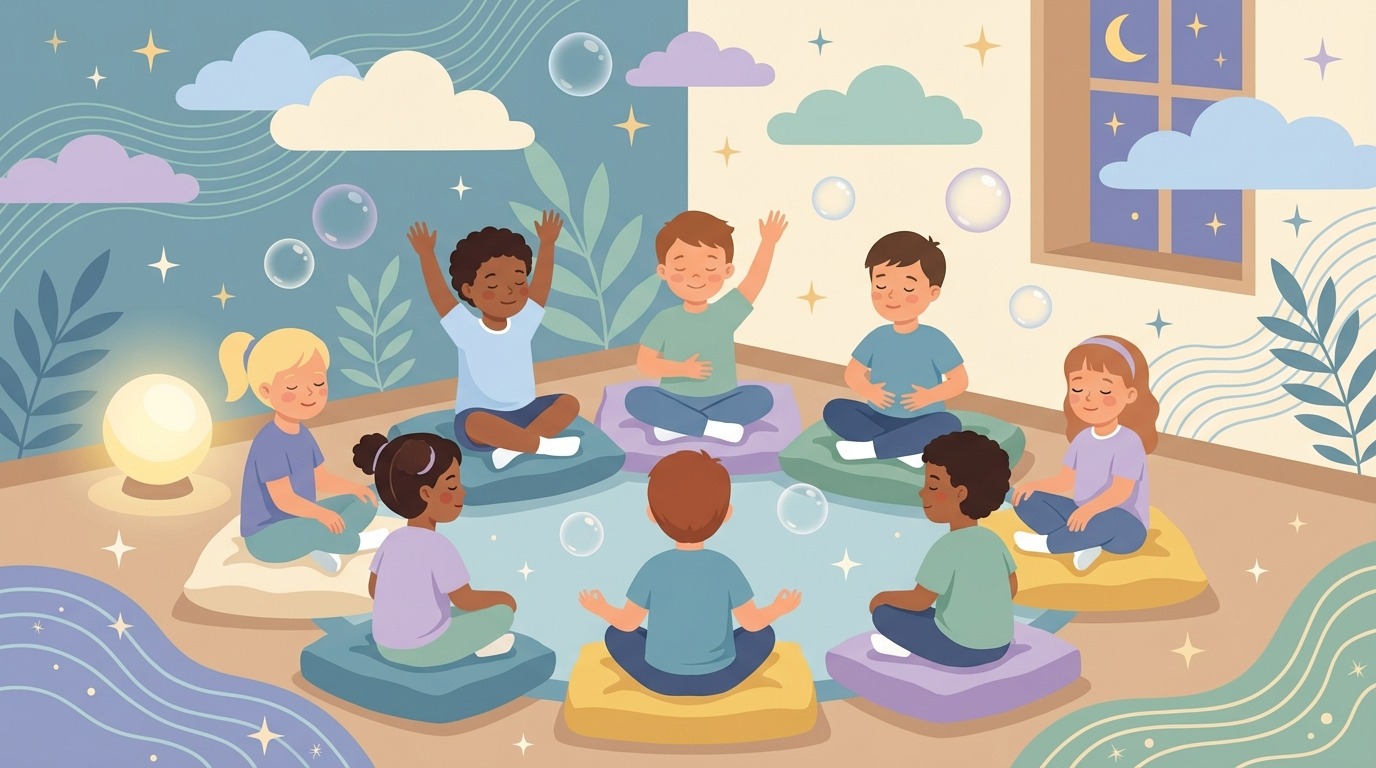
The “candle-flower” game alternates inspiration through the nose, expiration through the mouth. This cycle makes the rhythm readable. The “belly balloon” invites placing hands on the abdomen. You visualize the air inflating, then emptying. Finally, the “ocean wave” proposes a long breath while making a light “shhhh” sound. Gradually, stress eases.
- 🕯️ Candle-flower: breathe in the flower, blow the candle; simple, immediate, effective.
- 🎈 Belly balloon: hands placed, observe the gentle back-and-forth of the air.
- 🌊 Ocean wave: slow and sonorous expiration, ideal to lengthen the breath.
- 🐢 Turtle breathing: tuck the head, make yourself small, then open calmly.
- 🫧 Soap bubbles: make imaginary bubbles without popping them, thus blowing slowly.
These games may seem trivial. Yet, they regulate the vagus nerve, reduce heart rate, and anchor presence. As a result, the child quickly regains a bodily anchor. This anchor precedes any more settled meditation.
Structuring a mini-session
A clear framework helps. First, announce the duration: “three minutes.” Then, give a concrete goal: “we breathe so the shoulders become soft.” Finally, praise progress, not perfection. This approach strengthens intrinsic motivation. Thus, the child observes their success, which fuels the desire to try again.
To go further, the paths proposed in this article on quick calming methods enrich the family toolbox. One detail changes everything: offer the breath even when all is well. Because repetition in calm establishes solid automatisms, reusable during emotional storms.
Pitfalls to avoid
Too fast guidance cuts the benefit. Better to slow down and repeat. Also avoid comparing children: each has their own tempo. Finally, do not link these practices only to “crises.” Linking them to gentle moments gives them a positive coloring. Calm becomes a joyful skill, not a punishment.
When the breath becomes familiar, the mind can open to inner images. Guided meditation then naturally settles and enhances relaxation.
Guided meditation and visualizations: relaxation and imagination serving children
Meditation does not require perfect stillness. It demands a clear story, a warm voice, and a predictable rhythm. Successful videos offer accessible visualization: a soft cloud, a secret cabin, a sunset beach. With these images, the child feels like an actor. They “build” their inner space of relaxation.
Images that speak
The brain loves concrete metaphors. A cuddly toy becoming the guardian of calm. An imaginary key closing the door to stress. A chest that collects noisy thoughts. Thanks to these scenarios, attention focuses effortlessly. Interferences gradually dissipate.
A duration of three to eight minutes suits most children. Then, it is useful to mark the exit from the exercise: “we stretch, we yawn.” This transition prevents abruptness. It helps the body return to action while keeping a trace of calm.
Coupling with gentle movements
A micro yoga sequence improves anchoring. Two postures suffice: the tree child and the butterfly. Stability becomes a game. Combined with a clear video, this routine promotes attention and confidence. The benefits of yoga for children are extensively described: flexibility, emotional regulation, and better quality of sleep.
Concrete example at school and at home
In Paul’s class, age 7, a five-minute “walk in the magic forest” opens the writing workshop. Words come more easily because the mind has “put away its inner pencils.” At home, a “starry cabin” bubble before homework reduces endless negotiations. The child knows where to shelter internally.
This fertile ground naturally prepares the evening. Well-chosen evening rituals transform the bedroom into a soothing cocoon.
Evening relaxation rituals: preparing sleep without stress
Children’s sleep is nourished by gentle repetitions. Evening relaxation rituals are neither optional nor a luxury. They constitute a landing system. Dimmed light, slow breathing, calm story: these chained landmarks tell the body “we descend.” Falling asleep becomes easier, and night awakenings recede.
A simple and stable framework
Defining a fixed pattern helps the whole family. For example: 1) two minutes of “belly balloon” breath, 2) three minutes of slow stretches, 3) a four-minute meditation-story video. Thus, the brain recognizes the sequence. Bedtime loses its random and anxiety-provoking character.
The environment matters as much as the method. Lowering light intensity and stopping stimulating screens at least one hour before bedtime are pillars. For more, this dossier on reliable sleep advice offers concrete landmarks. These are basics to consolidate before adding everything else.
Audio stories and the weight of words
Present tense narration, with a slow pace, reassures. Words like “heavy,” “warm,” “soft” guide sensations. In parallel, breathing synchronized with the narrator creates a rocking feeling. The child no longer fights fatigue. They surrender to it confidently.
Managing night awakenings
A simple anchoring works at night: placing a hand on the belly, counting three slow breaths, then visualizing a “light blanket.” This sequence, repeated during the day, becomes a night pause button. It limits parental back-and-forth and gives power back to the child. Calm reactivates without drama.
Once the night is better organized, the day gains fluidity. Emotional storms remain to be tamed unexpectedly: tantrums, fears, separations.
Taming stress and strong emotions thanks to video techniques
Strong emotions are not enemies. They are urgent messengers. Relaxation techniques in video help listen without drowning. First, name it. Then, breathe. Finally, act: shake hands, blow long, imagine a protective bubble. This sequence turns the hurricane into fine rain.
When separation weighs heavy
For some children, morning separation remains tense. A short breathing clip, watched before leaving, prepares the switch. A bond ritual is associated: a heart drawn on the wrist, activated by three breaths. This protocol reassures parent and child. The paths offered around separation anxiety give practical levers.
Transforming anger
Anger needs movement. A “volcano breathing” video channels energy: inhale while standing tall, blow out strongly while lowering arms. Then move to a “light rain” to lengthen expiration. The body calms, thought takes back control. The conflict soothes faster.
Portable toolbox
Taking two brief rituals everywhere is strategic. A “candle-flower” breath and a “lift-hand” (inhale while raising the finger on each phalanx, exhale while lowering) suffice. Practice discreetly in a restaurant or car. Thus, emotional autonomy is exercised in real conditions.
Ultimately, these tools do not erase emotion. They provide a safe channel for expression. The child learns that an uncomfortable sensation can be transformed without being denied. It is a foundation to grow up peaceful.
Quick reference table to choose the right technique
| Situation ➜ Recommended technique 🧩 |
|---|
| Excitement after recess ➜ “Ocean wave” breathing 🌊 |
| Sadness at the end of the day ➜ “Starry cabin” meditation story 🏕️ |
| Rising anger ➜ “Volcano breathing” + shaking hands 🔥 |
| Evening anxiety ➜ Slow stretches + “belly balloon” breath 🌙 |
| Lack of attention ➜ Tree posture + three breathing cycles 🌳 |
By combining these cues with clear and short videos, families build a soothing daily ecology. Calm is no longer a happy accident. It becomes a shared skill.
“When the breath guides attention, the child’s soul finds its way back to calm.” ✨
How long should a relaxation video for children last?
Between 2 and 5 minutes before age 7, then up to 8 minutes. Better short and regular than long and rare. The key remains consistency, at the same time of day.
Should the video be used at every crisis?
No. Also offer it during calm periods to create positive automatisms. Thus, the child will know how to reactivate it when emotions rise.
What are the signs that the technique is working?
Shoulders dropping, longer breath, steady gaze, softer voice. Generally, these markers appear within 60 to 90 seconds.
Is meditation suitable for very active children?
Yes, provided it is playful, short, and sometimes in movement. Visualizations, simple postures, and sonorous breathing facilitate entry.
How to integrate these rituals at bedtime?
Create a fixed sequence: soft light, 2 minutes of breathing, 3 minutes of stretches, 4 minutes of guided story. Repeat every evening to anchor sleep.