Petit Navire : Game: The little ship for children from 1 to 3 years old.
| Short on time? Here’s the essentials ⚓ |
|---|
| Age: game for 1 to 3 years, evolving and screen-free 📵 |
| Benefits: language, motor skills, spatial awareness, confidence 🌟 |
| Materials: cushions for “islands”, supervised water basin, figurines 🧸 |
| Duration: 5 to 12 minutes per session, several times a day ⏱️ |
| Educational keys: sensory play, interactive game, imitation, singing 🎵 |
| Safety: clear zone, water within adult reach, slow movements 🛟 |
| Inspiration: nursery rhyme “There Was a Little Ship” + marine scenarios 🛶 |
Inspired by the nursery rhyme “There Was a Little Ship,” this game for toddlers transforms a living room, a daycare, or a motor skills room into an ocean of explorations. Children aged 1 to 3 find there a lively, sensory, and reassuring setting. Through singing, rhythm, and imitation, the activity encourages movement, listening, and cooperation.
Designed as an educational game that progresses, “Petit Navire” adapts to each child’s pace. The rules remain simple, the rituals warm, and the setup light. Thus, the awakening game combines pleasure, learning, and safety. Adults observe rapid progress in coordination, language, and shared attention.
Because a game for toddlers must also soothe, the marine universe naturally calms. Blue, rocking movements, soothing words build a bubble of serenity. It suits both very active children and more reserved ones. In short, “Petit Navire” becomes a daily landmark, simple to lead and rich in discoveries.
“Petit Navire” game for 1 to 3 years: simple rules and concrete benefits
The setting is told like a story. A mat becomes the sea, a few cushions form islands, and a small box symbolizes the boat. The children embark, sing the nursery rhyme, then go look for “treasures” scattered around. This interactive game immediately draws attention.
At 12-18 months, the adult guides every gesture. One points, names, laughs. The baby game focuses on touch and slow movements. One walks from the island to the boat, places, picks up again. The rule fits in two words: together, gently.
Between 18-24 months, very short instructions are added. “Put the shell in the boat.” “Walk on the islands.” Children love being helpful. They repeat words and imitate intonation. The sensory game gains in structure without losing its poetry.
From 24 to 36 months, roles are proposed. A co-pilot shows the way, a cabin boy tidies the treasures, a captain counts out loud. This simple staging strengthens language skills. It also builds confidence, as the child feels responsible.
Each session lasts briefly but recurs often. Five to twelve minutes suffice to reignite interest. Transitions are sung. It opens with “All aboard!” and closes with “Home port!”. These landmarks pace the session and limit frustrations.
Benefits appear quickly. Rocking develops balance. Tidying refines grasp. Calm commands (“stop,” “wait,” “go”) organize motor inhibition. This provides a solid foundation for other educational games.
In terms of language, the nursery rhyme acts as a red thread. Rhymes and onomatopoeia catch the ear. Gestures linked to keywords are added: “oar,” “listen,” “place.” Memory builds through multisensory association.
The social climate calms thanks to cooperation. Children move the same boat, watch each other, wait their turn. A short, well-ritualized cooperation time teaches a lot. The group becomes a source of joy, not competition.
To vary, the weather changes. Calm sea to rest. Slow waves to toddle. Mist to whisper. The narration guides group energy and supports self-regulation. The session closes on a calm down phase, always gently.
All in all, this children’s game works because it combines clear rules, sensory richness, and positive emotions. It’s the right formula for this age.
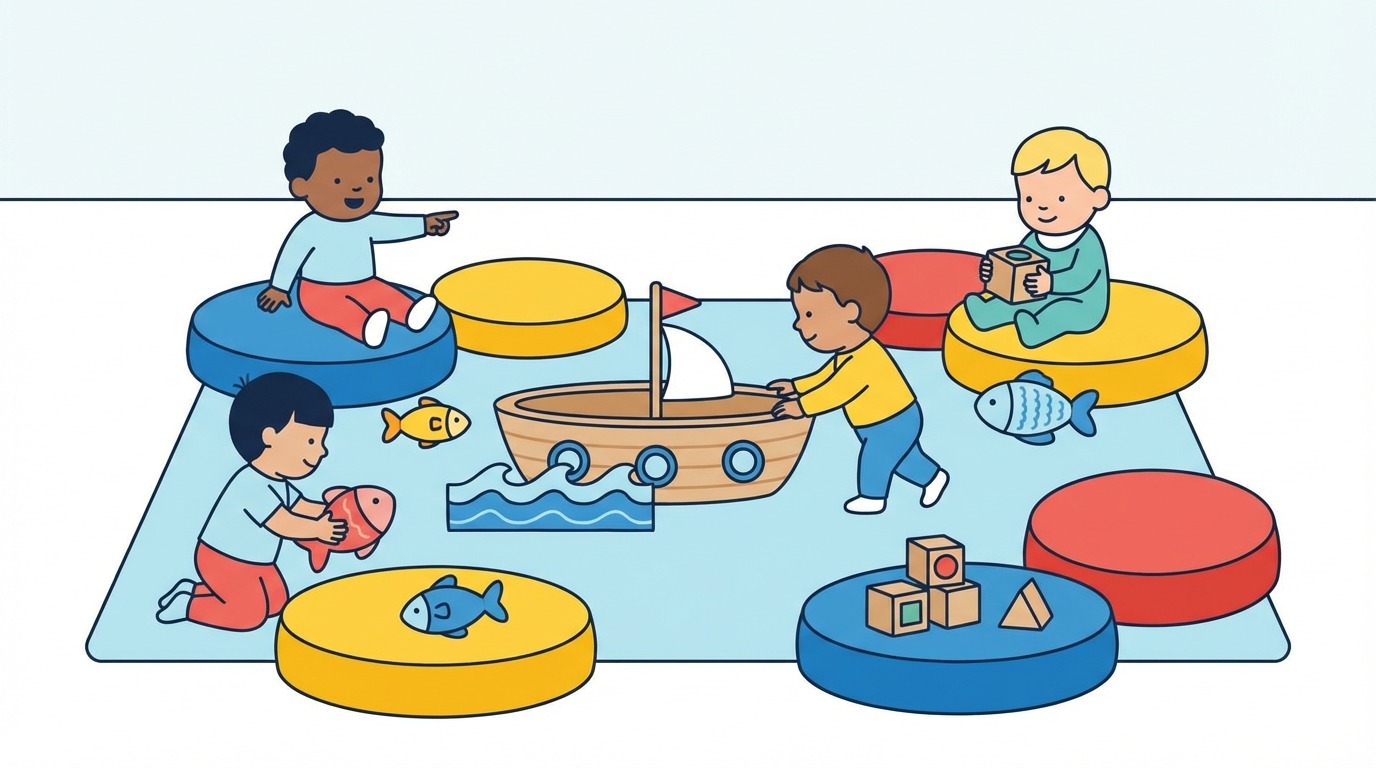
Sensory game and fine motor skills: the “sea and islands” experience
The strength of “Petit Navire” comes from the body. Children learn through movement. Crossing a “sea” with chasse steps engages balance. Placing a soft pebble in a box works the pincer grip. Gross and fine motor skills advance side by side.
For the materials, textures are favored. Firm cushions, soft mats, small honeycomb balls. Each object has its function and its word. “Island,” “bridge,” “sail.” The child explores, then labels. This is the heart of a successful awakening game.
Safety remains a priority. The floor is cleared. Islands are stabilized. Water is limited to a basin placed away from edges and always supervised. Movements are done without running. This clear intention frames the pleasure and reassures everyone.
Sound creates the atmosphere. A tambourine becomes the swell. Two maracas make the rain. Intensity is modulated to accompany the group’s energy. Music becomes a very effective emotional switch. Calm is relearned at every session.
At home, a mini-sea is made with a blue sheet. Figurines float on a tray. Whispered storytelling. At daycare, space is widened and roles ritualized. Outside, islands are replaced by hoops. Everything stays simple.
Touch guides language. Opposites are proposed: smooth/rough, soft/hard, cold/warm. Children associate a word with a sensation. Thus, the sensory game nurtures understanding even before complex sentences. Progress is seen in the gaze.
To spark curiosity, an object is hidden under a cushion. It’s searched for together, without rush. Success feeds perseverance. Failure too, if accompanied by reassuring words. The emotional climate makes all the difference.
Steps interlock. Free exploration, brief challenge, calm down. This undulation supports emerging attention. “All-or-nothing” sequences are avoided. The child navigates, like the boat, between impulse and calm. This rhythm recalls the rocking of a wave.
Need ideas to diversify textures? This guide on touch and tactile exploration offers concrete paths. It complements the game’s sensory approach.
To anchor these gestures, a nursery rhyme video helps a lot. Imitation structures the session and gives breath to the story. Here is a useful search.
The goal remains clear: link body, voice, and emotion to engage each child in a gentle adventure. This is the essence of this game for toddlers.
Educational and pedagogical dimension: language, landmarks, and first notions
“Petit Navire” acts as a very comprehensive educational game. Language progresses because it is sung, mimed, and replayed. Spatial awareness builds by walking on the islands. First quantities are experienced by loading the boat.
The vocabulary expands around a stable core: boat, sea, sail, anchor, oar. Simple action verbs are added: put, pull, push, count. Children repeat with pleasure, especially if the voice is melodic. Memory follows pleasure.
For rhymes, the nursery rhyme becomes a ramp. Sounds are isolated, exaggerated, smiled at. This article offers ideas for easy oral games to slip into the session: playing with rhymes. Progress is visible in weeks.
Colors naturally enter the game. Blue treasures for the sea, yellow for the sun, red for the buoys. The child sorts, then names. Sorting often precedes naming. The gesture prepares the word.
For numbers, no need to go far. Passengers are counted. “One, two, three” is announced while loading. “Many/not many” is compared. The key idea fits in the hand: do rather than debate. A pedagogical game lives on clear actions.
Syntax progresses through repetition of short phrases. “Captain, move ahead!” “Cabin boy, tidy up!” These ritualized phrases give a predictable frame. The child appropriates them, then creatively distorts them. It’s an excellent signal.
First social rules also settle in. One waits for the “go”. One shares an object. One congratulates a friend. Cooperation is built at the child’s level, without pressure. The group becomes a strong motivation engine.
Want to open up to other oral and playful practices? A detour through stimulating board games for creativity will feed your future sessions. Bridges are easily built with “Petit Navire”.
To pace learning, a second video resource can support memorization. A search focused on motor games for 12-36 months will offer very concrete complementary ideas.
In the end, the alliance between singing, gestures, and handling embodies the heart of a successful interactive game: the child understands because they do, sing, and feel at the same time.
Interactive group game: cooperation, emotions, and fine adjustments
The collective gives another dimension to “Petit Navire.” In the micro-daycare “Le Phare Marin,” Lila, 20 months, and Nils, 30 months, embark with three friends. Each holds a small rope connected to the boat. The group moves forward together. Smiles guaranteed.
The adult’s role is strategic. They clarify the instruction, show the first gesture, then step slightly back. They return to name the emotion, encourage, adjust the rhythm. This alternation creates a safe and stimulating atmosphere.
When excitement rises, the “weather” is lowered. The tambourine slows. The voice drops. A stop at the “calm island” restores attention. The child learns that energy can be regulated. This is a precious gain for daily life.
Sometimes, a child wants to go faster or keep a treasure. Short and positive rules are relied on: “We share,” “We wait for go,” “We place gently.” These aesthetic and simple codes guide without restricting.
Frustration is handled with concrete words. “You want the boat. We will wait for your turn.” A steady gaze and slow gesture often suffice. The emotional tool takes precedence over performance. The game continues, calm.
To deepen the topic, this file sheds light on mechanisms and proposes gentle strategies: understanding young children’s stress. The link between emotions and play is nourished with concrete examples.
Should you let a child win? In this setting, cooperation is favored. Everyone wins together by bringing the boat back to port. A nuanced reading here can help frame other activities: should you let them win?. The debate remains useful to adjust one’s stance.
To vary modes of interaction, a mini bubble battle is introduced on the wind island. The idea is not to conquer, but to aim for a buoy. Motor precision pairs with joy. Eyes sparkle, the group laughs.
Want a bridge with simple card games later? The 7 families card game, animal version will be a relevant relay for 3-4 year olds. Already experienced turn-taking will serve as an anchor.
The pedagogical conclusion is clear: the spirit of the crew transforms learning. The collective fosters autonomy, step by step.
Practical organization: time, space, safety, and continuity at home
Success relies on light logistics. Prepare a marine basket: two cushions, a box-boat, three “treasures,” a tambourine. Five minutes suffice. The material landmark reassures the adult and excites children’s curiosity.
Ideal timing? Two to three sessions per day in daycare, one to two at home. Each moment targets a specific need: start the morning, release energy, calm down before the story. Regularity creates happy anticipation.
Regarding space, a clear corridor is mapped out. Islands are placed at a good distance. Narrow passages are anticipated. Falls are prevented by slowness and clear rules. Safety is first thought of as a rhythm.
The screen question arises often. To support emerging attention, the game remains non-mediated. This landmark clarifies the overall approach well: screens and young children. Sensory resources suffice here.
To memorize without rigidity, rituals are relied on. The sailors’ call to start. The home port to finish. These markers set an emotional structure. The child feels where they are going and why.
Here is a simple framework to follow. It facilitates starting and adapting to each group. Keep it visible near the marine basket.
- 🛶 Prepare the setting in 2 minutes (sea, islands, boat).
- 🎵 Sing the introduction and name roles.
- 👣 Propose 2 very short motor challenges.
- 🧸 Load/unload 3 treasures while counting.
- 🌬️ Adjust the weather to regulate energy.
- 🛟 Return to port + individual congratulations.
Need more dynamic opposition games for very active 30-36 month olds? A gentle symbolic cushion battle can be framed with clear rules. To feed reflection, you can browse this recap on children’s battle games. The dosage remains key.
Finally, a logbook can be created. A photo of the setting, three keywords, a drawing with a blue felt-tip pen. The home-daycare continuity strengthens. The game firmly anchors in emotional memory.
In practice, a children’s game gains power when it becomes a smooth, readable, and joyful ritual. “Petit Navire” checks these boxes elegantly.
Thematic variants and fine progressions
The marine universe is adapted according to the seasons. In spring, the bird island encourages fine listening. In summer, sponge fishing in a basin works coordination. In autumn, “leaf-shells” are gathered by color. In winter, a night port invites whispering.
Progressions are controlled by a single parameter at a time. The route is lengthened, the treasure’s weight increased, or vocabulary enriched. Never all at once. This precision avoids overload and supports success.
For more reserved children, start with an adult-child duo. The shared gaze fosters confidence. Then open up to the small group. One-on-one success serves as a springboard. Pleasure leads the group, not the opposite.
Conversely, for a very active child, channel through short missions. “Captain, two round trips.” Weather is used to lower intensity after exertion. Calming down is ritualized as a safe port.
By keeping this flexible framework, “Petit Navire” remains a solid, aesthetic, and lasting game for 1 to 3 years. It is a beacon for the day.
Quick guidelines to lead “Petit Navire”
| Animation Checklist 🧭 |
|---|
| Before: clear space, stable islands, basket ready |
| During: short instruction, modulated weather, soft voice |
| After: return to port, congratulations, shared tidying |
Following these landmarks ensures a peaceful and engaging navigation, day after day.
How long does a “Petit Navire” session last?
Five to twelve minutes suffice. Multiple mini-sessions can be offered throughout the day, with calm down periods between each.
What minimal materials are needed to start?
A mat, two cushions as “islands,” a small box for the boat, three treasure objects, and a simple instrument (tambourine or maracas).
How to adapt for a very active child?
Offer very short missions, use the ‘weather’ to modulate intensity, and ritualize a stop at the calm island before restarting.
What if my child refuses to participate?
Let them observe. Offer the role of observer or port guardian. Often, imitation will come by itself over the sessions.
“One song, two islands, three smiles: Petit Navire helps grow without forcing.”