Video Development: The stages of psychomotor development in children.
| Short on time? Here’s the essentials ⚡ |
|---|
| 👶 Psychomotor development follows predictable stages, but each child progresses at their own pace. |
| 🧠 Short videos help observe milestones and adjust daily stimulation. |
| 🏃 Gross motor skills prepare coordination and upright posture; fine motor skills support language and autonomy. |
| 🛋️ Floor arrangement, free and safe, promotes achievements without forcing posture. |
| ⏳ Growth variations are common; spotting true delays avoids unnecessary anxiety. |
| 🤝 Nursery and family progress together with reliable video resources and feedback observations. |
Watching a baby roll, crawl, then pull themselves up tells a precise story, marked by stages that punctuate their psychomotor development. Thanks to video materials, these moments become readable and inspiring. The gaze sharpens, the educational posture gains nuance, and motor stimulation is nourished by concrete and safe ideas. Early childhood professionals rely on these landmarks to propose appropriate situations, while parents feel supported, far from injunctions.
Everything starts from the floor. The child first explores lying down, plays with gravity, refines coordination, and discovers the joy of action. Then they conquer space with gross motor skills, and refine their movements with fine motor skills. Between freedom and structure, achievement is part of their growth, always keeping the joy of acting in sight. The 2-minute videos, widely shared in recent years, then serve as a family and professional compass.
Development Video: follow the stages 0-18 months without skipping priorities
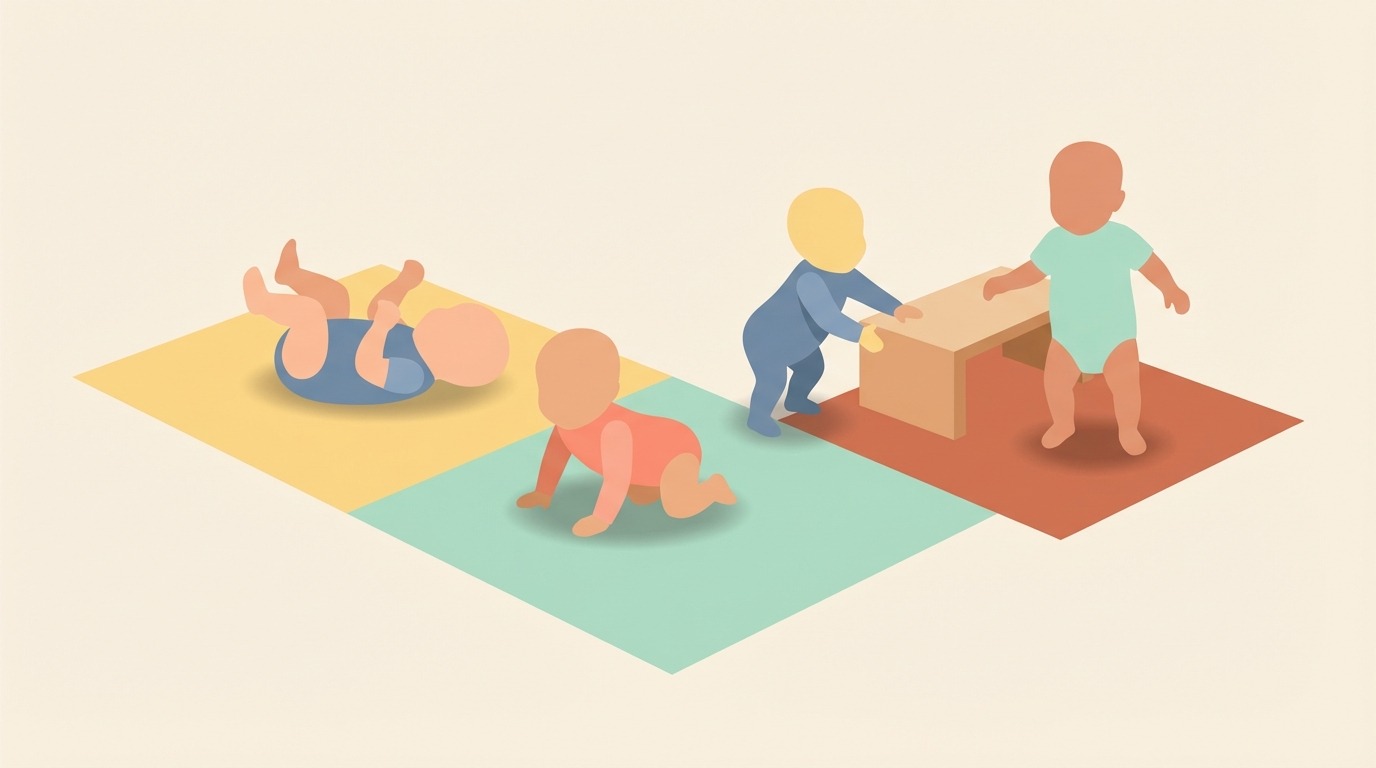
The first months lay the foundation of upright posture. Short recordings show how muscle tone organizes, from head to toe, thanks to varied supports. Simple milestones are quickly identified: hands to mouth, rolling over, forearm support, pivot, creeping, then crawling. This progression prepares a stable coordination and a confident engagement with space. Without this foundation, forced sitting fatigue and disturbs support acquisition.
A common example illustrates the point: seated too early, a baby freezes and watches. On the floor, however, they change angle, shift weight, pivot. Thus, play arises naturally. The videos guide the gaze: they zoom in on the opening hand, the head-trunk alignment, the leg pushing. This framing avoids hasty interpretations and encourages fair proposals, such as a firm mat, light objects, and time.
From lying down to sitting: the decisive role of supports
The autonomous transition from lying down to sitting is observed in the transitions. The child first supports themselves on the forearm, then on the hand. Next, they knead the floor with the knee and tilt the pelvis. This mechanism is established through trials, without intrusive help. To support this acquisition, the environment remains simple: clear space, variety of objects to grasp, and calm presence. A firm mat is strategic. One can rely on advice for choosing the right support via clear criteria for baby play mats.
Attention focuses on freedom of movement. Containers that block supports should be avoided, except for short and secure periods. In video, observe how the shoulder girdle opens, how the gaze guides action. This fine reading helps adjust adult posture: offer, but do not do it for the child. This is the condition for confident motor stimulation.
From upright posture to first steps: a progressive climb
Standing mastery is played out in transfers. Leaning against furniture encourages micro-flexions. Upright posture alternates trials and controlled falls. Filmed sequences provide landmarks: when the child releases a hand, squats then stands back up, postural stability consolidates. Low courses, varied surfaces, and pushable objects are proposed. This approach makes gross motor skills a springboard toward independent walking.
To support observation, a simple YouTube search displays free and useful sequences. This type of content allows articulating theory and practice.
Throughout, safety is ensured upfront. Angles are protected, floor is cleared, and falls anticipated by organizing space. The key message remains clear: respecting the pace makes progress stronger and the joy of action lasting.

Gross and fine motor skills in video: games, tools, and progression 0-6 years
Between 1 and 6 years, gross motor skills become a stage of intense exploration. The child climbs, runs, falls, then tries again. This dynamic shapes balance, reaction speed, and coordination. Meanwhile, fine motor skills refine at the pace of manipulations: fitting, beads, clay, and crayons. Tutorial videos help calibrate difficulty to support acquisition without overstimulation.
To guide choices, educational resources detail the challenges. An accessible article presents main principles and suggests adapted activities, as seen here: insights on gross motor skills. Relying on these ideas makes it easier to plan rich and fun sessions without multiplying purchases.
Filmed motor games: from simple to subtle
An effective progression advances in stages. It starts with a gross movement, then adds a fine demand. For example, pushing a heavy box, then sliding an object inside. Running in waves, then stopping on a signal. Meanwhile, fingers work: pinching, screwing, unscrewing. This articulation links body and attention, which supports executive functions.
- 🧱 Floor course with firm cushions, then adding tunnels to vary supports.
- 🎯 Throwing at nearby targets, then farther and changing ball size.
- 🧩 Giant fitting puzzles, then 4-piece puzzles for fine motor skills.
- ✂️ Tearing paper, then safely snipping thick strips.
- 🖍️ Scribbling broadly, then drawing roads to follow with a marker.
This plan avoids forced walking. It establishes success and opens the way to curiosity. In practice, short videos serve as concrete examples to calibrate each stage.
Simple tools, solid results
It’s not necessary to accumulate materials. Everyday objects suffice. A scarf becomes a target, a box turns into loot to carry. For the floor, a firm and spacious support remains key. The advice mentioned above on choosing mats guides families well. In case of doubt, adapt rather than impose.
To enrich practice, one can consult demonstrations adapted to 0-6 years. These compilations show how to link gestures, rhythm, and attention.
Ultimately, the synergy between gross and fine motor skills builds autonomy. It prepares handwriting, emotion management, and symbolic play. It is a ramp toward future learning.
Coordination and setup in early childhood settings: videos, spaces, and intentions
In nursery, motor stimulation makes sense in space. Videos help teams observe before acting. They draw inspiration from short images to script the floor, organize flows, and calibrate heights. The goal is clear: start from abilities, motivations, and desires. This includes quiet zones, movement spaces, and fine manipulation corners.
A case study illuminates this framework. In the “La Clairière” room, the team filmed three key moments. In the morning, the floor area welcomes rolls and pivots. Then, low modules invite transfers. In the afternoon, a table corner gathers beads and clay. This video setup allowed adjusting furniture and anticipating busy times, to reduce collisions.
Golden rules for blossoming coordination
Wide shots and readable materials are favored. Calm colors facilitate attention. Paths are clear. Additionally, heavy objects stay near the floor. This logic limits falls and encourages attempts. Moreover, the video footage reveals micro-signs of fatigue or overstimulation. The group’s rhythm is then readjusted.
Coordination thrives on alternations. Positions vary: tummy, back, crawling, standing. Speeds alternate: slow, fast, then stop. Textures oppose: hard, soft, smooth, rough. This sensory play sharpens landmarks and consolidates achievements. With a capsule playlist, the team shares a common language.
Accompany without restraining: the right presence
Sometimes, the best help is keeping quiet. One look suffices to support the attempt. When the challenge exceeds the child, a simple proposal rekindles desire: bring a grasp closer, lower a surface. Videos train this active restraint. They show the power of waiting. This delay gives the brain the chance to organize the gesture.
For everyone to find their place, a weekly dashboard lists filmed key moments. Families consult these extracts, understand the motor project, and leave with easy-to-reproduce ideas. This virtuous circle establishes a shared culture: safety, freedom, and joy of action.
Growth, milestones, and individual variations: landmarks, alerts, and early care
Growth variations often cause concern. Yet, variations are common. The important thing is to follow the trajectory. Videos clarify landmarks by showing movement qualities, not just age. Fluidity, symmetry, support taking are observed. This reading reduces comparison pressure.
Some signals nevertheless prompt consultation. Persistent asymmetry, discomfort when rolling, or absence of firm supports at key ages should alert. Likewise, frequent hyper-extension or avoidance of gaze in motion deserves assessment. Didactic capsules help spot without dramatizing.
Critical windows and daily prevention
Critical periods exist. Active tummy play, between 3 and 6 months, fuels the forward push. Skipping this time hinders later achievements. Simple micro-gestures prevent many issues. Aligning the neck-shoulder-hip axis, varying carrying positions, or managing time in containers makes a real difference.
When the head flattens on one side, it is called plagiocephaly. Early support corrects shape and comfort. Dedicated resources detail this care, as here: prevent and treat flat head syndrome. The key remains to act without alarm, and keep focus on the joy of acting.
Link weight, muscle tone, and desire to move
Weight gain influences play energy. Calm monitoring avoids false diagnoses. Clear landmarks exist to understand weight development and adapt motor proposals. A summary article can help: understanding baby growth and weight. Meanwhile, observe exploration appetite, as movement vivacity counts as much as the curve.
In 2026, guidelines remind to integrate context factors: sleep, pain, and screen exposure. Educational videos serve as a common base. They explain simply why a baby moves less some days, and how to reignite desire with an easier situation. Thus, confidence returns quickly.
Supporting families with videos: co-education, tools, and professional links
Short series dedicated to psychomotor development have become catalysts for co-education. A Franco-Quebec pedagogical collection, featuring 50 episodes of 2 minutes, illustrates daily scenes. Each capsule comes with a sheet that opens debate in teams and at home. This format invites questioning postures and sharing a common language, without jargon.
The topics are concrete: falling asleep, morning separation, screen time, block games, or permission to play alone. This gallery of situations helps link family life and nursery practice. A viewing can be launched at the beginning of a meeting, then a five-point action plan built, focused on safety and freedom to move.
From living room to nursery: the same compass
In the evening, two minutes suffice to nurture parental reflection. Then, the next day, the team takes up the idea and transposes it to the group. This back-and-forth establishes coherence. For families looking for support, comparing childcare modes can clarify expectations. A concise guide sheds light on the question: nanny or agency, what to choose?. This reading sets the right criteria and recalls the educational project’s importance.
Throughout parenting, challenges change. Between mental load, logistics, and emotions, stable supports feel good. Practical tracks are offered here: facing daily parenting challenges. The idea is not to aim for perfection, but to secure the essentials: floor time, free play, and benevolent observation.
Training and valuing everyday professionals
Nursing assistants and home caregivers carry these projects in the field. Videos support their skill development and highlight the invisible expertise of daily life. To go further, a dossier sheds light on this demanding and human profession: understanding the profession of parental assistant. Better recognition of these roles improves educational partnership and family experience.
In sum, video capsules do not replace human contact. They sharpen it. With them, the key phrase regains full meaning: observe first, propose next. This is how achievements are woven, in joy and safety.
At what age do the first rollovers appear ?
Most babies roll from back to belly between 4 and 6 months. However, the quality of movement matters more than the date. Look for firm supports, a head that accompanies, and a pelvis that follows.
Should a baby be seated to speed up walking ?
No. Seating too early hinders supports and disrupts coordination. Let the child reach sitting on their own. Rather offer time on the floor, graspable objects, and varied surfaces.
How to stimulate fine motor skills without overload ?
Progress in stages: simple fitting, modeling clay, wide grips, then small elements. Alternate free play and short proposals. Watch for fatigue and lighten if necessary.
When to consult a professional ?
In case of persistent asymmetry, evasive supports, marked discomfort, or loss of skills. Film a short sequence and show it to the pediatrician, physiotherapist, or psychomotor therapist.
Are videos enough to guide stimulation ?
They form an excellent observation and idea support. However, they complement, without replacing, exchanges with professionals and listening to the child’s unique rhythm.
“Where the pace is respected, every step becomes a victory and every game, a burst of freedom.” ✨