Development 13-18 Months: The developmental milestones of the child from 13 to 18 months.
| Short on time? Here’s the essentials ✨ |
|---|
| 🧠 13–18 months marks a surge in language and symbolic play (pointing, saying “no”, 5–20 words). |
| 🏃 Motor skills booming: walking, beginning stairs, first short runs, better fine coordination. |
| 🌙 Towards a single nap (1h30–2h30) between 15 and 18 months, with a 10–15 min sleep ritual. |
| 💞 Selective socialization: fear of strangers, strong attachment, emerging empathy, desire to share. |
| 🥄 Rise of autonomy: drinking from a cup, using cutlery, participating in dressing. |
| 🧩 Learning loves repetition, routines, and simple pretend play. |
| 🛌 In case of difficult nights, first adjust the day (nap/activity/light) and falling asleep. |
Between 13 and 18 months, the young child accelerates their trajectory: they walk farther, understand better, try out new words, and claim “do it myself” gestures. This period concentrates key developmental milestones, at the crossroads of motor skills, language, emotional regulation, and emerging autonomy. Family routines become powerful anchors, because the brain loves predictability when it learns so fast.
In this growth journey, a simple rule guides adults: what repeats gets engraved. Thus, constant rituals, warm interactions, and adapted games stimulate harmonious child development. To make these improvements visible and calm, it is better to proceed in small steps, often, with kindness and rhythm. The following explores, month by month, how to guide these advances without skipping stages, while preventing common pitfalls.
13 to 18 months: cognitive and language development, from intention to first words
At this age, thought is built through action. The little one points, imitates, experiments, then puts sounds on their desires. Adults first observe a profusion of gestures: pointing to ask, nodding to say no, clapping to encourage. These intentional acts lay the foundation of language, as each point invites a word, each waiting fits into a shared scene. Gradually, isolated words emerge (daddy, again, sleep), then simple combinations appear around 18 months.
Why does this sequence work so well? The brain processes multimodal signals: gaze, pointing hand, intonation. When the adult names what the child aims at, they close a loop of learning. They also strengthen understanding: commands at one stage, without gestures, become doable (“give the ball,” “go get the shoe”). Thus, comprehension often precedes oral production, which reassures families.
Concrete tools to nurture language daily
Routine feeds words, as scenes repeat. During dressing, the adult comments on short actions (“sock, foot, pull”). At the table, they name textures and colors. At the park, they anticipate action verbs (“we climb, we slide”). Board books with realistic photos stimulate recognition of common objects and awaken symbolic play: giving the teddy a drink, putting the doll to bed, saying “hello” with a spoon.
- 📚 Describe what the child looks at, not what the adult wants them to look at.
- 🗣️ Respond to each point with a precise word and a short sentence.
- 🔁 Repeat the same expressions in the same order to anchor landmarks.
- 🎭 Introduce a mini pretend play daily (feeding a stuffed animal).
- 🎵 Sing action rhymes to combine sounds and coordination.
In Noé’s family (16 months), a habitual command changed everything: “We tidy up, then we read.” Repeated over and over, Noé understood the sequence. He then started saying “li” while holding up the book. This micro-victory illustrates a strong principle: simple, coherent, and joyful expectations accelerate access to words. To refine the emotional dimension of language, a detour via a guide on early bonds helps contextualize proximity reactions: affective needs between 13 and 18 months usefully complement this relational perspective.
In short, language loves slowness and the light of reality. Speaking “in mirror” about what the child shows remains the most effective strategy. At this age, aiming for short, frequent, playful exchanges offers the best platform toward tomorrow’s sentences.
Motor skills and coordination 13–18 months: balance, exploration, and gesture precision
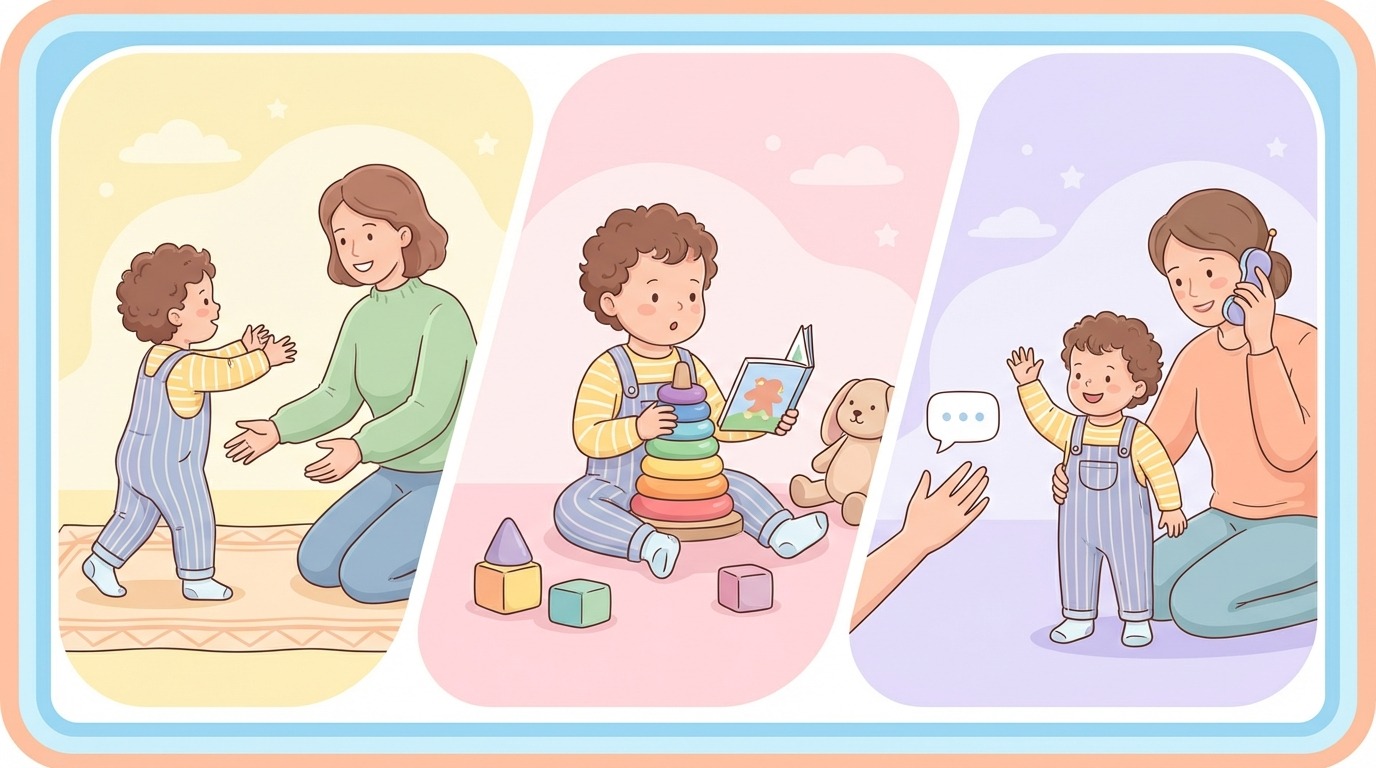
Motor skills take off. The child walks more steadily, bends to pick up an object, starts again without falling, then tries a short run. Stairs attract them: hand held at first, they climb one or two steps, sometimes on all fours to secure. Meanwhile, fine coordination progresses: pinching a large bead, turning thick pages, stacking 2–4 blocks, fitting a simple shape into a matching hole.
This need to climb calls for two responses: setting realistic challenges and minding rules. A cushion on the floor becomes a “mountain” to cross. A cardboard tunnel guides crawling movements. A stable stool allows learning “up/down” with the adult’s hand. Precision gestures are practiced at the table: holding the spoon, stabbing soft pieces, pouring water from a light pitcher into a cup, with a non-slip mat underneath.
Mini motor games for safe and joyful progress
- 🧱 Soft home course: cushions, tape on floor to step over, cardboard tunnel.
- 🎯 Throw-roll: roll a ball towards a nearby basket to calibrate force.
- 🍽️ Spoon workshop: thick compote, small bowl, cloth ready for autonomy.
- 📦 Treasure box: everyday safe objects to handle (soft brush, cup, spoons).
- 🖍️ Free scribbles: thick wax crayons, taped sheet, wide gestures.
Falls teach balance if environment remains controlled: clear floor, non-slip socks, active distant supervision. Repetitions sculpt neural networks: each stair climbed refines muscles and postural control. To measure progress without pressure, we value effort: “you tried, you try again” rather than raw performance. Finally, a simple principle closes this stage: the child goes further when the adult prepares the ground and steps back.
Sleep from 13 to 18 months: landmarks, rituals, and solutions to awakenings
Sleep structures and shapes the mood of the day. Over 24 hours, many sleep 12 to 14 hours. Between 15 and 18 months, the transition to a single nap begins: 1h30–2h30 after lunch, with a regular bedtime and predictable room. The biological clock loves morning light and a dimmed atmosphere at day’s end: these signals regulate melatonin and falling asleep.
Signs announce the switch to one nap: refusal of morning nap, too late afternoon nap, fragmented nights. Adjustment takes 2–3 weeks by shifting the nap 15–20 minutes every 2–3 days until 12–12:30 pm, then temporarily moving bedtime earlier by 30–60 minutes. A simple, short, and stable ritual (10–15 minutes) is required: bath if soothing, pajamas, teeth, story, cuddle, transition phrase, lights out. Same words, same order, same duration: the brain anticipates, so it relaxes.
7-day step-by-step anti-awakening plan
When nights get stuck, fixing the day often creates a domino effect. First adjust nap time (end before 3:30 pm), then monitor awake periods (4–5 hours with a nap). Decreasing presence aids difficult sleep: sit near the bed, then progressively move away, while keeping brief and reassuring speech. Multiple awakenings invite looking for root cause: late nap, bottle-assisted falling asleep, teething, illness.
- 🕘 Stable schedules over 7 consecutive days.
- 🌗 Well-placed single nap, no screens in the evening.
- 🌡️ Room 18–20 °C, darkness, soft white noise if needed.
- 🍼 Gradual nighttime bottle weaning (reduce 10–20 ml every 2–3 days).
- 💬 Short reassuring phrases, then leaving the room.
To go further, a practical guide on toddler nights can help during regression phases: see for example what to do when baby no longer sleeps through the night. And if the context raises tension (travel, illness, caregiver change), duplicate the ritual: same comfort object, same story, same words. Emotional stability reassures and shortens nighttime waking.
One last landmark saves energy for everyone: you can aim for regularity rather than perfection. A cheerful awakening indicates a good balance. The child sleeps better when the day has been clear, rhythmic, and full of connections.
Socialization and emotions at 18 months: attachment, fears, and emerging empathy
Around 18 months, the child balances proximity and exploration. They may fear strangers, cling to their caregiver, then play a few steps away, while checking the gaze. This relational dance underpins socialization: the child learns to come back to recharge, then leave again. In play, they sometimes hand an object to the adult, watch their reaction, and try again: giving-taking is not provocation, it is a miniature social lab.
Emotions rise quickly because words lack to say everything. Tantrums appear, often brief, sometimes intense. The adult asserts a clear frame, then names the emotion: “you are frustrated, I hear you.” By lowering sensory intensity (soft light, calm voice), we help the nervous system regulate. For concrete landmarks, a resource on young child’s emotional load can complement support: check this young child stress dossier to turn these moments into learning opportunities.
Simple social scenes that develop empathy
- 🤝 Give-receive game: adult thanks, child tries again with pride.
- 👆 Point to share interest: adult names and gets excited.
- 🎭 Affectionate pretend play: feed the stuffed animal, rock the doll.
- 🪞 Mirror games: greet “the baby”, touch the nose, hide-and-seek.
- 📷 Photo album of close ones: comment, recall, create a bridge between homes.
Lina’s family (17 months) adopted a “good night card” with three pictograms (comfort object, story, kisses). Each evening, Lina points to the steps. This bonding ritual reassures her and reduces bedtime protests. The same logic applies to daytime separations: short goodbye, stable phrase, promise kept. Children calm better when the environment clearly announces what’s coming.
In short, relationship is a playground. It offers simple micro-contracts that the child increasingly understands and honors. The clearer and warmer the framework, the smoother emotional autonomy settles.
Autonomy, nutrition, and routines: eating, dressing, self-care
Autonomy progresses through small tasks at child level. At the table, the child drinks alone from a cup and tries solid foods in small pieces (tender chicken, soft squash). They learn to use cutlery, sometimes combining hand and spoon. Hygiene routines become learning scenes: washing hands together, “brushing” teeth with the adult, choosing between two pajamas.
The secret? Give time and break down the action. Offering two options avoids a deadlock: “red socks or blue?”. To support food intake, serve easy-to-pick textures and a non-slip bowl. Meals remain calm and short, without screens, since attention is shared between hunger, fine motor skills, and taste discovery. The child eats almost the whole family menu if we adapt piece size and follow current nutritional recommendations.
Winning routines to consolidate gestures and confidence
- 🥄 “Your turn, my turn” with the spoon: alternate to avoid frustration.
- 🥤 Pouring from a small pitcher into an empty cup, on a tray.
- 👕 Helping to take off the cardigan: adult initiates, child pulls.
- 🧼 Washing hands together while counting to 10.
- 🧩 Putting 3 objects back in place, with a finishing song 👉 motivation.
When a difficulty persists (food refusal, extreme slowness, agitation), review the context: constant schedules, respected hunger signals, calm atmosphere. Small victories add up quickly to widen the field of possibilities: today two spoonfuls, tomorrow three. This discreet but steady progression draws a solid path toward daily independence.
Last milestone to keep in mind: in these developmental milestones, we don’t speed up the river. We shape its banks. A calm meal, chosen outfit, and joyful hand washing are worth more than any speech about autonomy.
“At 13–18 months, each repeated gesture becomes a bridge: between desire and word, between trial and success, between today and tomorrow.”
How many hours does a 13–18 month old child sleep on average?
Most accumulate 12 to 14 hours over 24h, with a night of 10–12h and, between 15 and 18 months, a single nap of 1h30–2h30 in early afternoon. A cheerful wake-up often indicates sufficient sleep.
When to switch to a single nap?
Signs of readiness include repeated refusal of the morning nap, a late afternoon nap, or fragmented nights. Shift the nap by 15–20 minutes every 2–3 days until 12–12:30 pm and advance bedtime during adjustment.
What words to expect around 18 months?
Many children say 5 to 20 words, sometimes more, and understand much more. They also use gestures (pointing, shaking head to say no). Put words on what they show and repeat short sentences to support language growth.
How to secure exploding motor skills?
Set up soft courses, keep floors clear, offer non-slip socks, and closely supervise stair attempts. Value effort and avoid challenges that are too high too early.
What to do in case of sleep regressions?
First regulate the day (nap finished before 3:30 pm, morning light, calm evening), adjust the sleep ritual (10–15 min), reduce sleep aids. For practical tips, consult a guide dedicated to difficult nights.