Development 5-8 Years: The key stages of child development from 5 to 8 years old.
- 🧱 Colorful clothespin game to strengthen thumb-index
- 🧵 Lacing cards to coordinate eye-hand
- 🍳 Culinary help: crack an egg, peel a banana, spread
- 🧩 50-piece puzzles to plan and persevere
To link family and school life, transitions matter. A common experience, the first separation in a care setting, leaves positive marks when accompanied. For inspiration, this article on the adaptation week in a micro-crèche shows how the softness of the beginnings then nurtures socialization and motor confidence in primary school.
In short, strengthening gross and fine motor skills is not contradictory. Fine motor skills, coordination, and autonomy rise when activities are playful, progressive, and regular.
Development 5-8 Years: language, early reading, and communication supporting learning
Vocabulary, syntax, and comprehension: giving voice to ideas
At these ages, language becomes a tool for thinking. The child expands vocabulary, constructs more complex sentences, and deduces meaning from context. Moreover, shared reading for five minutes a day strengthens oral comprehension. Then, retelling the story in their own words consolidates narrative memory, useful in science as well as history.
To activate these levers, targeted listening games are valuable. For example, “listen and check” on two-step instructions. Then, creating a “jar of new words” encourages lexical curiosity. In parallel, reading short documentaries nurtures the precision of technical vocabulary.
Concrete practices and games that boost speech
An educational game of riddles works on description, categorization, and turn-taking. Then, puppets create a safe environment to dare, even for the shyest children. In class or at home, the child plays a role, tests humor, regulates emotions, and integrates nuances of social pragmatics.
If a gradual introduction to group care is considered for a younger child, this resource highlights the benefits of a gentle reception period: supporting first separations. These experiences of relational security form a solid base for expression and socialization at school.
To broaden practices, audiovisual resources help to equip oneself.
Additionally, linking oral language, singing, and gestures works very well. Action rhymes synchronize rhythm, breath, and articulation. This synchrony supports concentration and clarity of speech flow. Finally, a “proud words” notebook where the child writes down new terms strengthens autonomy and self-esteem.
In short, language is nourished by real situations and targeted games. The child speaks better because they have something alive to tell.
Development 5-8 Years: cognition, attention, and meaningful projects
Concentration and working memory: concrete tools to progress
Learning relies on executive functions in full development. Between 5 and 8 years, sustaining concentration longer becomes possible, though variability remains. This is normal. Thus, a “10 minutes effort – 2 minutes active break” alternation improves attention endurance. Then, games like “Simon says” train inhibition, useful to wait one’s turn.
Working memory strengthens too. First, verbally recall three instructions before acting. Then, practice visual series (shapes or colors) to reproduce in order. Finally, build a cube tower following a model develops planning and spatial awareness.
- 🧠 “No yes no” to practice verbal inhibition
- 🟩 Color sequences to memorize then reverse
- 📦 Reproduce a brick model with time constraint
- 📚 “Summarize in 3 words” cards after a short reading
Parents who establish simple routines see effects quickly. For example, posting a visual morning “to-do” avoids cognitive overload. At the same time, stable landmarks create a calmer environment for creativity and initiative.
Logical thinking, problem-solving, and joy of learning
At 7-8 years, the child compares, classifies, and anticipates with more subtlety. Problem-solving gains relevance when it relates to real life. Calculating a snack recipe or planning a mini-garden exercises logic, measurement, and responsibility. Then, presenting the project to family works oral skills, visual aids, and confidence.
For inspiration on smooth and continuous transitions from early childhood to school, this post may be useful: practical tips for a gentle transition. Continuity and educational coherence favor intrinsic motivation, the quiet engine of lasting progress.
In sum, cognition flourishes when the child understands why they learn. Meaning opens the door; regular practice keeps it open.
Development 5-8 Years: socialization, emotions, and conflict management
Socio-emotional skills: recognize, name, regulate
At this age, socialization intensifies. Children forge more stable friendships while experiencing rivalry. To move forward, three key steps help. First, identify emotions with precise vocabulary: upset, relieved, puzzled. Then, link emotion, thought, and action. Finally, choose a strategy: breathe, ask for help, suggest an alternative.
Short and concrete tools work very well. The solutions wheel, displayed at child height, becomes a mediator. Moreover, a “inner weather” ritual at the start of the day sets a foundation for mutual listening. Thus, the class or family gains cohesion and affective security.
Cooperation and game rules: clear framework, freedom to act
Rules support freedom when they are simple and co-constructed. For example, “I propose – you arrange – we choose” for Wednesday activities. Then, alternating leader and follower in a cooperative game develops a sense of fairness. This lived justice makes rules more acceptable.
During friction moments, a 3-step protocol calms down: 60-second pause, recapitulating the request, choosing between two options compatible with the rule. This framework, repeated without dramatizing, protects the bond and anchors emotional autonomy. To understand the importance of gradual reception for relational security, this parent testimony sheds light: useful landmarks for families.
Ultimately, social competence is a learning process. It is nourished by examples, brief repetitions, and rich emotional vocabulary.
Development 5-8 Years: routines, targeted games and warning signs to know
Daily rituals and facilitating environment
A predictable framework nurtures inner security. Thus, keeping three key times helps: move, create, read. The first releases energy and stabilizes coordination. The second develops imagination and fine motor skills. The third strengthens language and concentration. Then, a calm corner without screens set as a “serenity contract” protects learning.
For busier days, a “quick activity menu” comes in handy:
- 🎯 5 minutes of jump rope to restart attention
- 🎨 10 minutes of guided drawing for creativity
- 📖 8 minutes of aloud reading with a comprehension question
- 🧘 2 minutes of “3-2-4” breathing to regulate emotions
To grasp the importance of gentle transitions from early childhood, this testimony offers an encouraging perspective: parents and team testimony. Caring reception practices radiate throughout schooling.
When to consult? Concrete markers, no panic
Every child has their own rhythm. However, some signs call for advice. For example, very painful writing despite adaptations, persistent choppy reading at the end of Year 2, or systematic exclusion from peer interactions. Then, recurring sleep troubles coupled with stomach aches at school deserve a kind exploration.
Here is a simple checklist:
- 🚩 Lasting isolation or constant conflicts with peers
- 🚩 Very variable understanding of instructions despite clear explanations
- 🚩 Fine motor skills very impaired: impossible cutting, inaccessible laces
- 🚩 High fatigue, pain in hand or shoulder when writing
Addressing these points early changes the trajectory. Contacting the teacher, a speech therapist, or psychomotor therapist allows adjustments. Moreover, a brief family-school meeting clarifies expectations and tools. For inspiration on step-by-step support, reread this gradual reception guide: useful resource to prepare transitions.
Finally, calm vigilance protects the drive to learn. Spot, act, readjust: the trio that reassures everyone.
What quick games strengthen fine motor skills and writing at 6-7 years?
Colorful clothespins to strengthen thumb-index, firm modeling clay to roll and pinch, lacing cards, and small mazes to trace. 10 minutes, three times a week, are enough to gain precision without tiring.
How to support concentration after school?
Offer a 10-minute active break (jump rope, ground course), then a short, clear task with a visual timer. Alternate effort and recovery, and keep a calm corner without screens.
My 7-year-old avoids group games. Should I worry?
Observe frequency and context. Offer cooperative games in pairs to secure the experience, then expand to a small group. If isolation persists and is accompanied by distress, talk with the teacher and seek professional advice.
How to enrich language without « teaching » at home?
Read aloud for 5 minutes, ask a comprehension question, play riddles, and keep a jar of new words. Puppets and role-playing games smooth out speaking gently.
“Between 5 and 8 years, every day counts: sow play, harvest momentum.”
| Short on time? Here’s the essentials 🧭 |
|---|
| 5-6 years: consolidate coordination, nurture language and curiosity with educational play 🎲 |
| 6-7 years: learning routines, first challenges of autonomy at school and home 🏫 |
| 7-8 years: more stable attention, concentration and projects that engage creativity ✨ |
| Socio-emotional: naming one’s emotions, cooperating, managing conflicts with simple tools 🤝 |
| Fine motor skills: cutting, lacing, writing pain-free thanks to micro-exercises ✂️ |
| Warning signs: marked reading difficulties, social isolation, persistent sleep troubles 🚩 |
| Golden key: connecting coordination, language and socialization in short, regular, joyful games 🌈 |
From 5 to 8 years old, the child goes from enthusiastic explorer to student capable of planning, negotiating, and cooperating. In primary school, these years weave strong links between fine motor skills, language, concentration, and managing emotions. In the living room, park, or classroom, every situation becomes a discovery lab. Thus, running a relay sharpens coordination, while reading an instruction nurtures autonomy and learning.
Families and educators quickly notice: a well-chosen educational game is worth a long speech. Then, a secure relational climate multiplies creativity and the desire to learn. For orientation, concrete landmarks help without trapping the child in boxes. Because each journey is unique, and variations are normal. Yet, some signs deserve gentle and swift attention. Here you will find proven tools, precise examples, and a practical roadmap to enthusiastically support these four decisive years.
Development 5-8 Years: motor skills, coordination, and daily autonomy
Gross motor skills and coordination: from playground to school routes
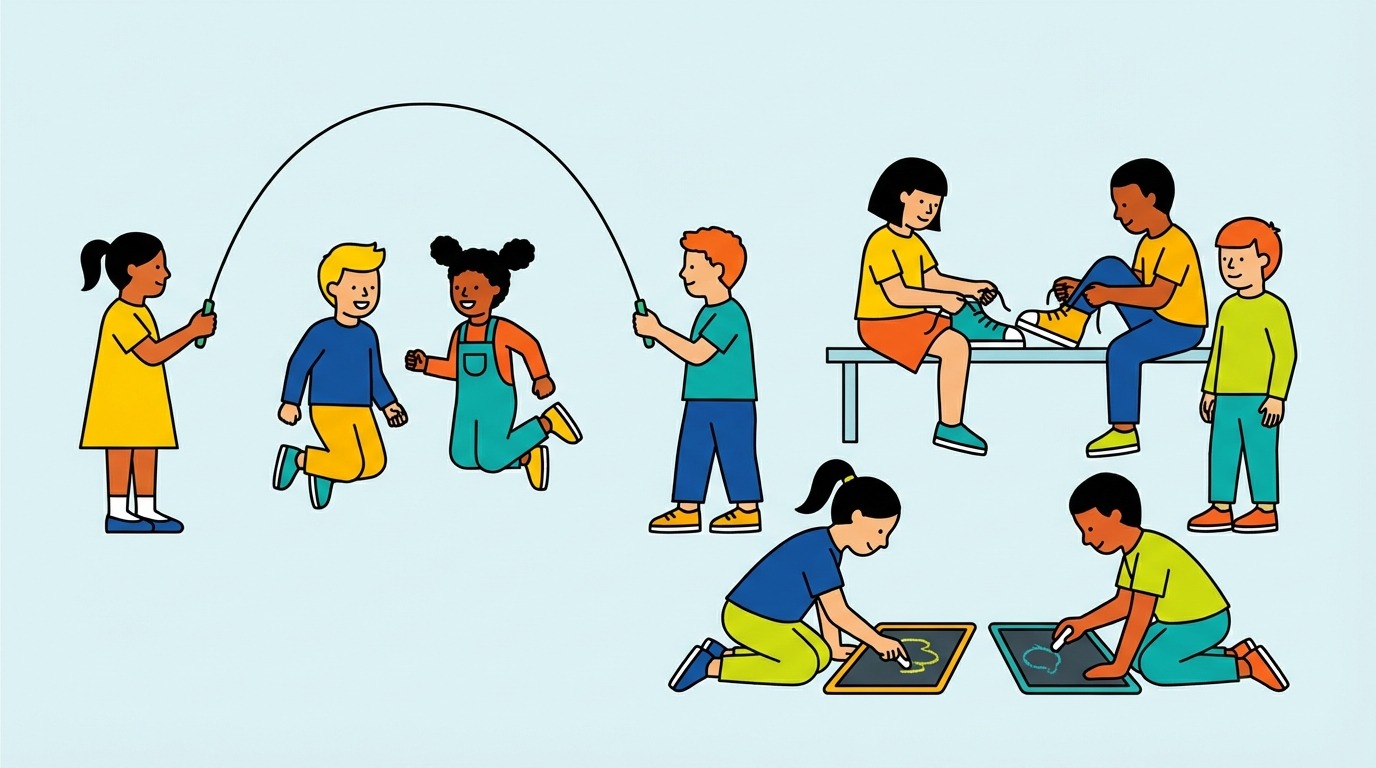
Between 5 and 8 years, coordination becomes finer, and the body gains confidence. Thanks to running, balancing, and jumping games, the child better organizes movements. Thus, crossing a course with cones, rope laid on the ground, and small hurdles strengthens stability and posture. Moreover, alternating left/right during jump rope stimulates both hemispheres, which also supports concentration.
Lina, 6 years old, often tripped during recess. With two weekly mini-course sessions at home, she now synchronizes running and sudden stops. Additionally, her trajectories become more precise on the bike. This type of progress encourages varying environments: grass, sand, hard ground. These sensory contrasts sharpen reactions and nurture autonomy.
Fine motor skills and functional gestures: preparing, cutting, lacing
Fine motor skills support writing and all daily gestures. Cutting strips with suitable scissors, molding thick dough, screwing and unscrewing large nuts make effective training. Then, lacing shoes or buttoning a shirt trains functional independence. These are realistic challenges that build confidence.
A simple protocol helps a lot. First, warm up the fingers by squeezing a soft ball. Then, make a series of dots to connect before tracing letters. Finally, finish with coloring inside the lines. This trio combines precision, endurance, and calming down. As a result, writing gains fluidity, pain-free.
- 🧱 Colorful clothespin game to strengthen thumb-index
- 🧵 Lacing cards to coordinate eye-hand
- 🍳 Culinary help: crack an egg, peel a banana, spread
- 🧩 50-piece puzzles to plan and persevere
To link family and school life, transitions matter. A common experience, the first separation in a care setting, leaves positive marks when accompanied. For inspiration, this article on the adaptation week in a micro-crèche shows how the softness of the beginnings then nurtures socialization and motor confidence in primary school.
In short, strengthening gross and fine motor skills is not contradictory. Fine motor skills, coordination, and autonomy rise when activities are playful, progressive, and regular.
Development 5-8 Years: language, early reading, and communication supporting learning
Vocabulary, syntax, and comprehension: giving voice to ideas
At these ages, language becomes a tool for thinking. The child expands vocabulary, constructs more complex sentences, and deduces meaning from context. Moreover, shared reading for five minutes a day strengthens oral comprehension. Then, retelling the story in their own words consolidates narrative memory, useful in science as well as history.
To activate these levers, targeted listening games are valuable. For example, “listen and check” on two-step instructions. Then, creating a “jar of new words” encourages lexical curiosity. In parallel, reading short documentaries nurtures the precision of technical vocabulary.
Concrete practices and games that boost speech
An educational game of riddles works on description, categorization, and turn-taking. Then, puppets create a safe environment to dare, even for the shyest children. In class or at home, the child plays a role, tests humor, regulates emotions, and integrates nuances of social pragmatics.
If a gradual introduction to group care is considered for a younger child, this resource highlights the benefits of a gentle reception period: supporting first separations. These experiences of relational security form a solid base for expression and socialization at school.
To broaden practices, audiovisual resources help to equip oneself.
Additionally, linking oral language, singing, and gestures works very well. Action rhymes synchronize rhythm, breath, and articulation. This synchrony supports concentration and clarity of speech flow. Finally, a “proud words” notebook where the child writes down new terms strengthens autonomy and self-esteem.
In short, language is nourished by real situations and targeted games. The child speaks better because they have something alive to tell.
Development 5-8 Years: cognition, attention, and meaningful projects
Concentration and working memory: concrete tools to progress
Learning relies on executive functions in full development. Between 5 and 8 years, sustaining concentration longer becomes possible, though variability remains. This is normal. Thus, a “10 minutes effort – 2 minutes active break” alternation improves attention endurance. Then, games like “Simon says” train inhibition, useful to wait one’s turn.
Working memory strengthens too. First, verbally recall three instructions before acting. Then, practice visual series (shapes or colors) to reproduce in order. Finally, build a cube tower following a model develops planning and spatial awareness.
- 🧠 “No yes no” to practice verbal inhibition
- 🟩 Color sequences to memorize then reverse
- 📦 Reproduce a brick model with time constraint
- 📚 “Summarize in 3 words” cards after a short reading
Parents who establish simple routines see effects quickly. For example, posting a visual morning “to-do” avoids cognitive overload. At the same time, stable landmarks create a calmer environment for creativity and initiative.
Logical thinking, problem-solving, and joy of learning
At 7-8 years, the child compares, classifies, and anticipates with more subtlety. Problem-solving gains relevance when it relates to real life. Calculating a snack recipe or planning a mini-garden exercises logic, measurement, and responsibility. Then, presenting the project to family works oral skills, visual aids, and confidence.
For inspiration on smooth and continuous transitions from early childhood to school, this post may be useful: practical tips for a gentle transition. Continuity and educational coherence favor intrinsic motivation, the quiet engine of lasting progress.
In sum, cognition flourishes when the child understands why they learn. Meaning opens the door; regular practice keeps it open.
Development 5-8 Years: socialization, emotions, and conflict management
Socio-emotional skills: recognize, name, regulate
At this age, socialization intensifies. Children forge more stable friendships while experiencing rivalry. To move forward, three key steps help. First, identify emotions with precise vocabulary: upset, relieved, puzzled. Then, link emotion, thought, and action. Finally, choose a strategy: breathe, ask for help, suggest an alternative.
Short and concrete tools work very well. The solutions wheel, displayed at child height, becomes a mediator. Moreover, a “inner weather” ritual at the start of the day sets a foundation for mutual listening. Thus, the class or family gains cohesion and affective security.
Cooperation and game rules: clear framework, freedom to act
Rules support freedom when they are simple and co-constructed. For example, “I propose – you arrange – we choose” for Wednesday activities. Then, alternating leader and follower in a cooperative game develops a sense of fairness. This lived justice makes rules more acceptable.
During friction moments, a 3-step protocol calms down: 60-second pause, recapitulating the request, choosing between two options compatible with the rule. This framework, repeated without dramatizing, protects the bond and anchors emotional autonomy. To understand the importance of gradual reception for relational security, this parent testimony sheds light: useful landmarks for families.
Ultimately, social competence is a learning process. It is nourished by examples, brief repetitions, and rich emotional vocabulary.
Development 5-8 Years: routines, targeted games and warning signs to know
Daily rituals and facilitating environment
A predictable framework nurtures inner security. Thus, keeping three key times helps: move, create, read. The first releases energy and stabilizes coordination. The second develops imagination and fine motor skills. The third strengthens language and concentration. Then, a calm corner without screens set as a “serenity contract” protects learning.
For busier days, a “quick activity menu” comes in handy:
- 🎯 5 minutes of jump rope to restart attention
- 🎨 10 minutes of guided drawing for creativity
- 📖 8 minutes of aloud reading with a comprehension question
- 🧘 2 minutes of “3-2-4” breathing to regulate emotions
To grasp the importance of gentle transitions from early childhood, this testimony offers an encouraging perspective: parents and team testimony. Caring reception practices radiate throughout schooling.
When to consult? Concrete markers, no panic
Every child has their own rhythm. However, some signs call for advice. For example, very painful writing despite adaptations, persistent choppy reading at the end of Year 2, or systematic exclusion from peer interactions. Then, recurring sleep troubles coupled with stomach aches at school deserve a kind exploration.
Here is a simple checklist:
- 🚩 Lasting isolation or constant conflicts with peers
- 🚩 Very variable understanding of instructions despite clear explanations
- 🚩 Fine motor skills very impaired: impossible cutting, inaccessible laces
- 🚩 High fatigue, pain in hand or shoulder when writing
Addressing these points early changes the trajectory. Contacting the teacher, a speech therapist, or psychomotor therapist allows adjustments. Moreover, a brief family-school meeting clarifies expectations and tools. For inspiration on step-by-step support, reread this gradual reception guide: useful resource to prepare transitions.
Finally, calm vigilance protects the drive to learn. Spot, act, readjust: the trio that reassures everyone.
What quick games strengthen fine motor skills and writing at 6-7 years?
Colorful clothespins to strengthen thumb-index, firm modeling clay to roll and pinch, lacing cards, and small mazes to trace. 10 minutes, three times a week, are enough to gain precision without tiring.
How to support concentration after school?
Offer a 10-minute active break (jump rope, ground course), then a short, clear task with a visual timer. Alternate effort and recovery, and keep a calm corner without screens.
My 7-year-old avoids group games. Should I worry?
Observe frequency and context. Offer cooperative games in pairs to secure the experience, then expand to a small group. If isolation persists and is accompanied by distress, talk with the teacher and seek professional advice.
How to enrich language without « teaching » at home?
Read aloud for 5 minutes, ask a comprehension question, play riddles, and keep a jar of new words. Puppets and role-playing games smooth out speaking gently.
“Between 5 and 8 years, every day counts: sow play, harvest momentum.”